Our systems detected an issue with your IP. If you think this is an error please submit your concerns via our contact form.
Explore the Art of the Possible for Exponential IT
As technology moves exponentially, so must your entire organization – led by IT.
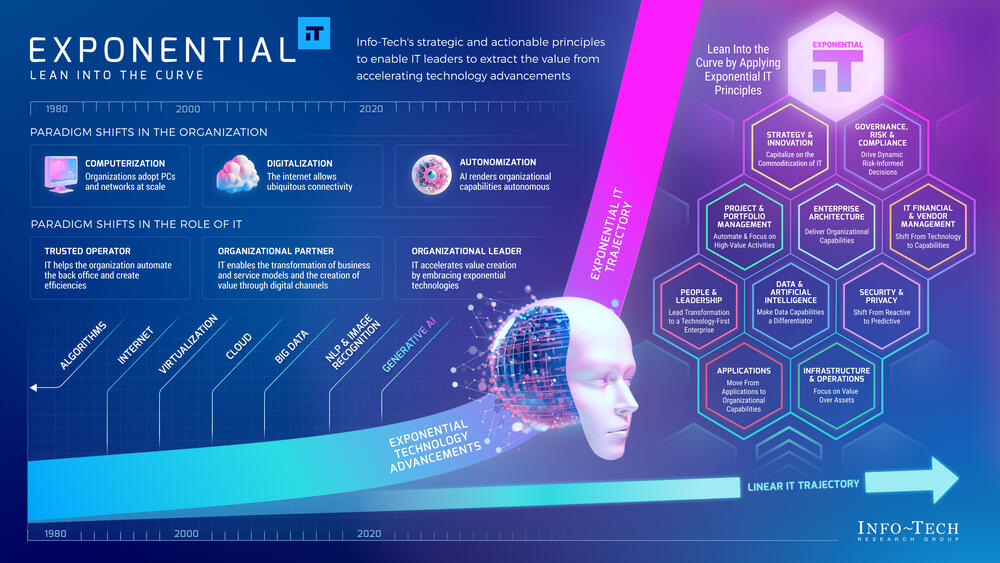
Technologies such as generative AI have ushered in a new era of exponential opportunities and risk. Constantly playing catch-up will leave IT – and organizations as a result – increasingly falling behind the curve.
The answer? Exponential IT, a framework defined by Info-Tech Research Group to instruct IT leaders across nine domains on how to elevate their maturity and value creation capabilities, which have implications across all traditional IT domains.
To close the gap between the exponential progression of technological change and current linear trajectories, IT will have to be the agent of change for the organization.
Get ready to lead the charge
Use the insights in each of the following primers to help you:
- Explore the art of the possible. Leaders in every IT domain must take action now to prepare for rapid technological change.
- Bring a clear vision to the table. Highlight what’s at stake for your organization as we pass the inflection point of exponential change.
Research & Tools
1. Strategy, Risk, and Governance
Earn and own your seat at the table to govern new technology adoption, leverage risk’s potential to create value and advantage, and co-own organizational outcomes.
2. Project and Portfolio Management
Automate traditional PMO capabilities, plan in real time, and enable true accountability.
3. People and Leadership
Embrace federated and hybrid models, design an outcome-based delivery network, and prioritize human-centered leadership.
4. Service Planning and Architecture
Focus on customer value delivery, take a coaching approach to architect business capabilities, and create integrated enterprise services.
5. IT Financial and Vendor Management
Implement financial management practices that can fund exponential value creation, boost your vendor management practices, and measure outcomes.
6. Security and Privacy
Strengthen your ability to defend against AI-enabled attacks, mitigate rampant privacy risks, and enable autonomous decision-making.
7. Data, Analytics, and AI
Treat your data as a product, augment your data for more value, and team up DataOps with MLOps.
8. Applications
Use AI and ML to deliver autonomously, use natural language to deliver organizational outcomes, and elevate your business relationship management practices.
9. Infrastructure and Operations
Let AI take over core operations, implement FinOps, and abstract away underlying infrastructure to support autonomous provisioning.