Develop Your Agentic AI Prototype
Develop agents with engineering best practices.
IT leaders face rising pressure to demonstrate value from agentic AI, yet many organizations struggle to move agents into production and realize ROI due to insufficient evidence of solution feasibility, viability, and security. Follow our structured five-phase engineering methodology to turn agentic AI designs into defensible, evidence-generating prototypes. This framework focuses on technical implementation after the design process has been completed.
Organizations that successfully design agentic AI prototypes often stall at implementation, producing fragile demos that can’t survive real-world inputs, scale beyond a single developer’s laptop, or provide the evidence of solution feasibility, viability, and security that leadership needs to approve investment. To engineer agentic AI systems, traditional software development patterns must be supplemented with new patterns to address challenges such as build sequencing, orchestration complexity, limited observability into model reasoning, invisible costs, and the absence of standardized evaluation discipline.
1. Autonomy isn’t a substitute for architecture.
Production readiness doesn’t come from the model, it comes from the architecture underneath it. There has never been a better time to build, but waiting for a “perfect” model isn’t a strategy. Model capability sets the ceiling, but engineering determines how much of that ceiling you can reach.
2. You can’t optimize what you can’t see.
Optimization is a loop: run > observe > evaluate > refine. Evals and observability aren’t optional; they’re how you make progress. Every run should be instrumented to show what the agent saw, what it did, where it failed, how long it took, and what it cost.
3. Evaluation turns a demo into a decision.
A prototype becomes valuable when leadership can assess it. Clear evidence on performance, cost, and reliability is what turns a demo into an approved investment.
Use this step-by-step blueprint to move from fragile demo to a defensible system with measurable signal of business impact.
Our framework provides the methodology and supporting tools you need to build an agentic AI prototype in five key phases. (Note: Prior completion of our Design Your Agentic AI Prototype blueprint is required.)
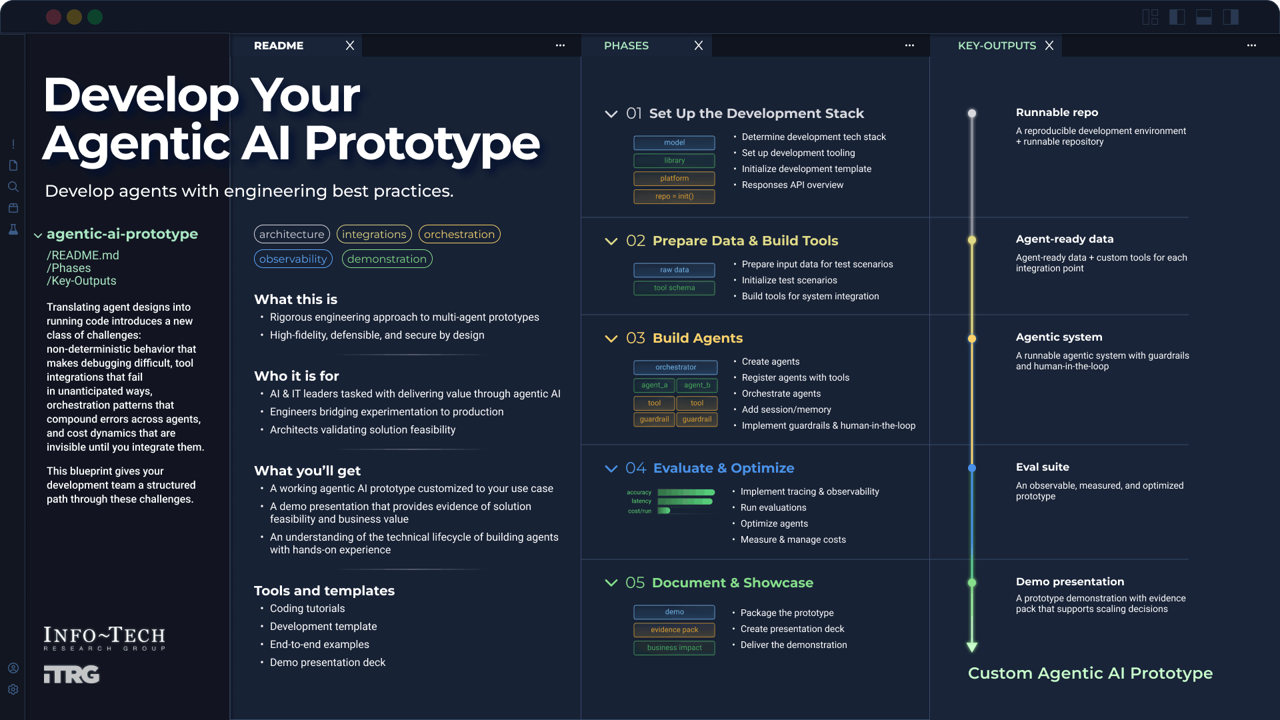
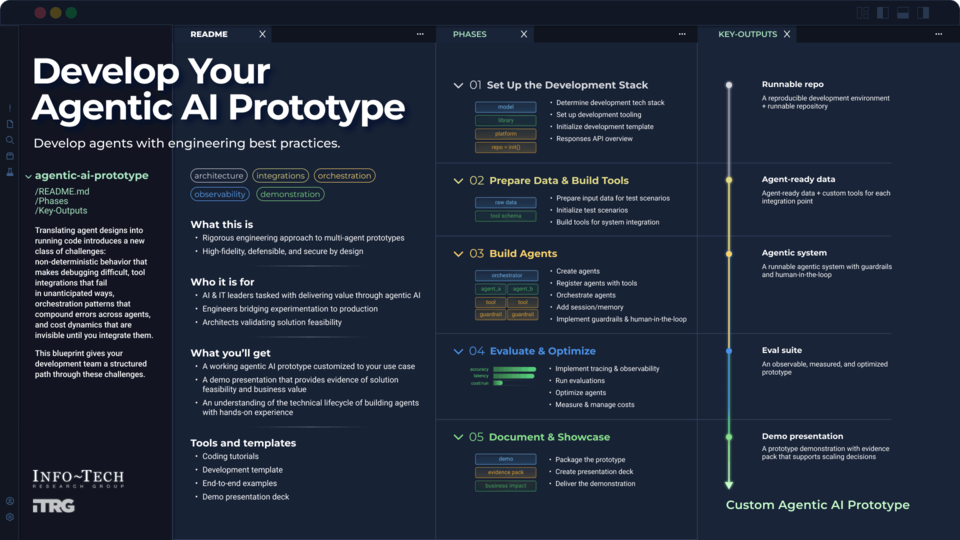
- Set up the development stack. Create a reproducible development environment and runnable repository.
- Prepare data and build tools. At the end of this phase, you’ll have agent-ready data and custom tools for each integration point.
- Build agents. This phase gives you a runnable agentic system with guardrails and human-in-the-loop elements.
- Evaluate and optimize. The outcome of this phase is an observable, measured, and optimized prototype.
- Document and showcase. This final phase produces a prototype demonstration with an evidence pack that supports scaling decisions.
Workshop: Develop Your Agentic AI Prototype
Workshops offer an easy way to accelerate your project. If you are unable to do the project yourself, and a Guided Implementation isn't enough, we offer low-cost delivery of our project workshops. We take you through every phase of your project and ensure that you have a roadmap in place to complete your project successfully.
Module 1: Set Up the Development Stack
The Purpose
Key Benefits Achieved
Activities
Outputs
Determine agent development tech stack.
- Chosen model access API, agent development library, and agent development platform.
Set up agent development tooling.
- Git, IDE, and uv set up to build, test, and iterate quickly. Coding tutorials repository execution enabled to run code samples.
Initialize agent development template.
- Cloned development template that includes scaffolding for agent development.
Responses API overview.
- Understanding of model access, instructions, parameters, structured outputs, built-in tools, and streaming.
Module 2: Prepare Data & Build Tools
The Purpose
Key Benefits Achieved
Activities
Outputs
Prepare input data for test scenarios.
- Clean, anonymize, and reformat source data as necessary so it can be easily understood by agents.
Initialize test scenarios.
- Turn PRD test cases into runnable scenarios in scenarios.json – each with an id, description, payload, and any metadata needed to invoke the workflow.
Build tools for system integration.
- Define the tools your agents will call to act on your systems – APIs, databases, file operations, and any MCP servers – and ensure they are wired up and ready to attach to agents in Phase 3.
Module 3: Build Agents
The Purpose
Without rigorous engineering, agents improvise. No orchestration, no guardrails, and no memory management leads to unpredictable behavior. The agent will “make it work,” but in an inconsistent and ungoverned way.
Key Benefits Achieved
A runnable agentic system with guardrails and human-in-the-loop.
Activities
Outputs
Create agents.
- Create your individual agents and equip each one with structured outputs.
Run agents.
- Run each agent on real inputs from your test scenarios, validating behavior before wiring up tools and orchestration.
Register agents with tools.
- Attach the tools you built in Phase 2 so agents can act on your systems.
Orchestrate agents.
- Compose your agents into multi-agent workflows using either code-driven control flow or LLM-driven handoffs, depending on the reliability and flexibility you need.
Compose your agents into multi-agent workflows using either code-driven control flow or LLM-driven handoffs, depending on the reliability and flexibility you need.
- Add session and memory management so agents persist context across turns, enabling coherent conversations and long-running multi-step workflows.
Implement guardrails and human-in-the-loop.
- Implement agent-level and tool-level guardrails, content moderation via the Moderation API, and human-in-the-loop approval gates for high-risk tool calls.
Module 4: Evaluate & Optimize
The Purpose
Key Benefits Achieved
Activities
Outputs
Implement tracing and observability.
- Set up observability for your agents using the SDK's built-in tracing, custom traces for app-specific events, and run hooks for cross-cutting logic and external integrations.
Run evaluations.
- Decide between programmatic and LLM-driven evaluation, then build and run evaluation sets against your traced agent runs to score quality and surface regressions.
Optimize agents.
- Turn evaluation results into an optimization flywheel and maintain an experiment log to track changes, A/B comparisons, and quality gains over time.
Establish agentic AI FinOps.
- Measure the costs associated with your agentic solution and compare to existing baselines to estimate ROI.
Module 5: Document & Showcase
The Purpose
Key Benefits Achieved
Activities
Outputs
Package the prototype.
- Package the working prototype so it is reproducible and ready to demo. Finalize the repository structure, dependencies, environment configuration, and a runnable entry point.
Build a user interface.
- Optionally add a lightweight UI on top of the agent so reviewers can interact with it directly and see inputs, outputs, and intermediate steps without reading code.
Summarize the implementation.
- Summarize the implementation: the agents and tools built, the models powering them, and the governance and security controls applied across the system.
Document results and business impact.
- Document the evaluation approach and the results: quality metrics, business impact, and the supporting evidence that justifies moving from prototype to pilot.
Identify blockers and next steps.
- Identify the blockers preventing production readiness and define the next-step workstreams needed to close them, from integrations and guardrails to architecture and rollout.
Prepare the demo presentation.
- Prepare the demo presentation: assemble the deck, plan the live walkthrough, and rehearse the agenda so stakeholders can clearly evaluate value and next steps.
Develop Your Agentic AI Prototype
Develop agents with engineering best practices.
Develop Your Agentic AI Prototype
EXECUTIVE BRIEF
Executive summary
Your Challenge
- Organizations that successfully design agentic AI prototypes often stall at implementation.
- Development teams face unfamiliar tooling, nondeterministic system behavior, and integration complexity that traditional software development practices don't address.
- Without engineering discipline, promising designs become fragile demos that can't survive real-world inputs, scale beyond a single developer's laptop, or provide the evidence leadership needs to approve investment.
Common Obstacles
- Moving from design documents to working code without a reproducible development environment.
- Building agents that work on happy paths but break unpredictably on edge cases.
- Inability to measure what the system costs, how fast it runs, or where it fails.
- Producing demos that impress but lack the evidence (evaluation results, cost projections, risk analysis) to justify production investment.
- Knowledge silos – only the original developer can run or modify the prototype.
Info-Tech's Approach
- Apply a disciplined build methodology that turns agentic AI designs into reproducible, defensible prototypes.
- Follow a structured five-phase path – set up the stack, prepare data and tools, build agents, evaluate and optimize, then document and showcase.
- Embed guardrails, human-in-the-loop checkpoints, tracing, and cost controls directly into the build so safety and observability are designed in, not bolted on.
- Deliver a working prototype with an evidence pack – evaluation results, cost projections, and a demo – that gives leadership the proof they need to fund scaling.
Info-Tech Insight
Building a defensible agentic AI prototype requires five reinforcing phases: Set Up the Development Stack, Prepare Data & Build Tools, Build Agents, Evaluate & Optimize, and Document & Showcase. Together they move teams from fragile demo to defensible system with measurable business impact.
Your challenge
Composable multi-agent systems have the potential to deliver significant business value by automating complex business processes end to end. IDC predicts that within three years, 40% of Global 2,000 organizations will adopt agentic AI, with successful implementations doubling productivity (IDC, 2025).
As interest in agentic AI grows, IT leaders face increasing pressure to demonstrate value. In IBM's October 2025 survey of 800 C-suite executives, 38% of CIOs cited agentic AI as the year's most strategically important IT investment.
While interest and experimentation are high, many organizations struggle to move agents into production and realize ROI. Before moving to production, organizations need evidence that agentic AI solutions are feasible, viable, and secure within their business context. Prototyping is critical for generating this evidence, but the gap between agent design and a working prototype is larger than most teams expect.
Translating agent designs into running code introduces new challenges: nondeterministic behavior that complicates debugging, fragile tool integrations, orchestration patterns that compound errors across agents, and hidden cost dynamics that only emerge at runtime.
|
24% |
of executives say AI agents take independent action in their organization today. |
|---|---|
|
67% |
of executives expect AI agents will take independent action by 2027. |
Source: IBM, 2025
Barriers making it difficult to realize value
Due to the emergent nature of agentic AI, many development teams lack a disciplined approach for translating approved designs into code.
Engineering agentic AI systems requires supplementing traditional software development patterns with new patterns to address challenges such as unclear build sequencing, orchestration complexity, limited observability into model reasoning, and the absence of standardized evaluation discipline. Common failure patterns include:
- Environment Fragility: Without reproducible, containerized environments, prototypes break when they move between developers, demo rooms, or CI pipelines.
- Happy-Path Optimism: Agents work in demos but fail on edge cases. Without structured error handling, retry logic, and failure-mode testing, prototypes remain brittle.
- Invisible Costs: Token spend is opaque until instrumented. Teams discover cost problems after deployment rather than during development.
- Evaluation Theater: Running a demo is not an evaluation. Without rigorous, automated evals, teams can't objectively measure performance.
- Security Gaps: Guardrails are implemented but never tested. Prompt injection, data exfiltration, and tool abuse scenarios go unexercised.
|
39% |
of organizations are experimenting with agentic AI. |
|---|---|
|
23% |
of organizations have scaled an agentic AI system – but most only in one or two business functions. |
Source: McKinsey & Company, 2025
Info-Tech's methodology to develop an agentic AI prototype
Product Requirements Document
|
1. Set Up the Development Stack |
2. Prepare Data & Build Tools |
3. Build Agents |
4. Evaluate & Optimize |
5. Document & Showcase |
|
|---|---|---|---|---|---|
|
Phase Steps |
1.1 Determine agent development tech stack |
2.1 Prepare input data for test scenarios |
3.1 Create agents |
4.1 Implement tracing and observability |
5.1 Package the prototype |
|
Phase Outcomes |
A reproducible development environment and runnable repository |
Agent-ready data and custom tools for each integration point |
A runnable agentic system with guardrails and human-in-the-loop |
An observable, measured, and optimized prototype |
A prototype demonstration with evidence pack that supports scaling decisions |
Insight summary
Autonomy isn't a substitute for architecture
Production readiness doesn't come from the model; it comes from the architecture underneath it. There has never been a better time to build, but waiting for a "perfect" model isn't a strategy. Model capability sets the ceiling, but engineering determines how much of that ceiling you can reach.
Skip the setup and every later phase pays the tax
Focus on creating a reproducible, runnable environment. If you can't reliably build and run it, you won't be able to evolve or scale it.
The real engineering is in the integrations
The model is a commodity. What differentiates your system is the tools, integrations, and scenarios you design.
Without rigorous engineering, agents improvise
No orchestration, no guardrails, and no memory management will result in unpredictable behavior. The agent will "make it work," but in an inconsistent and ungoverned way.
You can't optimize what you can't see
Optimization is a loop: run > observe > evaluate > refine. Evaluations and observability aren't optional; they're how you make progress. Every run should be instrumented to show what the agent saw, what it did, where it failed, how long it took, and what it cost.
Evaluation turns a demo into a decision
A prototype becomes valuable when leadership can assess it. Clear evidence on performance, cost, and reliability is what turns a demo into an approved investment.
Key deliverables
You'll leave the blueprint with two artifacts: a runnable agent prototype and a stakeholder-ready demo deck. Together they prove the agent works and identify what it costs and where the risks sit, providing everything leadership needs to greenlight production.
Supporting tools & templates:
- Coding tutorials
- Development template
- End-to-end examples
- Demo presentation template
A working prototype
A runnable agent system built around your use case, with guardrails, human-in-the-loop checkpoints, and session memory wired in end to end.
A demo presentation
A presentation that showcases the agent in validated scenarios alongside evaluation results, risk analysis, cost indicators, and ROI projections – everything leadership needs to greenlight production.
Blueprint benefits
|
IT Benefits |
Business Benefits |
|---|---|
|
|
Info-Tech offers various levels of support to best suit your needs
DIY Toolkit
"Our team has already made this critical project a priority, and we have the time and capability, but some guidance along the way would be helpful."
Guided Implementation
"Our team knows that we need to fix a process, but we need assistance to determine where to focus. Some check-ins along the way would help keep us on track."
Workshop
"We need to hit the ground running and get this project kicked off immediately. Our team has the ability to take this over once we get a framework and strategy in place."
Executive & Technical Counseling
"Our team and processes are maturing; however, to expedite the journey we'll need a seasoned practitioner to coach and validate approaches, deliverables, and opportunities."
Consulting
"Our team does not have the time or the knowledge to take this project on. We need assistance through the entirety of this project."
Diagnostics and consistent frameworks are used throughout all five options.
Guided Implementation
What does a typical GI on this topic look like?
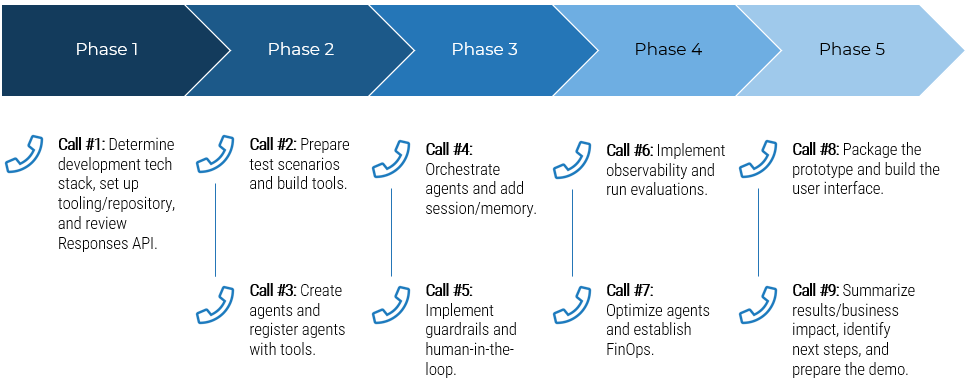
A Guided Implementation (GI) is a series of calls with an Info-Tech analyst to help implement our best practices in your organization.
A typical GI is 8 to 12 calls over the course of 4 to 6 months.
Develop Your Agentic AI Prototype Workshop Agenda
|
SESSION 0 Prototype Confirmation |
SESSION 1 Base Prototype Development |
SESSIONS 2 & 3 Two-Day Hackathon for Prototype Expansion & Validation |
SESSION 4 Prototype Showcase |
|
|---|---|---|---|---|
|
WHO |
Leaders |
Info-Tech Powered |
Technical Teams |
Leaders and Technical Teams |
|
ACTIVITIES |
|
|
|
|
|
OUTCOMES |
|
|
|
|
This research covers Step 2 in Info-Tech's agentic AI prototyping series. Leverage Info-Tech's Design and Develop workshops to rapidly go from vision to a working AI prototype.
Contact your account representative for more information.
workshops@infotech.com
1-888-670-8889
Workshop 1: Design Your Agentic AI Prototype
Design an AI agent that aligns business and technical requirements, is scalable, and is ready for development. In this workshop, your team will gain the skills to map business needs into a production-ready PRD with agent capabilities, orchestration patterns, guardrails, and clear evaluation criteria.
Workshop 2: Develop Your Agentic AI Prototype
Translate your vision into a working AI agent while acquiring essential strategies, hands-on skills, and a deeper understanding of what it takes to build successful AI agents.
Design Your Agentic AI Prototype Workshop Agenda
SESSION 0 | SESSION 1 | SESSION 2 | SESSION 3 | SESSION 4 | |
WHO | Leaders | Leaders, Business Stakeholders, Technical Teams | Business Stakeholders, Technical Teams | Business Stakeholders, Technical Teams | Business Stakeholders, Technical Teams + Leaders |
|---|---|---|---|---|---|
ACTIVITIES |
|
|
|
|
|
OUTCOMES |
|
|
|
|
|
Design your agentic AI workflow before starting this blueprint
Before you begin
As a prerequisite to this blueprint, you must have completed the Design Your Agentic AI Prototype blueprint, which covers selecting a use case, designing your agentic workflow, and documenting your design decisions in a product requirements document (PRD).
If you have not completed the Design Your Agentic AI Prototype blueprint or you do not have a PRD for your use case containing all the components on the right, you are not ready to work on this blueprint. Complete Design Your Agentic AI Prototype and then start this blueprint.
Download Info-Tech's Design Your Agentic AI Prototype
A complete product requirements document (PRD) will include:
- Problem statement
- KPIs with baselines & targets
- Current-state workflow map
- Defined prototype scope
- Agentic workflow design
- Models, tools & instructions
- Orchestration pattern
- Guardrails & risk controls
- Human-in-the-loop
- Success criteria
- Tracing & observability criteria
- Test scenarios
Pro-code vs. low-code
Building agents in a drag-and-drop platform gets you to a demo fast. Building them in code gets you to production.
Low-code trades flexibility for convenience. If your use case fits the platform's patterns, the speed advantage is real. But the moment you need custom orchestration, adversarial testing, fine-grained cost control, or production-grade observability, you'll outgrow the platform (and migration costs are steep).
This blueprint uses a pro-code development approach. The goal isn't just a demo – it's a prototype with the evidence pack (eval results, cost data, latency benchmarks) needed to justify production investment. That level of instrumentation, testing rigor, and architectural control requires code.
|
Dimension |
Pro-Code (Python + SDK) |
Low-Code (Drag and Drop) |
|---|---|---|
|
Flexibility |
Full control over agent logic, orchestration, prompts, and tool integrations. |
Constrained to prebuilt components; custom logic requires workarounds or exits to code. |
|
Customization |
Every behavior is programmable – guardrails, evals, cost hooks, memory strategies. |
Limited to platform config options; advanced customization hits a wall. |
|
Integration |
You own every connection – more work, but no vendor lock-in. |
Prebuilt connectors for common systems; unsupported systems leave you stuck. |
|
Debugging & Observability |
Full access to logs, traces, execution state – instrument anything. |
Limited to what the platform exposes; closed-box execution complicates root-cause analysis. |
|
Portability |
Code runs anywhere – local, cloud, CI/CD, air-gapped. |
Tied to the platform; migration means rebuilding, not redeploying. |
|
Speed to First Demo |
Slower setup – dev environment, SDK knowledge, coding effort. |
Faster – visual builders lower the barrier to a working prototype. |
|
Team Skill |
Requires Python proficiency and software engineering practices. |
Accessible to nondevelopers or teams with limited coding experience. |
Understand the repositories provided with this research
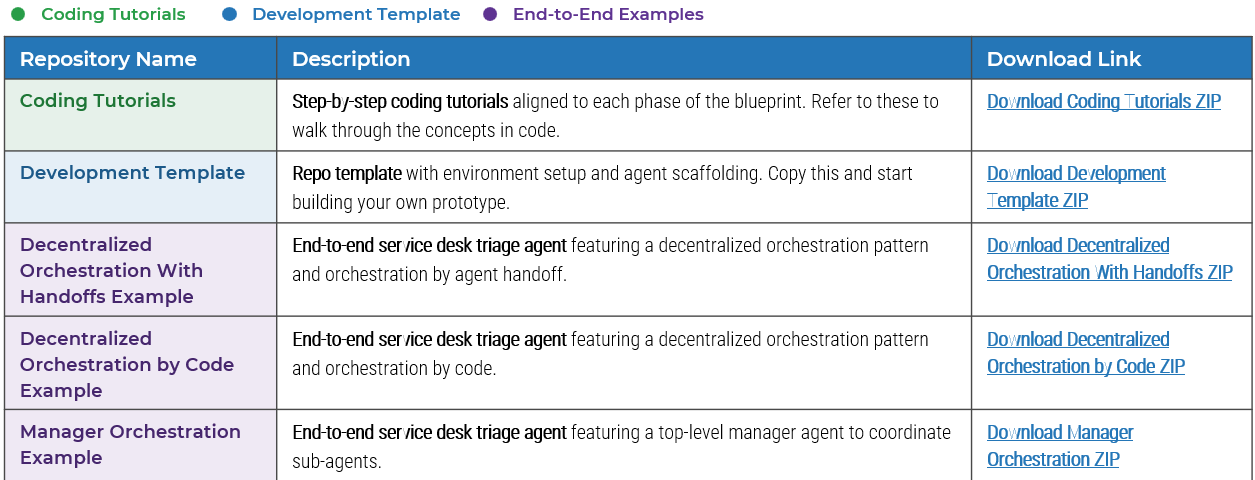
Five repositories support this research, organized into three types:
Understand the use case referenced in the repositories
The repositories feature examples from a real service desk agentic AI system.
PROBLEM STATEMENT
The service desk triages thousands of tickets per month. The current process is manual, time consuming, and inconsistent. Agents must classify and route tickets across a large category taxonomy while working from unclear descriptions, incomplete information, and weak subject lines. This leads to long assignment times, avoidable back-and-forth with requestors, and inconsistent routing outcomes.
The workflow is also burdened by irrelevant tickets that belong outside the service desk and repetitive ticket types such as Database Integrity Reports, which consume capacity that should go to higher-value work. Because ticket content is highly variable and often ambiguous, traditional rules-based automation is not sufficient to automate classification, prioritization, routing, and requester follow-up reliably.
AGENTIC SOLUTION
- Ticket Templating Agent
Determines if the ticket is a service request or incident report and selects the correct template. - Ticket Classification & Prioritization Agent
Categorizes the ticket by category, subcategory, and item and sets the ticket's priority. - Ticket Routing Agent
Routes the ticket to the correct team or technician based on capacity, availability, and topic. - Ticket Validation Agent
Requests additional information from the ticket submitter as needed. - Ticket Resolution Agent
Forwards irrelevant tickets and resolves Database Integrity Report tickets.
Phase 1
Set Up the Development Stack
|
Phase 1 |
Phase 2 |
Phase 3 |
Phase 4 |
Phase 5 |
|---|---|---|---|---|
|
1.1 Determine agent development tech stack 1.2 Set up agent development tooling 1.3 Initialize agent development template 1.4 Review the Responses API |
2.1 Prepare input data for test scenarios 2.2 Initialize test scenarios 2.3 Build tools for system integration |
3.1 Create agents 3.2 Run agents 3.3 Register agents with tools 3.4 Orchestrate agents 3.5 Add session/memory 3.6 Implement guardrails and human-in-the-loop |
4.1 Implement tracing and observability 4.2 Run evaluations 4.3 Optimize agents 4.4 Establish agentic AI FinOps |
5.1 Package the prototype 5.2 Build the user interface (optional) 5.3 Summarize the implementation 5.4 Document results and business impact 5.5 Identify blockers and next steps 5.6 Prepare the demo presentation |
This phase involves the following participants:
- Developers/AI Engineers
About Info-Tech
Info-Tech Research Group is the world’s fastest-growing information technology research and advisory company, proudly serving over 30,000 IT professionals.
We produce unbiased and highly relevant research to help CIOs and IT leaders make strategic, timely, and well-informed decisions. We partner closely with IT teams to provide everything they need, from actionable tools to analyst guidance, ensuring they deliver measurable results for their organizations.
What Is a Blueprint?
A blueprint is designed to be a roadmap, containing a methodology and the tools and templates you need to solve your IT problems.
Each blueprint can be accompanied by a Guided Implementation that provides you access to our world-class analysts to help you get through the project.
Need Extra Help?
Speak With An Analyst
Get the help you need in this 5-phase advisory process. You'll receive multiple touchpoints with our researchers, all included in your membership.
Guided Implementation 1: Set Up the Development Stack
- Call 1: Determine development tech stack, set up tooling/repository, and review Responses API.
Guided Implementation 2: Prepare Data & Build Tools
- Call 1: Prepare test scenarios and build tools.
- Call 2: Create agents and register agents with tools.
Guided Implementation 3: Build Agents
- Call 1: Orchestrate agents and add session/memory.
- Call 2: Implement guardrails and human-in-the-loop.
Guided Implementation 4: Evaluate & Optimize
- Call 1: Implement observability and run evaluations.
- Call 2: Optimize agents and establish FinOps.
Guided Implementation 5: Document & Showcase
- Call 1: Package the prototype and build the user interface.
- Call 2: Summarize results/business impact, identify next steps, and prepare the demo.
 Tech Trends 2025
 Define Your Digital Business Strategy
 Kick-Start IT-Led Business Innovation
 Establish a Foresight Capability
 Apply Design Thinking to Build Empathy With the Business
 Sustain and Grow the Maturity of Innovation in Your Enterprise
 Position IT to Support and Be a Leader in Open Data Initiatives
 Double Your Organization’s Effectiveness With a Digital Twin
 Develop a Use Case for Smart Contracts
 Adopt Design Thinking in Your Organization
 Accelerate Digital Transformation With a Digital Factory
 Tech Trends 2024
 2021 Tech Trends
 Implement and Mature Your User Experience Design Practice
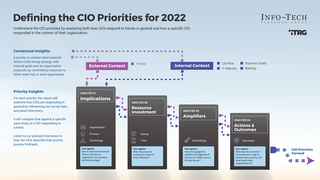 CIO Priorities 2022
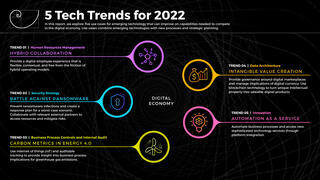 2022 Tech Trends
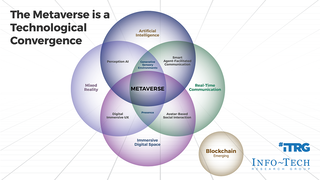 Into the Metaverse
 Demystify Blockchain: How Can It Bring Value to Your Organization?
 2020 Tech Trend Report
 2020 CIO Priorities Report
 CIO Trend Report 2019
 CIO Trend Report 2018
 CIO Trend Report 2017
 AI and the Future of Enterprise Productivity
 Evolve Your Business Through Innovation
 Build a Platform-Based Organization
 Tech Trend Update: If Contact Tracing Then Distributed Trust
 Tech Trend Update: If Biosecurity Then Autonomous Edge
 Tech Trend Update: If Digital Ethics Then Data Equity
 Tech Trends 2023
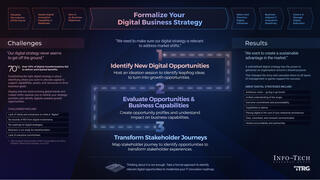 Formalize Your Digital Business Strategy
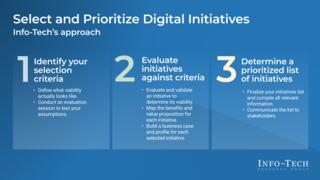 Select and Prioritize Digital Initiatives
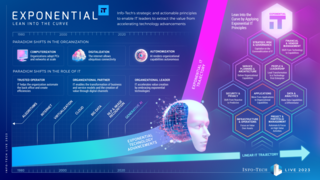 Adopt an Exponential IT Mindset
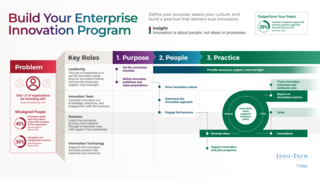 Build Your Enterprise Innovation Program
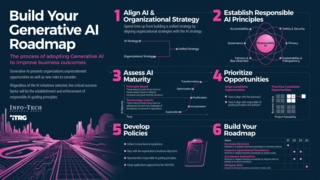 Build Your Generative AI Roadmap
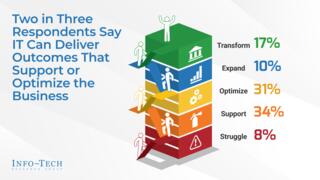 Annual CIO Survey Report 2024
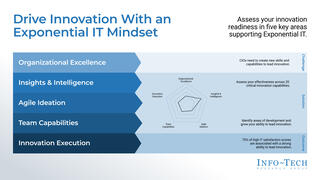 Drive Innovation With an Exponential IT Mindset
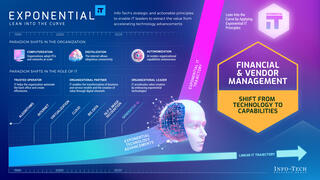 Exponential IT for Financial and Vendor Management
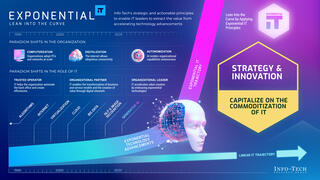 Exponential IT for Strategy, Risk, and Governance
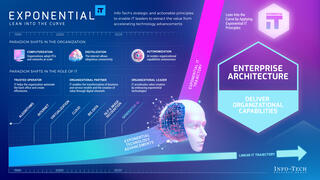 Exponential IT for Service Planning and Architecture
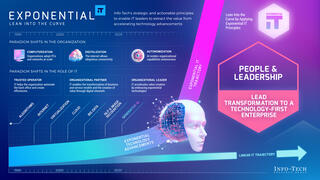 Exponential IT for People and Leadership
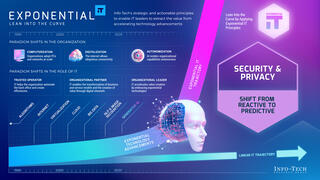 Exponential IT for Security and Privacy
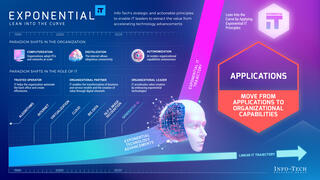 Exponential IT for Applications
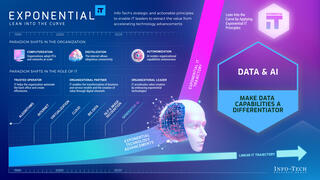 Exponential IT for Data and Analytics
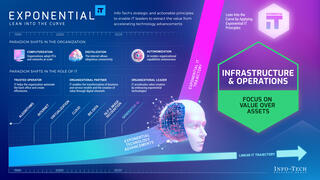 Exponential IT for Infrastructure and Operations
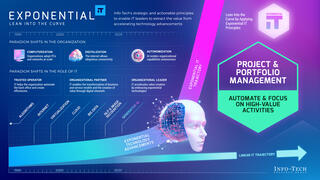 Exponential IT for Project and Portfolio Management
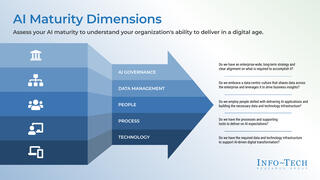 Assess Your AI Maturity
 Develop Responsible AI Guiding Principles
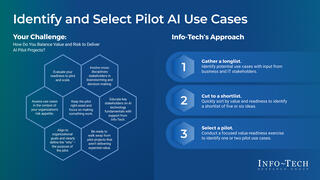 Identify and Select Pilot AI Use Cases
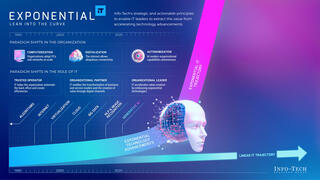 Exponential IT Keynote
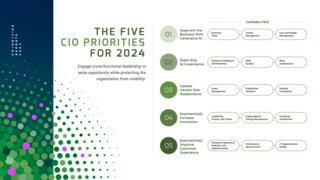 CIO Priorities 2024
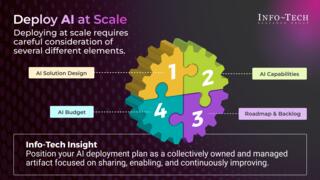 Build a Scalable AI Deployment Plan
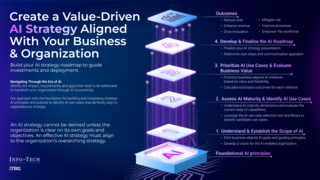 Build Your AI Strategy and Roadmap
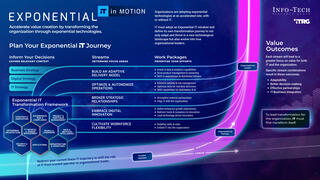 Develop an Exponential IT Roadmap
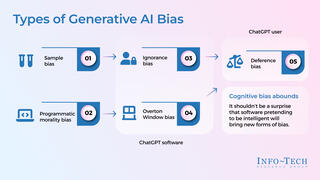 Use ChatGPT Wisely to Improve Productivity
 Build a FinOps Strategy to Enable Dynamic Cloud Cost Management
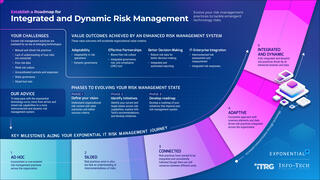 Establish a Roadmap for Integrated and Dynamic Risk Management
 Info-Tech’s Best of 2024 Mid-Year Report: AI Rewrites the Script for CIOs
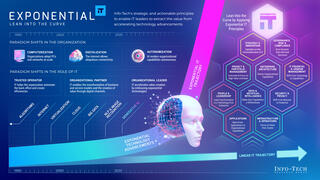 Explore the Art of the Possible for Exponential IT
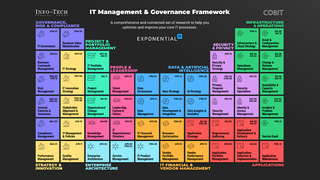 IT Management & Governance: The Next Evolution
 Bending the Exponential IT Curve Keynote
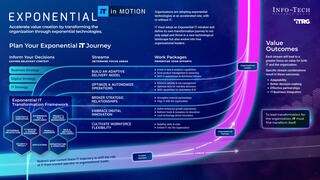
 Exponential IT in Motion: Transform Your Organization by Transforming IT
 AI Trends 2025
 LIVE 2024 Keynote Presentations
 LIVE 2024 Lightning Round Presentations
 CIO Priorities 2025
 Info-Tech’s Best of 2024 Report: IT Moves Into Position
 Build Your AI Risk Management Roadmap
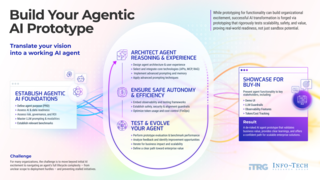 Design Your Agentic AI Prototype
 An Operational Framework for Rolling Out AI
 The AI Vendor Landscape in IT
 Run IT By the Numbers
 Building Info-Tech’s Chatbot
 Assessing the AI Ecosystem
 Bring AI Out of the Shadows
 Transform IT, Transform Everything
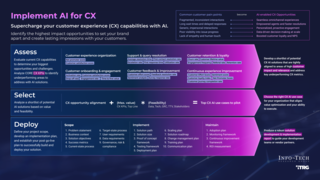 Implement AI for Customer Experience
 Info-Tech’s Best of 2025 Mid-Year Report: IT Moves From Disruption to Decisive Action
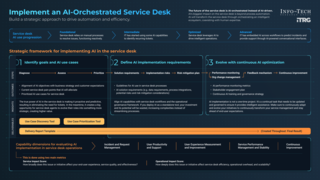 Implement an AI-Orchestrated Service Desk
 Info-Tech's All-Time Best, 2025 Edition: Change Is the Headline, Fundamentals Are the Path
 Tech Trends 2026
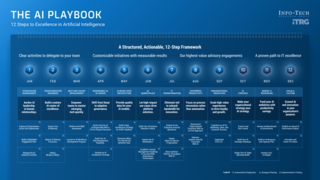 The AI Playbook
 AI Trends 2026
 Info-Tech’s Best of 2025: The Year AI Stopped Being a Project and Became the Strategy
 Publish an Annual AI Performance Report
 Develop Your Agentic AI Prototype
 Changing Landscape: Rethinking Vendor Decisions in the Agentic AI Era
 AI in Seven Charts
 Emerging AI Trends and Predictions From Our Global Technical Counselor Team
 Turn Customer Friction Into Agentic Opportunity
 People Change in the Face of Disruptive Technology
 Lead IT Like a Business: Every Dollar Is a Decision
 Optimize Cloud & AI Spend With Agentic FinOps
 Leadership Summit: The Ultimate Onboarding Experience 2026
 Resilience Is Not Planned – It Is Architected
 Redefine What It Means to Be CIO
 Navigating AI Agents in Service Management
 Influence Unleashed: The IT Leader’s Superpower
 The Challenge of Ethics in the Use of AI
 Revolutionize Risk Management With Agentic AI
 Introducing the Info-Tech Speakers Bureau
 Inside the Agentic Enterprise
 Agents 2.0: From Autonomy to Architecture
 Agentic IT: From Hype to Value
 Tech Trends 2027 Keynote
 Become an Exponential CIO
 Beyond the Agent: The Leadership Ecosystem for an AI-Enabled World
 Five Key Takeaways From Info-Tech LIVE 2026
 Info-Tech’s Best of 2026 Mid-Year Report
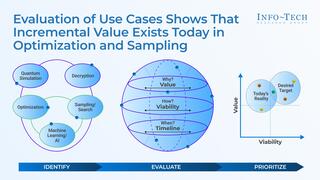 Identify and Evaluate Quantum Computing Use Cases
 AI Adoption & Impact Study: AI in Software Development June 2026 Top 10 Insights
 AI Adoption & Impact Study: AI in the Enterprise June 2026 Top 10 Insights