- Please login to continue.

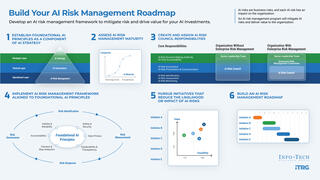
Build Your AI Risk Management Roadmap
Develop your AI risk management framework to mitigate risk and drive value for your AI investments.
AI continues to be the most transformative and disruptive technology today, with organizations around the world accelerating their adoption and deployment of AI-based solutions. Alongside these new and exponential opportunities, AI solutions are also introducing severe financial and reputational risks that require evaluation and management to mitigate. Our step-by-step blueprint provides detailed guidance through the process of AI risk management, helping you to create a comprehensive roadmap and AI strategy aligned with organizational needs.
Risk is an unavoidable part of business that must be actively monitored, managed, and mitigated to avoid financial losses and reputational damage to your organization. Though their effects are just as impactful, AI risks are often addressed separately from organizational risks – causing inconsistencies in the approach and leaving AI leaders too accountable for impacts. Transform your ad hoc AI risk management processes into a formalized, ongoing program aligned with existing business risk management processes to take a proactive stance against AI threats and vulnerabilities.
1. Build off the back of existing standards.
The scale and scope of opportunities made possible by AI are limitless, but you do not have to start from scratch when shaping foundational principles for its use. Our blueprint leverages the NIST AI Risk Management Framework 1.0 as a starting point, to be refined by senior leadership and aligned with your organizational risk appetite and AI maturity.
2. Make risk measurable and manageable.
Identifying potential risks to your organization is an essential first step in your risk management approach, but not all risks are created equal. Establish an AI risk council with key players from across your organization to determine acceptable risk thresholds, create risk likelihood, severity level, and reputational assessments, and provide accessible documentation for all potential risks.
3. Don’t risk your reputation.
Once an organizational AI risk program has been agreed upon, communicated, and implemented, the greatest risk you face might be a false sense of security. AI is evolving exponentially, risking that your assessment will quickly become outdated. Perform regular health checks to keep your finger on the pulse of the key risks threatening the organization and your reputation.
Use our comprehensive blueprint to navigate the risks and take full advantage of the exponential capabilities of AI.
Build an AI risk management program and roadmap that can stand up to the current rapidly changing technical environment by leveraging our step-by-step methodology, tools, and templates to:
- Transform your ad hoc AI risk management processes into a formalized, ongoing program and increase AI risk management success.
- Take a proactive stance against AI threats and vulnerabilities by identifying and assessing the greatest AI risks before they occur.
- Involve key stakeholders, including the organization’s senior management team, to gain buy-in and to focus on the AI risks most critical to the organization.

On Demand
Webinar

Building Your Responsible AI Risk Management Roadmap
Play WebinarMember Testimonials
After each Info-Tech experience, we ask our members to quantify the real-time savings, monetary impact, and project improvements our research helped them achieve. See our top member experiences for this blueprint and what our clients have to say.
10.0/10
Overall Impact
$13,799
Average $ Saved
8
Average Days Saved
Client
Experience
Impact
$ Saved
Days Saved
San Antonio Water System
Guided Implementation
10/10
$13,799
10
Waymo LLC
Guided Implementation
10/10
N/A
5
Frequently Asked Questions
What is an AI risk management roadmap?
An AI risk management roadmap is a comprehensive plan that transforms ad hoc AI risk management processes into a formalized, ongoing program aligned with organizational needs. Info-Tech Research Group's AI risk management roadmap framework helps organizations proactively identify, measure, govern, and respond to AI risks that could impact financial performance and reputation. The roadmap builds on the NIST AI Risk Management Framework 1.0 and aligns AI risk management with existing enterprise risk management processes.
Why do organizations need an AI risk management program?
AI solutions introduce severe financial and reputational risks that require evaluation and management to mitigate. According to Info-Tech Research Group, AI risks are often addressed separately from organizational risks, causing inconsistencies in approach and leaving AI leaders too accountable for impacts. Info-Tech's research emphasizes that AI risk is business risk—every AI risk has business implications that must be actively monitored, managed, and mitigated to avoid financial losses and reputational damage.
What are Info-Tech's six foundational AI principles?
Info-Tech Research Group recommends six core AI guiding principles that were distilled from industry frameworks and practitioner insights. These foundational AI principles serve as the foundation of responsible action to mitigate harm to people, corporations, and society. Info-Tech's framework helps organizations use these six principles as a jumping-off point in defining the right principles for their unique organizational needs, ensuring foundational AI principles govern the entire AI system lifecycle.
How does Info-Tech's AI risk management framework differ from NIST AI RMF 1.0?
Info-Tech Research Group's AI Risk Management Roadmap provides a blueprint for organizations to implement NIST AI RMF 1.0 with added practical guidance. All NIST AI RMF definitions, core functions, categories, and subcategories are included in Info-Tech's framework, but Info-Tech maps NIST terminology to terms that align with Info-Tech's best practices and compliance initiatives. Info-Tech's approach emphasizes alignment to foundational AI principles and provides specific tools, templates, and step-by-step implementation guidance beyond the NIST framework.
What are the four core functions of AI risk management?
Info-Tech Research Group's AI risk management framework includes four core functions: AI Risk Governance (establishing and maintaining a culture of AI risk management), AI Risk Identification (identifying and categorizing AI systems and risks), AI Risk Measurement (establishing AI risk metrics and targets), and AI Risk Response (developing response plans, implementing controls, and continuously improving AI systems). These four dimensions form the basis of Info-Tech's AI Risk Management Maturity Assessment.
How do I assess my organization's AI risk management maturity?
Info-Tech Research Group's AI Risk Management Maturity Assessment Tool measures maturity across four core capabilities: AI Risk Governance, AI Risk Identification, AI Risk Measurement, and AI Risk Response. The assessment helps organizations determine their current maturity and readiness for AI risk management, identify gaps between current and target states, and determine the type of AI risk management program that should be adopted. Info-Tech's framework distinguishes between technology-centric maturity levels and principle-based maturity that addresses human-based principles for responsible AI development.
What is an AI risk council and who should be on it?
An AI risk council is a group of key stakeholders from across the organization responsible for establishing AI risk management program goals, determining acceptable risk thresholds, and creating risk assessments. According to Info-Tech Research Group, the AI risk council should include the AI initiative lead, CIO, and other AI and risk leadership to ensure cross-functional accountability. Info-Tech's framework emphasizes that involving the business senior management team is essential to gain buy-in and focus on AI risks most critical to the organization.
How do I identify and categorize AI risks?
Info-Tech Research Group's AI risk identification process includes identifying relevant AI risks, identifying risk events, determining thresholds for acceptable and unacceptable risk, selecting techniques to measure reputational cost, performing root cause analysis, creating likelihood scales, and assessing risk severity levels. Info-Tech's AI Risk Register Tool and AI Risk Assessment Worksheet provide structured templates to explore and evaluate common AI risks, identify specific risks within an AI risk taxonomy, and create centralized documentation for all identified AI risks.
What tools does Info-Tech provide for AI risk management?
Info-Tech Research Group provides nine comprehensive tools for AI risk management: AI Risk Management Maturity Assessment Tool, AI Risk Assessment Worksheet, AI Risk Register Tool, AI Risk Action Plan, AI Risk Report, AI Risk Management Program Manual, AI Initiatives Prioritization and Roadmap Planning Tool, AI Risk Management Roadmap Presentation Template, and the Build Your AI Risk Management Roadmap Storyboard. These tools help organizations assess risk maturity, document and report on activities, and create a comprehensive program manual as a single source of truth.
How do I measure AI risks and establish key risk indicators?
Info-Tech Research Group's AI risk measurement process involves developing key risk indicators (KRIs), identifying metrics and targets to meet objectives, and establishing reporting schedules. After completing Info-Tech's Measure function, objective, repeatable, or scalable test, evaluation, verification, and validation (TEVV) processes including metrics, methods, and methodologies are in place, followed, and documented. Info-Tech's framework ensures AI risk measurement uses consistent, data-driven approaches aligned with organizational risk appetite.
What are the steps to respond to identified AI risks?
Info-Tech Research Group's AI risk response process includes developing risk responses to positive and negative AI risks, identifying current AI risk controls, assigning risk owners for each risk event, identifying factors contributing to risk severity, analyzing and selecting risk responses, obtaining executive approval for risk action plans, and socializing the Risk Report. Info-Tech's AI Risk Action Plan template helps establish and track accountability to determine next steps for managing AI risk, while the AI Risk Report communicates results of risk assessments to senior leadership.
Can I implement AI risk management without an enterprise risk management program?
According to Info-Tech Research Group, building an effective AI risk management program for the organization is possible even without an enterprise risk management program. Info-Tech's framework is designed to work as a standalone AI risk management approach or to integrate with existing enterprise risk management systems. The framework aligns with foundational AI principles and can be adapted to each organization's unique context, maturity level, and governance structure.
What is included in Info-Tech's Guided Implementation for AI risk management?
Info-Tech Research Group's Guided Implementation for Build Your AI Risk Management Roadmap is a series of 6 to 8 calls over 3 to 6 months with an Info-Tech analyst. The six phases include: Frame AI Risks (assess current maturity and organizational buy-in), AI Risk Governance (establish AI risk council and program goals), AI Risk Identification (identify risk categories and thresholds), AI Risk Measurement (create methods to assess risk severity), AI Risk Response (monitor priority risks and consider responses), and AI Risk Management Roadmap (communicate priorities and implement the plan).
What results can organizations expect from implementing Info-Tech's AI risk management framework?
According to Info-Tech Research Group member testimonials, organizations implementing the AI risk management roadmap achieved an average overall impact rating of 10.0 out of 10, saved an average of $13,799, and saved an average of 8 days. Organizations benefit from operational excellence through structured risk management frameworks, growth through explicit go/no-go decision processes, and risk mitigation through established policies and better information sharing. Info-Tech's framework helps organizations increase AI risk management success by transforming ad hoc processes into formalized programs.
How long does it take to build an AI risk management roadmap using Info-Tech's methodology?
Info-Tech Research Group's workshop for Build Your AI Risk Management Roadmap spans 5 days covering six modules: AI Risk Fundamentals, Govern AI Risks, Identify AI Risks, Measure AI Risk, Respond to AI Risks, and Develop the Roadmap. The workshop includes onsite facilitation for four days with a fifth day offsite for completing in-progress deliverables and setting up review time. Info-Tech's Guided Implementation alternative provides the same comprehensive coverage over 3 to 6 months with 6 to 8 analyst calls, allowing organizations to implement at their own pace.
Workshop: Build Your AI Risk Management Roadmap
Workshops offer an easy way to accelerate your project. If you are unable to do the project yourself, and a Guided Implementation isn't enough, we offer low-cost delivery of our project workshops. We take you through every phase of your project and ensure that you have a roadmap in place to complete your project successfully.
Module 1: AI Risk Fundamentals
The Purpose
Frame AI risks and review AI risk fundamentals and frameworks.
Key Benefits Achieved
- Overview of AI risk management, foundational AI principles, and AI risks and frameworks
- Define foundational AI principles
- AI risk management vs. enterprise risk management programs
- Risk management frameworks for AI
Activities
Outputs
Assess current AI risk management maturity.
- AI Risk Management Maturity Assessment
Identify challenges and pain points.
- AI Risk Management Program Manual
Develop goals for the AI risk management program.
Module 2: Govern AI Risks
The Purpose
After completing the Governance function, organizations will have a purpose-driven culture focused on risk understanding and management.
Key Benefits Achieved
- Review AI risk governance functions
- Review AI risk actors in the organization
Activities
Outputs
Create the AI risk council.
Align your AI risk taxonomy.
Determine the risk culture of your organization.
Define the organization’s risk appetite and tolerance.
Complete the RACI chart.
Module 3: Identify AI Risks
The Purpose
After completing the Identification function, users should have sufficient contextual knowledge about AI system impacts to inform an initial go/no-go decision about whether to design, develop, or deploy an AI system.
Key Benefits Achieved
- Review AI risk identification functions
- Review generative AI risk types
- Use the AI lifecycle to define AI risk context
Activities
Outputs
Identify relevant AI risks.
- List of AI risks
Identify risk events.
- AI Risk Register
Determine the threshold for (un)acceptable risk.
- AI Risk Management Program Manual
Select a technique to measure reputational cost.
Perform root cause analysis.
Create a likelihood scale.
Assess risk severity level.
Module 4: Measure AI Risk
The Purpose
After completing the Measure function, objective, repeatable, or scalable test, evaluation, verification, and validation (TEVV) processes including metrics, methods, and methodologies are in place, followed, and documented.
Key Benefits Achieved
- Review AI risk measurement functions
- Review key risk indicators
Activities
Outputs
Develop key risk indicators.
Identify metrics and targets to meet objectives.
Establish the reporting schedule.
- AI Risk Action Plans
Module 5: Respond to AI Risks
The Purpose
After completing the Response function, plans for prioritizing risk and regular monitoring and improvement will be in place.
Key Benefits Achieved
- Review AI risk response functions
- Review AI incident response plans
Activities
Outputs
Develop risk responses to positive and negative AI risks.
Identify current AI risk controls.
Assign a risk owner for each risk event.
Identify factors that contribute to the severity of the AI risk.
Identify, analyze, and select risk responses.
Obtain executive approval for risk action plans.
Socialize the Risk Report.
- AI Risk Report
Finalize the Risk Management Program Manual.
- AI Risk Management Program Manual
Module 6: Develop the Roadmap
The Purpose
Develop the AI risk management roadmap.
Key Benefits Achieved
Determine next steps and communication approach. Include an executive presentation to present the AI risk management roadmap to the executive leadership team.
Activities
Outputs
Develop the AI risk management roadmap.
- AI Risk Management Program Manual
Determine next steps and communication approach.
- AI Risk Management Roadmap Presentation Template
Build Your AI Risk Management Roadmap
Develop your AI risk management framework to mitigate risk and drive value for your AI investments.
Analyst perspective
Transform the organization with AI.
AI continues to be the most transformative and disruptive technology today. Around the world, organizations are accelerating their adoption and deployment of AI-based solutions. AI solutions are also introducing new risks, and organizations are being challenged on how best to plan for and mitigate these risks.
A successful business-driven AI risk management program requires:
Building an AI strategy that is driven by and aligned with the organizational strategy.
Establishing foundational AI principles as a key component of an organization's AI strategy to mitigate the risks that are introduced with the deployment of AI-based solutions.
Implementing AI governance throughout the organization to promote AI initiatives and align them to foundational AI principles.
Building and delivering an AI risk management roadmap to operationalize the mitigation of AI risks and deliver value to the organization.

Bill Wong
AI Research Fellow
Info-Tech Research Group
Executive summary
Your Challenge
- Risk is unavoidable. Without a formal program to manage AI risk, you may be unaware of your severest AI risks.
- The business could be making decisions that are not informed by AI risk.
- Reacting to AI risks after they occur can be costly, yet it is one of the most common tactics used by organizations.
Common Obstacles
- Without a proper AI strategy and foundational AI principles, the risks of deploying AI technology/solutions could negatively impact business outcomes.
- AI risks and business risks are often addressed separately, causing inconsistencies in the approach.
- Failing to include the business in AI risk management leaves AI leaders too accountable; the business must have accountability as well.
Info-Tech's Approach
- Transform your ad hoc AI risk management processes into a formalized, ongoing program and increase AI risk management success.
- Take a proactive stance against AI threats and vulnerabilities by identifying and assessing the greatest AI risks before they occur.
- Involve key stakeholders, including the business senior management team, to gain buy-in and to focus on the AI risks most critical to the organization.
Info-Tech Insight
AI risk is business risk. Every AI risk has business implications. Create an AI risk management program that shares accountability with the business.
AI Risk Management Framework
DEFINITIONS
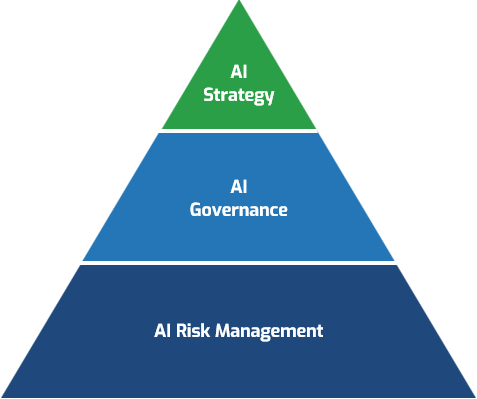
|
AI strategy is aligned with the firm's organizational strategy, and foundational AI principles are established. |
|
AI governance is aligned with the firm's enterprise governance and identifies the AI risks associated with each foundational AI principle. |
|
|
AI risk management is aligned with the firm's enterprise risk management system and operationalizes the management of the AI risks. |
Top AI risk actions
What is your organization currently doing to actively manage the risks around your Generative AI implementations?
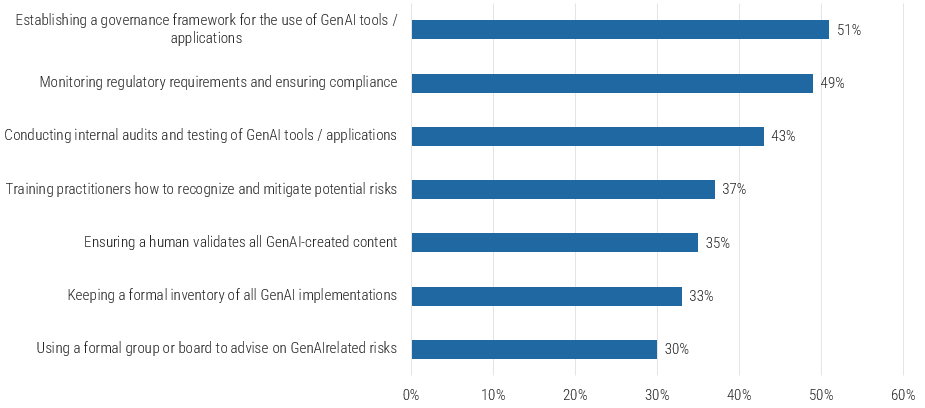
Source: Deloitte, 2024; N=2,770
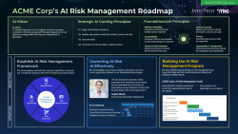
Building your AI risk management roadmap
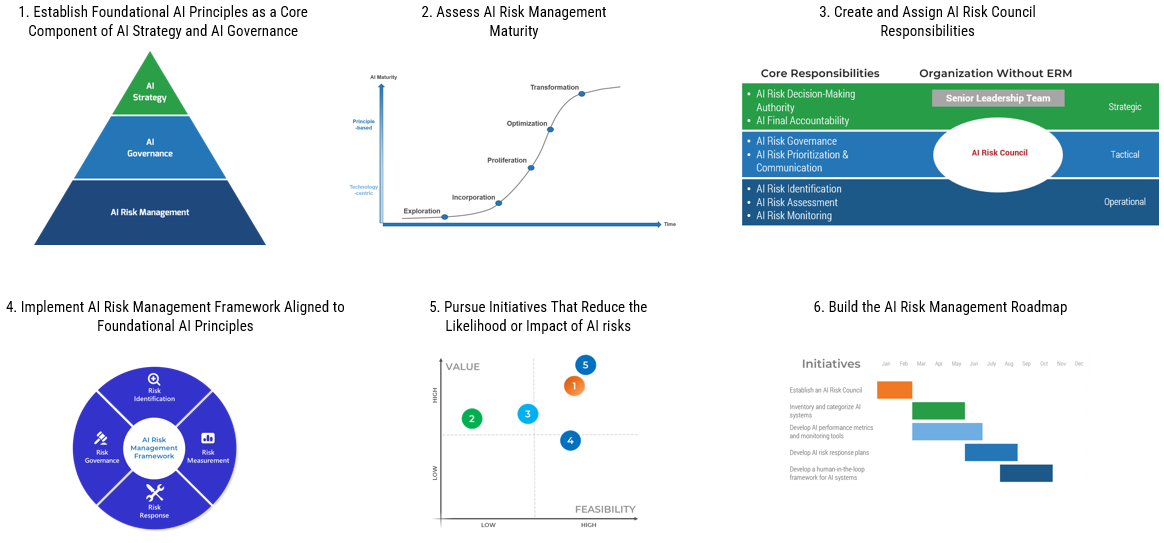
Blueprint deliverables
|
AI Risk Management Maturity Assessment Tool |
Assess the organization's current maturity for AI risk management. |
|
|---|---|---|
|
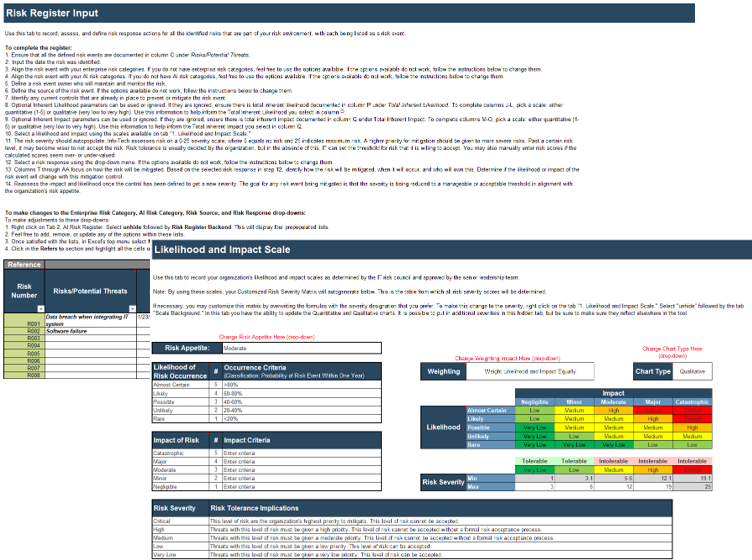
AI Risk Register Tool |
Fill out a repository for the AI risks that have been identified within your environment. |
|
|
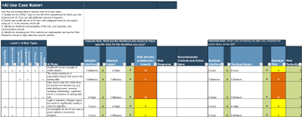
AI Risk Assessment Tool |
Assess potential AI risks for your organization. |
|
|
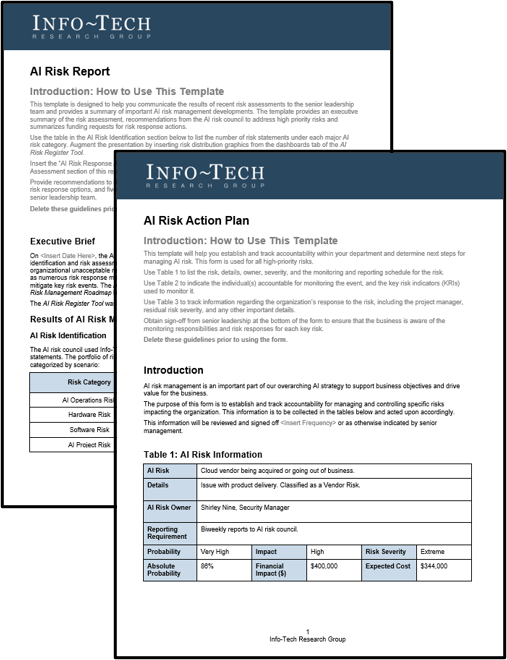
AI Risk Report & AI Risk Action Plan |
Report AI risk severity and hold risk owners accountable for chosen method of responding. |
|
|
AI Risk Management Program Manual |
Develop a customized program manual for the ongoing management of AI risk. |
|
|
AI Risk Management Roadmap Presentation Template |
Present your AI risk management roadmap in a prepopulated document that summarizes all the key findings of this blueprint and provides your C-suite with a view of the AI risk challenges and your plan of action to meet it. |
|
Info-Tech offers various levels of support to best suit your needs
DIY Toolkit
“Our team has already made this critical project a priority, and we have the time and capability, but some guidance along the way would be helpful.”
Guided Implementation
“Our team knows that we need to fix a process, but we need assistance to determine where to focus. Some check-ins along the way would help keep us on track.”
Workshop
“We need to hit the ground running and get this project kicked off immediately. Our team has the ability to take this over once we get a framework and strategy in place.”
Consulting
“Our team does not have the time or the knowledge to take this project on. We need assistance through the entirety of this project.”
Diagnostics and consistent frameworks used throughout all four options
Guided Implementation
What does a typical GI on this topic look like?
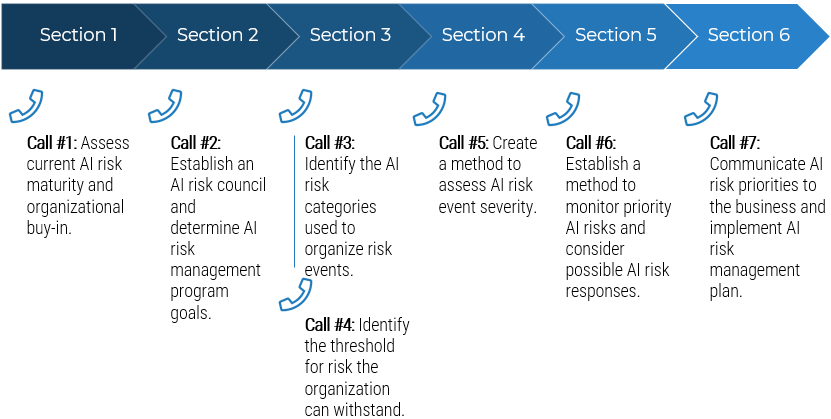
A Guided Implementation (GI) is a series of calls with an Info-Tech analyst to help implement our best practices in your organization.
A typical GI is 6 to 8 calls over the course of 3 to 6 months.
Workshop Overview
Contact your account representative for more information.
workshops@infotech.com 1-888-670-8889
|
Day 1 |
Day 2 |
Day 3 |
Day 4 |
Day 5 |
|
|---|---|---|---|---|---|
|
Activities |
AI Risk Fundamentals |
Govern AI Risks, Identify AI Risks |
Identify AI Risks (cont'd), Measure AI Risk |
Respond to AI Risks |
Develop the Roadmap, Next Steps and |
|
1.1 Assess current AI risk management maturity. |
2.1 Create the AI risk council. |
3.3 Determine the threshold for (un)acceptable risk. |
5.1 Develop risk responses to positive and negative AI risks |
6.1 Develop the AI risk management roadmap
|
|
|
Deliverables |
|
|
|
|
|
Section 1
Frame AI Risks and Review AI Risk Fundamentals and Frameworks
Sections
- Frame AI Risks
- AI Risk Governance
- AI Risk Identification
- AI Risk Measurement
- AI Risk Response
- AI Risk Management Roadmap
Build Your AI Risk Management Roadmap
This section will walk you through the following:
- Overview of AI risk management, foundational AI principles, and AI risks and frameworks
- Define foundational AI principles
- AI risk management vs. enterprise risk management programs
- Risk management frameworks for AI
- Activity: Assess current AI risk management maturity
- Activity: Identify challenges and pain points
- Activity: Develop goals for the AI risk management program
This section involves the following participants:
- AI initiative lead
- CIO
- Other AI and risk leadership
AI risk management program objectives
Ensure foundational AI principles are adopted for the development, deployment, and operation of AI systems
- Ensure foundational AI principles govern the entire AI system lifecycle.
Implement an AI risk management framework to manage and mitigate AI risks
- AI Risk Governance: Establish and maintain a culture of AI risk management.
- AI Risk Identification: Identify and categorize AI systems.
- AI Risk Measurement: Establish AI risk metrics and targets.
- AI Risk Response: Develop response plans, implement controls, and continuously improve the AI systems.
Leverage tools to accelerate building the AI risk management program
- Use the AI Risk Management Maturity Assessment and AI Risk Assessment tools to assess risk and your risk management maturity.
- Use the AI Risk Register, AI Risk Report, AI Risk Action Plan, and AI Risk Management Program Manual to document and report on activities.
Develop an AI risk management roadmap
- Propose AI risk initiatives that deliver value and enhance the organization's risk management maturity and capabilities.
What are foundational AI principles?
To mitigate risks to the corporation and staff, organizations need a responsible approach to developing, implementing, and using AI systems.
- OECD developed the first intergovernmental standard on AI, with AI principles that "promote use of AI that is innovative and trustworthy and that respects human rights and democratic values" (OECD). OECD's Recommendation on AI is followed by 47 countries, enabling international cooperation.
- AI principles like these are the foundation of the practice of responsible action to mitigate harm to people, corporations, and society.
- The terms responsible, ethical, and trustworthy are often used interchangeably, and people who use the terms often have similar goals and objectives.
Info-Tech's Foundational AI Principles
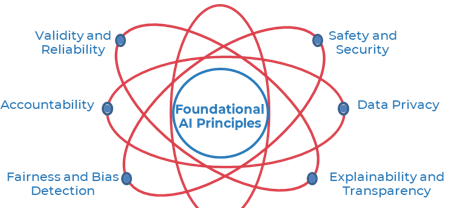
Info-Tech recommends six core AI guiding principles that were distilled from industry frameworks and practitioner insights. This research will help you use our core six as a jumping-off point in defining the right principles for the unique needs of your organization.
Benefits of an AI risk management program
Users of the AI Risk Management Framework are expected to benefit from:
Operational Excellence
- Structured framework for an organization's risk management activities.
- Improved awareness of the relationships and tradeoffs among foundational AI characteristics, sociotechnical approaches, and AI risks.
Growth
- Explicit processes for making go/no-go system commissioning and deployment decisions.
- Enhanced organizational culture which prioritizes the identification and management of AI system risks and potential impacts to individuals, communities, organizations, and society.
Risk Mitigation
- Established policies, processes, practices, and procedures for improving organizational accountability efforts related to AI system risks.
- Better information sharing within and across organizations about risks, decision making processes, responsibilities, common pitfalls, Test and Evaluation, Verification and Validation (TEVV) practices, and approaches for continuous improvement.
- Greater contextual knowledge for increased awareness of downstream risks.
Source: The content on this slide is from NIST AI RMF 1.0. For more information see slide 17 (Alignment to NIST AI RMF 1.0).
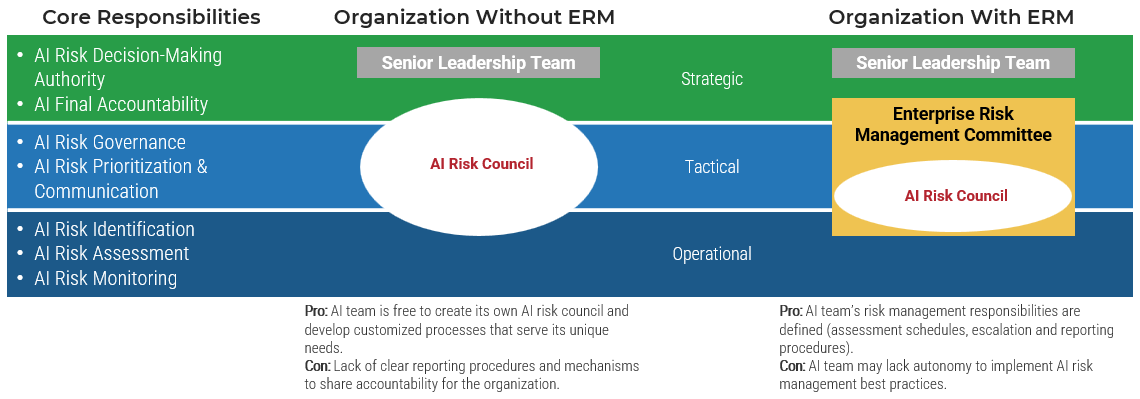
AI risk management is possible without an enterprise risk management program
Building an effective AI risk management program for the organization is possible even without an enterprise risk management program.
Risk management frameworks for AI systems
|
NIST AI RMF |
ISO/IEC 23894:2023 |
ISO 31000 |
COSO ERM |
Info-Tech AI Risk Management Framework |
|
|---|---|---|---|---|---|
|
Focus |
Specifically designed for AI risk management |
Specifically designed for AI risk management |
Enterprise risk management framework that can be adapted for AI |
Enterprise risk management framework that can be adapted for AI |
Specifically designed for AI risk management |
|
Regulatory Nature |
Non-regulatory, voluntary guidance |
International standard |
International standard |
Non-regulatory, voluntary guidance |
Non-regulatory, voluntary guidance |
|
AI Principles |
Focus on trustworthiness |
Focus on international AI ethics and human rights principles |
Outlines eight principles for effective risk management |
Principles focus on effective risk management and can be adapted to focus on AI risks |
Focus on foundational AI principles |
|
Risk Categories |
Wide range of AI risks, focus on trustworthiness |
Risks based on potential impact and likelihood of occurrence |
Emphasizes process to identify and categorize risks based on context |
Enterprise risks, including those related to AI |
Wide range of AI risks, focus on alignment to foundational AI principles |
|
Framework Adaptability |
Highly adaptable |
Flexible framework that can be adapted |
Flexible framework that can be adapted |
Highly adaptable |
Highly adaptable |
|
Implementation Approach |
Structured and adaptable process |
Structured and systematic approach |
Structured and systematic approach |
Structured and will require adaptation to address AI-specific risks |
Structured and adaptable process |
Info-Tech AI Risk Management Roadmap alignment to NIST AI Risk Management Framework (RMF) 1.0
The Info-Tech AI Risk Management Roadmap provides a blueprint for organizations to implement NIST AI RMF 1.0. All of the NIST AI RMF definitions, core functions, categories, and subcategories are included in the Info-Tech AI Risk Management Roadmap. The following terms used by NIST been mapped to Info-Tech terms that align with Info-Tech's best practices and/or compliance initiatives.
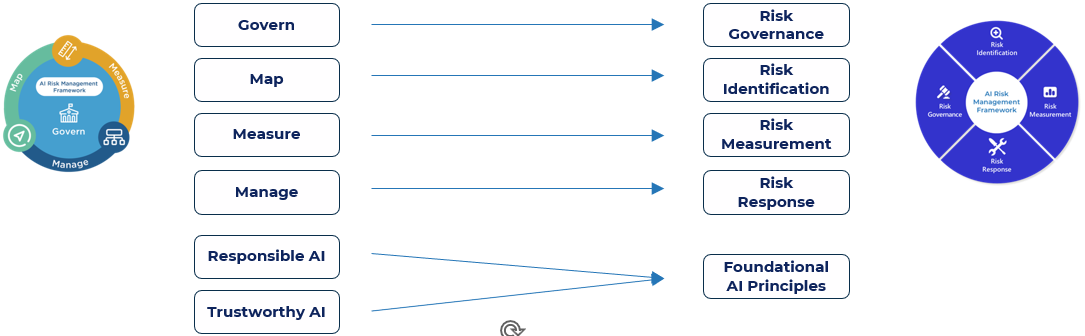
When NIST is referenced as a source, the content was produced by NIST.
AI risk management interoperability framework
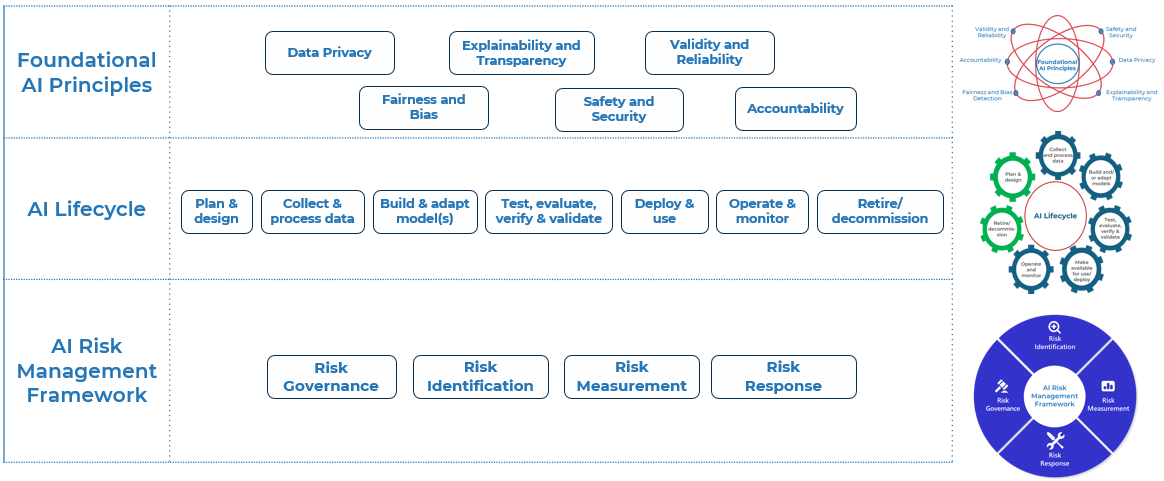
Source: The AI Lifecycle is from NIST AI RMF 1.0. For more information see slide 17 (Alignment to NIST AI RMF 1.0).
AI Risk Management Maturity Model
A principle-based approach is required to advance AI maturity
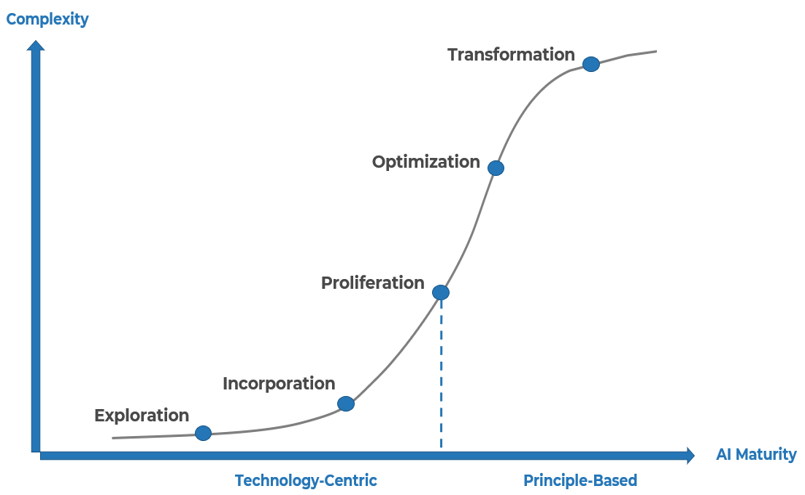
AI Risk Management Dimensions
- Risk Governance
- Risk Identification
- Risk Measurement
- Risk Response
Technology-Centric
These maturity levels focus primarily on addressing the technical challenges of building a functional AI model.
Principle-Based
Beyond the technical challenges of building the AI model are human-based principles that guide development in a responsible manner to address consumer and government demands.
AI Risk Management Maturity Assessment
The purpose of the AI Risk Management Maturity Assessment is to assess the organization's current maturity and readiness for AI risk management.
AI Risk Management Maturity Assessment
A simple tool to understand if your organization is ready to embrace AI risk management by measuring maturity across four core capabilities: AI Risk Governance, AI Risk Identification, AI Risk Measurement and AI Risk Response.
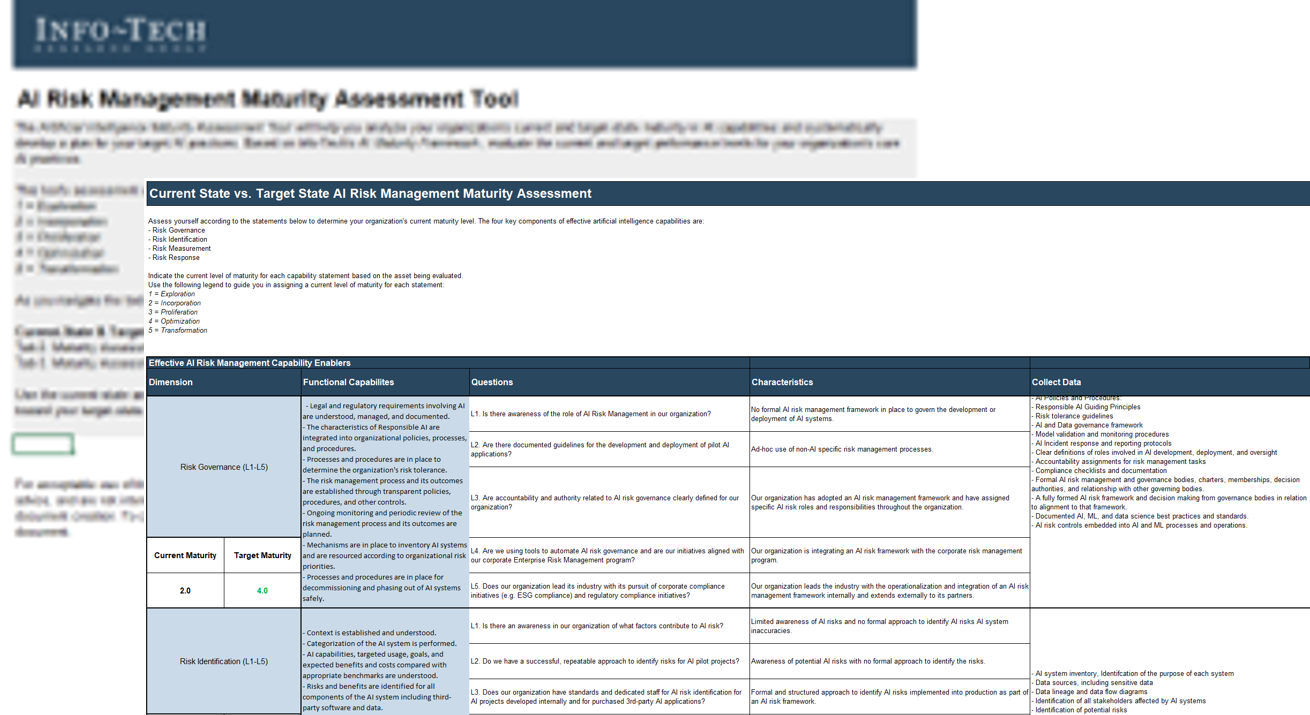
Use the results from this AI risk management maturity assessment to determine the type of AI risk management program that can and should be adopted by your organization.
Some organizations will need to remain siloed and focused on AI risk management only, while others will be able to integrate risk-related information to start enabling automatic controls that respond to this data.
On Demand
Webinar
Building Your Responsible AI Risk Management Roadmap
Play Webinar
Bill
Wong
AI Research Fellow

Valence
Howden
Advisory Fellow
About Info-Tech
Info-Tech Research Group is the world’s fastest-growing information technology research and advisory company, proudly serving over 30,000 IT professionals.
We produce unbiased and highly relevant research to help CIOs and IT leaders make strategic, timely, and well-informed decisions. We partner closely with IT teams to provide everything they need, from actionable tools to analyst guidance, ensuring they deliver measurable results for their organizations.
What Is a Blueprint?
A blueprint is designed to be a roadmap, containing a methodology and the tools and templates you need to solve your IT problems.
Each blueprint can be accompanied by a Guided Implementation that provides you access to our world-class analysts to help you get through the project.
You get:
- Build Your AI Risk Management Roadmap Storyboard
- AI Risk Management Roadmap Presentation Template
- AI Risk Management Maturity Assessment Tool
- AI Risk Assessment Tool
- AI Risk Register Tool
- AI Risk Action Plan
- AI Risk Report
- AI Risk Management Program Manual
- AI Initiatives Prioritization and Roadmap Planning Tool
Need Extra Help?
Speak With An Analyst
Get the help you need in this 6-phase advisory process. You'll receive multiple touchpoints with our researchers, all included in your membership.
Guided Implementation 1: Frame AI Risks
- Call 1: Assess current AI risk maturity and organizational buy-in.
Guided Implementation 2: AI Risk Governance
- Call 1: Establish an AI risk council and determine AI risk management program goals.
Guided Implementation 3: AI Risk Identification
- Call 1: Identify the AI risk categories used to organize risk events.
- Call 2: Identify the threshold for risk the organization can withstand.
Guided Implementation 4: AI Risk Measurement
- Call 1: Create a method to assess AI risk event severity.
Guided Implementation 5: AI Risk Measurement
- Call 1: Establish a method to monitor priority AI risks and consider possible AI risk responses.
Guided Implementation 6: AI Risk Management Roadmap
- Call 1: Communicate AI risk priorities to the business and implement AI risk management plan.
Contributors
- Salvador Barragan, Global Data & AI Strategy and Governance Leader, Data Meaning
- Jeremy Gill, Managing Director, Enterprise Applications and Data Platforms
 Tech Trends 2025
 Define Your Digital Business Strategy
 Kick-Start IT-Led Business Innovation
 Establish a Foresight Capability
 Apply Design Thinking to Build Empathy With the Business
 Sustain and Grow the Maturity of Innovation in Your Enterprise
 Position IT to Support and Be a Leader in Open Data Initiatives
 Double Your Organization’s Effectiveness With a Digital Twin
 Develop a Use Case for Smart Contracts
 Adopt Design Thinking in Your Organization
 Accelerate Digital Transformation With a Digital Factory
 Tech Trends 2024
 2021 Tech Trends
 Implement and Mature Your User Experience Design Practice
 CIO Priorities 2022
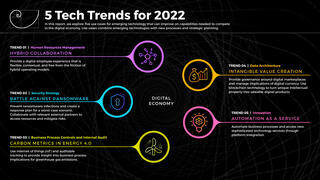 2022 Tech Trends
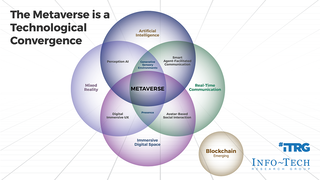 Into the Metaverse
 Demystify Blockchain: How Can It Bring Value to Your Organization?
 2020 Tech Trend Report
 2020 CIO Priorities Report
 CIO Trend Report 2019
 CIO Trend Report 2018
 CIO Trend Report 2017
 AI and the Future of Enterprise Productivity
 Evolve Your Business Through Innovation
 Build a Platform-Based Organization
 Tech Trend Update: If Contact Tracing Then Distributed Trust
 Tech Trend Update: If Biosecurity Then Autonomous Edge
 Tech Trend Update: If Digital Ethics Then Data Equity
 Tech Trends 2023
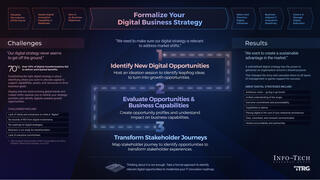 Formalize Your Digital Business Strategy
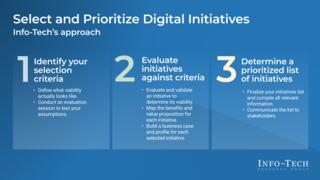 Select and Prioritize Digital Initiatives
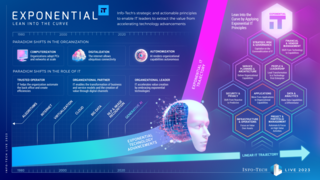 Adopt an Exponential IT Mindset
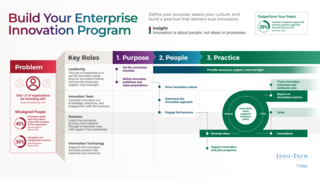 Build Your Enterprise Innovation Program
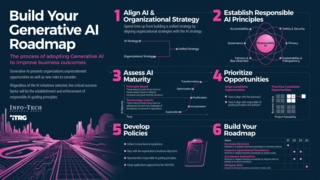 Build Your Generative AI Roadmap
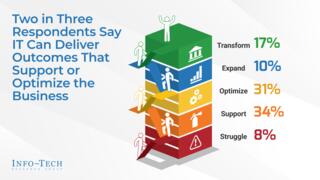 Annual CIO Survey Report 2024
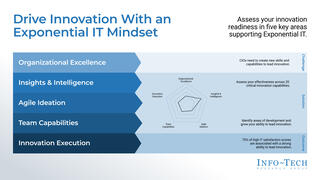 Drive Innovation With an Exponential IT Mindset
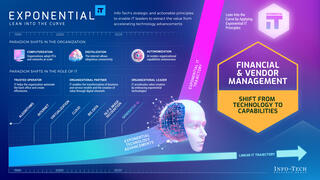 Exponential IT for Financial and Vendor Management
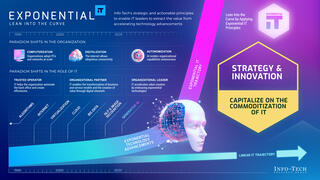 Exponential IT for Strategy, Risk, and Governance
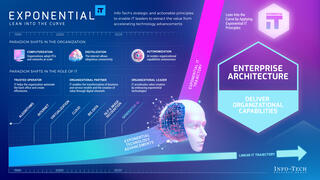 Exponential IT for Service Planning and Architecture
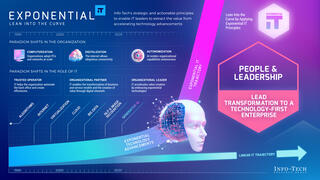 Exponential IT for People and Leadership
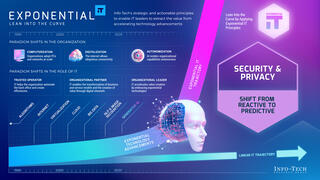 Exponential IT for Security and Privacy
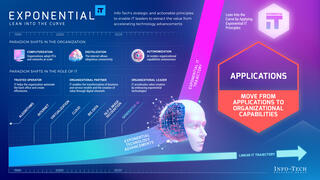 Exponential IT for Applications
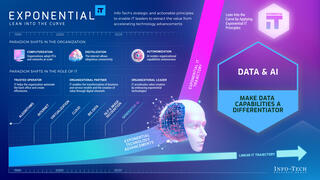 Exponential IT for Data and Analytics
 Exponential IT for Infrastructure and Operations
 Exponential IT for Project and Portfolio Management
 Assess Your AI Maturity
 Develop Responsible AI Guiding Principles
 Identify and Select Pilot AI Use Cases
 Exponential IT Keynote
 CIO Priorities 2024
 Build a Scalable AI Deployment Plan
 Build Your AI Strategy and Roadmap
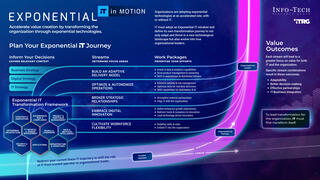 Develop an Exponential IT Roadmap
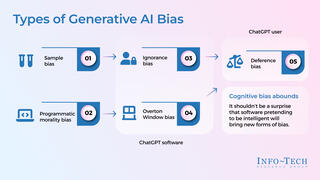 Use ChatGPT Wisely to Improve Productivity
 Build a FinOps Strategy to Enable Dynamic Cloud Cost Management
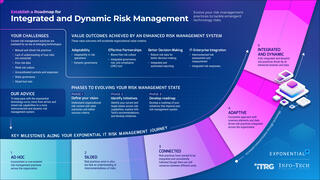 Establish a Roadmap for Integrated and Dynamic Risk Management
 Info-Tech’s Best of 2024 Mid-Year Report: AI Rewrites the Script for CIOs
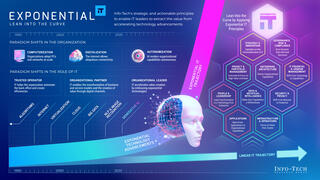 Explore the Art of the Possible for Exponential IT
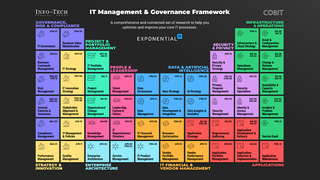 IT Management & Governance: The Next Evolution
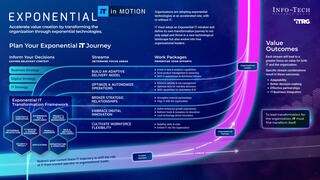 Bending the Exponential IT Curve Keynote
 Exponential IT in Motion: Transform Your Organization by Transforming IT
 AI Trends 2025
 LIVE 2024 Keynote Presentations
 LIVE 2024 Lightning Round Presentations
 CIO Priorities 2025
 Info-Tech’s Best of 2024 Report: IT Moves Into Position
 Build Your AI Risk Management Roadmap
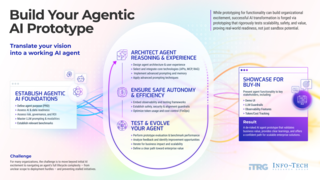 Design Your Agentic AI Prototype
 An Operational Framework for Rolling Out AI
 The AI Vendor Landscape in IT
 Run IT By the Numbers
 Building Info-Tech’s Chatbot
 Assessing the AI Ecosystem
 Bring AI Out of the Shadows
 Transform IT, Transform Everything
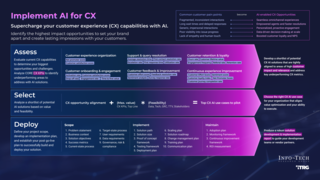 Implement AI for Customer Experience
 Info-Tech’s Best of 2025 Mid-Year Report: IT Moves From Disruption to Decisive Action
 Implement an AI-Orchestrated Service Desk
 Info-Tech's All-Time Best, 2025 Edition: Change Is the Headline, Fundamentals Are the Path
 Tech Trends 2026
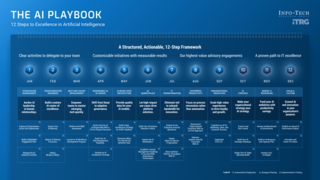 The AI Playbook
 AI Trends 2026
 Info-Tech’s Best of 2025: The Year AI Stopped Being a Project and Became the Strategy
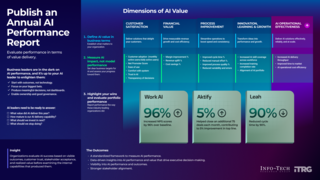 Publish an Annual AI Performance Report
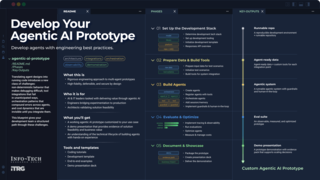 Develop Your Agentic AI Prototype
 Changing Landscape: Rethinking Vendor Decisions in the Agentic AI Era
 AI in Seven Charts
 Emerging AI Trends and Predictions From Our Global Technical Counselor Team
 Turn Customer Friction Into Agentic Opportunity
 People Change in the Face of Disruptive Technology
 Lead IT Like a Business: Every Dollar Is a Decision
 Optimize Cloud & AI Spend With Agentic FinOps
 Leadership Summit: The Ultimate Onboarding Experience 2026
 Resilience Is Not Planned – It Is Architected
 Redefine What It Means to Be CIO
 Navigating AI Agents in Service Management
 Influence Unleashed: The IT Leader’s Superpower
 The Challenge of Ethics in the Use of AI
 Revolutionize Risk Management With Agentic AI
 Introducing the Info-Tech Speakers Bureau
 Inside the Agentic Enterprise
 Agents 2.0: From Autonomy to Architecture
 Agentic IT: From Hype to Value
 Tech Trends 2027 Keynote
 Become an Exponential CIO
 Beyond the Agent: The Leadership Ecosystem for an AI-Enabled World
 Five Key Takeaways From Info-Tech LIVE 2026
 Info-Tech’s Best of 2026 Mid-Year Report
 Identify and Evaluate Quantum Computing Use Cases
 Get Your AI Projects Back on Track
 AI Adoption & Impact Study: AI in Software Development June 2026 Top 10 Insights
 AI Adoption & Impact Study: AI in the Enterprise June 2026 Top 10 Insights
