Discover the Enterprise Agentic AI Technology Stack
Make the right vendor choices to sustainably, safely, and dynamically scale your agentic AI capabilities.
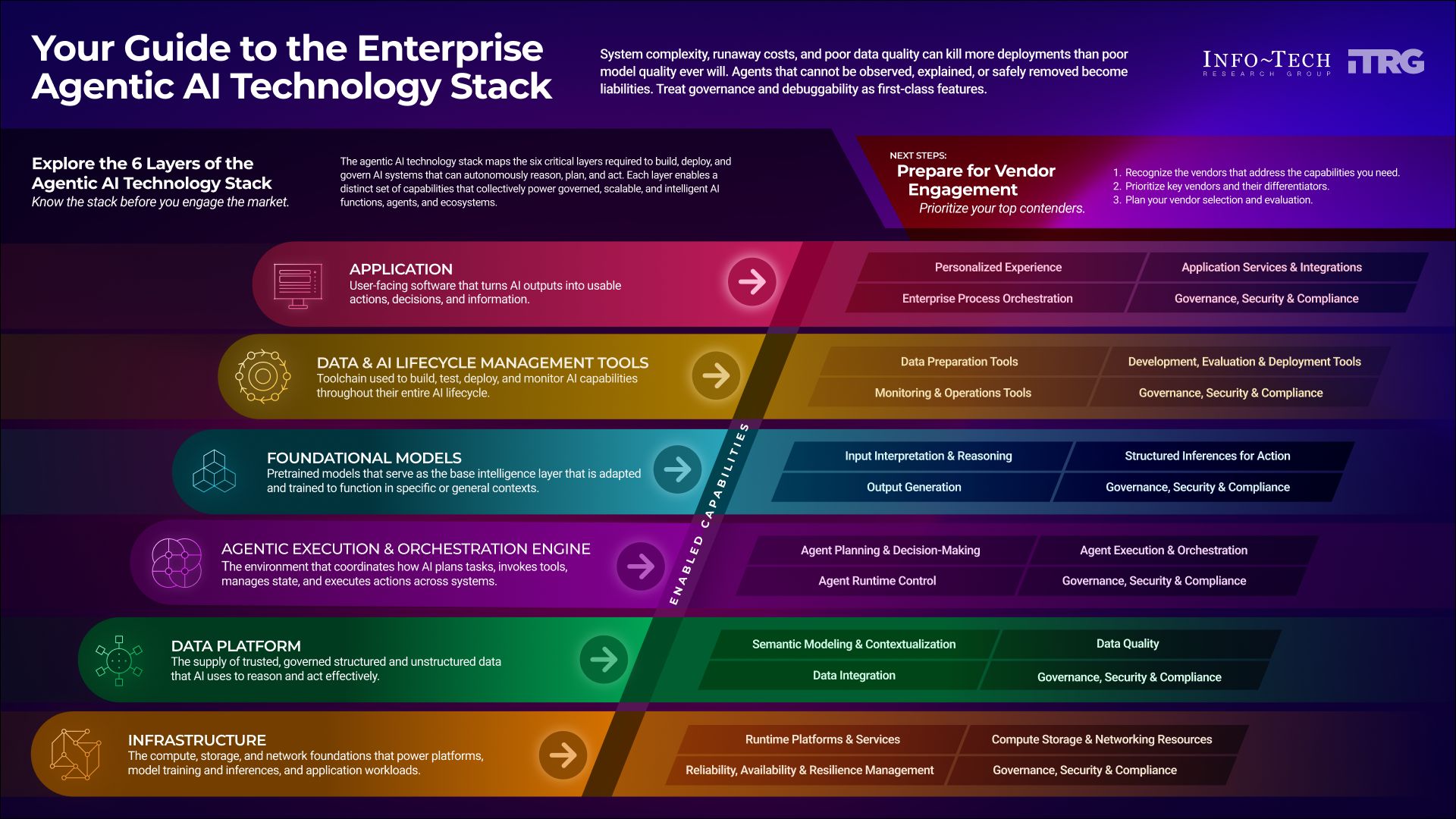
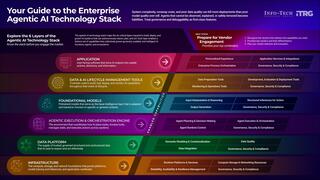
Many organizations have moved past chatbot pilots and are adopting autonomous systems that trigger workflows, access sensitive data, and make operational decisions across the enterprise. As agentic AI embeds itself into core workflows and critical systems, the piecemeal stack assembled for quick wins exposes organizations to challenges unseen in earlier AI pilots. This expansive research maps the six layers of the agentic AI technology stack to help IT leaders understand how the pieces fit together, learn the vendors shaping each layer, and prepare for vendor evaluation.
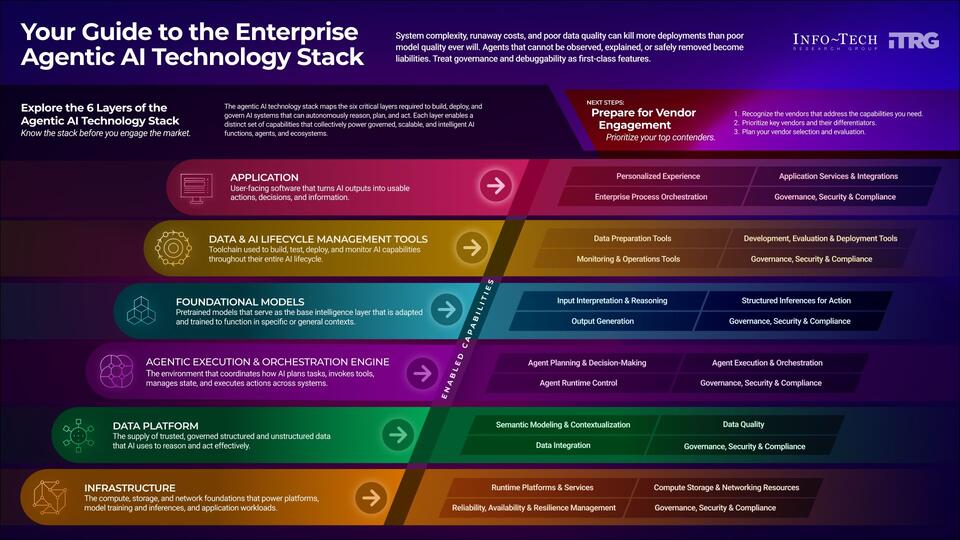
What worked for early AI pilots will not hold up at enterprise scale. Before making long-term decisions, IT leaders, enterprise architects, and AI product owners need a clear view of all the layers of the agentic AI stack: Application, Data & AI Lifecycle Management Tools, Foundational Models, Agentic Execution & Orchestration Engine, Data Platform, and Infrastructure.
1. Application: Turn user intent into autonomous workflows.
Agentic applications that respond only to prompts leave most of their value on the table. Without application integration, memory retention, and tooling execution working together, teams stall at chatbot-style use cases and never reach real autonomy. Configure or build applications so user intent flows into autonomous multistep tasks that act, recall context, and complete work end to end.
2. Data & AI Lifecycle Management: Streamline the path from prototype to production.
Manual and fragmented AI delivery pipelines struggle to meet enterprise demands for AI customization, reusability, testing, and monitoring. Without reusable lifecycle components, every new agent restarts the engineering work and lengthens time to value. Prioritize lifecycle tools with reusable parts for prompt chaining, function calling, and agent evaluation so prototypes are safely promoted to production.
3. Foundational Models: Pick the smallest viable model.
Defaulting to the largest generative AI model inflates cost and latency without lifting outcomes. Oversized foundational models drain budgets and slow agents in the workflows where speed and unit economics matter most. Identify the smallest viable model that meets each agent's functional and nonfunctional requirements, and use fit-for-purpose or mid-tier models for unique use cases.
4. Agentic Execution & Orchestration: Engineer the runtime for coordination and control.
Agents that act in isolation cannot deliver on cross-system workflows or composite decisions. A weak agent orchestration layer fragments execution, leaves agent behavior hidden, and lets strategic and operational goals go unenforced. Architect a runtime that coordinates agents across systems, synthesizes multimodal results, and embeds observability and AI governance into every decision and action.
5. Data Platform: Feed agents trusted, real-time data.
Agents are only as intelligent as the data they can reach. Stale, siloed, or ungoverned data produces unreliable outputs that erode trust in agentic systems. Build a data platform that delivers real-time access to structured and unstructured data and scales as adoption accelerates across the organization.
6. Infrastructure: Tune infrastructure for inference, not training.
Infrastructure built for batch machine learning training cannot absorb the sequential reasoning steps and tool calls agentic workloads demand. Without inference-optimized accelerators, response latency climbs and agent performance degrades under real operating conditions. Validate that accelerators, compute resources, and networks are tuned for low-latency inference at the scale your agentic workloads require.
Use this step-by-step research to map the agentic AI stack and its vendors
This comprehensive research includes a high-level capstone report accompanied by six companion reports, each focused on a different layer of the agentic AI technology stack along with vendors that shape them. Together, they guide teams from a piecemeal pilot architecture to a coordinated, enterprise AI-ready foundation for scaling agentic systems.
- Learn the agentic AI technology stack. Develop a working understanding of each layer and how they connect to power intelligent, autonomous systems.
- Recognize the vendors in the marketplace. Identify commonly referenced vendors shaping each layer of the stack.
- Prepare for vendor selection. Equip teams with structured criteria, trade-offs, and key questions to ask before entering formal evaluation.
About Info-Tech
Info-Tech Research Group is the world’s fastest-growing information technology research and advisory company, proudly serving over 30,000 IT professionals.
We produce unbiased and highly relevant research to help CIOs and IT leaders make strategic, timely, and well-informed decisions. We partner closely with IT teams to provide everything they need, from actionable tools to analyst guidance, ensuring they deliver measurable results for their organizations.
What Is a Blueprint?
A blueprint is designed to be a roadmap, containing a methodology and the tools and templates you need to solve your IT problems.
Each blueprint can be accompanied by a Guided Implementation that provides you access to our world-class analysts to help you get through the project.
Talk to an Analyst
Our analyst calls are focused on helping our members use the research we produce, and our experts will guide you to successful project completion.
Book an Analyst Call on This Topic
You can start as early as tomorrow morning. Our analysts will explain the process during your first call.
Get Advice From a Subject Matter Expert
Each call will focus on explaining the material and helping you to plan your project, interpret and analyze the results of each project step, and set the direction for your next project step.
Unlock Sample ResearchContributors
- Danny Buie – Vice President, IT Strategy & Data, Tyler Technologies, Inc.
- Deepti Bahel – Senior Data Engineer, AI Builder, Founder, MediMate Foundation
- James Galvin –AI and Emerging Technology Manager, Washington Technology Solutions
- Chaney Curry – Enterprise AI Business Architect, Washington Technology Solutions
- 3 anonymous contributors
 Build Your AI Solution Selection Criteria
 Build a Reporting and Analytical Insights Strategy
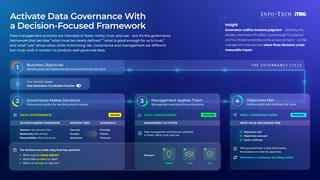 Activate Data Governance
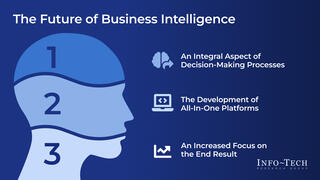 Business Intelligence and Analytics Platform Selection Guide
 Mitigate Machine Bias
 Get Started With Artificial Intelligence
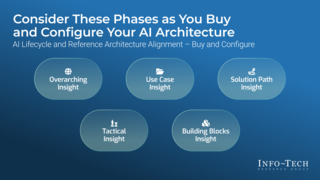 Define the Components of Your AI Architecture
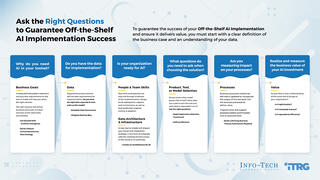 Drive Business Value With Off-the-Shelf AI
 AI Trends 2023
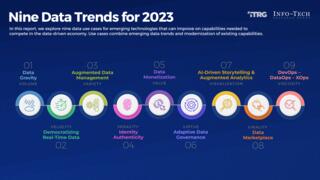 Data and Analytics Trends 2023
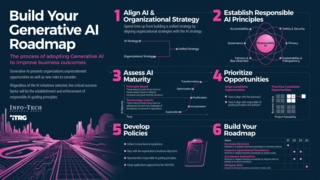 Build Your Generative AI Roadmap
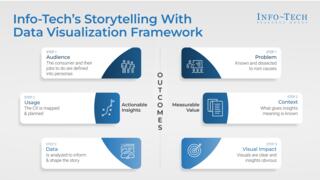 Tell Your Story With Data Visualization
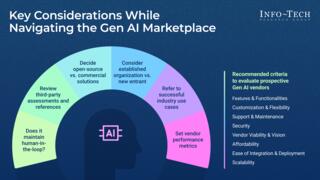 Select Your Generative AI Vendor
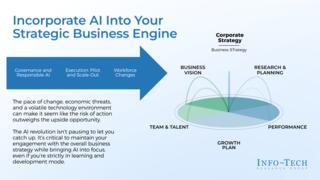 An AI Primer for Business Leaders
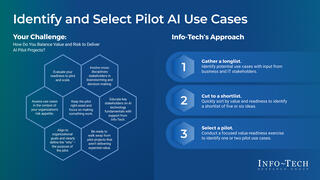 Identify and Select Pilot AI Use Cases
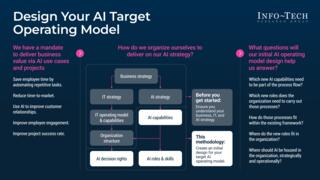 Design Your AI Target Operating Model
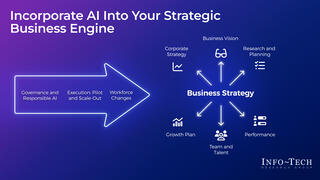 Plan Your Early AI Moves: Training for Business Leaders
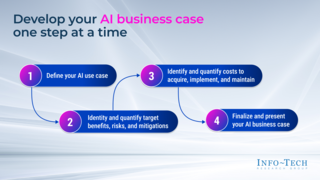 Build Your AI Business Case
 Run IT By the Numbers
 Transform IT, Transform Everything
 The Race to Develop Talent
 Assessing the AI Ecosystem
 Sync or Sink: Aligning IT and HR for the Future of Work
 Bring AI Out of the Shadows
 The AI Vendor Landscape in IT
 IT Spend and Staffing Benchmarking
 The Data Playbook
 Assess Your Data Science and Machine Learning Capabilities
 Discover the Enterprise Agentic AI Technology Stack
 AI in Seven Charts
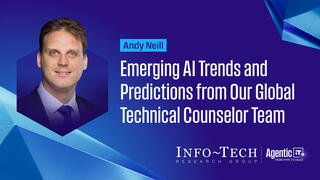 Emerging AI Trends and Predictions From Our Global Technical Counselor Team
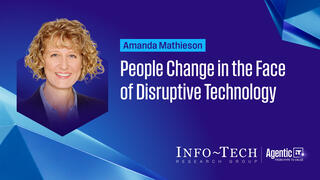 People Change in the Face of Disruptive Technology
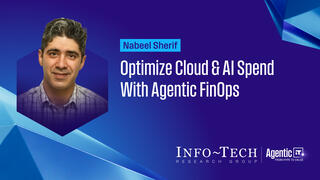 Optimize Cloud & AI Spend With Agentic FinOps
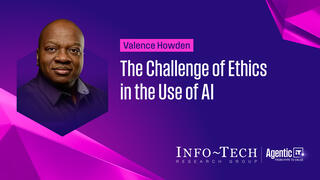 The Challenge of Ethics in the Use of AI
 Introducing the Info-Tech Speakers Bureau
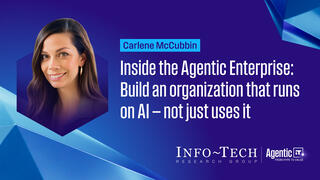 Inside the Agentic Enterprise
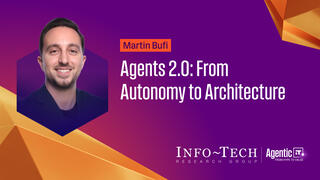 Agents 2.0: From Autonomy to Architecture
 Agentic IT: From Hype to Value
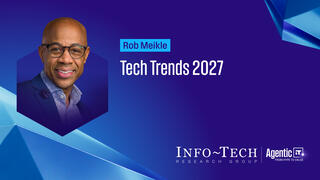 Tech Trends 2027 Keynote
 Become an Exponential CIO
 Beyond the Agent: The Leadership Ecosystem for an AI-Enabled World
 Five Key Takeaways From Info-Tech LIVE 2026
 From Data as a Product to the Data Value Chain