
Design Your AI Target Operating Model
Incorporate AI into your organization based on your current IT operating model.
Your organization has identified a slate of AI use cases and projects that are expected to deliver business value. You are tasked with building a plan to develop, deliver, and support AI across the enterprise, which requires you to:
- Identify, assess, and implement required AI-related business and IT capabilities.
- Identify the roles required to support those capabilities.
- Establish decision-making rights and authority.
- It’s not enough to simply create an isolated, siloed AI team. You must understand how AI roles and capabilities will fit in the context of your larger IT and organizational operating model.
- What works for one organization may not work for
another. You need to develop a solution that helps you deliver on your
strategy in the context of your organization’s existing capabilities and
structure.
Our Advice
Critical Insight
- It’s not enough to simply create an isolated, siloed AI team. You must understand how AI roles and capabilities will fit in the context of your larger IT and organizational operating model.
- IT organizations that successfully deliver AI projects are those that successfully integrate AI capabilities within their larger IT operating model.
Impact and Result
Use this methodology to:
- Build a framework for incorporating AI skills and roles into your own organization, based on your strategic goals and your organization’s target technology operating model.
- Identify the organizational capabilities needed in your organization to execute on key AI initiatives.
- Define the roles required to support organizational capabilities related to AI.
- Understand the role of AI within your organization.
Member Testimonials
After each Info-Tech experience, we ask our members to quantify the real-time savings, monetary impact, and project improvements our research helped them achieve. See our top member experiences for this blueprint and what our clients have to say.
8.2/10
Overall Impact
$11,623
Average $ Saved
9
Average Days Saved
Client
Experience
Impact
$ Saved
Days Saved
BOLDYN NETWORKS GROUP LIMITED
Guided Implementation
7/10
N/A
2
I think the end of the call was really good as we were looking for example of how we could set up as an AI op model
Canadian Tolling Company International Inc
Guided Implementation
5/10
N/A
N/A
Some of the tools - like operating model assessment- does not really adapt to our unique situation
Toronto Community Housing Corporation
Guided Implementation
9/10
$23,500
20
excellent advisory knowledgeable
Spin Master Ltd
Guided Implementation
10/10
$10,000
5
Job and Family Services
Guided Implementation
10/10
$1,370
10
Frequently Asked Questions
What is an AI target operating model?
An AI target operating model is a structured framework that defines how AI capabilities, roles, and decision-making authority will be integrated within an organization's existing IT operating model. Info-Tech Research Group's AI target operating model methodology helps organizations identify AI-related business and IT capabilities, define the roles required to support those capabilities, and establish decision-making rights and authority. This approach ensures AI teams are not isolated silos but instead are successfully integrated within the larger IT operating model to deliver business value.
Why do organizations need to design an AI operating model?
Organizations need to design an AI operating model because simply creating an isolated, siloed AI team will fail to deliver expected business value. According to Info-Tech Research Group, IT organizations that successfully deliver AI projects are those that successfully integrate AI capabilities within their larger IT operating model. Without a structured operating model, organizations struggle to develop, deliver, and support AI across the enterprise, fail to enable business ownership of AI projects, and cannot execute on their AI strategy effectively.
What problem does Info-Tech's AI target operating model solve?
Info-Tech Research Group's AI target operating model solves the challenge of incorporating AI capabilities into an organization without creating isolated teams or attempting to replicate another organization's model inappropriately. The methodology addresses three critical obstacles: AI teams being isolated from other teams in the organization, organizations attempting to replicate another organization's operating model without considering their own strategy and organizational context, and the failure to develop solutions that work within the organization's existing capabilities and structure.
What are the two main steps in Info-Tech's AI target operating model methodology?
Info-Tech Research Group's AI target operating model methodology consists of two main steps. Step 1 is to identify your IT target operating model by reviewing your AI strategy and roadmap and confirming which IT operating model best aligns to your strategy and roadmap. Step 2 is to design your AI target operating model by reviewing key AI-related roles and capabilities and designing AI roles and capabilities within your target operating model. The outcomes include confirming your target IT operating model, creating a list of needed AI-related roles and capabilities, and producing a sketch of your target organizational structure outlining AI-related roles.
How do I identify my IT target operating model for AI?
To identify your IT target operating model for AI, Info-Tech Research Group recommends first reviewing your AI strategy and roadmap, then using Info-Tech's Operating Model Decision Tool to identify a general operating model you can customize to your own organization. This step involves reviewing Info-Tech's definition of an IT operating model after defining your AI strategy and requires participation from core working group members. The outcome of this step is confirmation of your target IT operating model that aligns to your strategy and roadmap.
How do I design AI roles and capabilities within my operating model?
To design AI roles and capabilities within your operating model, Info-Tech Research Group recommends reviewing key AI-related roles and capabilities, then designing how those AI roles and capabilities fit within your target operating model. This process produces two key deliverables: a list of needed AI-related roles and capabilities specific to your organization, and a sketch of your target organizational structure that outlines where AI-related roles will sit. Info-Tech's AI Operating Model Sketchbook provides examples of AI roles, capabilities, and structures for all operating model archetypes to use as reference when creating your own.
What percentage of organizations accelerated their AI strategy due to generative AI advances?
According to Info-Tech Research Group's research citing Scale (2023), 65% of respondents accelerated their existing AI strategy, or were forced to create a strategy, due to the advances in generative AI models in 2022. This demonstrates that generative AI has burst into the public consciousness and launched a race to discover and be first to market with valuable use cases, making it critical for organizations to design operating models that can support AI development, deployment, and support enterprise-wide.
What are the main barriers to AI adoption in organizations?
According to Info-Tech Research Group's research, there are two primary barriers to AI adoption. First, 34% of companies cite limited AI skills, expertise, or knowledge as a barrier to AI adoption (IBM, 2022), reflecting a limited supply and high cost for key skills required to build, train, and support AI applications. Second, 47% of executives say it's challenging to integrate AI initiatives into existing processes and systems (Veritone, 2020), highlighting that operating models can enhance or impede business ownership of key AI projects.
What business benefits can successful AI incorporation deliver?
Successful AI incorporation can lead to multiple measurable business benefits according to Info-Tech Research Group. These benefits include improving time to market by speeding product innovation (Convercon, 2023), identifying missed strategic opportunities (Veritone, 2020), improving employee efficiency by allowing staff to focus on more meaningful work, and increasing profits by helping reduce costs and increase revenue (Mexico Business News, 2023). With the right framework of incorporation, AI adoption can be less resource consuming while delivering these outcomes.
What tools does Info-Tech provide for designing an AI operating model?
Info-Tech Research Group provides three primary tools for designing an AI operating model. First, the Design Your AI Target Operating Model Storyboard offers a step-by-step guide to design AI capabilities in your organization. Second, the Operating Model Decision Tool is an Excel questionnaire that helps organizations determine their current or target IT operating model by identifying which Info-Tech general model best matches their future-state. Third, the AI Operating Model Sketchbook provides a set of AI roles and capabilities as well as example structures for all operating model archetypes to use as reference when creating your own.
How does Info-Tech's approach to AI operating models differ from creating a standalone AI team?
Info-Tech Research Group's approach differs fundamentally from creating a standalone AI team by emphasizing integration rather than isolation. While many organizations attempt to simply create an isolated, siloed AI team, Info-Tech's methodology requires understanding how AI roles and capabilities will fit in the context of the larger IT and organizational operating model. Info-Tech's critical insight is that IT organizations that successfully deliver AI projects are those that successfully integrate AI capabilities within their larger IT operating model, not those that create separate, disconnected teams.
What is Info-Tech's Guided Implementation process for AI operating model design?
Info-Tech Research Group's Guided Implementation for AI operating model design is a series of four calls with an Info-Tech analyst to help implement best practices. Call 1 discusses current state and reviews drivers for developing the operating model and key elements of the AI strategy. Call 2 identifies the target IT operating model. Call 3 reviews and defines key AI roles and capabilities. Call 4 discusses how to build a capability map and draft an organizational sketch. This guided process provides multiple touchpoints with researchers, all included in membership.
Why must AI operating model design start with strategy?
Info-Tech Research Group's approach requires starting with strategy because organizations must confirm what they want to accomplish before defining how they'll do it. The methodology emphasizes that what works for one organization may not work for another, so organizations need to develop a solution that helps them deliver on their strategy in the context of their organization's existing capabilities and structure. By starting with strategy, organizations can identify an operating model that aligns to what they're expected to deliver, then identify key AI capabilities and roles that fit within that model.
What member results has Info-Tech measured for this AI operating model blueprint?
Info-Tech Research Group measures member impact after each experience and has documented significant results for the AI target operating model blueprint. Members reported an overall impact rating of 8.2 out of 10, average savings of $11,623, and average time savings of 9 days. One member from Toronto Community Housing Corporation reported a 9 out of 10 impact rating with $23,500 saved and 20 days saved. These results demonstrate the measurable value organizations achieve when using Info-Tech's methodology to design their AI operating models.
What happens if organizations fail to design an effective AI operating model?
According to Info-Tech Research Group, organizations that fail to design an effective AI operating model will struggle to deliver on their objectives in several ways. If AI teams are isolated from other teams in the organization, if organizations attempt to replicate another organization's operating model without considering their own strategy and organizational context, or if the operating model fails to enable business ownership of AI projects, organizations will struggle to execute on their AI strategy and fail to realize expected value. The operating model can either enhance or impede business ownership of key AI projects, making it a critical success factor.
Design Your AI Target Operating Model
Incorporate AI into your organization based on your current IT operating model.
Executive Summary
Your Challenge
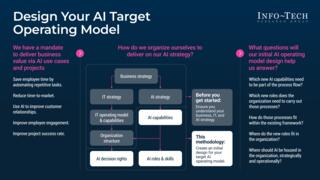
Your organization has identified a slate of artificial intelligence (AI) use cases and projects that are expected to deliver business value. You are tasked with building a plan to develop, deliver, and support AI across the enterprise, which requires you to:
- Identify, assess, and implement required AI-related business and IT capabilities.
- Identify the roles required to support those capabilities.
- Establish decision-making rights and authority.
Common Obstacles
You will struggle to deliver on your objectives if:
- AI teams are isolated from other teams in the organization.
- You attempt to replicate another organization's operating model, without considering your own strategy and organizational context.
- What works for one organization may not work for another. You need to develop a solution that helps you deliver on your strategy, in the context of your organization's existing capabilities and structure.
Info-Tech's Approach
- Start with strategy. Confirm what you want to accomplish, before you try to define how you'll do it.
- Identify an operating model that aligns to what you're expected to deliver through your strategy.
- Identify key AI capabilities and roles, and where they typically sit within that model.
- Use Info-Tech's templates and methodology to create a visualization of your AI operating model.
Info-Tech Insight
IT organizations that successfully deliver AI projects are those that successfully integrate AI capabilities within their larger IT operating model.
Develop, deploy, and support AI projects enterprise-wide
Generative AI has burst into the public consciousness, launching a race to discover and be first to market with golden use cases.
IT departments are struggling to support generative AI initiatives, as there's a limited supply and consequent high cost for key skills required to build, train, and support AI applications.
Your operating model can enhance or impede business ownership of key AI projects. If you fail to enable business ownership of AI projects, you will struggle to execute on your AI strategy and fail to realize expected value.
To be an organization that succeeds, you must design an operating model that supports your strategy and key initiatives, fits with your culture and organization, and makes the most of the skills and resources available to you.
With the right framework of incorporation, AI adoption can be less resource consuming.
|
65% |
of respondents accelerated their existing AI strategy, or were forced to create a strategy, due to the advances in generative AI models in 2022 |
|---|---|
| 34% |
of companies say that limited AI skills, expertise, or knowledge are a barrier to AI adoption |
| 47% |
of executives say it's challenging to integrate AI initiatives into existing processes and systems |
Research benefits
Use this research to design an initial AI operating model that will help you successfully incorporate AI within your IT operating model:
- Build a framework for incorporating AI skills and roles into your own organization, based on your strategic goals and your organization's target technology operating model.
- Identify the organizational capabilities needed in your organization to execute on key AI initiatives.
- Define the roles required to support organizational capabilities related to AI.
- Understand the role of AI within your organization.
- Successfully begin your organization's AI incorporation.
Successful AI incorporation can lead to multiple benefits, such as:
- Improving time to market by speeding product innovation (Convercon, 2023).
- Time to Market = Average product time to market before AI – Average product time to market post AI incorporation
- Identifying missed strategic opportunities (Veritone, 2020).
- Improving employee efficiency by allowing staff to focus on more meaningful work.
- Employee Efficiency = (how long the task ought to take/how long the task takes)*100 – (how long the task ought to take/how long the task takes with AI processes in place)*100
- Increasing profits by helping reduce costs and increase revenue (Mexico Business News, 2023).

Info-Tech's methodology
|
Step 1. Identify your IT target operating model |
Step 2. Design your AI target operating model |
|
|---|---|---|
|
Substeps |
|
|
|
Step Outcomes |
|
|
Guided implementation
What does a typical guided implementation (GI) on this topic look like?
|
Step 1: Identify your IT target operating model |
Step 2: Design your AI target operating model |
|---|---|
|
Call #1: Discuss your current state and review your drivers for developing your operating model. Review key elements of your AI strategy. Call #2: Identify your target IT operating model. |
Call #3: Review and define key AI roles and capabilities. Call #4: Discuss how to build a capability map and draft an organizational sketch. |
A GI is a series of calls with an Info-Tech analyst to help implement our best practices in your organization.
Step 1: Identify your target IT operating model
- Review Info-Tech's definition of an IT operating model after defining your AI strategy.
- Use Info-Tech's Operating Model Decision Tool to identify a general operating model you can customize to your own organization.
This step involves the following participants:
- Core working group members
Outcomes of this step:
- Identify your target IT operating model

About Info-Tech
Info-Tech Research Group is the world’s fastest-growing information technology research and advisory company, proudly serving over 30,000 IT professionals.
We produce unbiased and highly relevant research to help CIOs and IT leaders make strategic, timely, and well-informed decisions. We partner closely with IT teams to provide everything they need, from actionable tools to analyst guidance, ensuring they deliver measurable results for their organizations.
What Is a Blueprint?
A blueprint is designed to be a roadmap, containing a methodology and the tools and templates you need to solve your IT problems.
Each blueprint can be accompanied by a Guided Implementation that provides you access to our world-class analysts to help you get through the project.
Need Extra Help?
Speak With An Analyst
Get the help you need in this 2-phase advisory process. You'll receive multiple touchpoints with our researchers, all included in your membership.
Guided Implementation 1: Identify your IT target operating model
- Call 1: Discuss your current state and review your drivers for developing your operating model. Review key elements of your AI strategy.
- Call 2: Identify your target IT operating model.
Guided Implementation 2: Design your AI target operating model
- Call 1: Review and define key AI roles and capabilities.
- Call 2: Discuss how to build a capability map and draft an organizational sketch.
Contributors
- Veer Hossain, Director, InfoWorks Inc
- Judy Brown, Marketing Coordinator, InfoWorks Inc
- Jeffrey Kramer, Executive Vice President-Digital Transformation, Aprio
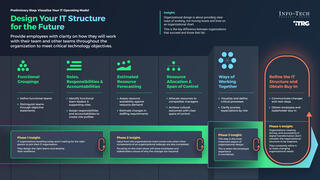 Design Your IT Organization for the Future
 Implement a New IT Organizational Structure
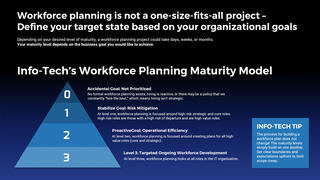 Build a Strategic IT Workforce Plan
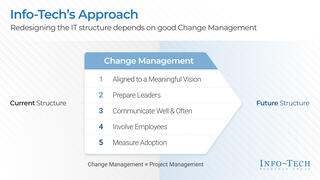 Adopt Change Management Practices and Succeed at IT Organizational Redesign
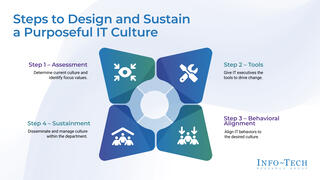 Design and Sustain a Purposeful IT Culture
 Establish an Integrated IT-Business Operating Model
 Design Your AI Target Operating Model
 Visualize the IT Operating Model
 Sync or Sink: Aligning IT and HR for the Future of Work