Accelerate Business Growth and Valuation by Building Brand Awareness
Develop and deploy comprehensive, multi-touchpoint brand awareness strategies to become the trusted brand that buyers think of first.
Brands that fail to invest in brand awareness are likely to face some, if not all these problems:
Lack of brand visibility and recognition
Inability to reach and engage with the buyers
Difficulties generating and converting leads
Low customer retention rate
Inability to justify higher pricing
Limited brand equity, business valuation, and sustainability
Our Advice
Critical Insight
Awareness brings visibility and traction to brands, which is essential in taking the market leadership position and becoming the trusted brand that buyers think of first.
Brand awareness also significantly contributes to increasing brand equity, market valuation, and business sustainability.
Impact and Result
Building brand awareness allows for the increase of:
Brand visibility, perception, recognition, and reputation
Interactions and engagement with the target audience
Digital advertising performance and ROI
Conversion rates and sales wins
Revenue and profitability
Market share & share of voice (SOV)
Talents, partners, and investors attraction and retention
Brand equity, business growth, and market valuation
Research & Tools
1. Accelerate Business Growth and Valuation by Building Brand Awareness Storyboard - Learn how to establish the brand foundation, create assets and workflows, and deploy effective brand awareness strategies and tactics.
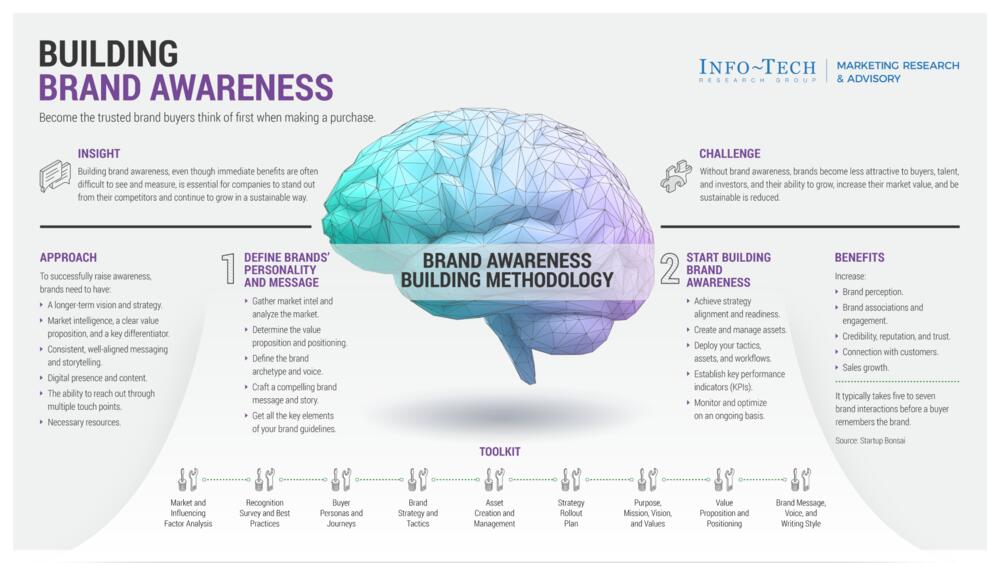
A two-step approach to building brand awareness, starting with defining the brand foundations and then implementing effective brand awareness strategies and tactics.
2. Define Brand's Personality and Message - Analyze your target market and develop key elements of your brand guidelines.
With this set of
tools, you will be able to capture and analyze your target market, your buyers and their journeys, define your brand's values, personality, and voice, and
develop all the key elements of your brand guidelines to enable people within
your organization and external resources to build a consistent and recognizable
image across all assets and platforms.
3. Start Building Brand Awareness - Achieve strategic alignment.
These tools will
allow you to achieve
strategic alignment and readiness, create assets and workflows, deploy tactics, establish
Key Performance Indicators (KPIs), and monitor and optimize your strategy on an
ongoing basis.
Workshop
Accelerate Business Growth and Valuation by Building Brand Awareness Workshop
Work with our analysts to accelerate this project using Info-Tech's proven workshop approach.
Module 1: Elicit Brand & Market Context
The Purpose
Uncover the brand mission, vision statement, core values, value proposition, and positioning.
Key Benefits Achieved
A clear value proposition and positioning are determined.
Activities
Outputs
1.1
Identify all buyer personas and determine the top 3.
Outputs
Identified top 3 buyer personas.
1.2
Gather market intelligence and relevant data.
Outputs
Current documented market intelligence.
1.3
Complete brand recognition survey (optional).
Outputs
Module 2: Analyze Market & Internal Forces
The Purpose
Gather market intelligence and analyze the market.
Key Benefits Achieved
Target market is identified and documented.
Activities
Outputs
2.1
Complete SWOT.
Outputs
Completed and documented market and competitive analysis
2.2
Complete PESTLE, Porter’s Five Forces.
Outputs
2.3
Complete VRIO analysis and Internal Factors.
Outputs
Identified competitive advantage
Module 3: Understand Target Buyers
The Purpose
Develop and document the buyer’s persona and journey
Key Benefits Achieved
Target audience is identified and
documented.
Activities
Outputs
3.1
Develop and document tier 1-3 buyer personas and journeys.
Outputs
Target market and audience are identified and documented.
3.2
Review the brand purpose, mission, vision statement, core values (optional).
Outputs
Module 4: Define the Brand
The Purpose
Define the brand’s archetype and tone of voice, then craft a compelling brand message.
Key Benefits Achieved
The brand personality, voice, and messaging are developed.
All the key elements of the brand guidelines are in place and ready to use, along with the existing logo, typography, color palette, and imagery.
Activities
Outputs
4.1
Develop value proposition and positioning.
Outputs
4.2
Develop brand messaging.
Outputs
4.3
Define the brand’s archetype and tone of voice.
Outputs
Module 5: Develop Strategy & Rollout Plan
The Purpose
Achieve strategy alignment and readiness.
Create assets and workflows and deploy tactics.
Establish key performance indicators (KPIs), monitor, and optimize
on an ongoing basis
Key Benefits Achieved
A comprehensive and actionable brand awareness strategy, with
tactics, KPIs, and metrics, is set and ready to execute.
A progressive and effective deployment plan with deliverables,
timelines, workflows, and checklists is in place.
Resources are assigned.
Activities
Outputs
5.1
Develop brand awareness tactics.
Outputs
Brand awareness strategy, with 1 complete tactic and associated KPIs, and metrics.
5.2
Map out strategy deployment and campaign workflow. Identify missing or out-of-date assets needed.
Outputs
5.3
Establish performance metrics and KPIs, RACI, and high-level timeline for rollout.
Accelerate Business Growth and Valuation By Building Brand Awareness
Develop and deploy comprehensive, multi-touchpoint brand awareness strategies to become the trusted brand that buyers think of first.
EXECUTIVE BRIEF
Analyst perspective
Building brand awareness
Achieving high brand awareness in a given market and becoming the benchmark for buyers is what every brand wants to achieve, as it is a guarantee of success. Building brand awareness, even though its immediate benefits are often difficult to see and measure, is essential for companies that want to stand out from their competitors and continue to grow in a sustainable way. The return on investment (ROI) may take longer, but the benefits are also greater than those achieved through short-term initiatives with the expectation of immediate, albeit often limited, results.
Brands that are familiar to their target market have greater credibility, generate more sales, and have a more loyal customer base. CMOs that successfully execute brand awareness programs build brand equity and grow company valuation.
Nathalie Vezina
Research Director
Marketing Advisory
Info-Tech Research Group
Executive summary
Brand leaders know that brand awareness is essential to the success of all marketing and sales activities. Brands that fail to invest in brand awareness are likely to face some, if not all these problems:
Lack of brand visibility and compelling storytelling.
Inability to reach the target audience.
Low engagement on digital platforms and with ads.
Difficulties generating and converting leads, or closing/winning sales/deals, and facing a high cost per acquisition.
Low/no interest or brand recognition, trust level, and customer retention rate.
Inability to justify higher pricing.
Convincing stakeholders of the benefits of strong brand awareness can be difficult when the positive outcomes are hard to quantify, and the return on investment (ROI) is often long-term. Among the many obstacles brand leaders must overcome are:
Lack of longer-term corporate vision, focusing all efforts and resources on short-term growth strategies for a quick ROI.
Insufficient market and target buyers' information and understanding of the brand's key differentiator.
Misalignment of brand message, and difficulties creating compelling content that resonates with target audiences.
Limited or no resources dedicated to the development of the brand.
Inspired by top-performing businesses and best practices, this blueprint provides the guidance and tools needed to successfully build awareness and help businesses grow. By following these guidelines, brand leaders can expect to:
Gain market intelligence and a clear understanding of the buyer's needs, your competitive advantage, and key differentiator.
Develop a clear and compelling value proposition and a human-centric brand messaging driven by the brand's values.
Increase online presence and brand awareness to attract and engage with buyers.
Develop a long-term brand strategy and execution plan.
"A brand is the set of expectations, memories, stories, and relationships that, taken together, account for a consumer's decision to choose one product or service over another."
– Seth Godin
What is brand awareness?
The act of making a brand visible and memorable.
Brand awareness is the degree to which buyers are familiar with and recognize the attributes and image of a particular brand, product, or service. The higher the level of awareness, the more likely the brand is to come into play when a target audience enters the " buying consideration" phase of the buyer's journey.
Brand awareness also plays an important role in building equity and increasing business valuation. Brands that are familiar to their target market have greater credibility, drive more sales and have a more loyal customer base.
Building brand awareness allows increasing:
Brand visibility, perception, recognition, and reputation
Interactions and engagement with the target audience
Digital advertising performance and ROI
Conversion rates and sales wins
Revenue and profitability
Market share and share of voice (SOV)
Talents, partners, and investors attraction and retention
Brand equity, business growth, and market valuation
"Products are made in a factory, but brands are created in the mind."
Source: Walter Landor
Capitalizing on a powerful brand
A longer-term approach for an increased and more sustainable ROI
Market leader position
Developing brand awareness is essential to increase the visibility and traction of a brand.
Several factors may cause a brand to be not well-known. One reason might be that the brand recently launched, such as a startup. Another reason could be that the brand has rebranded or entered a new market.
To become the trusted brand that buyers think of first in their target markets, it is critical for these brands to develop and deploy comprehensive, multi-touchpoint brand awareness strategies.
A relationship leading to loyalty
A longer-term brand awareness strategy helps build a strong relationship between the brand and the buyer, fostering a lasting and rewarding alliance.
It also enables brands to reach and engage with their target audience effectively by using compelling storytelling and meaningful content.
Adopting a more human-centric approach and emphasizing shared values makes the brand more attractive to buyers and can drive sales and gain loyalty.
Sustainable business growth
For brands that are not well established in their target market, short-term tactics that focus on immediate benefits can be ineffective. In contrast, long-term brand awareness strategies provide a more sustainable ROI.
Investing in building brand awareness can impact a business's ability to interact with its target audience, generate leads, and increase sales. Moreover, it can significantly contribute to boosting the business's brand equity and market valuation.
"Quick wins may work in the short term, but they're not an ideal substitute for long-term tactics and continued success."
Source: Forbes
This content is exclusive to members.
Sign up to continue reading the full blueprint, or sign in if you already have an account.
Our systems detected an issue with your IP. If you think this is an error please submit your concerns via our contact form.