Our systems detected an issue with your IP. If you think this is an error please submit your concerns via our contact form.
Master the AI Vendor Lifecycle
Make AI vendors earn their place.
As vendors rapidly add and update AI capabilities in enterprise software, they may dramatically change the costs, technical dependencies, data use, and risks of products that organizations already rely on. Yet organizations may continue investing without reassessing whether these capabilities still deliver enough value at an acceptable level of risk. This step-by-step research gives CIOs a repeatable, defensible approach to ensure AI-enabled capabilities continue to earn their place, as value, risk, and operating conditions evolve.
For CIOs, the challenge is maintaining oversight without creating an excessive review burden. Reassessing every change to an AI capability is impractical, but relying on only periodic reviews or contract renewals can allow significant changes to go unaddressed between assessments.
1. The original decision has a shelf life.
Pricing, usage, capabilities, alternatives, dependencies, and business requirements can change after an AI capability is adopted. When these changes undermine the assumptions that justified the original decision, organizations need to reassess whether the capability still delivers sufficient value at an acceptable level of risk.
2. Business outcomes do not equal vendor value.
AI outcomes depend on more than just the vendor’s capabilities. Implementation quality, data, adoption, and internal execution all influence results. Separating vendor contribution from project performance helps organizations understand what is driving results and make more informed decisions about their AI investments.
3. The evidence exists, but it is fragmented.
Procurement tracks contracts and pricing, business teams measure outcomes, technology teams monitor performance, and risk teams assess exposure. When this information is reviewed separately, organizations lack a complete picture of how their AI capabilities are performing and whether continued investment is justified.
Use this research to make evidence-based decisions throughout the AI vendor lifecycle.
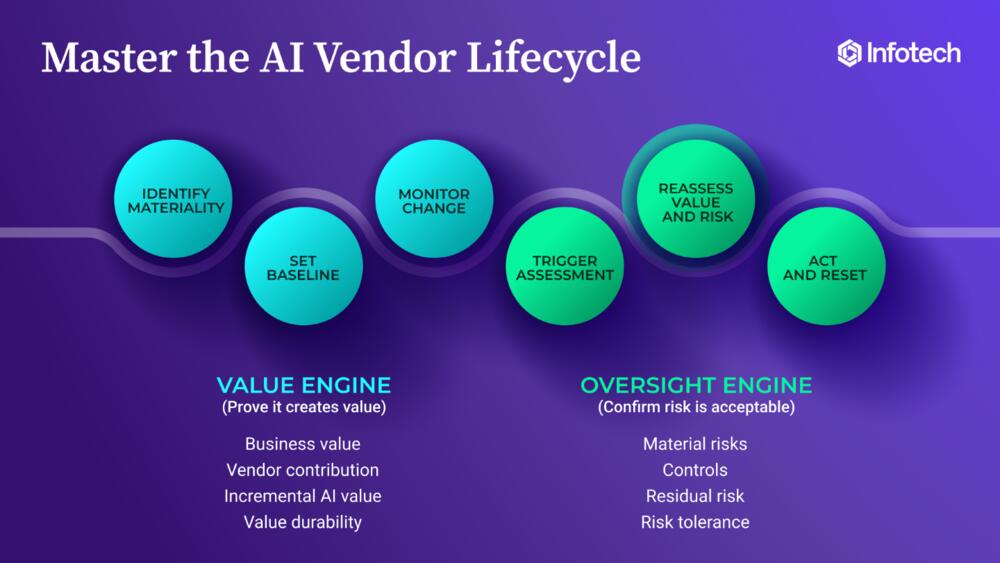
This practical methodology turns capability-level oversight into a closed-loop value and risk decision process. A value-risk decision matrix helps organizations identify the appropriate direction: whether to continue or expand an AI capability, address performance issues, reduce unacceptable risks, or discontinue its use. The research offers two approaches to suit different organizational needs: continuous monitoring for ongoing lifecycle management through six phases, and rapid assessment for a focused, point-in-time evaluation without the full monitoring cycle.
The continuous monitoring approach follows six phases:
- Identify AI materiality. Determine which AI capabilities require additional oversight based on their business impact, dependencies, and risk exposure.
- Establish the decision baseline. Document the expected value, service conditions, and risk assumptions supporting the current decision.
- Monitor for material change. Track changes in value, service performance, and risk that could affect the current decision.
- Trigger reassessment. Use defined thresholds to determine whether changes warrant a deeper review.
- Reassess value and risk acceptability. Evaluate realized business value, vendor contribution, and whether remaining risks are acceptable.
- Decide, act, and reset. Select the appropriate lifecycle action, assign accountability, and update the baseline for continued oversight.
Research & Tools
1. Master the AI Vendor Lifecycle Deck – Establish a repeatable, evidence-based approach to managing AI-enabled vendor capabilities as their value and risk change.
Use this research to:
- Establish defensible decision baselines that document expected value, service conditions, and risk assumptions.
- Identify material changes that warrant reassessment of existing AI capabilities.
- Explore how AI governance, SaaS/AI portfolio management, and third-party risk solutions support different aspects of the AI vendor lifecycle.
2. AI Vendor Lifecycle Continuous Monitoring Tool – Manage AI-enabled vendor capabilities throughout their lifecycle with an Excel-based workbook that supports ongoing oversight and decision-making.
With this tool, you can:
- Configure monitoring indicators and thresholds to identify changes that warrant reassessment.
- Evaluate realized business value, vendor contribution, incremental AI value, value durability, and residual risk.
- Document lifecycle decisions and follow-up actions to maintain a traceable record of vendor oversight.
3. AI Vendor Lifecycle Continuous Monitoring Tool With Populated Examples – Explore a completed reference workbook that demonstrates how to apply the continuous monitoring methodology to AI-enabled vendor capabilities.
Use the examples to:
- Understand how to document material AI capabilities, establish decision baselines, and configure monitoring indicators and thresholds.
- See how evidence flows through monitoring, reassessment, and lifecycle decisions.
- Review the expected level of detail and supporting information needed to apply the methodology in your organization.
4. AI Vendor Lifecycle Rapid Assessment Tool – An Excel-based resource for evaluating one vendor and up to five AI-enabled capabilities through a focused, point-in-time assessment.
With this assessment, you can:
- Determine which AI capabilities are material enough to require additional oversight.
- Compare capabilities based on their current value position and risk acceptability.
- Identify areas requiring attention and review recommended lifecycle directions to guide next steps.
5. AI Vendor Lifecycle Rapid Assessment Tool With Populated Examples – Learn how to complete a focused AI capability assessment using populated examples that demonstrate the process and expected inputs.
Explore the examples to:
- Understand how to document capability materiality, value position, and risk acceptability.
- See how assessment results translate into a recommended lifecycle direction.
- Review the level of detail required to complete your own assessments consistently.