Oracle Analyst Summit 2026: Integrating AI Data Platform, Fusion Data Intelligence and OCI Enterprise AI
Oracle's 2026 Analyst Relations Summit, held in San Francisco on May 5, 2026, covered the full Oracle Analytics and AI stack across several sessions, and also included a keynote by Srikant Gokulnatha, a customer panel, and a partner panel with KPMG, Apps Associates, and Accenture. One argument carried through every session: AI value in the enterprise depends on comprehensive governance rather than model selection, and Oracle creates a governance layer running across their AI Data Platform, Fusion Data Intelligence and Oracle Cloud Infrastructure.
Comprehensive Governance Is the AI Differentiator
Oracle Cloud Infrastructure (OCI) Enterprise AI provides the shared semantic layer spanning across the other two platforms:
- AI Data Platform (AIDP),
- Fusion Data Intelligence (FDI).
The shared semantic layer enables consistency of agentic AI use at scale, e.g. when business units use different methods to calculate the same metric, no AI model can produce trustworthy outputs, let alone hundreds of AI agents built by various business units. Oracle solves this problem at the platform level.
Two customer case studies backed up this approach with their actual implementation experiences:
- A customer in the aerospace industry with approximately $8.3 billion in 2025 revenue, reduced companywide workforce turnover from 19.3% in 2023 to 14.4% in 2025 after standardizing workforce metrics across four previously inconsistent business units using Oracle Fusion Data Intelligence.
- A vertically integrated housing construction company operating across 40-plus facilities automated profit and loss distribution across more than 400 locations and transitioned financial consolidation from spreadsheets to Oracle Financial Consolidation and Close.
Both customers confirmed that data and platform governance must be in place before AI readiness becomes a productive conversation.
Note: All figures cited were supplied by Oracle and are unaudited by Info-Tech Research Group.
OCI Enterprise AI Platform: Three Layers
Oracle Cloud Infrastructure (OCI) has been transformed into an Enterprise AI platform that is organized into three integrated layers.
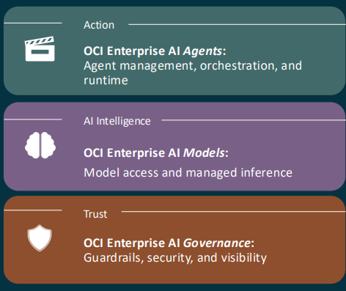
Image © Oracle
The Governance layer provides runtime guardrails, central policy management, dedicated AI clusters, sovereign AI support, access control, and visibility tools to ensure agents can be deployed with trust.
The Models layer provides access to multiple leading models through a managed inference service with smart routing that can choose the best model for a request and help manage consumption.
The Agents layer provides capabilities, tools, frameworks, and protocols to build end-to-end agentic workflows.
The agent runtime ships with eight hosted tool categories: web search, semantic file search, sandboxed code execution, container-hosted custom tools, schema-aware SQL generation against Oracle databases, managed retrieval-augmented generation, short-term compression and long-term memory for agent continuity, and an API gateway for external service integration.
The Agent Lifecycle supported by the new OCI Enterprise AI platform is built around a strong Governance core.
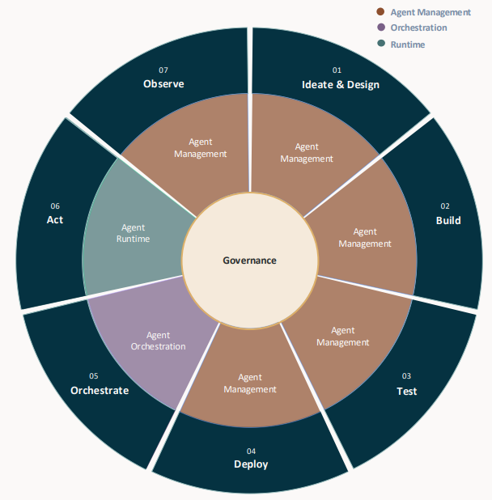
Image © Oracle
This Governance core controls and helps orchestrate Agent Management, Agent Orchestration, and Agent Runtime. This core is supposed to be integrated with the Governance core in the AI Data Platform and Fusion Data Intelligence.
AI Data Platform: Smart Data Repository for the Whole Enterprise
The AI Data Platform (AIDP) is based on the Lakehouse data repository and enables use of Delta Lake and Iceberg formats.
The AIDP is positioned to provide common semantics for the whole enterprise via a comprehensive data catalog, which enables consistent semantic correlation across numerous data sources, data security, and access control, and provides data lineage. The catalog works equally well across structured and unstructured data. The AIDP can integrate with third-party catalogs.
The same Catalog is used for AI and ML assets. Sometimes, Oracle refers to this catalog as “AI Registry,” but other parts of the same seem to be in both OCI and FDI.
The catalog also supports Agent2Agent (A2A) and Model Context Protocol (MCP), providing the foundation to create sophisticated multiagent systems.
Fusion Data Intelligence: Rich Packaged Analytics
Fusion Data Intelligence (FDI) is a suite of insight applications with embedded AI, prebuilt models, and packaged analytics spanning Fusion ERP, Fusion HCM, Fusion SCM, and Fusion CX. All four use embedded AI to provide easy-to-build and use advanced analytics for the core Fusion Enterprise Applications. The innovation: instead of building isolated solutions for each enterprise application, Oracle is building a suite of custom solutions (AI agents) based on the same infrastructure (OCI), data, and semantics (AIDP).
Partner Ecosystem Signals Growing Practice Investment
The partner panel featured KPMG, Apps Associates, and Accenture. All three firms are investing in Oracle Analytics and OCI AI practice capacity. All three pointed to customer readiness as the implementation bottleneck – product functionality was not the constraint they kept hitting. Clean data, governed definitions, and organizational alignment on what a successful outcome looks like are prerequisites that most organizations still need to build. KPMG's presence as both a consulting partner and an Analytics Challenge finalist (Rudy Juarez from KPMG built the exoplanet discovery visualization using NASA data) signals practitioner depth inside the Oracle practice beyond business development posture.
What CIOs and CTOs Need to Remember
- Organizations already running Oracle Fusion ERP or HCM should evaluate Oracle Fusion Data Intelligence as the first analytics investment before committing to other AI agents.
- Organizations considering OCI Enterprise AI as an agentic platform should conduct a structured pilot against a specific workflow before making architectural commitments. Request audited performance data and routing logic documentation before signing.
- Enterprises in regulated industries (financial services, healthcare, utilities) should evaluate Oracle's governance layer as a primary selection criterion rather than a checklist item. The roadmap items addressing runtime guardrails, agent workflow controls, and cost governance are designed for this buyer.
Our Take
Oracle's trajectory over three years of analyst summits has a clear arc. In 2023, the answer to how Oracle would grow adoption was simply its installed base. In 2024, Oracle began announcing connectors to Databricks Delta Lake, Snowflake, Google BigQuery, Amazon Redshift, SQL Server, IBM DB2, SAP HANA, Sybase, and Teradata, acknowledging that enterprises do not run on Oracle data alone. By 2026, Oracle is actively embracing open-source platforms including PostgreSQL, MySQL, Apache Cassandra, Apache Kafka, and MongoDB. This is a real strategic shift: a company that once relied on proprietary formats is now competing on integration breadth and governance depth instead of data custody.
Oracle's structural advantage remains its end-to-end stack. Few vendors control hardware, database, application suite, business workflow, and last-mile publishing in a single architecture with consistent semantics throughout. AI embedded at this layer, with semantic consistency enforced from the ERP transaction to the analytics dashboard to the agent action, is a real point of differentiation. The question is whether enterprises are willing to accept the concentration risk that comes with it.
The appointment of Federico Torreti, formerly of AWS, as Vice President of AI Product for Oracle Cloud Infrastructure approximately 18 months ago reflects Oracle's recognition that its AI go-to-market message was fragmented. The three-layer OCI Enterprise AI architecture (Models, Agents, Governance) is the output of that strategic consolidation work.
However, despite the repetitive mantra about governance being the integrating layer across OCI, AIDP, and FDI, there was little evidence presented of a truly unified governance – e.g. semantics and metadata managed in AIDP are disjoint from the governance pieces embedded in OCI and FDI. Admittedly, Oracle has the right potential to make it happen – and to advance to the next level of becoming a macro-agentic AI platform capable of connecting other agentic AI platforms – not just individual agents.
Among the data analytics and agentic AI platforms, Oracle has the longest and deepest experience with building ontologies and graphs – they now need to apply this experience to create a multifaceted, multilayered, but fully unified governance and semantics layer, which would not only bring together OCI, AIDP, and FDI, but would set the standard for a cross-AI-platform registry.
Connecting different and competing agentic AI platforms within a single enterprise will require five capabilities to comprise the Enterprise Agentic AI Governance Framework:
- Enterprise capabilities the agents are supposed to enhance/enable (BCM expressed as ontology)
- Enterprise semantic/conceptual model (ontology)
- Semantic correlations (knowledge graph)
- Business rules, policies, and constraints (context graph)
- External and internal regulations the agents must abide by