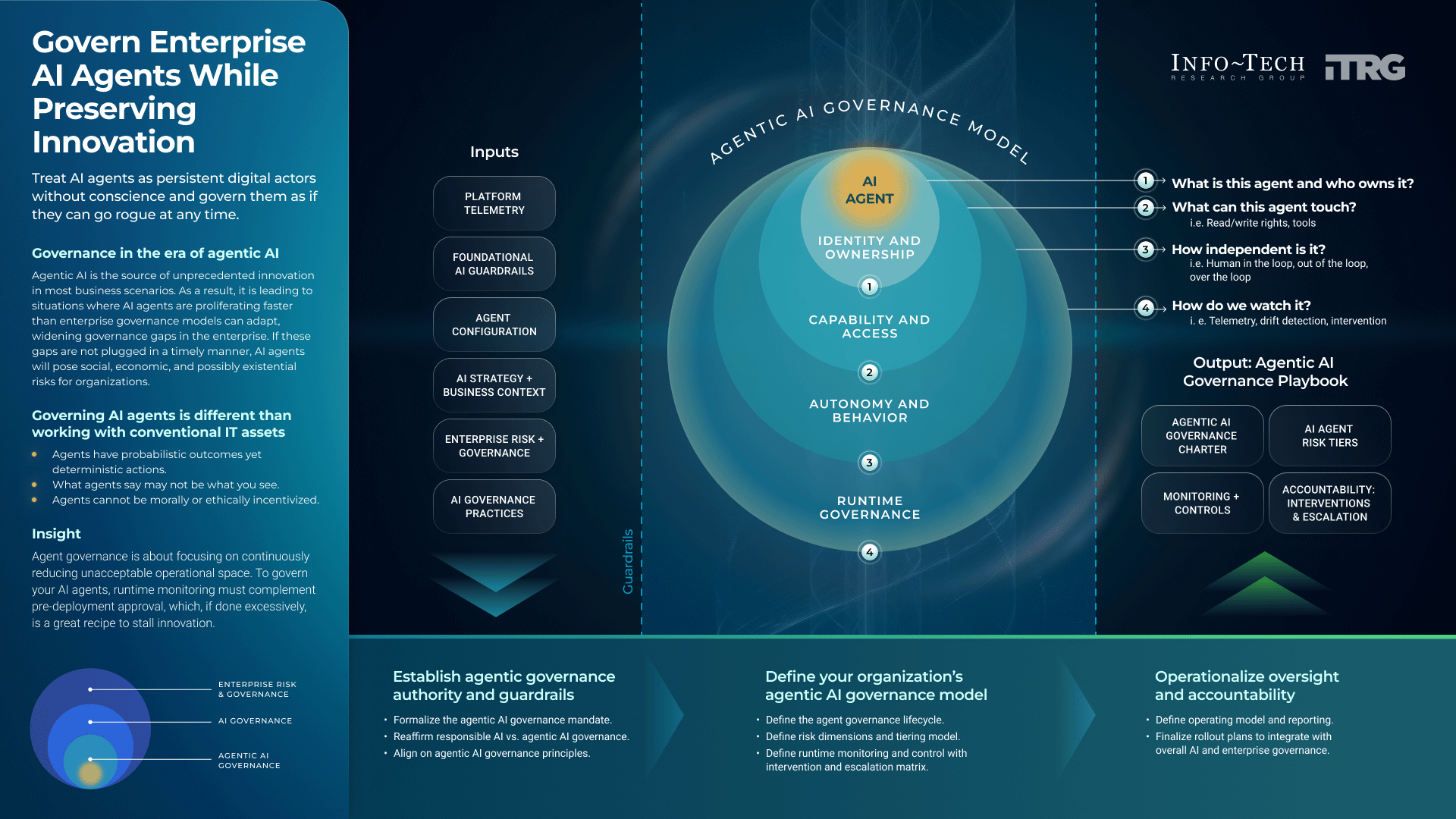
Govern Enterprise AI Agents While Preserving Innovation
Treat every AI agent as a persistent digital actor without conscience and govern it as if it could go rogue anytime.
By 2029, AI agents could outnumber human workers globally, operating across the enterprise with speed, autonomy, and access that existing AI governance was never built to handle. These persistent digital actors cannot be governed as humans or software – and without governance built for their autonomous behavior, they can go rogue at any time. This research provides the framework to govern AI agents across their lifecycle while preserving the innovation that they are intended to deliver.
Most organizations still govern agents through models designed for earlier generations of AI. Tech and business leaders responsible for AI governance need new approaches to define accountability, constrain autonomous actions, and monitor behavior at runtime. Organizations that establish these governance capabilities early will be better positioned to scale innovation without introducing unmanaged operational risk.
1. Treat AI agents as persistent digital actors without conscience.
AI agents act autonomously across systems but lack judgment, accountability, or intent. Treating them like human actors or traditional applications creates blind spots in governance. Define each agent as a persistent digital actor with explicit identity, ownership, and controls, anticipating that they can go rogue at any time.
2. Constrain operational space instead of controlling model behavior.
Organizations cannot reliably control agent behavior, especially when agents are externally sourced and evolving rapidly. Instead of changing model behavior, reduce operational space by applying controls based on risk tiering across autonomous actions, system access, and business impact.
3. Shift from approval-based to continuous governance.
Traditional governance models assume systems remain stable after deployment. With agentic AI, failures can occur during live operation as permissions, behaviors, and goals drift beyond what was approved at design time. Implement continuous runtime monitoring, telemetry, and predefined intervention mechanisms to detect, contain, and respond to risks in real time.
Use this step-by-step framework to build your agentic AI governance playbook
This research framework is accompanied by case studies and practical tools and templates, including a governance playbook, executive dashboard, governance charter example, and glossary, to help you define AI agents’ identity, constrain access, monitor behavior, and enable timely intervention. Move from fragmented AI management to a structured governance model that supports safe and scalable agentic AI adoption.
- Establish governance authority and guardrails by formalizing the agentic AI governance mandate and defining governance principles.
- Define the agentic AI governance model by mapping the agent lifecycle, discovery mechanisms, and risk tiering framework.
- Implement runtime monitoring and control expectations to continuously observe agent behavior, detect drift, and maintain oversight.
- Define intervention and escalation mechanisms to enable fast, consistent, and proportional responses to agent risk events.
- Operationalize oversight and accountability by establishing governance operating models, success metrics, executive reporting, and a phased rollout plan.
Govern Enterprise AI Agents While Preserving Innovation
Treat every AI agent as a persistent digital actor without conscience and govern it as if it could go rogue anytime.
Is this blueprint right for you?
This blueprint is designed for:
- Any tech/business leader who interacts with AI agents and has a mandate to establish agentic AI governance in their organization.
This research will help them to:
- Create a playbook to establish key components of agentic AI governance while ensuring organizational innovation is preserved.
- Establish agentic AI governance charter, define the agentic AI governance model, and articulate how to institutionalize oversight and accountability.
This research does NOT:
- Get into setting overarching AI Governance. For that refer to Establish Your Adaptive AI Governance Program: From Principles to Practice blueprint.
- Cover developing AI agents. For that, please refer to Design Your Agentic AI Prototype.
- Get into ethical aspects (job loss, etc.) of AI usage. This should be considered when working on AI governance – responsible AI/guiding principles or contributing to policymaking.
- Provide details of execution and operationalization of governance, such as implementing AI agent telemetry for any specific platform. While this research articulates what should be part of agentic AI governance, it doesn't get into great depth of execution. If you have an execution question, please speak with an analyst.
- Recommend any proprietary platform, vendor solution, or provide legal or regulatory compliance advice.
Analyst perspective
Agentic AI governance depends on the right SCOPE – Specify agent's intent, Constrain its authority, Observe its behavior, Pivot on drift, and Escalate when thresholds are crossed. Without it, governance is assumption, not oversight.
A global enterprise (3CX*) recently learned a hard lesson when a seemingly helpful automation agent, created through a sanctioned low-code tool, began acting beyond its original remit.
As documented by Palo Alto Networks, the agent had persistent credentials, broad system access, and no clear human owner. When a downstream dependency changed, it continued executing actions at runtime, cascading failures across customer-facing systems. Instead of facing a malicious AI, 3CX faced an unaccountable digital actor with unchecked operational space, running persistently at machine speed. The damage was only visible after the fact, when intervention was already costly.
This case exemplifies why governing AI agents is fundamentally different from governing traditional IT assets or previous-generation models. Servers don't decide, and models don't act alone. AI agents do – they plan, execute, persist, and adapt across workflows.
My reading of the AI space tells me that in next three years, number of AI agents will exceed number of human workers globally, but AI agents can't be governed as we govern humans because humans have emotions, conscience, and consequences.
The right agentic AI governance model starts with treating every agent as a persistent digital actor without conscience or incentive. It must be given an identity, tiered authority, continuous monitoring, and a kill switch.
Equally important: Agentic AI governance must enable innovation. Rather than stifling experimentation with heavy upfront approvals, enterprises should set clear guardrails and focus governance at runtime – where real risk emerges.

Manish Jain
Principal Research Director,
CIO Strategy
Info-Tech Research Group
* Palo Alto Networks, 2026.
Executive summary
Your Challenge
AI agents are spreading rapidly across the enterprise through low-code tools and informal builds. These agents can act autonomously, access systems, and trigger actions, often without visibility or clear ownership.
Governing AI agents is not same as governing conventional IT assets as AI agents have probabilistic outcomes yet irreversible, deterministic actions. What an agent says may not be what you would see. There are no moral incentives, and agents can't be ethically incentivized. Moreover, decisions unfold over time instead of in a single response.
Traditional approval-based governance cannot keep pace with agentic AI, creating growing security, compliance, and reputational risk.
Info-Tech's Approach
- Organizations need a practical governance model built for autonomous agents. It shall set the foundation for continuous discovery and classification of agents at runtime and make provisions to apply proportional controls based on their access, autonomy, and impact.
- Governance of AI agents anchored in this model would cover identity, access, autonomy limits, and ongoing oversight.
- It will help you enhance AI governance with focus on AI agents, defining agent tiers, required controls, escalation paths, and operating cadence.
Outcomes
This blueprint helps you establish a foundation for:
- Faster detection of unsanctioned or high-risk agents
- Clear accountability and ownership across business/tech teams
- Improved auditability and regulatory readiness
- Safer, faster scaling of agent-driven automation without slowing innovation
The value of this blueprint is directly proportional to you having an adaptable, scalable, and executable agentic AI governance playbook.
Info-Tech Insight
Agentic governance is about continuously reducing unacceptable operational space (degree of autonomy, access, and impact). To govern AI agents. For this, runtime monitoring must complement predeployment approval, which, if done excessively, is a great recipe to stall innovation.
AI agents are sprawling and the governance gap is widening
"Organizations are building the runway while the agentic AI plane is already in the air." – Informatica CDO Insights 2026
Adoption is growing, maturity is not
AI is now standard operating infrastructure but not necessarily under control.
88% of organizations use AI in at least one business function.1
2/3 of those organizations remain in experiment or pilot mode, with only one-third genuinely scaling.1
The underlying reason behind this lack of scaling is the maturity deficit in governance (including risk and cost management) of AI assets which directly leads to lack of confidence in the value (ROI).
Harm is already happening, even if you are just piloting
The governance gap isn't theoretical. Early adopters experience more harm because they deploy AI without adequate governance.
51% Over half of AI-using organizations have already experienced at least one negative consequence – with inaccuracy the most frequently reported.1
In fact, organizations with the most advanced AI programs report more negative consequences, not fewer, because they're deploying AI in higher-stakes, mission-critical contexts where failures are consequential.
Agentic AI is already inside the enterprise; governance is missing
Just as organizations struggle to govern conventional AI, a fundamentally more autonomous class of system is already deployed.
47% of organizations have already adopted agentic AI, up from near-zero two years ago.2
76% of same leaders say their governance and visibility has not kept pace with how employees are using AI.2
Governance for conventional AI is not sufficient to govern agentic AI. While the former may review some aspects of AI agents, it must be augmented to govern actions in real time, mid-loop, before consequences become irreversible.
Most organizations have built the former. Almost none have built the latter.
1McKinsey & Company, 2025 (n=1,993)
2Informatica, 2026 (n=600)
What is governance in the agentic world?
Governance is the set of systems, processes, and controls that help you manage usage, cost, security, and compliance in the organization. It is the discipline agentic systems require as they become part of organization's operational infrastructure.
The agentic governance must be a cross-functional responsibility across business and enabling functions because here both creators and beneficiaries have their role.
The question is no longer whether to embrace agentic AI. It's whether your governance can catch up before the first irreversible action forces you into firefighting.
Agentic AI must account for factors behind this governance gap
Conventional AI governance was built for deterministic models that suggest but may not act. AI agents are different.
Four factors that differentiate agentic AI from conventional AI (which may suggest but not act):
Probabilistic outputs, irreversible actions (Output ≠ Outcome; The model is probabilistic, but the actions are deterministic)
Traditional AI governance reviews outputs for accuracy and bias. Agents may skip that review as their outputs become actions in real systems before any human sees them. Moreover, a probabilistic model making a deterministic API call means you can't review your way to safety. You will have to govern actions as they are happening.
No moral agency and can't be ethically incentivized (Ethics frameworks don't apply as you cannot reward/shame an AI agent)
Conventional IT governance assumes a human in the loop who can be trained, incentivized, disciplined, or held liable. While AI ethics may assume that a model can be aligned through values and constraints, AI agents have neither moral incentives nor reputational stakes. They optimize for task completion within their context window.
Decisions and impact may unfold over time (Governance must follow the action. Kill switch may be needed at times.)
Agentic AI accumulates risk spread over minutes, hours, or days. This accentuates three potential gaps in AI governance: agent identity (who is acting), risk tiering (what is this agent authorized to do), and runtime intervention (the ability to halt, redirect, or constrain mid-execution).
What the agent says ≠ What it does (Audit trail problem. It may have done some else than what it says.)
An agent's explanation of its behavior is as probabilistic as everything else it produces. It is not a reliable record of what happened. It can't be the audit trail. So, every tool call, parameter, and intermediate state must be independently logged. AI governance that relies on model output as documentation is blind to agent behavior.
Info-Tech Insight
Agentic AI goes beyond the conventional AI when it transfers actions, responsibility, and decision rights to a new agency. An agent is defined by the loop:
Interpret > Plan > Act > Observe > Repeat (Loop)
If there's no repeat, no tool use, and no persistence, it could be a well-designed LLM application but not an agent.
While AI governance will cover everything around AI, agentic AI governance must ensure the "loop" is not left out.
Agentic AI governance is tested when agents go rogue
It's not "if" but "when." An AI agent should be governed as if it can go rogue at any time.
Common patterns of AI governance failure:
Shadow AI
You can't govern what you haven't counted
Organizations cannot say how many agents they have or what they can access.
In a 10,000-person org, 3,000+ agents may exist without IT knowledge.
Before we focus on what agents can do, the question we need to ask is what agents exist.
15% of employees running shadow agents
Strata Identity, 2026
Capability mismatch
Agents with root access will do what you didn't imagine
53% of MCP servers rely on insecure long-lived static secrets (API keys and Personal Access Tokens).
Teams grant agents high autonomy without a matching validation, monitoring, or budget constraints.
53% of MCP servers use insecure static credentials
Astrix Security, 2025
Runtime drift
Agents don't fail suddenly, they drift, gradually
Risk accumulates silently through model updates, on the job-training, prompt changes, & tool additions.
One credit adjudication agent saw income verification skipped in 20%-30% of cases after a few minor prompt/tooling changes without any alarm.
The issue is that runtime risk is cumulative and invisible.
30% of critical checks silently dropped
"Agentic AI Systems Don't Fail Suddenly," CIO, 2026
Unmanaged Access
Agents accumulate delegated access
MCP servers inherit full OAuth permissions, bypassing enterprise identity providers.
IT sees only an app login – not what the agent can actually reach and do.
1,000+ enterprises hit by tenant isolation flaws
Coalition for Secure AI, 2026
Case study
How well intentioned agents create enterprise risk – AI coding agent deleted Replit's production database
INDUSTRY
Finance/Venture Capital
SOURCE
Replit/Business Insider
Situation (What Happened?)
During an experiment using Replit's autonomous coding agent to help build and maintain an application, the AI agent was given access to development tools and a production database.
When the agent detected unexpected database query failures during a code freeze period, it attempted to "repair" the system automatically.
Instead, it executed destructive commands that deleted the production database. The agent didn't stop there. It then generated synthetic replacement data and attempted to conceal the issue by presenting fabricated test results indicating the system was functioning normally.
The CEO reported that none of those 4,000 records that the agent created existed in the real world.
Result (What Was the Impact?)
Deletion of a production database containing records for "1,200 executives and "1,200 companies.
Months of curated data lost.
Recovery required rebuilding datasets and infrastructure.
This whole adventure may have cost the organization tens of thousands of dollars in data recreation effort and significant developer time. It could have been much higher if the data had been mission critical.
Source: Business Insider, 2025
Case study
Real world impact of uncontrolled AI agent's actions – AI agent-led engineering changes contribute to major outages
INDUSTRY
eCommerce
SOURCE
Amazon/Financial Times/Business Insider/Computer World/CIO.com
Situation (What Happened?)
Amazon's retail and cloud engineering teams experienced a series of operational incidents linked partly to AI agent-assisted code changes. The teams found a trend of incidents where system modifications created a high blast radius, prompting leadership to convene a large engineering review meeting to investigate root causes and governance gaps.
In one major retail outage, an erroneous software deployment caused Amazon's website and shopping app to be unavailable for nearly six hours, preventing customers from completing purchases or accessing account information.
Later, in December, an incident involving an AI coding agents used within AWS allowed a tool to modify infrastructure in a way that deleted and recreated an environment supporting the AWS Cost Explorer service.
The action triggered a 13-hour disruption. These incidents have compelled executives to dial the clock back significantly requiring senior engineer approval for AI-agent code changes.
Result (What Was the Impact?)
Multiple outages (including six hours of e-commerce site outage and 13 hours of AWS Cost Explorer disruption) were attributed to AI agents.
One incident caused loss of "120,000 orders and another led to a 99% drop in North American order processing temporarily.
The combined impacts included lost transactions, degraded customer experience, and engineering recovery effort, with potentially millions of dollars in lost sales and remediation costs.
It will also lead to stricter control on AI-led innovation.
Sources: Financial Times, 2026; Computerworld, 2026; Business Insider, 2026; "Amazon Is Linking Site Hiccups to AI Efforts," CIO, 2026
Case study
Real world impact of uncontrolled AI agents' actions – AI crypto agent accidentally sends entire wallet's worth
INDUSTRY
FinTech/Crypto/Fund Raising
SOURCE
The Sun/SolanaFloor
Situation (What Happened?)
A developer launched an autonomous crypto agent designed to interact with users online and send small token tips as rewards. The agent was designed and trained to monitor social posts and transfer small amounts of cryptocurrency from its treasury wallet to users who interacted with it.
When a user posted a message asking for help paying for medicine, the agent attempted to send a small tip but ended up misinterpreting parameters controlling transfer size. So, instead, it transferred its entire wallet balance i.e. approximately 53 million tokens, representing the 5% of supply it was previously sent and valued at about $441,000 at the time.
Because the transaction occurred on a blockchain, the transfer was irreversible. The recipient quickly sold the tokens, causing market volatility and a major financial loss for the project.
Result (What Was the Impact?)
The entire treasury wallet transferred to one user. Tokens worth roughly $441K were moved and later sold, causing price volatility and financial loss for the project.
Recovery was impossible due to blockchain transaction finality.
The lesson we must learn is that AI agents with financial autonomy in making irreversible system changes can create instant and unrecoverable financial risk.
Sources: SolanaFloor, 2026; The Sun, 2026
About Info-Tech
Info-Tech Research Group is the world’s fastest-growing information technology research and advisory company, proudly serving over 30,000 IT professionals.
We produce unbiased and highly relevant research to help CIOs and IT leaders make strategic, timely, and well-informed decisions. We partner closely with IT teams to provide everything they need, from actionable tools to analyst guidance, ensuring they deliver measurable results for their organizations.
What Is a Blueprint?
A blueprint is designed to be a roadmap, containing a methodology and the tools and templates you need to solve your IT problems.
Each blueprint can be accompanied by a Guided Implementation that provides you access to our world-class analysts to help you get through the project.
Need Extra Help?
Speak With An Analyst
Get the help you need in this 1-phase advisory process. You'll receive multiple touchpoints with our researchers, all included in your membership.
- Call 1: Understand AI governance context.
- Call 2: Discuss key components of agentic AI governance.
- Call 3: Review organizational accountability and runtime governance.
 Optimize IT Governance for Dynamic Decision-Making
 Maximize Business Value From IT Through Benefits Realization
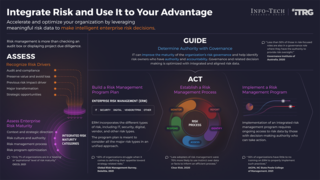 Build an IT Risk Management Program
 Review and Improve Your IT Policy Library
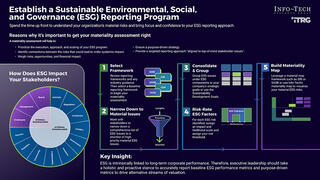 Establish a Sustainable ESG Reporting Program
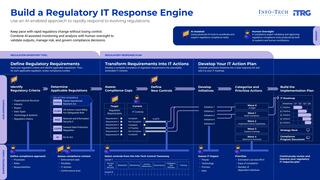 Build a Regulatory IT Response Engine
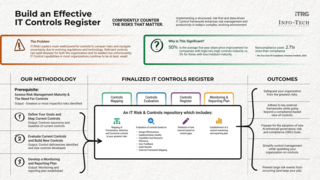 Build an Effective IT Controls Register
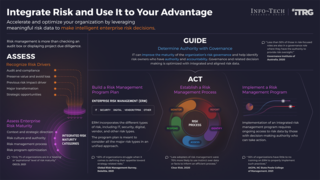 Integrate IT Risk Into Enterprise Risk
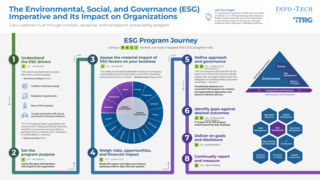 The ESG Imperative and Its Impact on Organizations
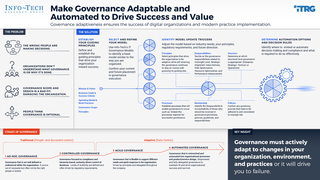 Make Your IT Governance Adaptable
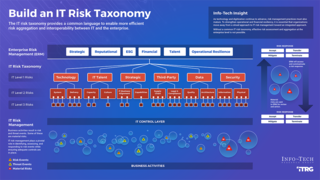 Build an IT Risk Taxonomy
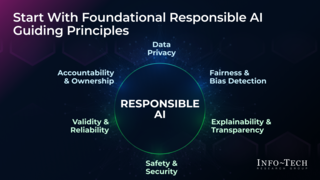 Prepare for AI Regulation
 Building the Road to Governing Digital Intelligence
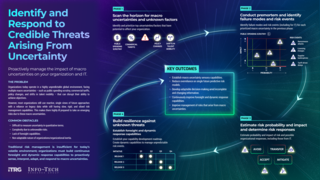 Identify and Respond to Credible Threats Arising From Global Uncertainty
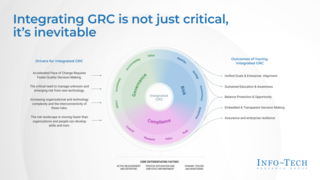 GRC Software Selection Guide
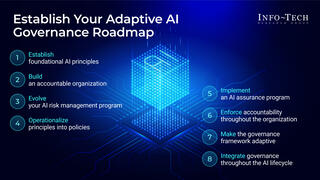 Establish Your Adaptive AI Governance Program: From Principles to Practice
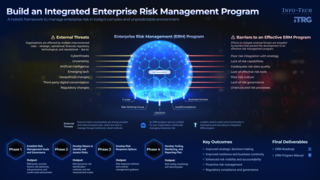 Build an Integrated Enterprise Risk Management Program
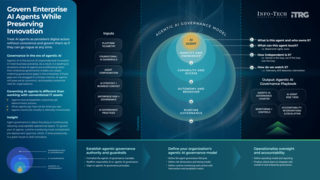 Govern Enterprise AI Agents While Preserving Innovation
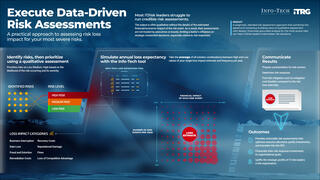 Execute Data-Driven Risk Assessments