Defend Against Defects and Technical Debt in Your AI-Generated Code
Establish guardrails that keep AI‑generated code understandable, maintainable, and production‑ready.
AI-generated code accelerates software delivery but can also accelerate the spread of defects and technical debt across the software development lifecycle (SDLC). Development teams need governance standards and human accountability to ensure AI-assisted development remains secure, maintainable, and aligned with business objectives. Our research helps organizations operationalize AI-generated code responsibly by embedding guardrails directly into development workflows.
Organizations are under growing pressure to increase developer productivity and delivery with AI-generated code. But unmanaged adoption creates quality and security issues that surface only during production. For development teams, the challenge is balancing faster development with disciplined oversight that supports long-term maintainability.
1. Define the problem before using AI.
AI writes code fast but does not understand business context, constraints, or trade-offs. When the intent is unclear, AI optimizes for the wrong outcome and does not solve the real problem. Start with a clear problem definition so AI solves the work your team is accountable for.
2. Embed guardrails directly into development workflows.
Without validation, AI tools may produce unnecessary complexity and hidden risks. Weak prompting practices increase technical debt and operational risk over time. Reinforce prompt engineering standards and code review into your workflows to reduce defects and rework.
3. Keep humans accountable for AI-assisted development.
AI-generated code introduces new categories of errors because the technology lacks understanding of long-term operational impact. Maintain strong human oversight and measurable controls to ensure AI-assisted development does not compromise maintainability or security.
Use this step-by-step framework to put guardrails around your AI-generated code.
This research offers a practical framework, accompanied by an AI Code Quality Starter Kit, to help organizations establish clear guardrails for the responsible use of AI-generated code.
- Establish tool usage by defining AI scope across the development process and the motivation for its use.
- Define your necessary guardrails by establishing prompting standards and practices.
- Roadmap your development milestones by setting objectives and success metrics using a Now, Next, Later plan.
INFO~TECH RESEARCH GROUP
Defend Against Defects and Technical Debt in Your AI-Generated Code
Establish guardrails that keep AI‑generated code understandable, maintainable, and production‑ready.
Analyst Perspective
AI accelerates delivery; discipline preserves quality.
A common concern among junior software developers is that they’ll be made obsolete by artificial intelligence; 66% of developers worry about AI replacing humans in development workflows (Boundev Team, 2026). But the risk isn’t that developers become irrelevant, it’s that teams start treating generated output as a completed product.
AI will almost always solve a problem faster than a developer, but it does not always solve a problem correctly within a specific context. Speed is not the same as understanding. In practice, AI can generate code that looks right but quietly breaks requirements, violates architectural constraints, or introduces security and maintenance risk.
AI is here to stay. The real question is not whether you use it but whether you use it responsibly. By implementing necessary guardrails on your AI tools, you can ship reliable products and put your developers in the best place to succeed.

Caleb Pittman
Research Specialist, Applications Delivery and Management
Info-Tech Research Group
Executive summary
Your Challenge
- AI makes defects and technical debt less visible. AI-generated code can look polished and complete, which reduces healthy skepticism and delays the discovery of issues until later in the cycle.
- AI scales complexity and bad decisions faster than teams can correct them. Small prompting gaps and weak constraints get amplified into repeated patterns across features, making rework and refactoring more expensive over time.
- AI can erode consistency across the codebase. When AI produces code without a consistent set of nonfunctional requirements and coding standards, inconsistent security, performance, and reliability become embedded.
Common Obstacles
- Developers overrely on AI-generated output. Teams can treat AI-generated code as correct by default, reviewing it less rigorously than code written by humans.
- Organizations lack clear constraints and guardrails for AI use. Without explicit requirements, standards, and boundaries, AI-generated code may reflect implicit assumptions rather than deliberate design decisions.
- Coding standards are enforced inconsistently. When standards are applied unevenly or bypassed for AI-generated code, quality varies across teams and defects accumulate in ways that are hard to detect and correct.
Info-Tech’s Approach
The solution isn’t to use AI less but to use it responsibly:
- Establish how you’ll use AI-generated code in your codebase. Clearly define where and how AI-generated code will be implemented within the software development lifecycle (SDLC).
- Implement necessary protections. Reinforce nonfunctional requirements and define prompting standards.
- Create a roadmap. Define a clear Now, Next, Later plan that translates guardrails and standards into concrete actions and adoption milestones.
Info-Tech Insight
AI-generated code increases the likelihood that defects and technical debt will accumulate faster. Put AI behind guardrails with explicit constraints and verification checks. Without these necessary guardrails, faster code delivery just means faster debt delivery.
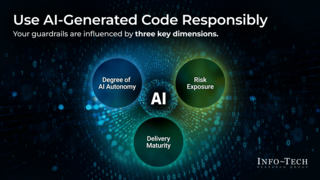
Use AI-generated code responsibly
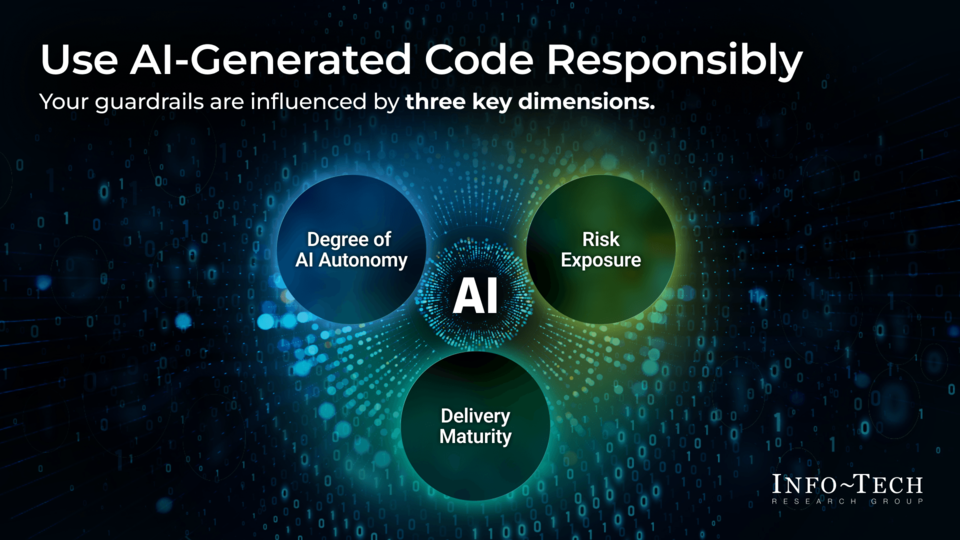
Your guardrails are influenced by three key dimensions.
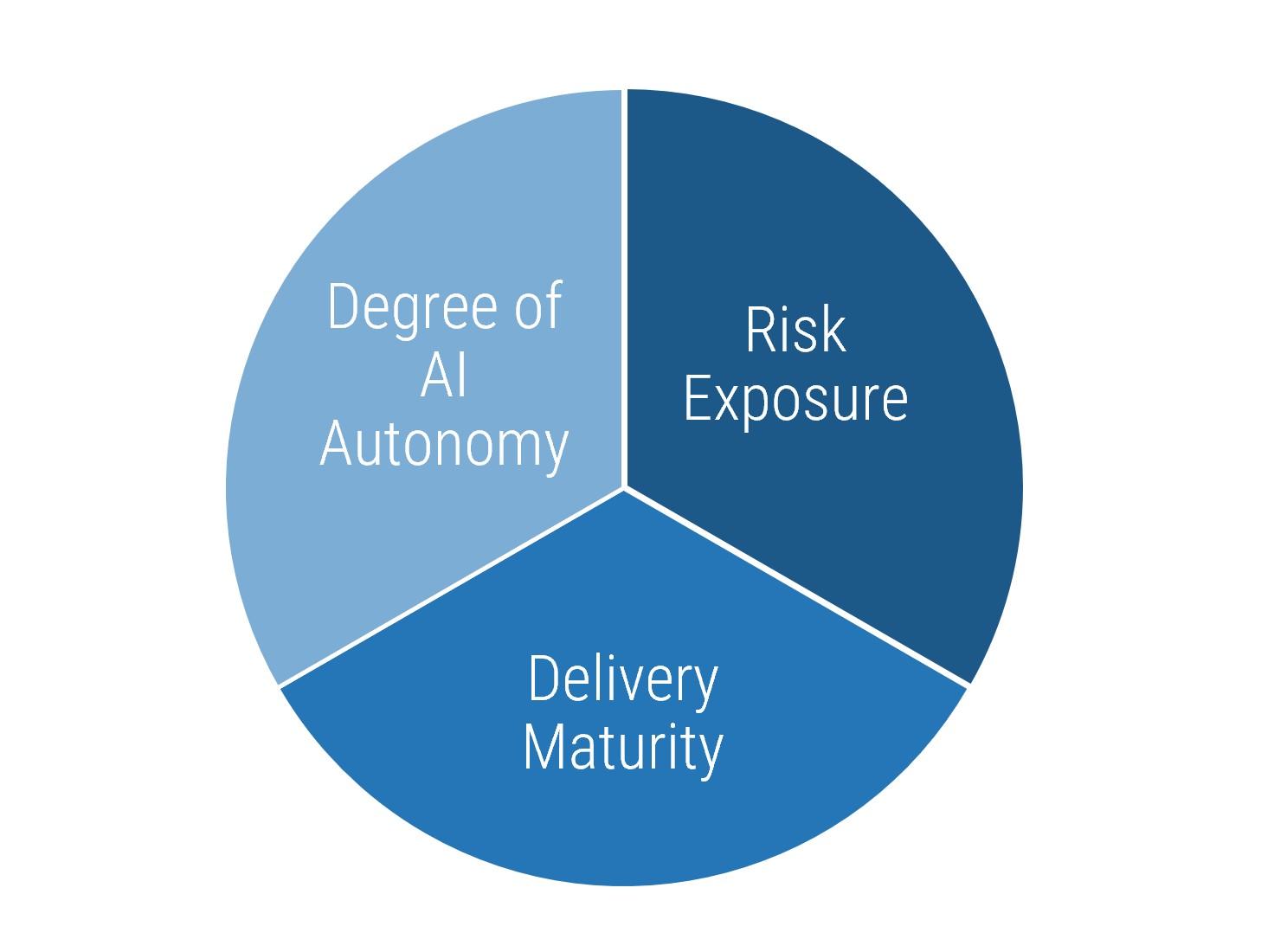
Degree of AI Autonomy
How much decision-making responsibility has been delegated to AI in the creation or modification of code.The potential organizational impact if the code behaves incorrectly, degrades over time, or accumulates hidden technical debt.
The potential organizational impact if the code behaves incorrectly, degrades over time, or accumulates hidden technical debt.Delivery Maturity
How effectively the delivery team operates today, including its ability to collaborate, follow consistent practices, and deliver maintainable code.
Compared to human-written code, AI-coauthored pull requests (PRs) carry 1.7x more issues, 75% more logic errors, and 2.74x more security vulnerabilities (CodeRabbit, 2025).
Velocity without discipline compounds risk. Place your AI code generation tools behind explicit guardrails.
AI is transforming how organizations code
- AI-powered code generation tools can produce code automatically based on certain inputs and parameters, such as natural language descriptions. This approach can generally fall into two main categories: code completion and code suggestions. Both categories enhance code development and code efficiency (GitLab, 2024). These tools help reduce the manual work that human developers must accomplish, freeing up their time to work on more meaningful and complex tasks.
- AI code completion, an advanced code generation feature, is used in integrated development environments (IDEs) and code editors to provide automated suggestions for completing code based on context, prior code, and best practices. This capability aims to speed up the coding workflow and reduce errors by predicting the most likely pieces of code to be written next, often by suggesting variable names, method signatures, and other language-specific constructs.
“In the fast-moving world of AI, today’s tools are tomorrow’s history – because AI is now building the tools that build AI.” – Ryan Favro, Founder, Gravy.ai
Download the AI-Assisted Code Generation Tools blueprint
Case study

Industry: Finance | Source: Info-Tech Research Group
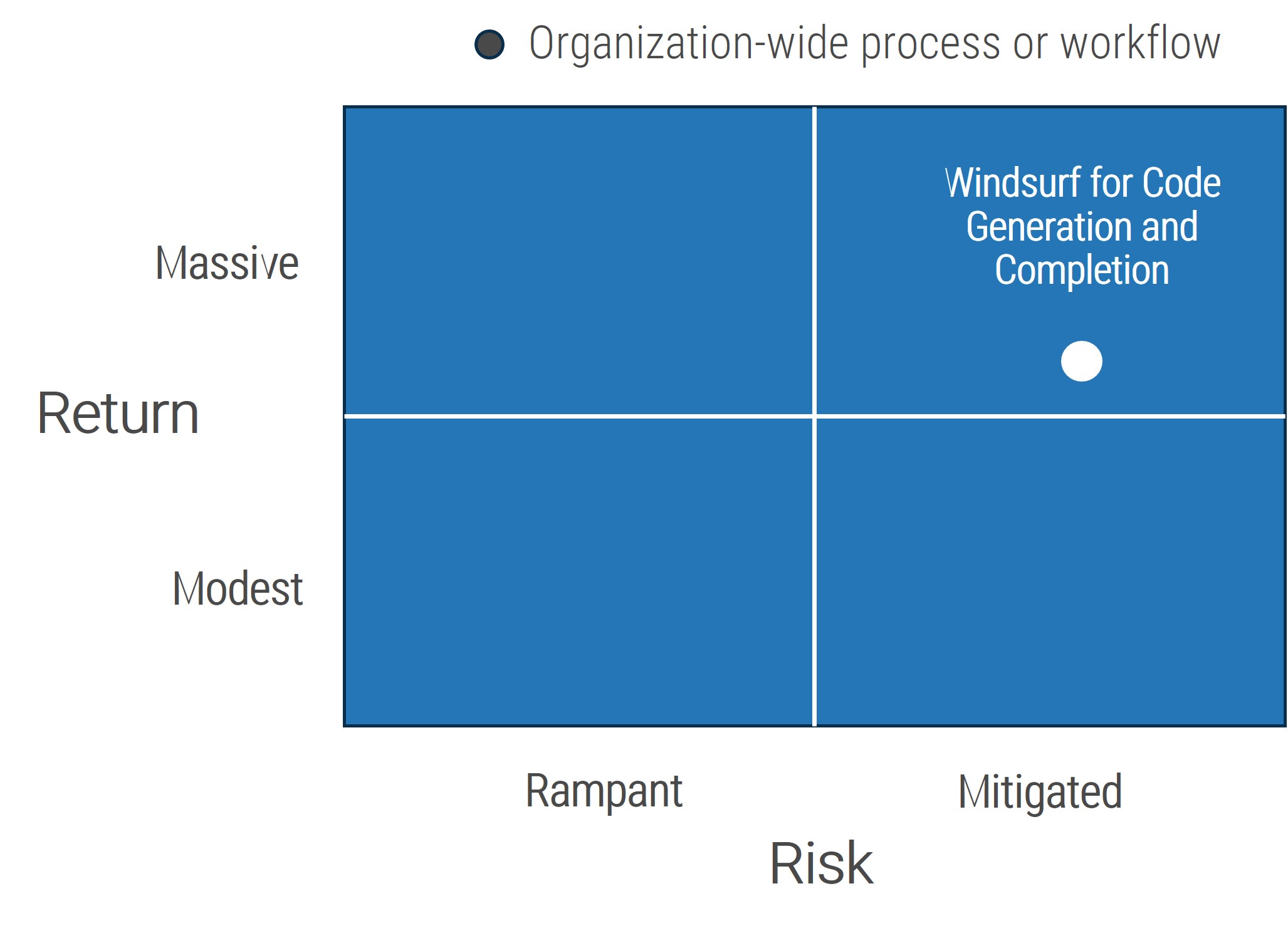
Clearwater Analytics accelerates development and improves code quality with Windsurf's AI coding assistant.
- Windsurf, formerly Codeium, partnered with Clearwater Analytics to enhance its SDLC using AI-driven tools. By integrating Windsurf’s intelligent coding assistant, Clearwater empowered its developers to maintain deep focus, reduce repetitive tasks, and improve code quality. The platform facilitated better collaboration across teams, minimized bugs early in the development process, and enforced consistent coding standards. These improvements led to faster development cycles and more efficient delivery of high-quality software.
- Windsurf also helped break down knowledge silos, enabling developers to contribute more effectively across the codebase and support Clearwater’s innovation and growth objectives.
Results
- Clearwater saw a 30% increase in developer productivity and 40% faster feature delivery. Bug rates dropped significantly due to early detection and consistent code quality. Team collaboration and cross-functional contributions improved across the board.
Insight summary
Info-Tech Insight
AI-generated code increases the likelihood that defects and technical debt will accumulate faster. Put AI behind guardrails with explicit constraints and verification checks. Without these necessary guardrails, faster code delivery just means faster debt delivery.
Step 1
AI is often better at writing code than individual developers, but it usually does not fully understand business context, constraints, or trade-offs. Start with a clear problem definition before involving AI. When intent is vague or poorly understood, AI will confidently optimize for the wrong outcome, producing technically sound code that fails to solve the real problem your team is accountable for.Step 2
AI tools frequently produce unnecessary complexity. Constrain AI outputs to the simplest correct design and reject complexity that isn’t justified by the ticket. The rules of development don’t change just because AI is being used. Standards for simplicity, maintainability, and justified design still apply – and developers should remain accountable for enforcing them.Step 3
Adopting AI-generated code is not a one-time configuration – it requires deliberate, phased implementation across the SDLC. Define clear adoption goals, success metrics, and a staged rollout plan before integrating AI-generated code. Teams that treat AI-generated code as an ongoing process are better equipped to identify failure points early and course-correct before technical debt accumulates.
Info-Tech’s methodology for defending against defects and technical debt in your AI-generated code
1. Establish Tool Usage |
2. Define Your Necessary Guardrails |
3. Roadmap Your Development Milestones |
|
Activities |
1.1 Scope out the usage of AI-generated code in your SDLC.
1.2 Detail your motivations for using AI-generated code. |
2.1 Audit your delivery pipeline.
2.2 Embed your nonfunctional requirements. 2.3 Establish your prompting standards. 2.4 Create a personalized PR checklist. |
3.1 Define your objectives and metrics.
3.2 Create a Now, Next, Later roadmap. 3.3 Complete your AI Code Quality Starter Kit. |
Step Outcomes |
|
|
|
Key deliverable:
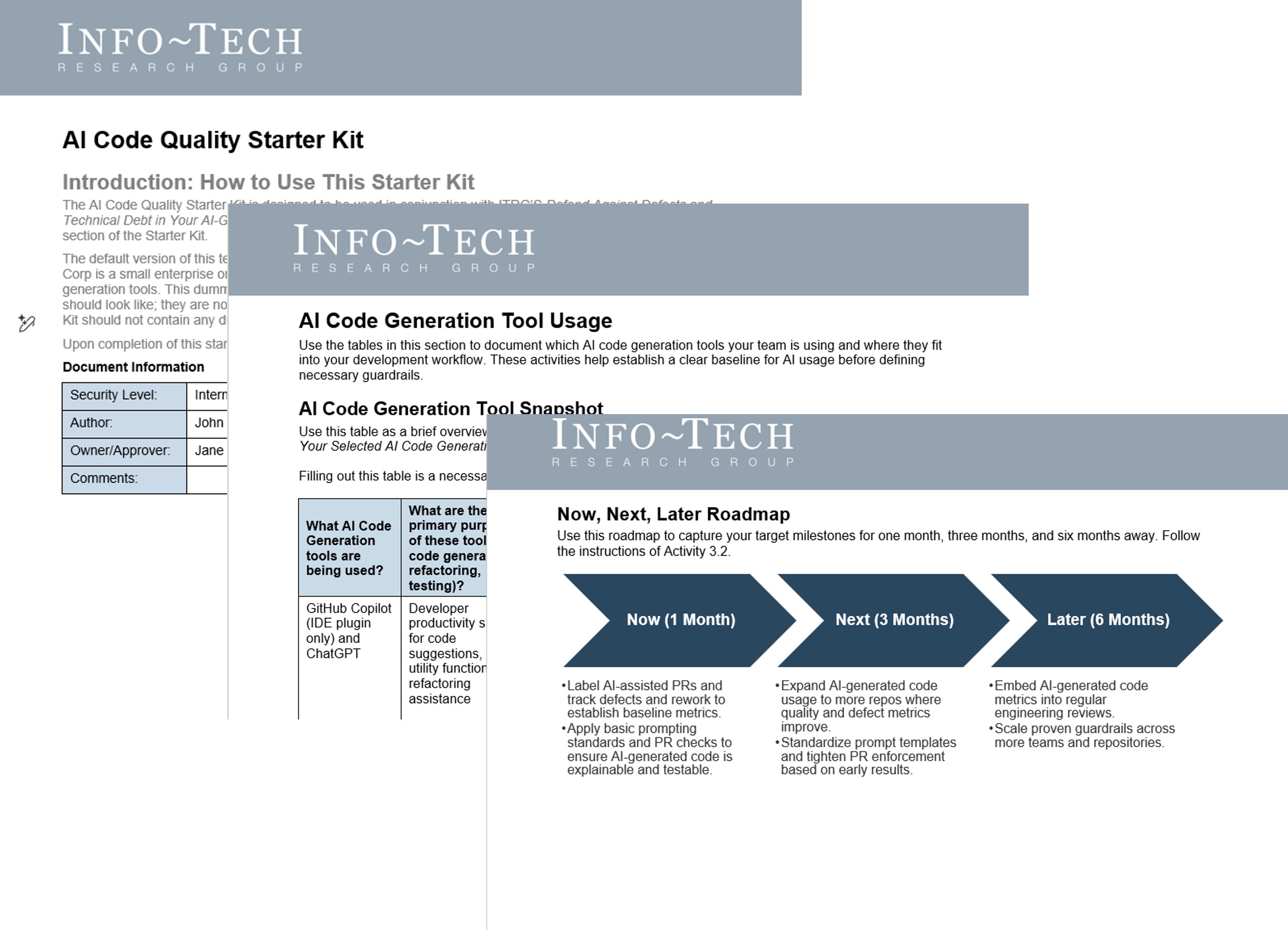
AI Code Quality Starter Kit
Use Info-Tech’s template to capture your desired delivery goals, AI guardrails, and success metrics.
Blueprint benefits
Define the Necessary Guardrails for Your AI-Generated Code
- Clearly define where and how AI-generated code is used across the SDLC.
- Identify high-risk SDLC steps through SWOT and root cause analyses.
- Embed nonfunctional requirements, prompting standards, and PR verification checks directly into daily development workflows.
- Reduce defect leakage from AI‑generated code.
- Improve code consistency, maintainability, and security.
Notable Impacts
Roadmap the Implementation Timeline of Your Necessary Guardrails
- Translate AI guardrails into a practical Now, Next, Later implementation plan aligned to organizational maturity.
- Connect guardrails to measurable objectives and success metrics over one‑, three‑, and six‑month horizons.
- Gain clear visibility into progress and value through defined milestones, benchmarks, and metrics.
- Enable sustainable long‑term use of AI‑generated code by operationalizing guardrails.
Notable Impacts
Tool selection is your foundation
Why your AI code tool choice predetermines quality, risk, and long-term maintainability.
Tool selection is the foundation of AI-generated code quality; the tool you choose will implicitly set the baseline for coding standards, maintainability, and security across everything it produces. Before designing guardrails or quality controls, you must first select the right AI code generation tool. A poor choice can undermine every downstream control you put in place.
To help you decide, you can read through Info-Tech’s AI-Assisted Code Generation Tools buyers guide and market trends report. Phase 1 will help you contextualize the AI code generation market by exploring key trends, future possibilities, a vendor comparison, and a SWOT analysis. Phase 2 will help you select an AI code generation tool by constructing a solid business case based on high-value use cases that are aligned to organizational goals.
Key Research
AI-Assisted Code Generation Tools
Use this comprehensive buyers guide to understand trends and future market direction, compare leading vendors, assess strengths and risks, and select an AI code generation tool.
0.1 Document your selected AI code generation tools
1-2 hours
Input: Existing knowledge of your AI-generated code tools and practices
Output: Documented rationale for AI code generation tool selection, A clear definition of intended use, constraints, and risk assumptions
- If you have not yet selected which AI tools or vendors you’ll use to generate code, first read through and refer to Info-Tech’s AI-Assisted Code Generation Tools, which acts as a prerequisite for this blueprint.
- Using your current knowledge of your organization’s selected AI code generation tools and vendors, write your answers to the following questions on the next slide.
- What AI code generation tools are being used?
- What are the primary purposes of these tools (new code generation, refactoring, testing)?
- Where in the development workflow will these tools mainly be used?
- What types of code or repositories are these tools permitted to generate code for?
- What known risks or limitations were accepted when selecting these tools?
- Enter your answers into the AI-Generated Code Tool Snapshot section of your AI Code Quality Starter Kit.
Download the AI Code Quality Starter Kit
0.1 Document your selected AI code generation tools (continued)
Example Answers:
What AI code generation tools are being used?
- GitHub Copilot (IDE plugin only) and ChatGPT
What are the primary purposes of these tools (new code generation, refactoring, testing)?
- Developer productivity support for code suggestions, small utility functions, and refactoring assistance
Where in the development workflow will these tools mainly be used?
- Local development within developers’ IDEs prior to manual code review
What types of code or repositories are these tools permitted to generate code for?
- Nonproduction repositories only, including internal tools, prototypes, and low‑criticality services
What known risks or limitations were accepted when selecting these tools?
- Potential for insecure or inconsistent code patterns, mitigated by limited scope, mandatory code review, and exclusion from critical production systems
Step 1
Establish Tool Usage
Activities
- 1.1 Scope out the usage of AI-generated code in your SDLC
- 1.2 Detail your motivations for using AI-generated code
This step involves the following participants:
- Software developers (junior/senior)
- Tech leads
- Engineering/development managers
- Development directors
- Solution architects
- QA/test engineers
- DevOps/SRE managers
- Technology executives
Outcomes of this step
- A table outlining the usage of AI-generated code in your SDLC
- The main motivations driving your team to expand its usage of AI-generated code
Defend Against Defects and Technical Debt in Your AI-Generated Code
| Step 1 | Step 2 | Step 3 |
Info-Tech Insight
Step 1
AI is often better at writing code than individual developers, but it usually does not fully understand business context, constraints, or trade-offs. Start with a clear problem definition before involving AI. When intent is vague or poorly understood, AI will confidently optimize for the wrong outcome, producing technically sound code that fails to solve the real problem your team is accountable for.
Strengthen your development workflow with AI-driven coding capabilities
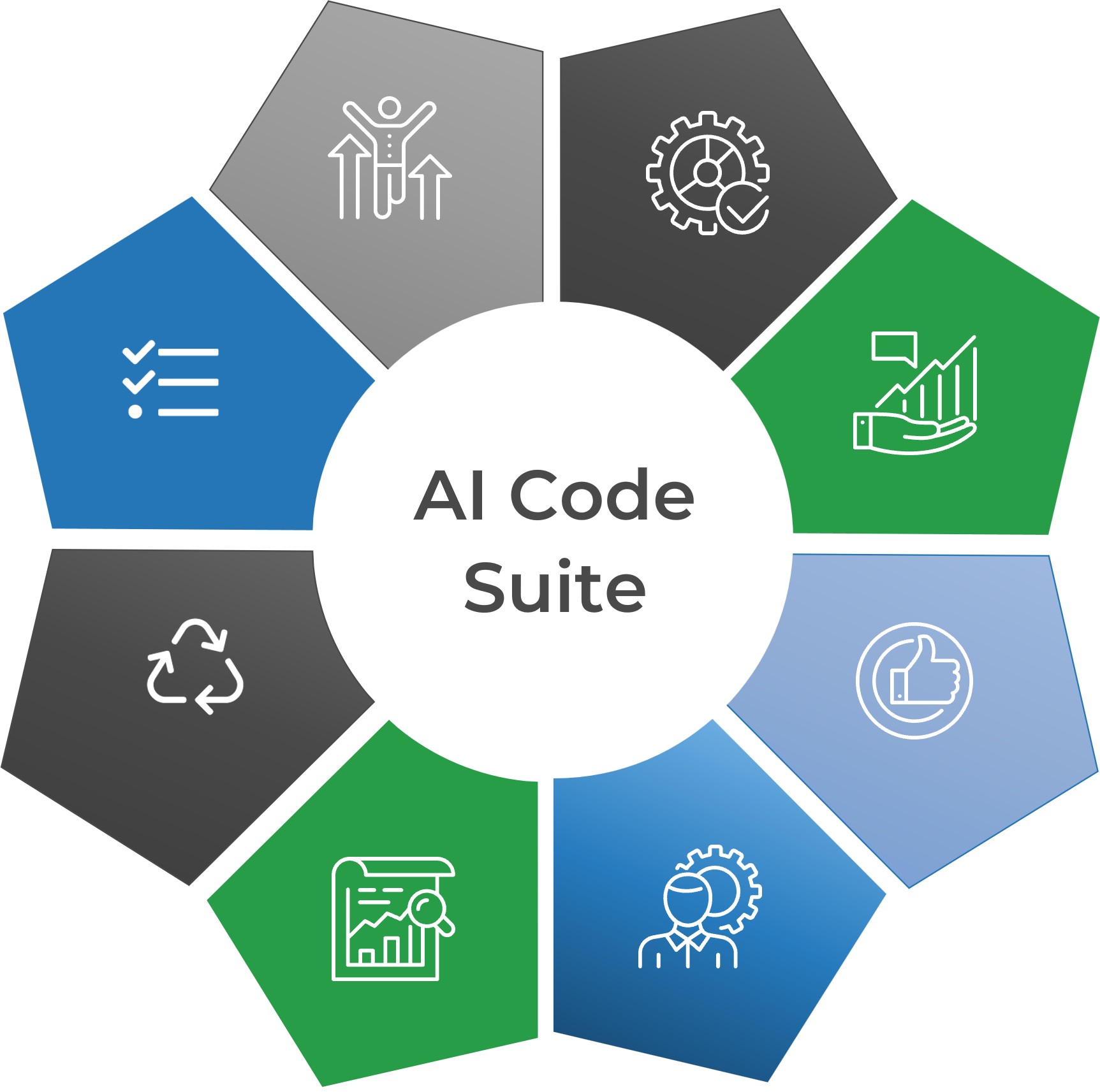
Test Generation
Test generation tools automatically create unit tests or test cases by analyzing source code or specifications, increasing test coverage.Document Generation
These tools produce comprehensive code documentation or inline comments by extracting information from code or developer input.Low-Code/No-Code Platforms
Low-code and no-code platforms enable users to design and deploy applications using visual interfaces and minimal handwritten code.API Integration
API integration tools generate code to connect software applications with external APIs, often from specifications or prompts.Code Review & Refactoring
Automated code review and refactoring tools analyze codebases to identify issues in readability, maintainability and security, offering actionable suggestions.Code Translation
Code translation tools convert source code from one programming language to another, preserving logic and functionality across languages.Code Synthesis
Code synthesis tools automatically generate code structures, such as functions or classes, from high-level specifications or natural language descriptions.Code Completion
Code completion tools provide intelligent, context-aware suggestions as developers type, helping to finish statements and reduce syntax errors.
Understand the benefits of AI-assisted code generation tools across high-value use cases
High-Value Use Case |
Process Stage |
Benefits |
| Explanations and Code Understanding | Debugging/Maintenance | AI uses natural language processing and code parsing to explain complex logic, unfamiliar syntax, or legacy code, making it easier for developers to understand unfamiliar codebases, onboard faster, and debug more effectively. |
| Code Commenting | Development | AI analyzes code context and intent to generate meaningful inline comments, improving code, maintainability, and team collaboration, especially in fast-paced or large-scale projects. |
| Documentation Generation | Development/Maintenance | AI automatically generates structured documentation (e.g. API references, usage examples, README files) from code, reducing manual effort and ensuring consistency across projects. |
| Intelligent Code Refactoring | Development/Maintenance | AI identifies redundant, inefficient, or nonstandard code patterns and suggests or applies improvements, helping to maintain clean code. |
| Autocomplete | Development | AI predicts and completes code snippets in real time, reducing typing effort, minimizing syntax errors, and speeding up development. |
| Code Generation | Development | AI generates entire functions, classes, or modules from natural language prompts or partial code, accelerating prototyping, reducing boilerplate, and enabling nonexperts. |
| Automated Unit Tests Creation | Testing | AI analyzes code logic and automatically generates relevant unit tests, improving test coverage, catching edge cases, and reducing the time developers spend writing and maintaining tests. |
| Complex Coding | Development/Architecture | AI handles multistep logic, algorithm design, and architectural scaffolding by reasoning through requirements and generating structured output. |
Download the AI-Assisted Code Generation Tools blueprint
AI tools deliver strongest value from design to deployment in the SDLC
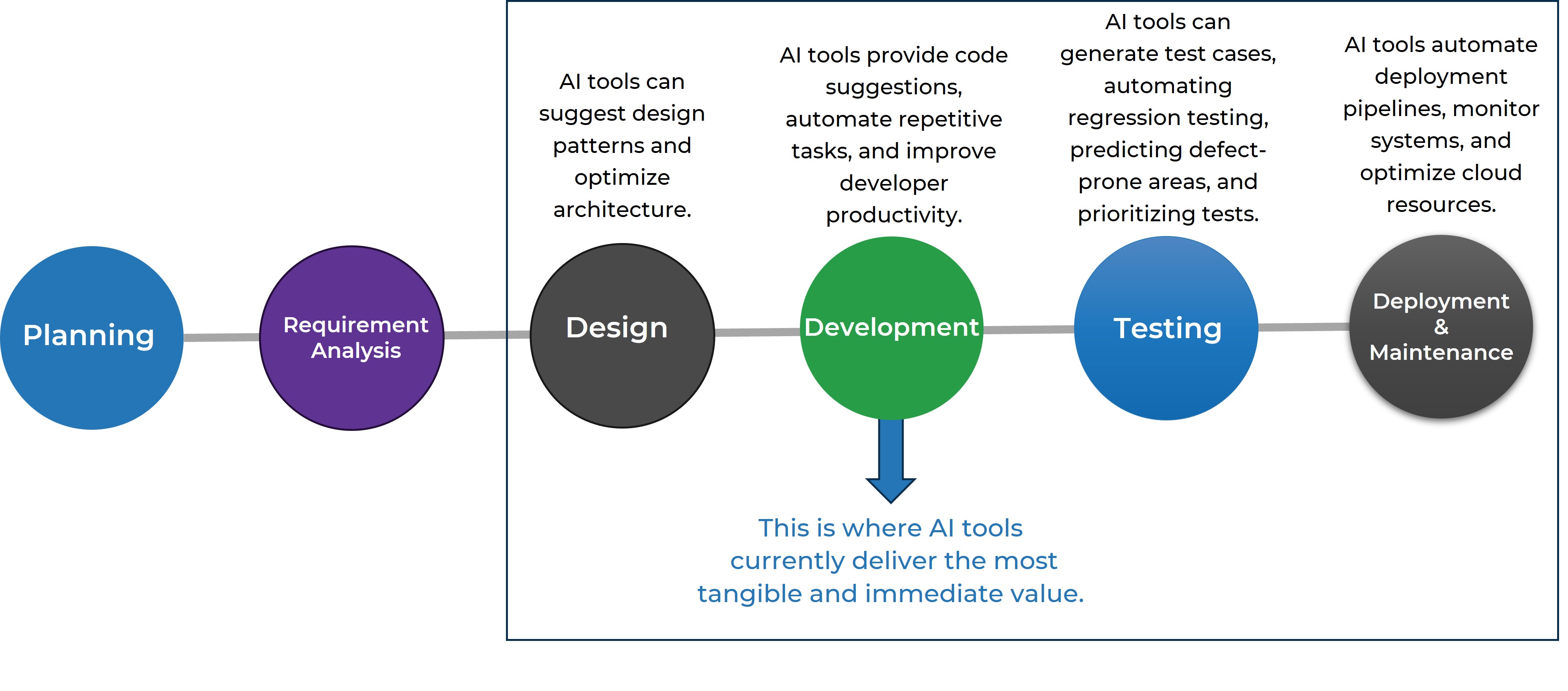
To develop your SDLC process in alignment with AI capabilities, start here: Evolve Your Software Development Lifecycle Into a Solution Delivery Lifecycle
1.1 Scope out the usage of AI-generated code in your SDLC
30-60 minutes
Input: Your current SDLC steps, Your planned AI-assisted code generation usage
Output: A table outlining the usage of AI-generated code in your SDLC
- Map out the SDLC steps that your team currently follows.
- For each SDLC step you include, document how AI-generated code will be used by answering the following:
- Who is going to be using AI-generated code?
- What is going to be done with AI-generated code?
- How will AI-generated code best be used?
- Of these SDLC steps, which ones should be the highest priority? Consider risk exposure, the amount of autonomy you want your AI tools to have, and your organizational maturity.
- Enter all information into the AI-Generated Code Within the SDLC section of your AI Code Quality Starter Kit.
Download the AI Code Quality Starter Kit
1.1 Scope out the usage of AI-generated code in your SDLC (continued)
Example Answers
SDLC step |
Who is going to be using AI-generated code? |
What will be done with AI-generated code? |
How will we best use AI-generated code? |
| Planning |
|
|
|
About Info-Tech
Info-Tech Research Group is the world’s fastest-growing information technology research and advisory company, proudly serving over 30,000 IT professionals.
We produce unbiased and highly relevant research to help CIOs and IT leaders make strategic, timely, and well-informed decisions. We partner closely with IT teams to provide everything they need, from actionable tools to analyst guidance, ensuring they deliver measurable results for their organizations.
What Is a Blueprint?
A blueprint is designed to be a roadmap, containing a methodology and the tools and templates you need to solve your IT problems.
Each blueprint can be accompanied by a Guided Implementation that provides you access to our world-class analysts to help you get through the project.
Need Extra Help?
Speak With An Analyst
Get the help you need in this 3-phase advisory process. You'll receive multiple touchpoints with our researchers, all included in your membership.
Guided Implementation 1: Establish Tool Usage
- Call 1: Discuss selected code generation tools and use cases.
- Call 2: Scope out exact tool usage throughout the SDLC and clarify overall motivations.
Guided Implementation 2: Define Your Necessary Guardrails
- Call 1: Conduct an audit of the SDLC, identifying high-risk steps.
- Call 2: Review results of SDLC audit and identify potential guardrails to implement.
- Call 3: Define implementation process and lay out exact guardrails.
Guided Implementation 3: Roadmap Your Development Milestones
- Call 1: Define long-term goals and success metrics and create a roadmap.
- Call 2: Review progress of implementation of necessary guardrails.
Contributors
- Nicky Pike, Field CTO, Coder
- Alexander Chisholm, Software Developer II, 7D Surgical
- 1 Anonymous contributor
 Mature and Scale Product Ownership
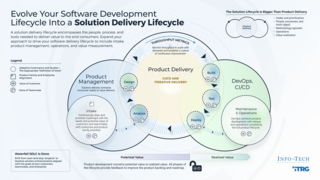 Evolve Your Software Development Lifecycle Into a Solution Delivery Lifecycle
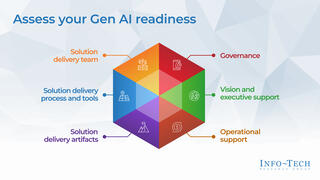 Adopt Generative AI in Solution Delivery
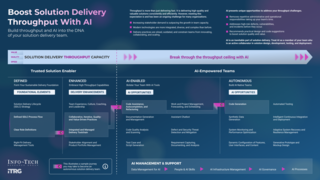 Boost Solution Delivery Throughput With AI
 Estimate Software Delivery With Confidence
 Select and Use SDLC Metrics Effectively
 Improve Application Development Throughput
 Spread Best Practices With an Agile Center of Excellence
 Perform an Agile Skills Assessment
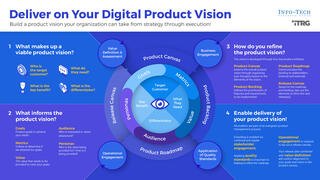 Deliver on Your Digital Product Vision
 Mentoring for Agile Teams
 Implement DevOps Practices That Work
 Deliver Digital Products at Scale
 Enhance Your Solution Architecture Practices
 Define a Release Management Process to Deliver Lasting Value
 2020 Applications Priorities Report
 Agile Readiness Assessment Survey
 Define a Sourcing Strategy for Your Development Team
 Define the Role of Project Management in Agile and Product-Centric Delivery
 Implement a Transformative IVR Experience That Empowers Your Customers
 Create an Agile-Friendly Project Gating and Governance Approach
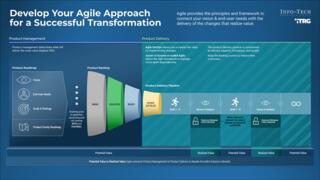 Develop Your Agile Approach for a Successful Transformation
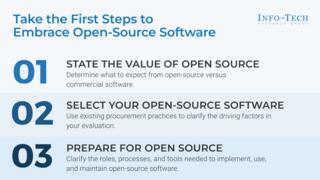 Take the First Steps to Embrace Open-Source Software
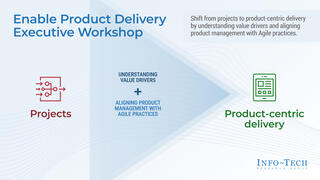 Enable Product Delivery – Executive Leadership Workshop
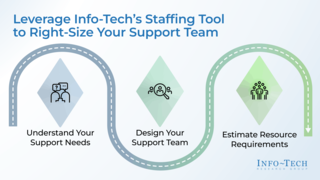 Right-Size Your Enterprise Application Support Team
 Defend Against Defects and Technical Debt in Your AI-Generated Code
 Master Systematic Application Replacement With a Fit-for-Purpose Plan