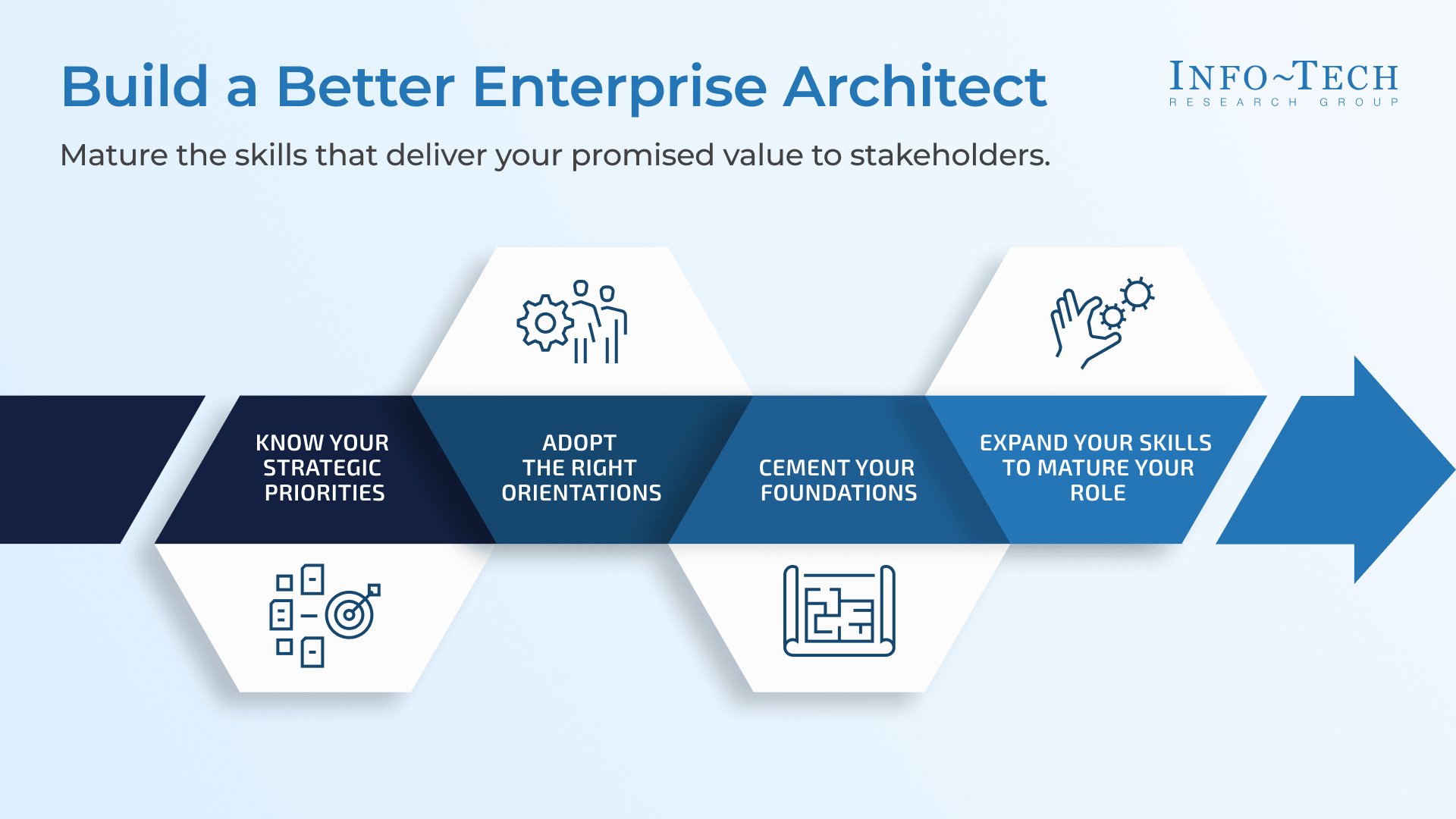
Build a Better Enterprise Architect
Mature the EA skills that deliver your promised value to stakeholders.
Not all enterprise architects are created equally. The enterprise architect role is context-sensitive, and what works in one organization may be the wrong posture in another. Hiring or developing for every possible skill at once can produce architects who are overwhelmed and ill-equipped to address enterprise problems. Our research gives enterprise architecture (EA) leaders and their teams a structured path to define the right role of an enterprise architect, identify the skills that matter, and roadmap development milestones tied to real stakeholder value.
Organizations often mistake technical brilliance for EA maturity, expecting architects to win credibility with frameworks, domain knowledge, and technical expertise. But successful organizations acknowledge that the skills that make enterprise architects truly effective are analytical thinking, relationship-building, and the ability to tell a compelling story that moves people to act.
1. Anchor the role to the value you are committed to deliver.
When the role is defined by broad expectations rather than specific committed outcomes, architects chase too many priorities and deliver on little. Anchor the enterprise architect role to the value your EA practice has promised stakeholders. Credibility and influence grow when the architect delivers meaningful results.
2. Prioritize human skills over technical expertise.
Technical expertise and domain specialization are no longer the primary success criteria for enterprise architects. Conceptualizing a long-term vision is one part of the role; getting stakeholders to buy into it and navigating its complexity is another. Prioritize the maturation of analytical thinking, communication, relationship building, and strategic analysis skills.
3. Show momentum early, then build for the long term.
Stakeholder confidence depends on seeing results within a reasonable timeframe. If progress takes too long to materialize, early enthusiasm fades and the role loses organizational support before it matures. Balance quick-win skill improvements with the groundwork for sustained growth, and communicate expanding the architect’s value through the services they support.
Use this framework to build a better enterprise architect
Our research offers robust tools, including a skills assessment tool and role profile template, and step-by-step guidance for crafting the enterprise architect role, assessing their skills, and roadmapping development milestones. Use this blueprint to move from a loosely defined enterprise architect role to one that is focused on delivering their commitments.
- Craft your enterprise architect role by establishing a clear definition, selecting the orientation that best serves your stakeholders, and anchoring the role’s scope to your EA practice's committed value.
- Prioritize and assess your enterprise architect skills using the Enterprise Architect Skills Assessment Tool to identify the gaps that matter most to your architect’s orientation without the burden of addressing every skill at once.
- Roadmap your development milestones by setting objectives and metrics, sequencing skill development activities across one, three, and six-month horizons, and capturing outputs in the Enterprise Architect Role Profile Template.
Build a Better Enterprise Architect
Mature the skills that deliver your promised value to stakeholders.
Analyst perspective
Influence isn’t earned by expertise. It’s earned by storytelling.
For years, organizations have mistaken technical brilliance for enterprise architecture (EA) maturity. They expect enterprise architects to win influence and credibility by layering frameworks, domain knowledge, and technical expertise in their way of working. This should not be the case.
The power of enterprise architects does not come from models. It comes from analytical thinking, clear communication, strong storytelling, the ability to build alliances, and the courage to help leaders navigate uncertainty and complexity with confidence.
Prospective enterprise architects do not need to be a coder or a strategist first. They need the curiosity to learn how everything connects and to mold themselves to how the organization grows, transforms, and competes. Once an enterprise architect stops chasing the universal desire to please everyone and focuses on a narrow, high-impact mandate, their influence and credibility flourishes and scales.


Andrew Kum-Seun and Caleb Pittman
Applications Practice
Info-Tech Research Group
Executive summary
|
Your Challenge |
Common Obstacles |
Info-Tech’s Approach |
|---|---|---|
|
As organizations mature and adopt more integrated and intelligent technologies, specific activities become even more critical for success:
An EA practice brings order to this growing complexity. For the practice to be successful, it needs skilled enterprise architects. |
Acquiring an enterprise architect is not as simple as hiring a technical expert. It involves building the necessary foundations for them to succeed. However, many factors stand in the way:
|
|
Info-Tech Insight
The industry treats enterprise architects as universal problem-solvers. This dilutes their identity and influence due to their mandate to please everyone. Mold the enterprise architect’s orientation to the people they serve and steer away from those they do not. When they narrow their scope to a few achievable expectations, their credibility deepens and expands.
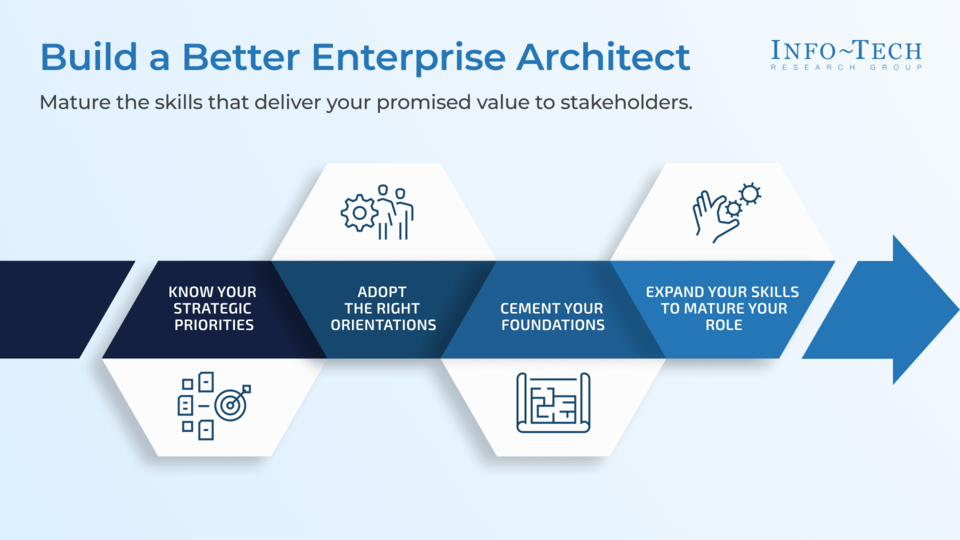
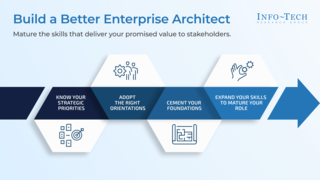
Build a better enterprise architect
Mature the skills that deliver your promised value to stakeholders.
|
Know Your Strategic Priorities |
Adopt the Right Orientations |
Cement Your Foundations |
Expand Your Skills to Mature Your Role |
|---|---|---|---|
|
Identify the critical business outcomes your stakeholders are pursuing so you can deliver the EA practice they need. This alignment ensures everything you do is relevant, influential, and tied directly to measurable results. Refer to Info-Tech’s Build Your EA Practice Strategy. |
Embrace the mindset, behaviors, and focus of one or a combination of orientations needed to deliver your business value commitments:
|
Build a solid grounding of key skills required to lead complex conversations with confidence. These skills are critical for all enterprise architects:
|
Extend your reach and involvement across the organization by supplementing your foundations with specific interdisciplinary and technical skills:
|
Insight Summary
Info-Tech Insight
The industry treats enterprise architects as universal problem-solvers. This dilutes their identity and influence due to their mandate to please everyone. Mold the enterprise architect’s orientation to the people they serve and steer away from those they do not. When they narrow their scope to a few achievable expectations, their credibility deepens and expands.
| Step 1 |
Industry standards and frameworks may not fully capture what your organization needs in an enterprise architect. Anchor the enterprise architect role to the value your EA practice is committed to delivering. The organizational credibility and influence of your architects improve when stakeholders see meaningful outcomes. |
|---|---|
| Step 2 |
Technical expertise and EA domain specialization are no longer the primary success criteria. Prioritize the maturity of your analytical thinking, communication, relationship-building, and strategic analysis skills. Transformation cannot start if stakeholders cannot agree on the destination or understand the impacts of their decisions. |
| Step 3 |
The excitement for enterprise architects will quickly lose momentum if it takes too long to show expected outcomes. Balance quick-win skill improvements with the groundwork for long-term growth. Communicate the maturing value of your enterprise architects through the EA services they can now support. |
Info-Tech’s methodology for building a better enterprise architect
|
Pre-Work: Set the EA Context |
1. Craft Your Enterprise Architect Role |
2. Prioritize & Assess Your EA Skills |
3. Roadmap Your Development Milestones |
|
|---|---|---|---|---|
|
Activities |
0.1 Detail your EA practice strategy |
1.1 Establish the role of the enterprise architect |
2.1 Prioritize your EA skills |
3.1 Define your objectives and metrics |
|
Step Outcomes |
|
|
|
|
Blueprint deliverables
Each step of this blueprint is accompanied by supporting deliverables to help you accomplish your goals:
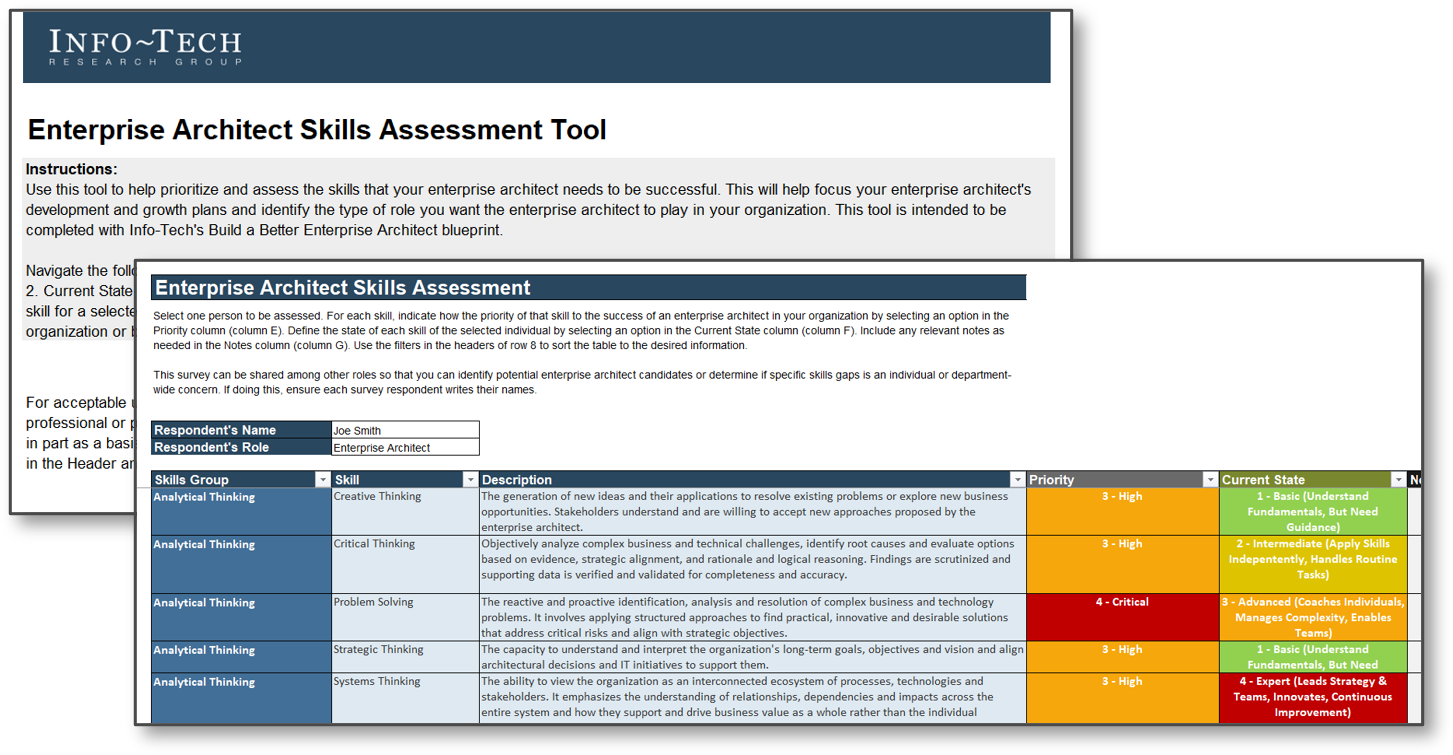
Key deliverable:
Enterprise Architect Role Profile
Use Info-Tech’s template to document and communicate the purpose, value, and skills of your enterprise architect in the language everyone can understand.
Blueprint benefits
|
State the Role the Enterprise Architect Must Play |
Roadmap the Goals to Upskill Your Enterprise Architects |
|---|---|
Notable Impacts
|
Notable Impacts
|
Info-Tech offers various levels of support to best suit your needs
| DIY Toolkit | Guided Implementation | Workshop | Executive & Technical Counseling | Consulting |
|---|---|---|---|---|
| "Our team has already made this critical project a priority, and we have the time and capability, but some guidance along the way would be helpful." | "Our team knows that we need to fix a process, but we need assistance to determine where to focus. Some check-ins along the way would help keep us on track." | "We need to hit the ground running and get this project kicked off immediately. Our team has the ability to take this over once we get a framework and strategy in place." | "Our team and processes are maturing; however, to expedite the journey we'll need a seasoned practitioner to coach and validate approaches, deliverables, and opportunities." | "Our team does not have the time or the knowledge to take this project on. We need assistance through the entirety of this project." |
Diagnostics and consistent frameworks are used throughout all five options.
Guided Implementation
What does a typical GI on this topic look like?
|
Pre-Work & Step 1 |
Step 2 |
Step 3 |
|---|---|---|
|
Call #1: Discuss the vision and purpose of your EA practice. Call #2: Describe the role you need the enterprise architect to play. |
Call #3: Prioritize the skills you need your enterprise architect to have. Call #4: Assess the skills of your enterprise architects. Call #5: Discuss solutions to fill your skills gaps. |
Call #6: Define the objectives and metrics of your enterprise architects. Call #7: Roadmap your enterprise architect development milestones. |
A Guided Implementation (GI) is a series of calls with an Info-Tech analyst to help implement our best practices in your organization.
A typical GI is 5 to 7 calls over the course of 2 to 3 months.
Workshop overview
Contact your account representative for more information.
workshops@infotech.com 1-888-670-8889
Module 1 | Module 2 | Module 3 | Module 4 | Post-Workshop | |
Activities | Capture the Vision of Your EA Practice | Assess Your EA Skills | Learn Enterprise Architect Best Practices | Roadmap Your Development Milestones | Next Steps and |
1.1 State the roles of your EA practice and enterprise architects. | 2.1 Select your enterprise architect orientation(s). | 3.1 Shortlist enterprise architect best practices to adopt. | 4.1 Define your enterprise architect objectives and metrics. | 5.1 Complete in-progress deliverables from the previous four days. | |
Deliverables |
|
|
|
|
|
Pre-Work
Set the EA Context
Activities
0.1 Detail Your EA Practice Strategy
This step involves the following participants:
- Current and prospective enterprise architects
- EA leaders
Outcomes of this step
- The context, organizational objectives and strategy of your EA practice
0.1 Detail your EA practice strategy
1-2 hours
- Using your current understanding of your EA practice, write your answers to the following questions on the next slide. Your responses will help complete the activities in this blueprint. If you are unable to answer all these questions, read through and refer to Info-Tech’s Build Your EA Practice Strategy, which acts as a prerequisite for this blueprint.
- What is the purpose of your EA practice?
- What are the objectives of your EA practice?
- What services do you want your EA practice to provide?
- What value do you want your EA practice to deliver?
- What is the scope of your EA practice?
- What are the guiding principles of your EA practice?
- Download a copy of the Enterprise Architect Role Profile Template.
- Enter your practice’s guiding principles into the “Guiding Principles” section of your Enterprise Architect Role Profile Template.
Download the Enterprise Architect Role Profile Template
|
Input |
|---|
|
|
Output |
|
0.1 Detail your EA practice strategy (continued)
|
What is the purpose of your EA practice? |
What are the objectives of your EA practice? |
What services do you want your EA practice to provide? |
What value do you want your EA practice to deliver? |
What is the scope of your EA practice? |
What are the guiding principles of your EA practice? |
|---|---|---|---|---|---|
0.1 Detail your EA practice strategy (continued)
Example answers
|
What is the purpose of your EA practice? |
What are the objectives of your EA practice? |
What services do you want your EA practice to provide? |
What value do you want your EA practice to deliver? |
What is the scope of your EA practice? |
What are the guiding principles of your EA practice? |
|
Enterprise architecture is an intricate discipline and a strategic business capability that addresses an organization's strategy, operations, structures, and behaviors. Its intent is to illustrate how an organization can most effectively move toward the future state and achieve its strategic objectives. |
|
|
|
|
|
About Info-Tech
Info-Tech Research Group is the world’s fastest-growing information technology research and advisory company, proudly serving over 30,000 IT professionals.
We produce unbiased and highly relevant research to help CIOs and IT leaders make strategic, timely, and well-informed decisions. We partner closely with IT teams to provide everything they need, from actionable tools to analyst guidance, ensuring they deliver measurable results for their organizations.
What Is a Blueprint?
A blueprint is designed to be a roadmap, containing a methodology and the tools and templates you need to solve your IT problems.
Each blueprint can be accompanied by a Guided Implementation that provides you access to our world-class analysts to help you get through the project.
Need Extra Help?
Speak With An Analyst
Get the help you need in this 3-phase advisory process. You'll receive multiple touchpoints with our researchers, all included in your membership.
Guided Implementation 1: Craft Your Enterprise Architect Role
- Call 1: Discuss the vision and purpose of your EA practice.
- Call 2: Describe the role you need the enterprise architect to play.
Guided Implementation 2: Prioritize & Assess Your EA Skills
- Call 1: Prioritize the skills you need your enterprise architect to have.
- Call 2: Assess the skills of your enterprise architects.
- Call 3: Discuss solutions to fill your skills gaps.
Guided Implementation 3: Roadmap Your Development Milestones
- Call 1: Define the objectives and metrics of your enterprise architects.
- Call 2: Roadmap your enterprise architect development milestones.
Contributors
- Cullen Hale, Enterprise Architect, Consumers Energy
- Ravi Guyyala, Enterprise Technology Architect Lead, Arkansas Blue Cross and Blue Shield
- Julian Hirjoi, Head of Enterprise Architecture, Ent Credit Union
- 5 anonymous contributors
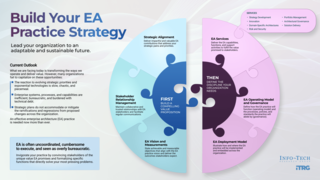 Build Your EA Practice Strategy
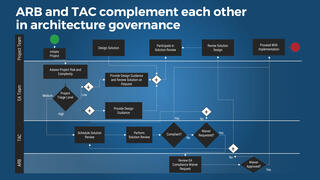 Agile Enterprise Architecture Operating Model
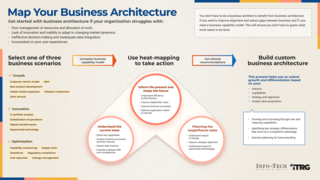 Map Your Business Architecture
 Drive Digital Transformation With Platform Strategies
 Create a Right-Sized Enterprise Architecture Governance Framework
 Excel Through COVID-19 With a Focused Business Architecture
 Create Stakeholder-Centric Architecture Governance
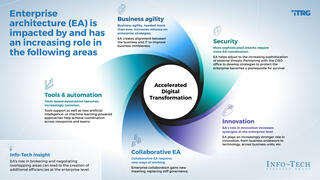 Enterprise Architecture Trends
 Prepare for AI Regulation
 Establish Your Adaptive AI Governance Program: From Principles to Practice
 Build a Better Enterprise Architect