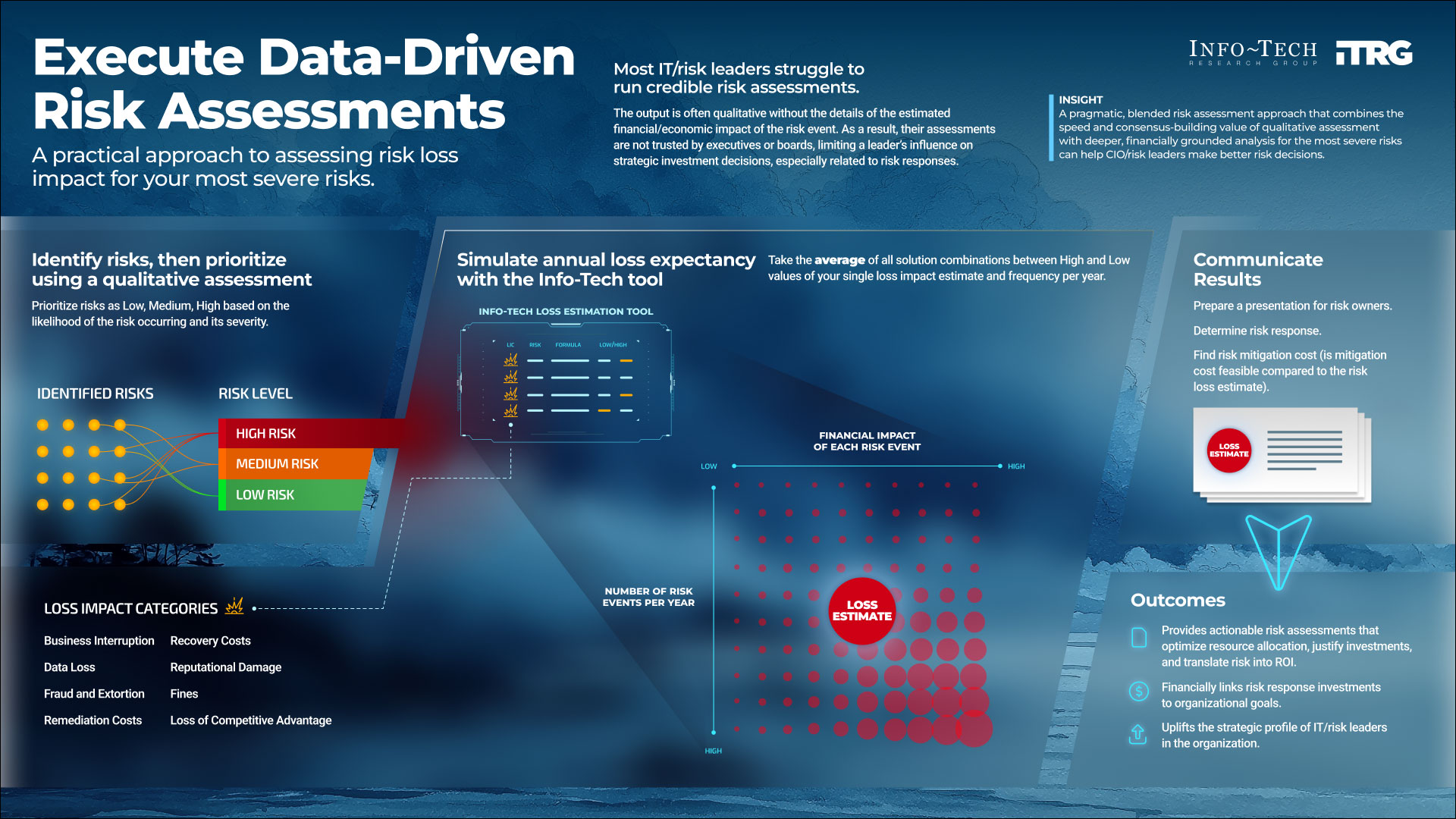
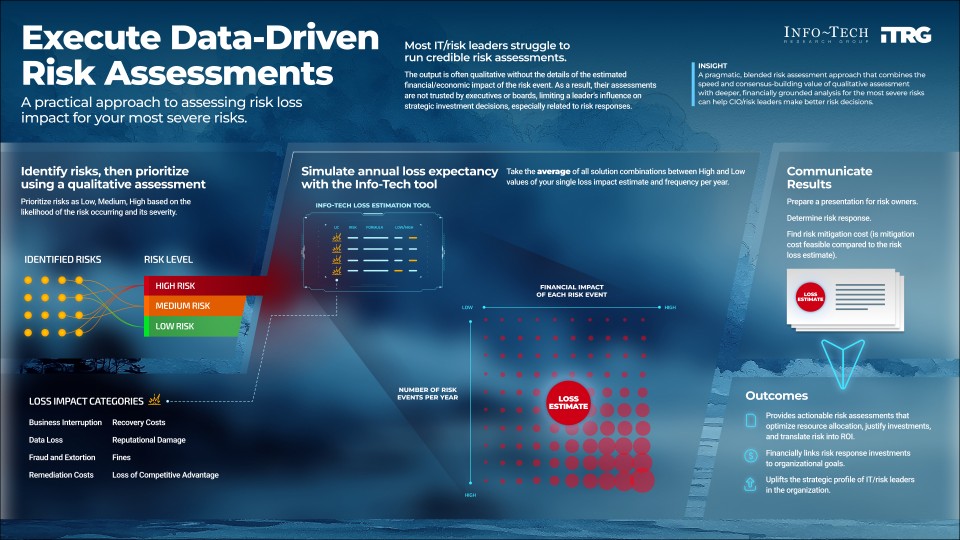
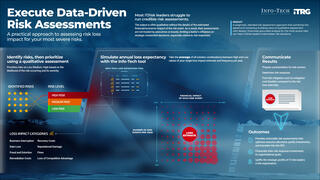
Execute Data-Driven Risk Assessments
A practical approach to assessing risk loss impact for your most severe risks.
Most organizations still rely on qualitative risk assessments that label exposure as high, medium, or low but fail to show the financial impact behind those ratings. That makes it harder for IT leaders to justify mitigation investments, align response plans to risk appetite, and communicate risk in financial terms that executives and boards can use to justify investment decisions. This blueprint gives a practical, data-driven approach to assess your most severe risks in business terms and improve risk-informed decision-making.
As technology, geopolitical, regulatory, and data governance pressures intensify, CIOs, CISOs, and risk leaders need a more credible way to evaluate risk exposure at a board level. Traditional qualitative risk assessments alone cannot provide the decision-grade insight required to prioritize investments and justify action. To move forward, organizations must quantify risk in financial terms and connect exposure directly to business impact.
1. Use qualitative scoring to build consensus and focus effort where it matters most.
Attempting to quantify every risk is costly, time-consuming, and difficult to sustain. Qualitative scoring acts as a filter to identify the most severe and decision-relevant risks that warrant deeper analysis. This ensures your effort is focused and supports more effective communication with the board.
2. Quantify risk in financial terms to enable better investment decisions.
Abstract risk ratings do not support investment decisions or meaningful trade-offs. Quantitative risk assessment translates exposure into financial terms using ranges, enabling comparison of risks and clearer evaluation of mitigation investments. This approach reveals key loss drivers, exposes data gaps, and enables risk owners to take informed, accountable action.
3. Communicate risk insights clearly to risk owners to drive action.
Even well-quantified risk insights fail to deliver value if they are not communicated effectively to decision-makers. Without clear translation into business terms, risk owners cannot assess exposure, prioritize responses, or take accountability. Package results into concise, financially grounded communication that enables risk owners and executives to make timely, confident decisions.
Use this step-by-step blueprint to quantify risk and drive better decisions
Our research helps you move from descriptive risk scoring to decision-grade risk insights by applying a blended approach that uses both qualitative and quantitative analysis. Use the tools, which include a storyboard, workbook, and communication deck, to identify key risks, prioritize severe exposures, estimate financial impact, and equip risk owners with the information needed to make better decisions.
- Identify and review key risks to establish a foundation for quantitative assessment by validating your risk register, confirming your taxonomy, and capturing a comprehensive view of risks across business and technology domains.
- Conduct qualitative risk assessment to filter and prioritize risks by evaluating likelihood and impact, building consensus, and focusing effort on the most severe exposures that warrant deeper analysis.
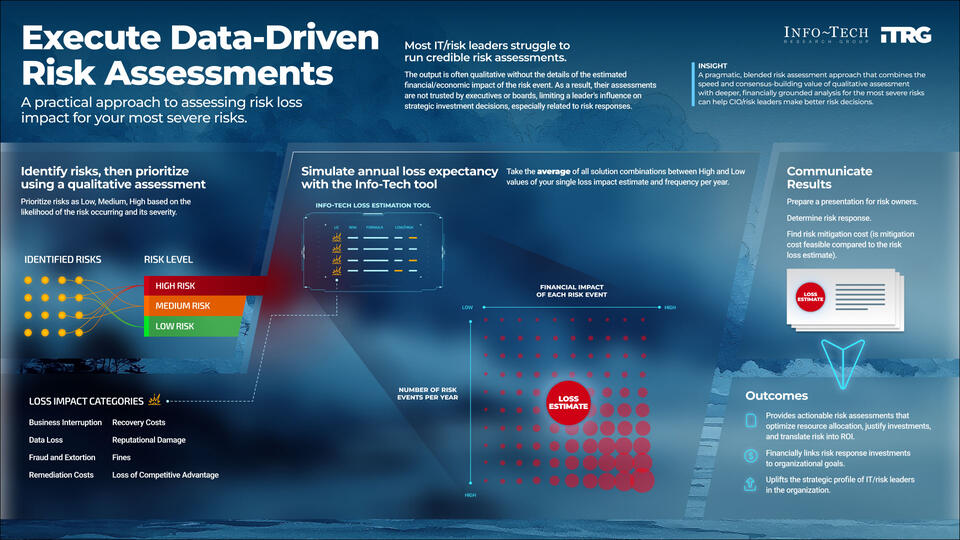
- Perform deeper quantitative financial assessment on prioritized risks by estimating single loss impact (SLI), occurrence frequency (OF), and annualized loss expectancy (ALE) to quantify exposure in clear financial terms.
- Communicate results and evaluate next steps in business terms by translating findings into priorities, aligning with risk appetite, and enabling risk owners and executives to make informed investment decisions.
Execute Data-Driven Risk Assessments
A practical approach to assessing risk loss impact for your most severe risks.
Analyst perspective
Deliver data-driven risk assessments for superior risk-informed decision-making.
As technology, geopolitical, and regulatory risks grow in both scale and interconnectedness, boards and executives are increasingly demanding risk insights that are decision grade, not merely descriptive. Yet many organizations remain constrained by qualitative, compliance-driven risk assessments that only classify risks as high, medium, or low without articulating what those risks mean in financial or business terms. This disconnect limits leaders' ability to prioritize investments, defend risk response budgets, or clearly communicate exposure across the enterprise. In this environment, risk assessments must evolve from static reporting exercises into analytically grounded inputs for strategic decision making.
This blueprint addresses that gap by introducing a pragmatic, blended approach to risk assessment that combines the speed and consensus building value of qualitative assessments with deeper, financially grounded analysis for the most severe risks. Rather than forcing organizations into overly rigid quantitative models or data heavy frameworks that are difficult to sustain, the methodology emphasizes proportionality: use qualitative scoring to filter and focus, then apply structured estimation techniques to simulate loss impact and occurrence frequency where it matters most. By anchoring risk discussions in concepts such as single loss impact and annualized loss expectancy – expressed as ranges rather than false precision – leaders gain a more credible and transparent view of uncertainty, tail risk, and trade-offs.
Financially grounded risk insights enable CIOs, CISOs, and enterprise risk leaders to compare risks across domains, align exposures with risk appetite, and evaluate whether the cost of mitigation is justified by the reduction in expected loss.

Anubhav (Anu) Sharma
Principal Research Director, CIO Research
Info-Tech Research Group
Get familiar with risk management terminology
| TERM | DESCRIPTION |
|---|---|
| Risk Management | The capability and practices used by an organization to manage risks. |
| Risk Appetite | The amount of risk an organization is willing to accept to achieve its goals/mandate. |
| Risk Assessment | The process of measuring and evaluating risk. |
| Risk Register | A tool used to identify and document potential and active risks in an organization and to track the actions in place to manage each risk. |
| Risk Response | The organization's decision on how to address identified risks (accept, mitigate, transfer, leverage or avoid). |
| Risk Tolerance | The amount of risk you are prepared or able to accept in a particular area or function. |
| Residual Risk | The amount of risk remaining after you have responded to a risk or implemented a mitigation approach (controls, monitoring, assurance). |
| Emergent Risk | Risk from new or unknown sources, many of which might be poorly understood but expected to grow in significance. |
| Risk Event | A risk occurrence (actual or potential) or a change of circumstances. Can consist of more than one occurrence or something not happening. Can be referred to as an incident or accident. |
| Qualitative Risk Assessment | Process that estimates the likelihood and impact of a risk event occurring that relies more on subjective judgment rather than numerical terms. |
| Risk Profile | A written description of a set of risks. |
| Risk Management Policy | A policy that expresses what must be established and done to ensure the organization can manage risks. |
| Risk Avoidance | The risk response where an organization chooses not to perform a particular action or maintain an existing engagement due to the risk involved. |
| Risk Acceptance | The risk response where you make an informed decision to take a particular risk. |
| Risk Transfer | The risk response where you transfer the risk to a third party. |
| Risk Mitigation | The risk response where an action is taken to reduce the impact or likelihood of a risk occurring. |
| Risk Identification | The process of finding, recognizing, categorizing, and documenting risks that could impact the achievement of objectives. |
| Risk Owner | The person or structure that has accountability and authority for a particular risk and decides on response. |
| Risk Likelihood | The chance of a risk occurring. Measured either mathematically using probability or qualitatively. |
| Quantitative Risk Assessment | Process that quantifies risk in numerical terms and is less reliant on subjective terms, though there is still a level of estimation involved. |
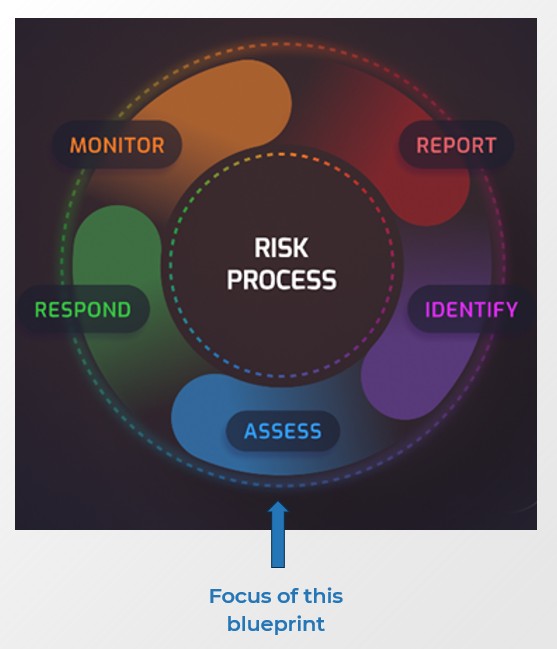
Where this blueprint fits in the risk process
If you are an enterprise risk management leader, this blueprint can help you to identify, assess, and measure enterprise risks to enable risk-informed decision-making.
If you are a CIO/IT Leader, this methodology can help you identify, assess, and measure technology-driven risks, which you can then bring up to enterprise leaders to ensure you have a strong data point based on which risk response decisions can be taken.
Executive summary
Your Challenge
- Many organizations remain constrained by qualitative, compliance-driven risk assessments that classify risks as high, medium, or low without articulating associated impact or costs. This makes it difficult for executives to determine appropriate funding and make strategic risk decisions.
- In today's global environment, as technology, geopolitical, and regulatory risks grow in both scale and interconnectedness, boards and executives are increasingly demanding risk insights that are decision grade, not merely descriptive.
- CIOs and executives need a blended approach to better evaluate their most severe risk exposures while balancing resource/time constraints.
Common Obstacles
- Siloed data sources and poor data quality: Leaders must contend with poor, inconsistent data records that increase difficulty in calculating losses.
- Inflexible estimation methods: Assessment methods do not leave room for range of estimation, leading to unreliable loss exposure values.
- Complex and time-consuming methods for calculating loss exposure due to risks lead to a bias toward qualitative assessments, which are less useful for financial and strategic decision-making.
- Resource constraints result in limited risk resources.
- Limited risk knowledge means organizations struggle to explain risk in financial/business value terms.
Info-Tech's Approach
Data-driven risk assessment is a practical approach to assessing risk loss impact for your most severe risks.
- Identify or review risks and create or update your risk register.
- Conduct a qualitative assessment of risks and filter the list down to your most severe risks.
- Conduct more-in-depth financial assessments for prioritized risks.
- Communicate results to risk owners and evaluate next steps in terms of risk response decisioning.
Info-Tech Insight
CIOs/risk leaders who cannot quantify their greatest risks in dollars will struggle to influence investment decisions, defend budgets, or earn a seat at the strategy table.
Risk leaders struggle to run actionable and financially grounded risk assessments
- Most organizations rely on qualitative risk assessments (marking risks as high, medium, low), which are quicker but tend to be more subjective in terms of assessing impact and cost of risks.
- Executives in today's uncertain times (see World Uncertainty Index) are seeking more details when making risk response investment decisions, especially for their most severe risks.
- This requires a more quantitative analysis of risks – which is more complex and resource intensive but provides better insights for decision-making.
- Hence, a blended approach between quantitative and qualitative can serve organizations well, which is what we advise in this blueprint.
Many enterprises rely primarily on qualitative assessments because they are faster and cheaper, even though they are subjective and lack fact-based financial grounding.
– ISACA, 2022
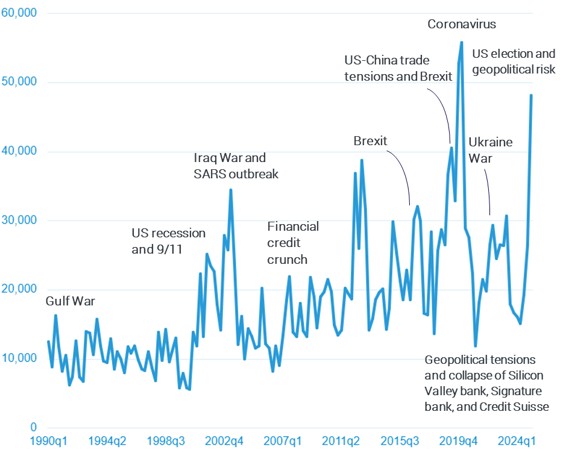
World Uncertainty Index (1990Q1 to 2025Q1)
Source: The World Uncertainty Index is a measure that tracks uncertainty across the globe by text mining the country reports of the Economist Intelligence Unit. The index is available for 143 countries.
This research is designed to help both technology and enterprise risk leaders run data-driven risk assessments
| CIO/IT Leader | Enterprise Risk Leader |
|---|---|
|
|
Leaders face several hindrances in conducting data-driven risk assessments
| 1 | Siloed data sources and poor data quality: CIOs/risk leaders must contend with poor and inconsistent data records that make it difficult to calculate asset values. Hyperproof's 2026 IT Compliance and Risk Benchmark Survey found that "39% of organizations struggle to find risk-related information when needed, largely due to siloed data." |
| 2 | Inflexible estimation methods: Assessment methods do not leave room for a range of estimation, leading to loss exposure values that cannot always be trusted. |
| 3 | Complex and time-consuming methodology for calculating loss exposure due to risks: This leads to a bias toward qualitative assessments, which are not as useful as more financially grounded risk assessments, especially for risk response decisioning. ISACA states that purely qualitative assessments can involve less critical thinking in a complex environment, with minimal data to back up any conclusions. |
| 4 | Resource constraints: Constrained budgets result in limited risk resources. |
| 5 | Limited risk knowledge: Organizations struggle to explain risk in financial or business value terms. |
Explore Info-Tech's approach to executing data-driven risk assessments
| Phase 1 | Phase 2 | Phase 3 | Phase 4 | |
|---|---|---|---|---|
| Activities | Identify or Review Key Risks | Conduct a Qualitative Assessment of Risks | Conduct a Deeper-Dive Financial Assessment for Prioritized Risks | Communicate Results and Evaluate Next Steps |
| 1.1 Assess completeness of risk register. If required, continue to steps 1.2 and 1.3. 1.2 Confirm risk taxonomy. 1.3 Identify risks across domains (e.g. cybersecurity, operational, regulatory, AI, data, infrastructure, vendor) through risk prompting/risk brainstorming techniques. |
2.1 Develop qualitative risk impact and likelihood scales. 2.2 Evaluate listed risk events qualitatively and identify the top one or two risk events for further deep dive. |
For each prioritized risk event: 3.1a Identify key factors required for estimating single event impact . 3.1b Calculate single event impact estimation in a range (low, high). 3.2a Identify possible data sources (internal/external) and control effectiveness for estimating occurrence frequency. 3.2b Make occurrence frequency estimation. 3.3 Arrive at annualized loss expectancy (ALE) impact. |
4.1 Develop next steps and recommendations. 4.2 Develop risk owner communication deck. |
|
| Outputs |
|
|
|
|
Insight summary
A pragmatic, blended risk assessment approach that combines the speed and consensus building value of qualitative assessment with deeper, financially grounded analysis for the most severe risks can help CIO/risk leaders make better risk decisions.
CIOs/risk leaders who cannot explain risk in business terms will struggle to influence investment decisions, defend budgets, or earn a seat at the strategy table.
Capturing risks across domains in a consistent taxonomy enables later aggregation and comparison.
Well-executed work in Phase 1 of this blueprint turns the risk register into a decision-ready artifact, not just a compliance document.
Qualitative scoring is not about precision – it is about building organizational consensus on what truly matters.
Phase 2 acts as a filter that preserves analytical effort – only risks that pass this screen deserve the cost and complexity of a further deep dive.
Quantification transforms risk from an abstract concern into a comparable economic trade-off.
Phase 3 reveals mismatches between perceived and actual risk drivers – for example, that financial exposure is driven more by prolonged downtime or regulatory penalties than by one-time remediation costs. It also surfaces data gaps and other concerns.
Risk insights only create value when they are translated into ownership, decisions, and action.
Effective communication at this stage reframes risks as choices – accept, mitigate, transfer, avoid, or exploit – rather than abstract exposures.
Developing the discipline of moving risks forward through the entire data-driven risk assessment outlined in this blueprint without losing context, intent, or ownership will help you make more risk-aware decisions.
Blueprint deliverables
Each step of this blueprint is accompanied by supporting artifacts to help you accomplish your goals:
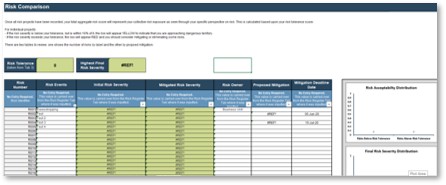
This structured Excel workbook helps you work through the activities throughout the blueprint and document your results.
Key deliverable:
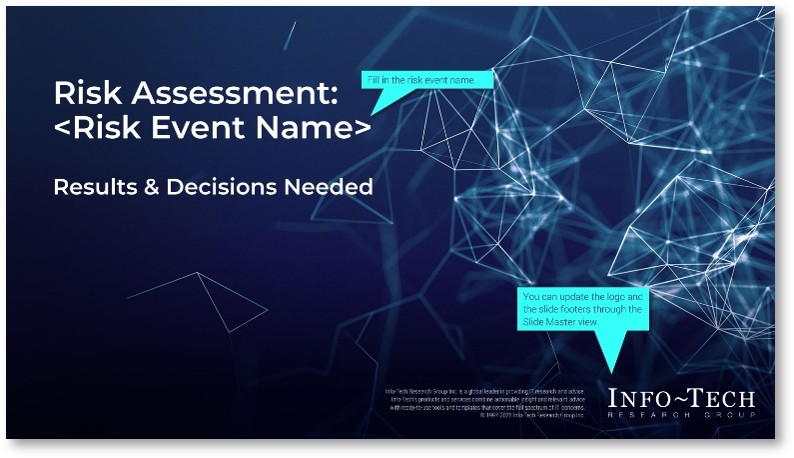
Risk Owner Communication Template
This deck will communicate the findings of the risk assessment exercise to risk owners for further decisioning
Measure the value of this research
Be ready to run better risk assessments whose results can be used to secure funding for risk responses.
- This research helps organizations develop a blended approach to risk assessment in which their most severe risks across a wide range of domains — e.g. Cybersecurity, Infrastructure, AI, data, Operations – can be evaluated in financial terms for better decision-making.
- Use this research to:
- Evaluate the current state of the organization's risk register and taxonomy.
- Conduct a qualitative assessment of risk events to filter down to most severe risks.
- Conduct a data-driven financially grounded risk assessment for better decisioning.
- Communicate loss impact to risk owners in a clear and concise format.
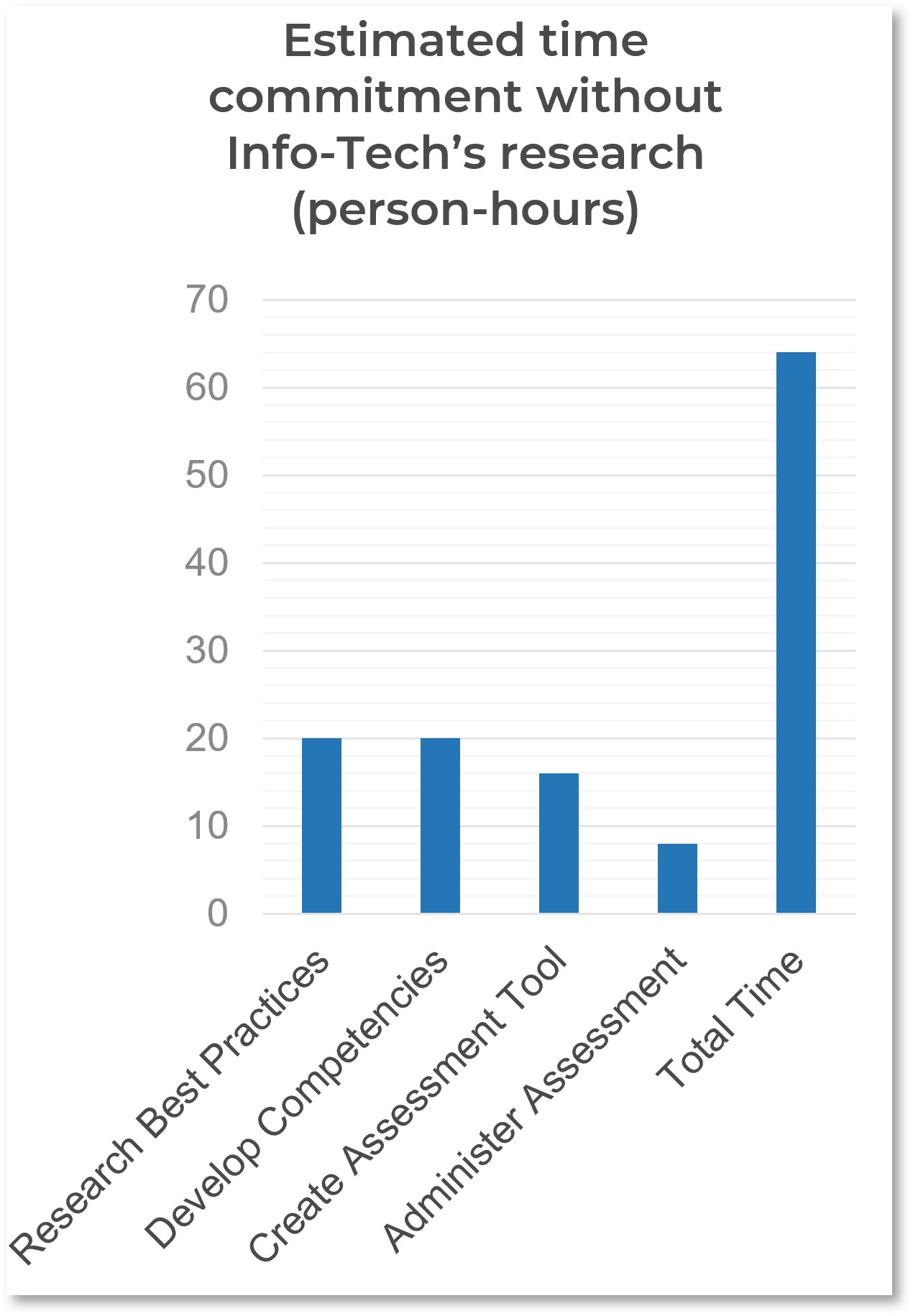
Most organizations would need to spend a great deal of money and resources to create and execute a blended risk assessment method.
Based on similar research and development efforts, we estimate that most organizations would take months to prepare a blended risk assessment methodology without our resources. That's nearly 65 hours per person multiplied by the number of people involved in researching and gathering data, conducting meetings and documenting findings for a total cost of thousands of dollars. Improve your success rate and reduce your effort by using Info-Tech's methodology, developed through the combined insights of seasoned Info-Tech experts as well as external industry viewpoints.
Value of this blueprint = Reduced effort and cost to develop a blended risk assessment method versus developing a similar document without Info-Tech's methodology and resources.
Example risk assessment journey: Acme Inc.
Company Profile:
Acme Inc. is a global semiconductor manufacturer specializing in advanced sensor technologies for automotive (original equipment manufacturer [OEM]).
Annual Revenue: $500 million
Employees: 1,500
Manufacturing facilities: US, Canada, UK, China
The Challenge:
Acme relies on a highly automated production environment, globally integrated enterprise resource planning (ERP), and cloud based lifecycle management systems that handle design files, engineering data, and intellectual property (IP). Amid rising geopolitical tensions, growing regulatory pressures, and a spike in cyberattacks targeting semiconductor IP, Acme faces mounting cyber and operational risks. Recently, Acme experienced a material data breach involving unauthorized access to its engineering design repository, which stores core sensor IP, product roadmaps, and manufacturing process specifications.
Forensic investigation indicated the intrusion likely persisted undetected for several weeks, with evidence of exfiltration of confidential design assets. The breach immediately elevated concerns across risk domains — cybersecurity, operational continuity, regulatory exposure, reputation, and potential loss of competitive advantage.
Executives realized that the company's current risk register understated interdependencies across its global operations and did not quantify financial exposure in a clear, decision ready manner. Recognizing the need to modernize the company's enterprise risk management (ERM) and IT risk practices, Acme's CIO, CISO, and CRO jointly sponsor a comprehensive risk assessment initiative grounded in Info Tech's blended (qualitative + financial) methodology. Their objectives are to rebuild confidence in the organization's ability to identify risks across business and technical domains; build consistent qualitative scoring scales; quantify financial exposures using single loss impact (SLI), occurrence frequency (OF), and annualized loss expectancy (ALE); and justify investments in cybersecurity, operational resilience, and IP protection.
Follow Acme's risk assessment journey throughout this blueprint:
Phase 1: Identify or Review Key Risks
Phase 2: Conduct a Qualitative Assessment of Risks
Phase 3: Conduct a Deeper-Dive Financial Assessment for Prioritized Risks
Phase 4: Communicate Results and Evaluate Next Steps
Phase 1
Identify or Review Key Risks
Phase 1
1.1 Assess completeness of the risk register
1.2 Confirm risk taxonomy
1.3 Identify risks across domains
Phase 2
2.1 Develop qualitative risk impact and likelihood scales
2.2 Evaluate listed risk events qualitatively and identify prioritized risk events for further deep dive
Phase 3
3.1 Identify key factors and estimate single event impact
3.2 Estimate occurrence frequency
3.3 Arrive at ALE impact
Phase 4
4.1 Develop next steps and recommendations
4.2 Build risk owner communication deck
This phase will produce the following outcomes:
- Filled-in risk register capturing a comprehensive view of the risk environment and risk events
This phase involves the following participants:
- For enterprise risk: CRO, business unit heads, internal audit, risk committee, risk SMEs
- For IT risk: CIO, CISO, business unit heads, internal audit, IT risk committee, risk SMEs
1.1 Assess completeness of risk register
Assess your readiness for running data-driven risk assessments by first reviewing your risk register and validating your risk taxonomy
This blueprint is part of a multistep risk journey. Before you jump into Phase 1, consider:
- Is your risk register up to date with key risks identified and documented?
- Are you using a common risk taxonomy?
- Have you documented your risk responses?
- Do you have a view of controls effectiveness?
- Is your organization's risk appetite well understood and incorporated into your risk outlook?
YES
Proceed to Phase 2
No
Continue with Phase 1
1.1 Assess completeness of risk register
1.1.1 Assess completeness of the risk register
30 minutes
On your own or with the assistance of your Info-Tech representative, assess:
- Is your risk register up to date with key risks identified and documented in the risk register?
- Are you using a common risk taxonomy?
- Have risk responses been documented, and do you have a view of controls effectiveness?
- Do you understand the risk appetite of the organization, and have you incorporated that in your risk outlook?
If the answer is "yes" to all the above, you can skip to Phase 2. Otherwise, continue on to steps 1.2 and 1.3.
| Input | Output |
|---|---|
|
|
| Materials | Participants |
|
|
1.2 Confirm risk taxonomy
What is a risk taxonomy?
A risk taxonomy provides a common risk view and enables integrated risk
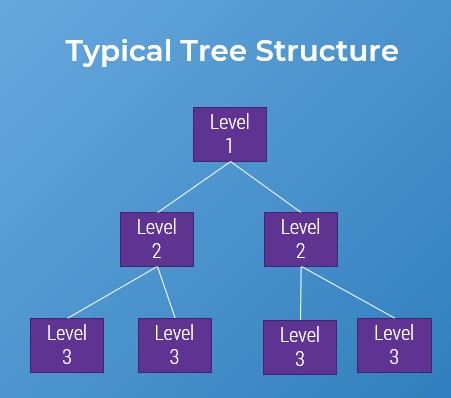
- A risk taxonomy is the (typically hierarchical) categorization of risk types organized by a classification scheme.
- Its purpose is to assist with the management of an organization's risk by arranging risks in a classification scheme.
- It provides foundational support across the risk management lifecycle in relation to each of the key risks.
- More material risk categories form the root nodes of the taxonomy, and risk types cascade into more granular manifestations (child nodes).
- From a risk management perspective, a taxonomy will:
- Enable more effective risk aggregation and interoperability.
- Provide the organization with a complete view of risks and how risks might be interconnected or concentrated.
- Help organizations form a robust control framework.
- Give risk managers a structure to manage risks proactively.
1.2 Confirm risk taxonomy
Example: Commonly used ERM Level 1 risk categories
Although many organizations have expanded their enterprise risk management taxonomies to address new threats, most organizations will have the following level 1 risk types:
| ERM Level 1 | Definition | Definition Source |
| Financial | The ability to obtain sufficient and timely funding capacity. | Global Association of Risk Professionals (GARP) |
| Operational & Technology | Risk to the organization's ability to operate and product value, including technology. | COSO ERM Info-Tech Research Group |
| Reputational | Potential negative publicity regarding business practices, regardless of validity. | US Federal Reserve Global Association of Risk Professionals (GARP) |
| Strategic | Risk of unsuccessful business performance due to internal or external uncertainties, whether the event is driven by events or trends. Actions or events that adversely impact an organization's strategies and/or implementation of its strategies. | The Risk Management Society (RIMS) |
| Sustainability (ESG) | The risk of any negative financial or reputational impact on an organization stemming from current or prospective impacts of ESG factors on its counterparties or invested assets. | Open Risk Manual Info-Tech Research Group |
| Talent and Risk Culture | The widespread behaviors and mindsets that can threaten sound decision-making, prudent risk-taking, and effective risk management and can weaken an institution's financial and operational resilience. | Info-Tech Research Group |
1.2 Confirm risk taxonomy
Structuring your risk taxonomy
Do's
- Ensure your organization's values are embedded into the risk types.
- Design your taxonomy to be forward-looking and risk-based.
- Make Level 1 risk types generic so they can be used across the organization.
- Ensure each risk has its own attributes and belongs to only one risk type.
- Collaborate on and communicate your taxonomy throughout the organization.
Don'ts
- Don't develop risk types based on function.
- Don't develop your taxonomy in a silo.
A successful risk taxonomy is forward-looking and codifies the risk language most frequently used across your organization.
About Info-Tech
Info-Tech Research Group is the world’s fastest-growing information technology research and advisory company, proudly serving over 30,000 IT professionals.
We produce unbiased and highly relevant research to help CIOs and IT leaders make strategic, timely, and well-informed decisions. We partner closely with IT teams to provide everything they need, from actionable tools to analyst guidance, ensuring they deliver measurable results for their organizations.
What Is a Blueprint?
A blueprint is designed to be a roadmap, containing a methodology and the tools and templates you need to solve your IT problems.
Each blueprint can be accompanied by a Guided Implementation that provides you access to our world-class analysts to help you get through the project.
You get:
- Execute Data-Driven Risk Assessments Storyboard
- Risk Assessment Workbook
- Risk Owner Communication Template
Talk to an Analyst
Our analyst calls are focused on helping our members use the research we produce, and our experts will guide you to successful project completion.
Book an Analyst Call on This Topic
You can start as early as tomorrow morning. Our analysts will explain the process during your first call.
Get Advice From a Subject Matter Expert
Each call will focus on explaining the material and helping you to plan your project, interpret and analyze the results of each project step, and set the direction for your next project step.
Unlock Sample ResearchContributors
- 2 anonymous contributors
 Optimize IT Governance for Dynamic Decision-Making
 Maximize Business Value From IT Through Benefits Realization
 Build an IT Risk Management Program
 Review and Improve Your IT Policy Library
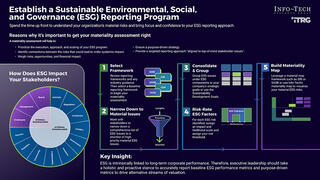 Establish a Sustainable ESG Reporting Program
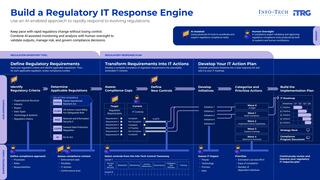 Build a Regulatory IT Response Engine
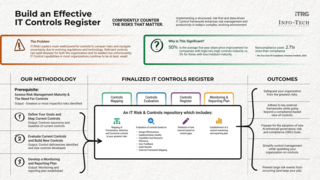 Build an Effective IT Controls Register
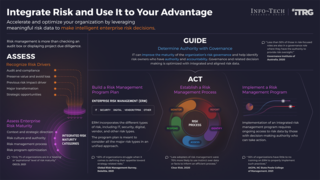 Integrate IT Risk Into Enterprise Risk
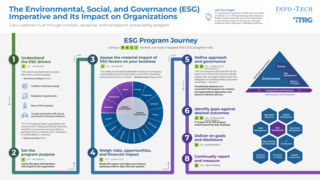 The ESG Imperative and Its Impact on Organizations
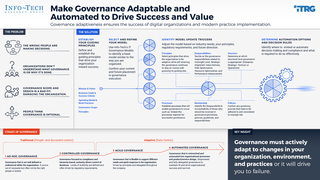 Make Your IT Governance Adaptable
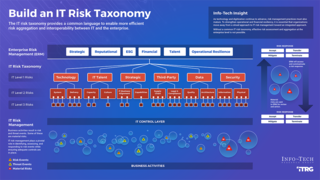 Build an IT Risk Taxonomy
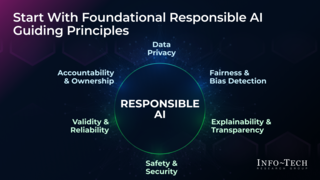 Prepare for AI Regulation
 Building the Road to Governing Digital Intelligence
 Identify and Respond to Credible Threats Arising From Global Uncertainty
 GRC Software Selection Guide
 Establish Your Adaptive AI Governance Program: From Principles to Practice
 Build an Integrated Enterprise Risk Management Program
 Govern Enterprise AI Agents While Preserving Innovation
 Execute Data-Driven Risk Assessments