Teradata Provides Smart Context and Spreads to OneLake
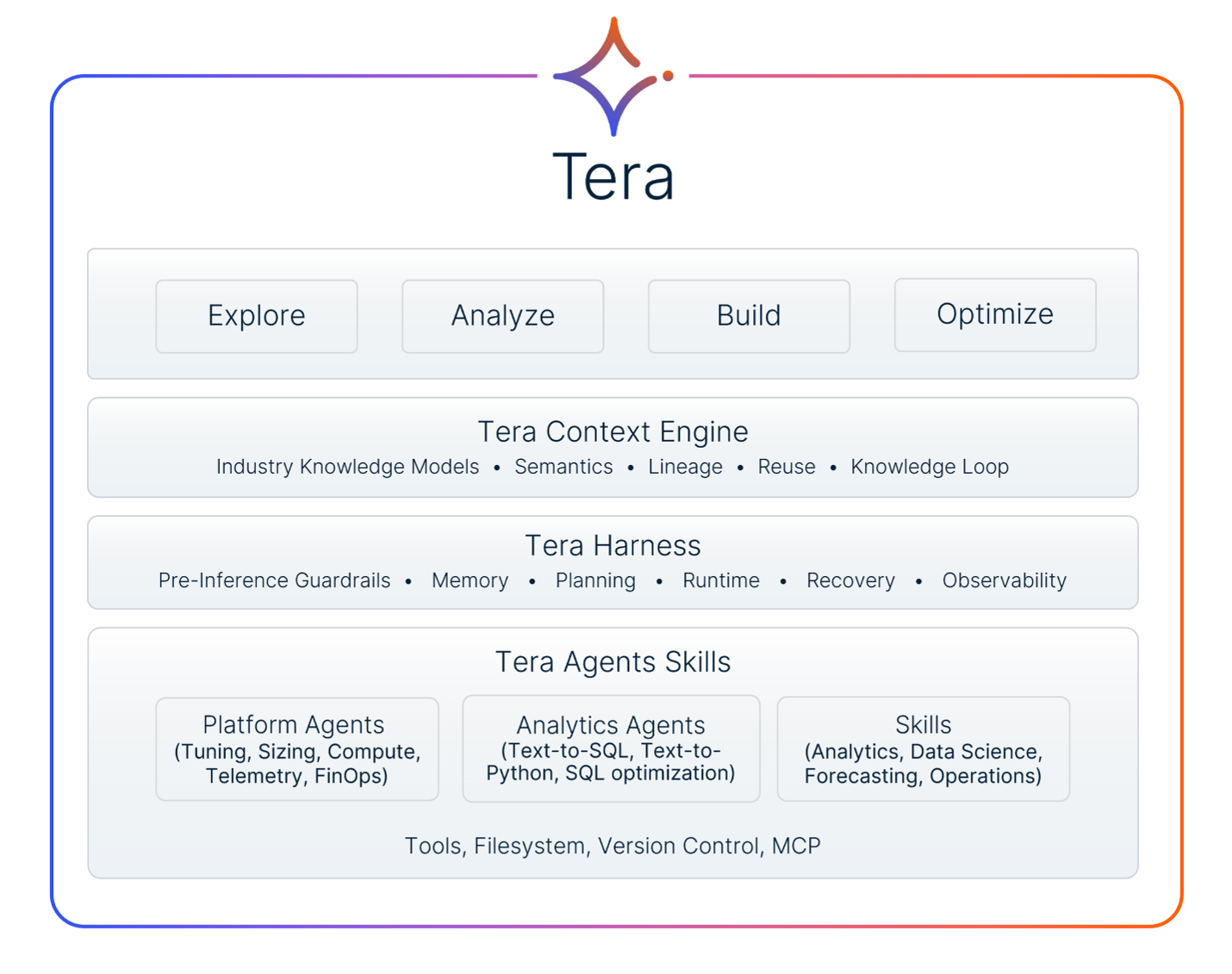
Image source: Teradata press release, 2026
Teradata’s September announcements reveal a strategy for remaining relevant as enterprise data spreads across cloud platforms: Bring business understanding and analytical capabilities to wherever customers keep their data. On September 2, Teradata announced available read access to Microsoft OneLake. On September 22, it introduced Tera Context Engine, Tera Harness, and Agent Skills, scheduled for Q4 2026. Together, these moves position Teradata to serve customers without requiring them to consolidate their data in a Teradata database.
The strategic logic is compelling. Access to enterprise data gives an AI agent material to work with, and context helps it understand what that material means. Context is power, to paraphrase the famous “scientia potentia est” (knowledge is power). An agent answering a profitability question needs more than table names. It needs approved calculations, valid relationships, allocation rules, and an understanding of which information it may use. Teradata is seeking to supply that business understanding while extending the reach of its analytical engine.
Tera Context Engine connects metadata, business meaning, lineage, policies, and provenance through a native context graph. Its Industry Knowledge Models provide reusable industry concepts and rules, while its “neurosymbolic” approach combines explicit knowledge with statistical AI. Teradata also describes bidirectional integration that can return enriched context to existing catalogs, pipelines, and BI environments. The potential benefit is less repeated interpretation by agents and less manual reconstruction of business knowledge by customers.
Why the Tera Context Engine is different from Microsoft, AWS, and Google offerings
- Multistorage/cloud scale. Each hyperscaler layer describes the data it hosts. Teradata claims to be a layer that spans platforms, clouds, and on-premises systems. For a mixed estate, that is very important.
- Prebuilt knowledge. Fabric IQ and AWS Context Ontology Accelerator rely on customers and domain experts to build or refine ontologies. Teradata pairs autonomous semantic mapping with Industry Knowledge Models built from Teradata's human-validated expertise. That addresses the blank canvas problem early Fabric IQ users report. The cost is services dependency, since Teradata ties it to AI services.
- Context bundled with execution. Tera Harness applies 84 execution patterns before inference, embeds guardrails in the agent loop, and checkpoints long-running work. As a result, Teradata promises a lower and more predictable inference cost.
Microsoft’s strongest advantage is continuity. Organizations can extend business definitions already embedded in Power BI into Fabric IQ, with OneLake providing the data foundation. Teradata’s opportunity is greater where enterprise knowledge spans multiple platforms and cannot be adequately represented through a Microsoft-centered architecture. Yet Microsoft allegedly also supports external ontology imports (still in preview), which would minimize Teradata’s advantage.
AWS Context explicitly combines inferred relationships, human curation, permissions, and learning from agent activity. Its support for third-party catalogs and Iceberg-based metadata portability means that Teradata must substantiate neutrality through deployment choices, interoperability, and practical customer control. Connecting to external systems alone will not be enough.
Google’s Knowledge Catalog aggregates context across platforms and catalogs, enriches it from structured and unstructured sources, and supplies relevant context to agents. It also incorporates verified query patterns and semantic guardrails. Consequently, Teradata’s emphasis on reducing probabilistic guesswork is valuable, but it is already shared across the market.
Teradata’s strongest potential distinction is the combination of packaged industry expertise, flexible deployment, and execution of enterprise data work. Industry models could shorten implementation if they accurately capture customers’ operating rules. Deployment across cloud, on-premises, and sovereign environments could matter where a hyperscaler-centered service is unsuitable. Tera Harness complements the Context Engine by coordinating tools, models, approvals, and durable workflows, but it belongs to the broader Teradata architecture.
The test will be how much customer-specific work remains. An industry model can supply a starting vocabulary, but it cannot independently settle an enterprise’s disputed revenue definition or determine which local exception is legitimate. Teradata will need to show that its approach reduces the effort of establishing and maintaining trusted context, with explainable mappings and controlled changes.
OneLake provides a practical route to proving that value. The announced integration lets Teradata read OneLake tables through Iceberg APIs, using Microsoft Entra ID for authentication. Customers can combine information across the two environments without maintaining a replicated analytical dataset. However, this is read access: It does not establish OneLake writeback, automatic reuse of Power BI calculations, or equivalence to a native Fabric workload.
Our Take
Chances on Microsoft OneLake
Data access: good. The integration uses open standards and Microsoft's own authentication. The data stays in OneLake, which suits Microsoft.
Context layer: a real opening, but time-limited and uncertain.
- The opening. An immature, OneLake-bound ontology is a weak neutral layer. A Fabric shop that also runs Teradata, or any other non-OneLake data, has a semantic gap Fabric IQ cannot close today. Fabric IQ's reach ends at OneLake, while Teradata can read OneLake and sit across the rest.
- The unstable integration target. Microsoft exposes the ontology through a preview MCP server. Its documentation warns that preview tool names and parameters might change and hard-coded dependencies should be avoided. A path for Tera to consume Fabric IQ exists, but Teradata would be building on moving ground.
- The window. Microsoft expects ontology GA within months, and V2 is aimed at the gaps above. Teradata's Q4 release lands in the same period, so Teradata is racing a product that is improving.
- Purview. Fabric shops Purview already as the business-context layer, so Teradata faces an incumbent beyond Fabric IQ.
- Write-back. The Context Engine is meant to write back to systems of record, and OneLake access is read-only today.
Teradata Positioning
Teradata has credible prospects among enterprises already operating both Teradata and Fabric but a harder path among customers starting entirely within Fabric. Existing customers have a clear reason to extend established analytical workloads to OneLake data. For them, the integration can support gradual modernization and preserve useful investments. A customer without Teradata must justify an additional platform, operating model, and commercial relationship.
Winning those new customers will require measurable advantages on demanding workloads: predictable performance under concurrency, lower total cost for a defined outcome, or materially faster deployment of an industry use case. Avoiding replication helps but does not eliminate data transfer during query execution or guarantee superior performance. Buyers should also verify policy enforcement end to end. Microsoft’s external-engine security architecture requires specific integration for row- and column-level controls.
The most promising commercial approach is therefore selective: Solve a difficult, valuable problem on OneLake, reuse the customer’s trusted definitions, and expand from demonstrated results. If Teradata requires organizations to maintain competing versions of business meaning, its context offering will create another governance burden. If it can reconcile existing knowledge and execute demanding workloads economically, OneLake could become a meaningful expansion channel.
Teradata does not need to become the default engine for every Fabric customer to succeed. It needs to earn a durable role in enterprises whose analytical and governance requirements justify additional capabilities. These announcements create that opportunity. Production evidence will determine whether smart context becomes a reason to buy Teradata.