
Prioritize IT Requests for Capability‑Aligned Transformation
Laying the foundation to enable scalable AI.
- AI is layered on business processes never designed for autonomous machine execution at operational scale.
- Processes are manual, non-linear, and riddled with undocumented exceptions.
- Institutional knowledge lives in people, not in systems.
- As a result, agents hit exceptions they can't handle, producing failed outputs, manual overrides, and silent errors.
Our Advice
Critical Insight
- AI doesn't clear process debt; it amplifies every flaw at automated scale, turning isolated failures into systemic outcomes.
- The market over-indexes on vendor capabilities and ignores the more fundamental question: can the organization actually run what it buys?
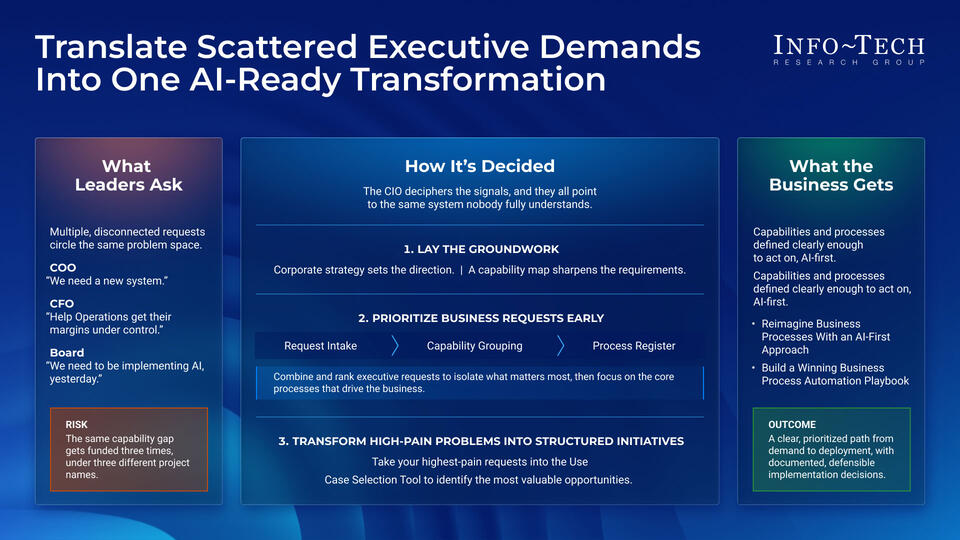
- Companies don't fail to see AI's value; they fail to map the processes underneath it with the accuracy an agent requires. Structuring and prioritizing demand upfront is what separates those who scale AI from those trapped in repeated pilot failure.
Impact and Result
- A capability-aligned, pain-scored register that consolidates scattered executive requests and surfaces the highest-impact problems to act on.
- Clear, defensible go/no-go decisions that focus AI investment on real operational demand rather than the loudest voice in the room.
- A high-level process register – owners named and key processes defined – ready to feed downstream AI-first redesign and further research.
About Info-Tech
Info-Tech Research Group is the world’s fastest-growing information technology research and advisory company, proudly serving over 30,000 IT professionals.
We produce unbiased and highly relevant research to help CIOs and IT leaders make strategic, timely, and well-informed decisions. We partner closely with IT teams to provide everything they need, from actionable tools to analyst guidance, ensuring they deliver measurable results for their organizations.
What Is a Blueprint?
A blueprint is designed to be a roadmap, containing a methodology and the tools and templates you need to solve your IT problems.
Each blueprint can be accompanied by a Guided Implementation that provides you access to our world-class analysts to help you get through the project.
Need Extra Help?
Speak With An Analyst
Get the help you need in this 3-phase advisory process. You'll receive multiple touchpoints with our researchers, all included in your membership.
Guided Implementation 1: Request Intake
- Call 1: Scope your executive requests and stand up structured intake with pain scoring.
Guided Implementation 2: Capability Clusters
- Call 1: Assign requests by business capability.
- Call 2: Review the pain ranking; decide go/no-go.
Guided Implementation 3: Process Register
- Call 1: Name the key processes behind each priority request and build the process register.
- Call 2: Document each process and plan the AI-ready redesign.
Contributors
- Heather Munoz, Research Director, Info-Tech Research Group
- Elizabeth Silva Smulski, Senior Executive Counselor, Info-Tech Research Group
- Mahmoud Ramin, Research Lead, Info-Tech Research Group
- Craig Broussard, Senior Executive Counselor, Info-Tech Research Group
- Andrew Kum-Seun, Research Director, Info-Tech Research Group
- Michel Hebert, Practice Lead, Info-Tech Research Group
- 3 anonymous