
Identify Use Cases to Inform an AI Strategy for Professional Services
From promise to practice: Select and prioritize AI use cases for professional service organizations.
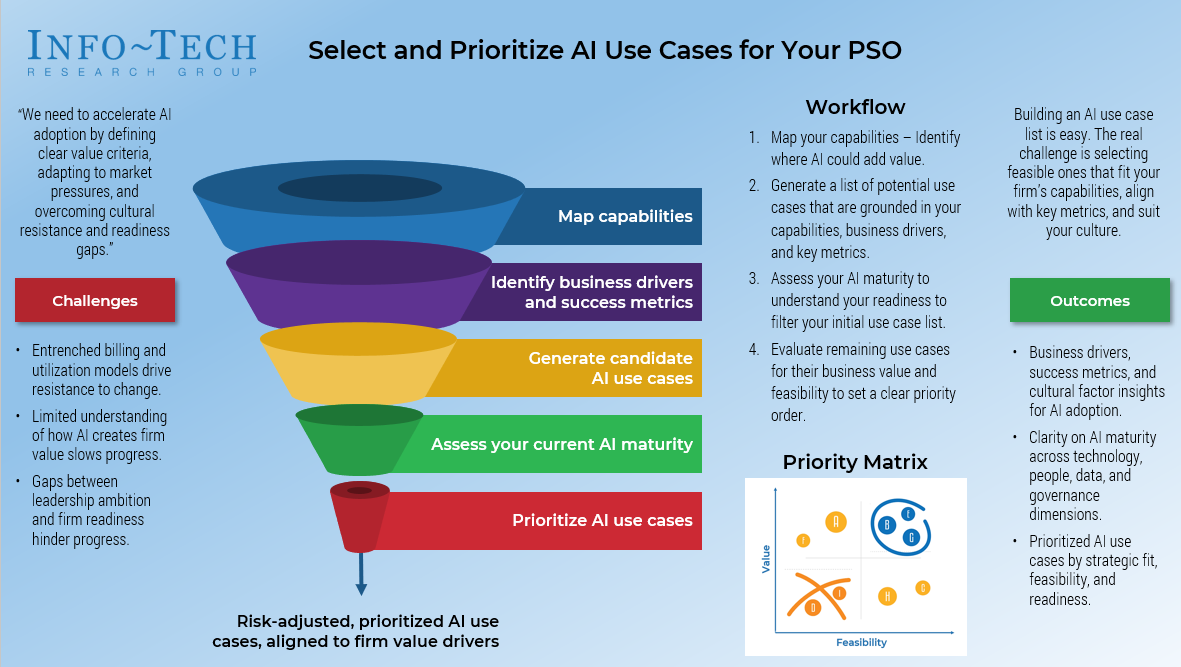
Professional service organizations face pressure to demonstrate AI value amid market and margin constraints yet struggle with feasibility, governance, and cultural resistance. Success depends on aligning AI use cases with business capability and maturity while managing costs and the threat to the traditional billing model. They also face other challenges, such as:
- Defining clear criteria and governance to avoid over investing in non-scalable initiatives and eroding confidence in overall AI adoption.
- Addressing the conflict with the traditional billing model plus cultural barriers such as adoption resistance.
- Selecting AI use cases with a clear link to profitability, utilization, or client satisfaction – ensuring that you are measuring outcomes, not just activity.
Our Advice
Critical Insight
- Professional service firms face a variety of obstacles in solving this problem, including lack of clarity on how AI will benefit their organization, governance gaps, and a mismatch between leadership ambition and overall firm readiness.
- Based on this, firms struggle to select and prioritize use cases, lack clarity on which metrics they should focus on impacting, and underestimate the cultural resistance to adoption.
Impact and Result
This research will enable professional service organizations to:
- Gain clarity on the most valuable and feasible AI use cases for their organization.
- Understand their current level of maturity from an AI-implementation perspective and opportunities for further refinement.
- Focus their AI initiatives on measurable improvements in efficiency, client value, and competitive positioning.
Select and Prioritize AI Use Cases for Your Professional Service Organization
From promise to practice.
Analyst Perspective
Embed AI with discipline, clarity, and human oversight.
Professional Service organizations (PSOs) face acute profitability pressures, driving leaders to urgently pursue AI initiatives to capture internal efficiency and drive client value. However, the traditional billing and utilization model with its embedded cultural resistance is at odds with leadership's AI ambition and firm-level feasibility. Professionals also remain concerned about AI model accuracy, privacy of client data, bias, and regulatory compliance. These structural and cultural barriers further complicate and slow adoption.
While it is not difficult to generate a list of opportunities, the challenge is how to select and prioritize use cases that deliver measurable, enduring value. Many PSOs struggle to define clear metrics for success leading to the early abandonment of projects due to unforeseen delays and costs. Success requires a highly disciplined approach that aligns with organizational capabilities, AI maturity, and cultural readiness. Furthermore, ROI definition must be widened to include long-term strategic benefits such as improved competitive positioning, client satisfaction, and talent retention.
Sustained success depends on a human-in-the-loop approach where upskilled professionals validate the outputs and retain decision-making responsibilities. Finally, adoption work must be iterative, focusing on injecting AI into workflow design versus simply layering on tools. In this way, organizations can build trust, capability, internal skill sets, and governance maturity. By taking a disciplined, metric-driven, human-centric approach, PSOs can move beyond the hype and deliver durable value and a sustained competitive advantage.

Kassim Dossa, MBA
Research Director
Info-Tech Research Group
Executive Summary
Your Challenge
PSO leaders are under pressure to demonstrate measurable value from AI opportunities due to sector profitability pressures. Unfortunately, firms find it challenging to balance business impact, feasibility, and ambition.
- Defining clear criteria and governance to avoid over investing in nonscalable initiatives and eroding confidence in overall AI adoption.
- Addressing the conflict with the traditional billing model plus cultural barriers such as adoption resistance.
- Selecting AI use cases with a clear link to profitability, utilization, or client satisfaction – ensuring that you are measuring outcomes, not just activity.
Common Obstacles
Business stakeholders need to cut through the hype surrounding AI, like ChatGPT, to optimize investments for leveraging this technology to drive business outcomes. The key barriers to success include:
- Managing expectations of elongated benefits realization timelines along with talent, culture, and integration costs.
- Gaps in data governance and AI maturity forming that undermine execution.
- Cultural resistance tied to the threat to professional identity coupled with the optics of using AI to deliver outputs.
- Underestimating feasibility factors across cost, timelines, and change management dimensions.
Solution
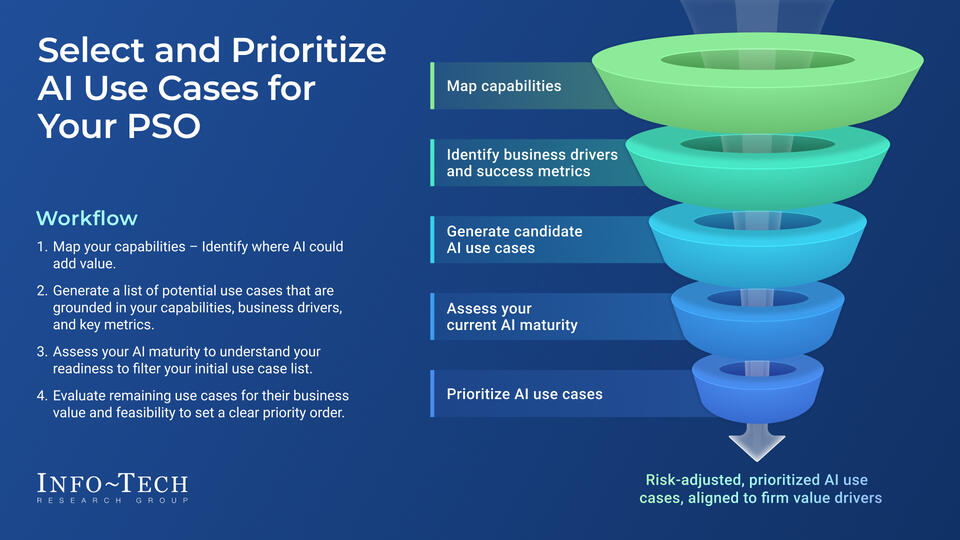
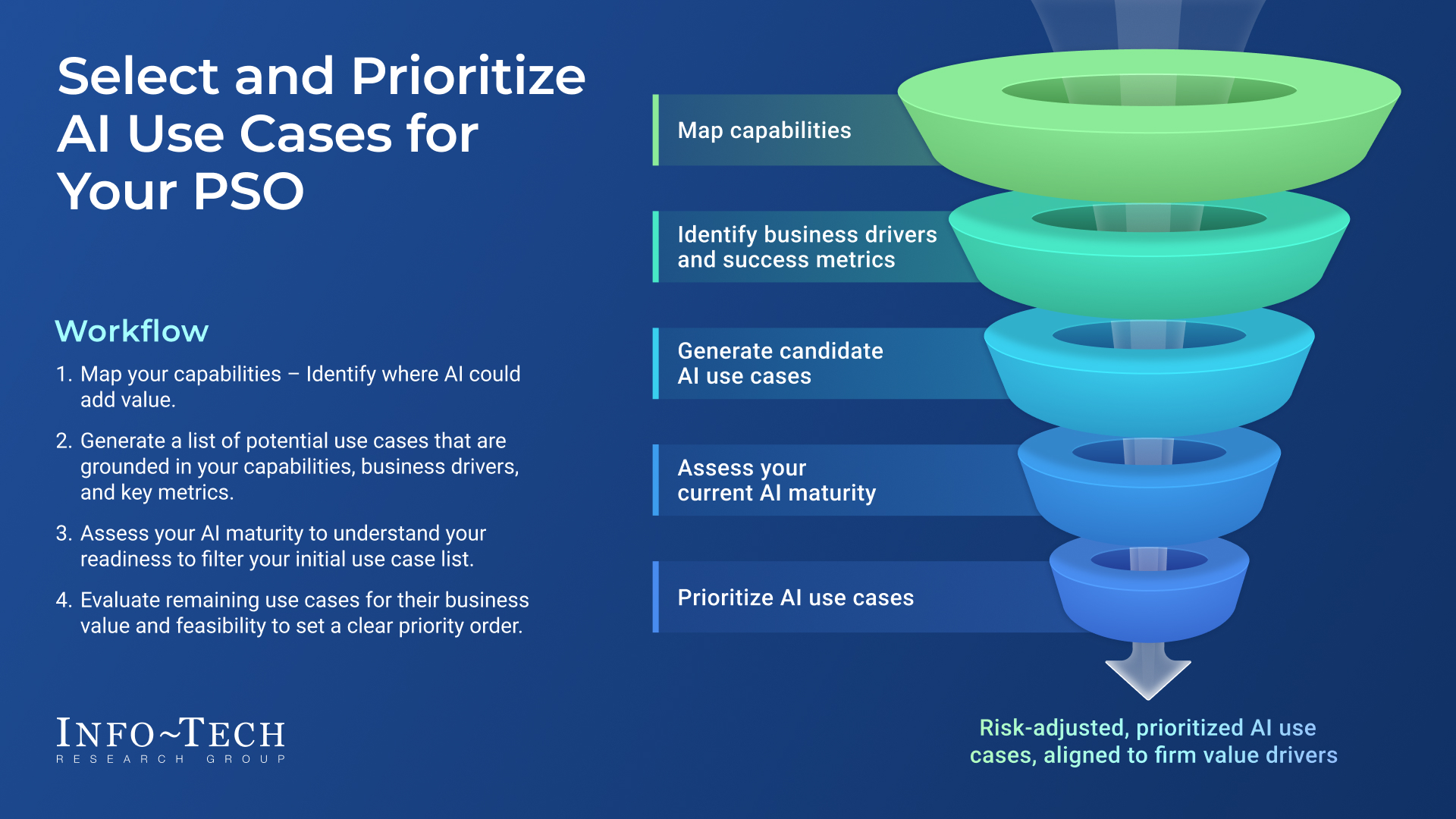
Info-Tech's human-centric, value-based approach is a guide for selecting and prioritizing AI use cases:
- Leverage a PSO-specific business reference architecture to identify organization-aligned AI use cases and key metrics you want to improve.
- Evaluate the firm's AI maturity as part of the use case feasibility evaluation process.
- Select and prioritize AI-based use cases across industry value drivers, while understanding the execution implications.
- Layer in governance structures to create conditions for success.
Info-Tech Insight:
Firms struggle to select and prioritize AI use cases as they lack clarity on the metrics they want to impact, coupled with the underestimation of cultural resistance to change in how value is delivered.
Key concepts
AI Vision Statement
An effective AI vision statement is usually forward-looking and aspirational and reflects the organization's commitment to leveraging AI to deliver positive and responsible outcomes.
Strategic AI Principles
Guiding principles that align the business strategy with the AI strategy and reflect the organization's overall approach to the use of AI. Whether AI should be used or not and the decision to buy or build the AI application are examples of strategic principles.
Responsible AI Principles
Guiding principles to govern the development, deployment, and maintenance of AI applications to mitigate the possible risks of deploying AI-based applications. In addition, these principles also address human-based requirements that AI applications should address.
AI Strategy
A business-driven AI strategy is aligned with the organizational strategy of the firm. Key components of the AI strategy include:
- AI Vision and Mission Statements
- Business Value Drivers
- Strategic AI Principles
- Responsible AI Principles
Business Value Drivers
These drivers represent the how value is recognized by the organization and are used to ensure candidate AI initiatives are aligned to the goals and objectives of the organization.
AI Maturity Model
AI strategic directions are part of the overall strategic planning process and are designed to align AI initiatives with the organization's vision and goals. These directions provide a roadmap regarding where to leverage AI to maximize the benefits to the organization.
Your challenge
Transform your bottom-line with business-informed AI initiatives.
- Develop a business-capability-driven AI strategy for your professional services organization while minimizing investment, business, and compliance risk.
- Determine the best-fit AI use cases aligned with your organization's business and AI maturity.
- Understand the best practices to govern the risks with developing or deploying AI applications within a professional services context.
- Have clear metrics in place to measure the progress and success of AI initiatives.
- Balance the trend of AI-commodification of expertise that was usually held within PSOs in the form of proprietary models and knowledge while finding augmentation opportunities to drive incremental customer and firm value.
- Address the urgent need to upskill team members to optimize productivity, resource allocation and enhance customer engagement while margin compression continues.
"74% of companies have yet to show tangible value from their use of AI."
– Boston Consulting Group , 2024.
Common obstacles
Why your AI projects stall out.
- Inability to easily define an AI strategy and tie it to true, measurable benefits with an ever-expanding universe of increasingly complex tools.
- Pressure to keep billing utilization high reduces willingness and time available for upskilling, process redesign, and pilots.
- Misaligned focus on low-impact use cases vs. metric-driven, value-realization opportunities, which are generally found in complex, inefficient processes.
- Challenges in data readiness that span quality, privacy, security, and governance, including the use of legacy systems.
- Management of concerns across ethical use of AI, model bias, and compliance in regulatory contexts.
- Successfully justifying the business case for AI initiatives, while understanding the true costs and risks.
- Low organizational readiness characterized by a lack of understanding, stakeholder alignment on strategy, AI talent, capacity, and cultural resistance.
Only 29% of professionals believe that they have a good understanding of practical applications of AI.
Thomson Reuters, 2025
Only 26% of companies made significant improvements in upskilling and development in the last 12 months.
The Adecco Group, 2024
Measure the value of this blueprint
Leverage this blueprint's approach to ensure your AI use cases align with and support your key business drivers and speed time to value.
| With Info-Tech Resources | Without Info-Tech Resources | |||
| Project Steps | Time | Average Cost (USD) | Time | Rationale |
| Capability and Strategy Mapping | 0.5-1 day | $7,500-$10,000 | 3-5 days | Creation of a reference architecture & facilitation |
| Use Case Generation | 0.5-1 day | $5,000-$7,500 | 2-3 days | Consultant facilitation |
| Maturity Assessment | 1-2 days | $5,000-$7,500 | 3-4 days | Assessment development & facilitation |
| Use Case Prioritization | 1 day | $5,000-$7,500 | 2-3 days | Scoring matrix & facilitation |
| Effort | 3 – 5 days | $22,500-$32,500 | 10-15 days | |
| Business Outcome Objective | Key Success Metric |
|---|---|
| Revenue Growth | Expand top line revenue. |
| Cost Efficiency | Reduction in delivery & administrative costs. |
| Process Effectiveness | Improved delivery speed, accuracy, and client experience. |
| Risk & Compliance | Reduced regulatory penalties and incidents. |
Info-Tech offers various levels of support to best suit your needs
| DIY Toolkit | Guided Implementation | Workshop | Consulting |
|---|---|---|---|
| "Our team has already made this critical project a priority, and we have the time and capability, but some guidance along the way would be helpful." | "Our team knows that we need to fix a process, but we need assistance to determine where to focus. Some check-ins along the way would help keep us on track." | "We need to hit the ground running and get this project kicked off immediately. Our team has the ability to take this over once we get a framework and strategy in place." | "Our team does not have the time or the knowledge to take this project on. We need assistance through the entirety of this project." |
Diagnostics and consistent frameworks are used throughout all four options.
About Info-Tech
Info-Tech Research Group is the world’s fastest-growing information technology research and advisory company, proudly serving over 30,000 IT professionals.
We produce unbiased and highly relevant research to help CIOs and IT leaders make strategic, timely, and well-informed decisions. We partner closely with IT teams to provide everything they need, from actionable tools to analyst guidance, ensuring they deliver measurable results for their organizations.
What Is a Blueprint?
A blueprint is designed to be a roadmap, containing a methodology and the tools and templates you need to solve your IT problems.
Each blueprint can be accompanied by a Guided Implementation that provides you access to our world-class analysts to help you get through the project.
Need Extra Help?
Speak With An Analyst
Get the help you need in this 3-phase advisory process. You'll receive multiple touchpoints with our researchers, all included in your membership.
Guided Implementation 1: Understand Firm Capabilities and Candidate Use Cases
- Call 1: Scope requirements, objectives, and your specific challenges.
- Call 2: Define AI vision statement.
- Call 3: Identify strategic principles.
- Call 4: Establish responsible AI guiding principles.
Guided Implementation 2: Assess the AI Maturity of Your Firm
- Call 1: Assess the organization’s current state capabilities for managing AI.
- Call 2: Identify candidate business capabilities to be addressed by AI-based solutions.
- Call 3: Assess the value and feasibility for the business AI initiatives.
- Call 4: Prioritize the business AI initiatives.
Guided Implementation 3: Prioritize AI Use Cases
- Call 1: Build a strategy roadmap.
- Call 2: Build a communication plan.
- Call 3: Build an executive AI strategy roadmap deck.
Contributors
- CJ Saretto, Chief Technology Officer, Axiom Law
- Bryan Tonne, SVP – Enterprise Technology, VGM Group