
Establish Effective Security Governance & Management
The key is in stakeholder interactions, not policy and process.
- The security team is unsure of governance needs and how to manage them.
- There is a lack of alignment between key stakeholder groups
- There are misunderstandings related to the role of policy and process.
Our Advice
Critical Insight
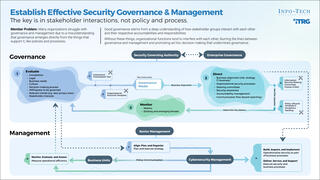
Good governance stems from a deep understanding of how stakeholder groups interact with each other and their respective accountabilities and responsibilities. Without these things, organizational functions tend to interfere with each other, blurring the lines between governance and management and promoting ad–hoc decision making that undermines governance.
Impact and Result
- The first phase of this project will help you establish or refine your security governance and management by determining the accountabilities, responsibilities, and key interactions of your stake holder groups.
- In phase two, the project will guide you through the implementation of essential governance processes: setting up a steering committee, determining risk appetite, and developing a policy exception-handling process.
Member Testimonials
After each Info-Tech experience, we ask our members to quantify the real-time savings, monetary impact, and project improvements our research helped them achieve. See our top member experiences for this blueprint and what our clients have to say.
Client
Experience
Impact
$ Saved
Days Saved
Donor Network West
Guided Implementation
10/10
$13,700
5
getting expert understanding in this space is very important to our organization. worst part is when the models don't have clear definition on the ... Read More
ATS CORPORATION
Guided Implementation
10/10
$25,000
20
Fritz Jean-Lois provided valuable guidance in quickly developing our security governance and management plan to support our goal of maturing the se... Read More
Sage Therapeutics
Workshop
10/10
N/A
N/A
The workshop was very insightful and I enjoyed the workshop immensely. Working through the charters and learning how to maximize our use of the to... Read More
NMB BANK PLC.
Guided Implementation
10/10
$12,599
50
The best experience was when Logan was explaining to me different options available with infotech, that opened my eyes for change of direction on m... Read More
The University Of Manchester
Guided Implementation
9/10
$152K
20
Wonder Brands Inc.
Guided Implementation
8/10
N/A
5
DAI Global, LLC
Guided Implementation
9/10
$13,600
5
I very much appreciate the knowledgeable experts who helped us quickly understand an approach to get our arms around a way to move forward with eva... Read More
Elementis Specialties, Inc.
Guided Implementation
10/10
N/A
120
City of Kirkland
Guided Implementation
10/10
N/A
N/A
Allegis
Guided Implementation
10/10
$2,720
5
Filipe is very knowledgeable on the topic and the other resources that Infotech has available.
Clark Schaefer Hackett
Guided Implementation
10/10
$3,820
20
Having Kevin's expertise to help me through this project was very helpful.
Frequently Asked Questions
What is security governance?
Security governance is a decision-making framework based on predetermined requirements that provides oversight and direction for security operations. Info-Tech Research Group defines security governance as the guiding hand that organizes and directs risk mitigation efforts into a business-aligned strategy for the entire organization. Good governance stems from a deep understanding of how stakeholder groups interact with each other and their respective accountabilities and responsibilities, rather than simply relying on policies and processes.
How does security governance differ from security management?
According to Info-Tech Research Group's framework, security governance provides oversight and direction by determining what an organization is and is not willing to permit in day-to-day operations, while security management executes business processes in accordance with the governance model. Governance is accountable for decisions and sets standards, whereas management is responsible for implementing controls and executing processes. Info-Tech's approach, based on COBIT principles, emphasizes that governance specifies the accountability framework and provides oversight to ensure risks are mitigated, while management ensures controls are implemented.
Why is security governance important for organizations?
Security governance is essential because it prevents stakeholder groups from operating in silos and interfering with each other due to poorly defined accountabilities. Info-Tech Research Group's research shows that 63% of security leaders are not reporting to the board about risk or incident detection and prevention, and only 46% report that senior leadership is confident cybersecurity leaders understand business goals. Without effective governance, organizations experience ad hoc decision making, lack of alignment between security and business, and an environment where policies and processes fail to deliver expected impact.
What are the three key ways governance is performed according to Info-Tech?
Info-Tech Research Group's security governance framework identifies three essential governance activities: Evaluate, Direct, and Monitor. First, governance must account for stakeholder interests and business needs to be effective. Second, governance determines how things should be done within an organization by setting standards and providing oversight for decision making during day-to-day management. Third, governance monitors key performance indicators to identify when governance needs change and inefficiencies need revision as organizational needs evolve.
What problems does Info-Tech's security governance blueprint solve?
Info-Tech Research Group's blueprint addresses three core challenges: security teams being unsure of governance needs and how to manage them, lack of alignment between key stakeholder groups, and misunderstandings related to the role of policy and process. The blueprint helps organizations establish security governance from scratch, improve security governance despite lack of cooperation from the business, and determine the accountabilities and responsibilities of each stakeholder group through a practical, actionable governance model.
How do I establish a security governance model?
Info-Tech Research Group's methodology involves a two-phase process. Phase 1 focuses on establishing or refining security governance and management by determining the accountabilities, responsibilities, and key interactions of stakeholder groups. Phase 2 guides organizations through implementing essential governance processes including setting up a steering committee, determining risk appetite, and developing a policy exception-handling process. The approach emphasizes understanding stakeholder interactions, inputs, and outputs before formalizing the accountability model.
What is the difference between accountability and responsibility in security governance?
Info-Tech Research Group applies RACI model principles to governance, explaining that accountability and responsibility are complementary but distinct. There can be several stakeholders responsible for executing something, but only one party can be accountable for the outcome. This distinction aligns with COBIT's separation of governance and management: governance establishes accountability for oversight and direction, while management handles the responsibility for executing processes and controls that support the governance model.
What tools does Info-Tech provide for security governance implementation?
Info-Tech Research Group provides six key tools for security governance: the Security Governance Model Tool and Templates to track accountabilities and stakeholder interactions, an Organizational Structure Template to address structural issues, an Information Security Steering Committee Charter and RACI Chart to formalize oversight roles, a Security Policy Lifecycle Template to model policy management, and Security Policy Exception Approval Process Templates including an approval workflow, exception tracker, and request form to bolster policy governance and risk management.
How do I set up an information security steering committee?
Info-Tech Research Group's Guided Implementation process includes dedicated support for standing up a steering committee as a core governance process. The blueprint provides an Information Security Steering Committee Charter template to formalize the committee's role and a RACI Chart to define oversight responsibilities. The steering committee serves as a key stakeholder interaction point in Info-Tech's governance model, providing the decision-making apparatus and oversight function that ensures governance operates effectively across the organization.
What is a policy exception approval process?
A policy exception approval process is a formalized workflow for handling situations where stakeholders need to deviate from established security policies. Info-Tech Research Group provides templates for this essential governance area including a Security Policy Exception Approval Workflow to define the approval process, a Policy Exception Tracker to monitor all exceptions, and an Information Security Policy Exception Request Form for stakeholders to submit requests. This process is critical because governance emerges from decisions about what an organization permits in operations, and exception handling is one of the key areas where governance makes its presence known.
How long does it take to implement Info-Tech's security governance framework?
According to Info-Tech Research Group's member testimonials, organizations implementing the security governance blueprint through Guided Implementation saved an average of 5 days, with one organization reporting 20 days saved. The framework includes two guided implementation phases: Phase 1 involves four analyst calls to design the governance model (scoping requirements, determining governance requirements, reviewing the model, and determining KPIs), and Phase 2 involves four calls to implement essential governance processes (standing up steering committee, setting risk appetite, establishing policy lifecycle, and revising exception handling).
What results can organizations expect from implementing Info-Tech's security governance blueprint?
Info-Tech Research Group's member testimonials show quantifiable impact: an overall satisfaction rating of 10.0 out of 10, average cost savings of $13,700, and average time savings of 5 days. Organizations report improved alignment between security and business stakeholders, clearly defined accountabilities and responsibilities, and effective governance processes for policy management, risk appetite setting, and exception handling. Members specifically cite the value of expert understanding in governance and the framework's effectiveness in quickly developing security governance plans to support organizational maturity goals.
Why do policies and processes alone not provide effective governance?
Info-Tech Research Group emphasizes that governance is often mistaken for formalized policies and processes, but these are governance supports rather than governance itself. For governance to work effectively, organizations must first understand how stakeholder groups interact with each other, what inputs and outputs they provide, who is accountable, and who is responsible. Failing to account for these three elements results in overlap, inefficiency, and lack of accountability, creating flawed governance where policies and processes cannot deliver their intended impact because they do not reflect the actual stakeholder accountability model.
What percentage of organizations struggle with security governance maturity?
According to Info-Tech Research Group's blueprint, McKinsey research from 2021 indicates that 70% of organizations have yet to fully advance to a maturity-based approach to security. Additionally, Info-Tech cites LogRhythm 2021 data showing that 63% of security leaders are not reporting to the board about risk or incident detection and prevention, and only 46% of senior leadership is confident that cybersecurity leaders understand business goals. These statistics demonstrate widespread challenges with effective security governance and stakeholder alignment.
How does Info-Tech's governance framework differ from COBIT?
Info-Tech Research Group's governance and management framework uses the foundational logic of COBIT's governance and management framework but distills this guidance into a practical, easy-to-implement series of steps. While COBIT provides comprehensive governance principles emphasizing the separation of governance from management, Info-Tech moves beyond rudimentary logic to provide an actionable and personalized governance model with specific tools, templates, and step-by-step guidance. Info-Tech's approach translates COBIT's theoretical framework into practical implementation activities that organizations can customize to their specific stakeholder interactions and accountability structures.

Security Management
Establish the missing bridge between security and the business to support tomorrow's enterprise with minimal resources.
- Course Modules: 3
- Estimated Completion Time: 1 hour
Establish Effective Security Governance & Management
The key is in stakeholder interactions, not policy and process.
Analyst Perspective
It's about stakeholder interactions, not policy and process.
Many security leaders complain about a lack of governance and management in their organizations. They have policies and processes but find neither have had the expected impact and that the organization is teetering on the edge of lawlessness, with stakeholder groups operating in ways that interfere with each other (usually due to poorly defined accountabilities).
Among the most common examples is security's relationship to the business. When these groups don't align, they tend to see each other as adversaries and make decisions in line with their respective positions: security endorses one standard, the business adopts another.
The consequences of this are vast. Such an organization is effectively opposed to itself. No wonder policy and process have not resolved the issue.
At a practical level, good governance stems from understanding how different stakeholder groups interact, providing inputs and outputs to each other and modeling who is accountable for what. But this implied accountability model needs to be formalized (perhaps even modified) before governance can help all stakeholder groups operate as strategic partners with clearly defined roles, responsibilities, and decision-making power. Only when policies and processes reflect this will they serve as effective tools to support governance.

Logan Rohde
Senior Research Analyst, Security & Privacy
Info-Tech Research Group
Executive Summary
| Your Challenge | Common Obstacles | Info-Tech's Approach |
Ineffective governance and management processes, if they are adopted at all, can lead to:
|
Most governance and management initiatives stumble because they do not address governance as a set of interactions and influences that stakeholders have with and over each other, seeing it instead as policy, process, and risk management. Challenges include:
| You will be able to establish a robust governance model to support the current and future state of your organization by accounting for these three essential parts:
|
Info-Tech Insight
Good governance stems from a deep understanding of how stakeholder groups interact with each other and their respective accountabilities and responsibilities. Without these things, organizational functions tend to interfere with each other, blurring the lines between governance and management and promoting ad hoc decision making that undermines governance.
Your challenge
This research is designed to help organizations who need to:
- Establish security governance from scratch.
- Improve security governance despite a lack of cooperation from the business.
- Determine the accountabilities and responsibilities of each stakeholder group.
This blueprint will solve the above challenges by helping you model your organization's governance structure and implement processes to support the essential governance areas: policy, risk, and performance metrics.
Percentage of organizations that have yet to fully advance to a maturity-based approach to security
70%
Source: McKinsey, 2021
Common obstacles
These barriers make this challenge difficult to address for many organizations:
- The business does not wish to be governed and does not seek to align with security on the basis of risk.
- Various stakeholder groups essentially govern themselves, causing business functions to interfere with each other.
- Security teams struggle to differentiate between governance and management and the purpose of each.
Early adopter infrastructure
63%
Security leaders not reporting to the board about risk or incident detection and prevention.
Source: LogRhythm, 2021
46%
Those who report that senior leadership is confident cybersecurity leaders understand business goals.
Source: LogRhythm, 2021
Governance isn't just policy and process
Governance is often mistaken for an organization's formalized policies and processes. While both are important governance supports, they do not provide governance in and of themselves.
For governance to work well, an organization needs to understand how stakeholder groups interact with each other. What inputs and outputs do they provide? Who is accountable? Who is responsible? These are the questions one needs to ask before designing a governance structure. Failing to account for any of these three elements tends to result in overlap, inefficiency, and a lack of accountability, creating flawed governance.
Separate governance from management
Oversight versus operations
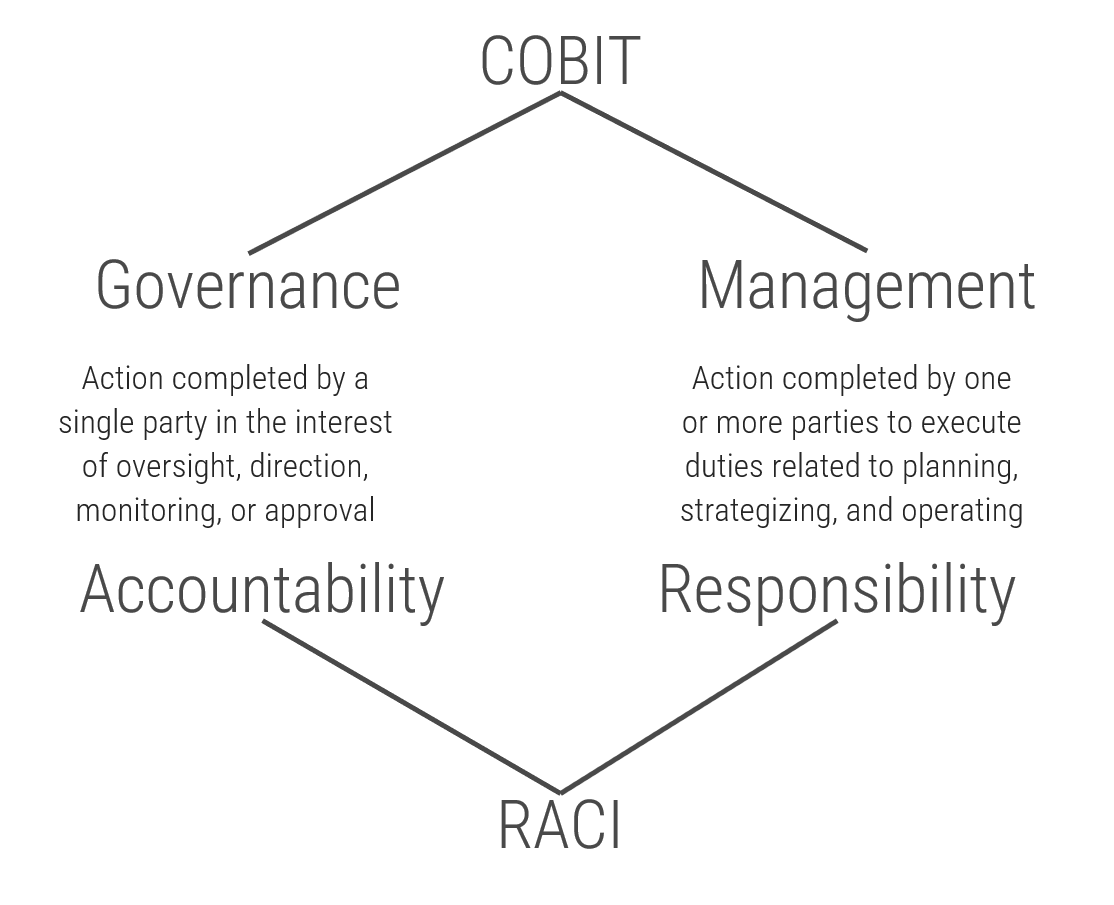
- COBIT emphasizes the importance of separating governance from management. These are complementary functions, but they refer to different parts of organizational operation.
- Governance provides a decision-making apparatus based on predetermined requirements to ensure smooth operations. It is used to provide oversight and direction and hinges on established accountabilities
- Simply put, governance refers to what an organization is and is not willing to permit in day-to-day operations, and it tends to make its presence known via the key areas of risk appetite, formal policy and process, and exception handling.
- Note: These key areas do not provide governance in and of themselves. Rather, governance emerges in accordance with the decisions an organization has made regarding these areas. Sometimes, however, these "decisions" have not been formally or consciously made and the current state of the organization's operations becomes the default - even when it is not working well.
- Management, by contrast, is concerned with executing business processes in accordance with the governance model, essentially, governance provides guidance for how to make decisions during daily management.
"Information security governance is the guiding hand that organizes and directs risk mitigation efforts into a business-aligned strategy for the entire organization."
Steve Durbin,
Chief Executive,
Information Security Forum, Forbes, 2023
Models for governance and management
Info-Tech's Governance and Management research uses the logic of COBIT's governance and management framework but distills this guidance into a practical, easy-to-implement series of steps, moving beyond the rudimentary logic of COBIT to provide an actionable and personalized governance model.


Clear accountabilities and responsibilities
Complementary frameworks to simplify governance and management
The distinction that COBIT draws between governance and management is roughly equivalent to that of accountability and responsibility, as seen in the RACI* model.
There can be several stakeholders responsible for something, but only one party can be accountable.
Use this guidance to help determine the accountabilities and responsibilities of your governance and management model.
*Responsible, Accountable, Consulted, Informed
Security governance framework
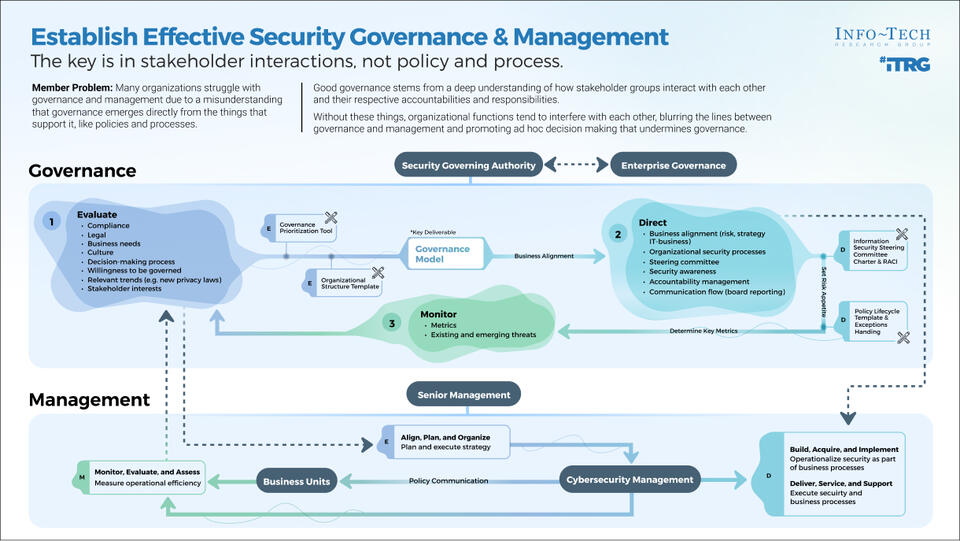
A security governance framework is a system that will design structures, processes, accountability definitions, and membership assignments that lead the security department toward optimal results for the business.
Governance is performed in three ways:
| 1 Evaluate | 2 Direct | 3 Monitor |
|---|---|---|
| For governance to be effective it must account for stakeholder interests and business needs. Determining what these are is the vital first step. | Governance is used to determine how things should be done within an organization. It sets standards and provides oversight so decisions can be made during day-to-day management. | Governance needs change and inefficiencies need to be revised. Therefore, monitoring key performance indicators is an essential step to course correct as organizational needs evolve. |
"Governance specifies the accountability framework and provides oversight to ensure that risks are adequately mitigated, while management ensures that controls are implemented to mitigate risks. Management recommends security strategies. Governance ensures that security strategies are aligned with business objectives and consistent with regulations."
- EDUCAUSE
About Info-Tech
Info-Tech Research Group is the world’s fastest-growing information technology research and advisory company, proudly serving over 30,000 IT professionals.
We produce unbiased and highly relevant research to help CIOs and IT leaders make strategic, timely, and well-informed decisions. We partner closely with IT teams to provide everything they need, from actionable tools to analyst guidance, ensuring they deliver measurable results for their organizations.
What Is a Blueprint?
A blueprint is designed to be a roadmap, containing a methodology and the tools and templates you need to solve your IT problems.
Each blueprint can be accompanied by a Guided Implementation that provides you access to our world-class analysts to help you get through the project.
Need Extra Help?
Speak With An Analyst
Get the help you need in this 2-phase advisory process. You'll receive multiple touchpoints with our researchers, all included in your membership.
Guided Implementation 1: Design your governance model
- Call 1: Scope requirements, objectives, and your specific challenges.
- Call 2: Determine governance requirements.
- Call 3: Review governance model.
- Call 4: Determine KPIs.
Guided Implementation 2: Implement essential governance processes
- Call 1: Stand up steering committee.
- Call 2: Set risk appetite.
- Call 3: Establish policy lifecycle.
- Call 4: Revise exception-handing process.
Contributors
- Michelle Tran, Consulting Industry
- 1 anonymous
 Assess and Manage Security Risks
 Assess Your Cybersecurity Insurance Policy
 Achieve Digital Resilience by Managing Digital Risk
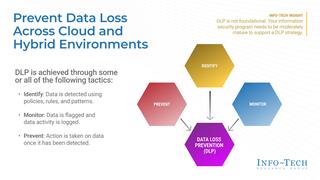 Prevent Data Loss Across Cloud and Hybrid Environments
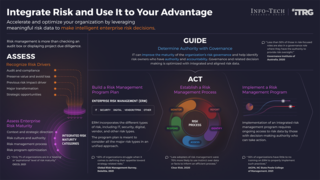 Build an IT Risk Management Program
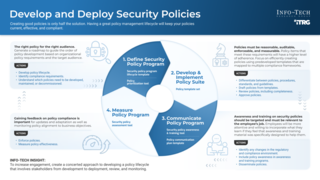 Develop and Deploy Security Policies
 Fast Track Your GDPR Compliance Efforts
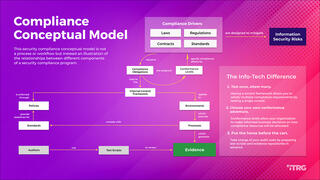 Build a Security Compliance Program
 Embed Privacy and Security Culture Within Your Organization
 Establish Effective Security Governance & Management
 Improve Security Governance With a Security Steering Committee
 Develop Necessary Documentation for GDPR Compliance
 Reduce and Manage Your Organization’s Insider Threat Risk
 Satisfy Customer Requirements for Information Security
 Master M&A Cybersecurity Due Diligence
 Integrate IT Risk Into Enterprise Risk
 Present Security to Executive Stakeholders
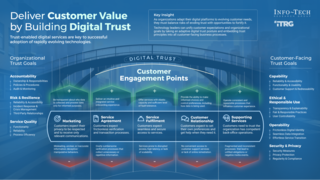 Deliver Customer Value by Building Digital Trust
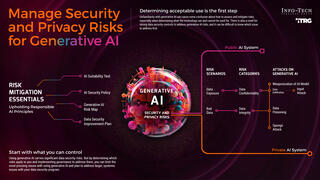 Address Security and Privacy Risks for Generative AI
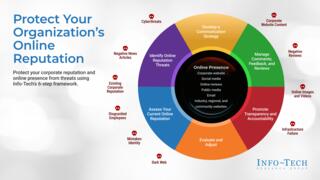 Protect Your Organization's Online Reputation
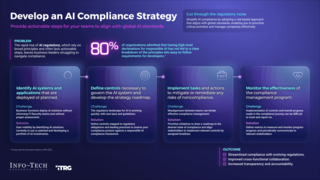 Develop an AI Compliance Strategy
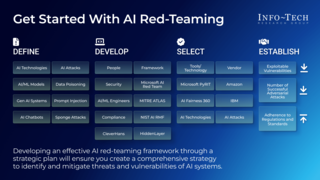 Get Started With AI Red-Teaming
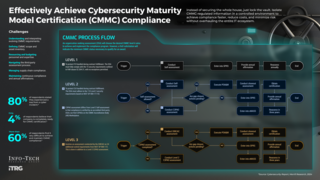 Achieve CMMC Compliance Effectively
 Building Info-Tech’s Chatbot
 Building the Road to Governing Digital Intelligence
 An Operational Framework for Rolling Out AI
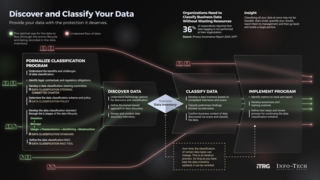 Discover and Classify Your Data
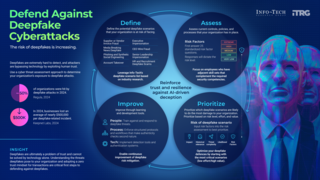 Defend Against Deepfake Cyberattacks
 Assess Your CMMC Readiness
