Our systems detected an issue with your IP. If you think this is an error please submit your concerns via our contact form.
Define Your Target AI Infrastructure
Start with the workload, not the technology.
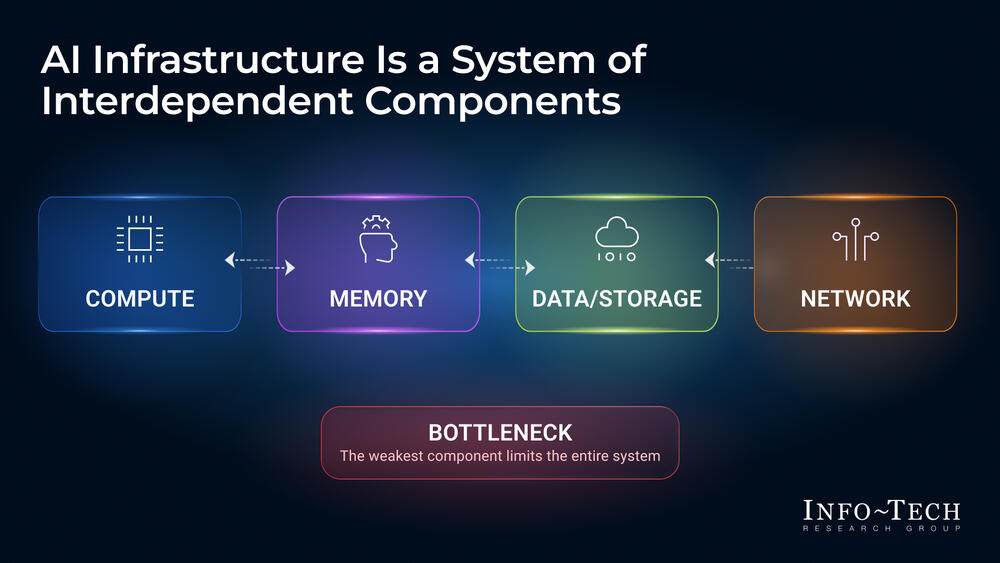
AI infrastructure is a system of interdependent components. While adding more compute produces temporary gains, hidden constraints generate diminishing returns: lower utilization, poor scalability, and higher cost. The most successful AI environments measure how effectively infrastructure resources are used to deliver business value. Approach AI infrastructure as a balanced systems design challenge rather than a hardware acquisition exercise.
1. Balanced infrastructure matters.
AI infrastructure performance is not determined by how much compute is deployed; it’s determined by how effectively compute, memory, storage, networking, and physical infrastructure operate as a balanced system that maximizes utilization, minimizes risk, and supports scalable AI growth.
2. Utilization drives value.
AI infrastructure value is determined by utilization rather than capacity. Organizations that optimize scheduling, data movement, resource allocation, and workload alignment achieve better performance and lower costs than those that simply deploy additional hardware.
3. Workloads shape architecture.
Training, inference, retrieval-augmented generation (RAG), agentic AI, and edge AI workloads place different demands on compute, memory, storage, and networking. Successful AI infrastructure strategies align architecture decisions to workload requirements rather than standardizing on a single technology approach.
Use this framework to maximize utilization and convert infrastructure investments into measurable business value.
Our detailed methodology, complemented by a practical supporting tool, helps translate AI infrastructure strategy into actionable architecture, sourcing, and investment decisions. Use this step-by-step framework to:
- Assess workload characteristics and AI demand patterns.
- Align processor and infrastructure strategy to workload needs.
- Identify constraints across compute, memory, storage, network, and physical infrastructure.
- Design balanced architectures that optimize utilization and scalability.
- Establish operational strategies to manage cost, performance, and infrastructure risk.
Research & Tools
1. Define Your Target AI Infrastructure Storyboard – A deck guiding you through the steps to select an AI infrastructure architecture and deployment model aligned to your organization’s workload requirements, investment priorities, and business objectives.
Use this framework to:
- Balance across all components.
- Optimize for utilization, not capacity.
- Minimize data movement.
- Design for workload variability.
- Plan for cost volatility.
2. AI Infrastructure Reference Architecture Workbook – A practical Excel tool to evaluate infrastructure options, compare sourcing models, and define a target-state AI infrastructure.
This workbook helps you:
- Profile the workload based on type, latency, scale, volume, sensitivity, and deployment.
- Select a reference architecture from one of seven architecture patterns.
- Define infrastructure components.
- Create vendor shortlists to select technology.
- Analyze cost using weighted spend priorities.
- Simulate scenarios by comparing any two patterns side by side.
- Create the target-state summary of a costed, validated target reference architecture.