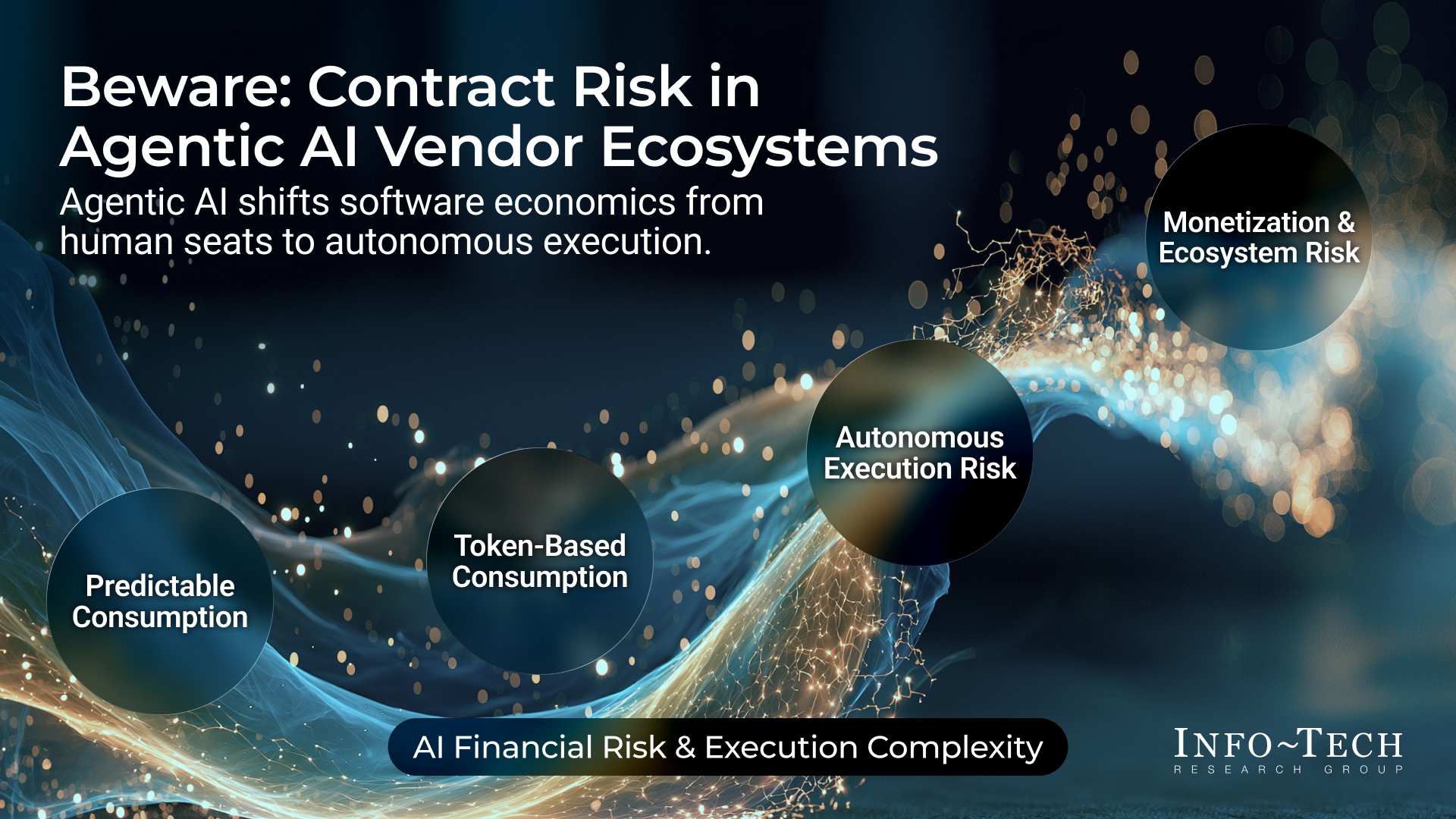
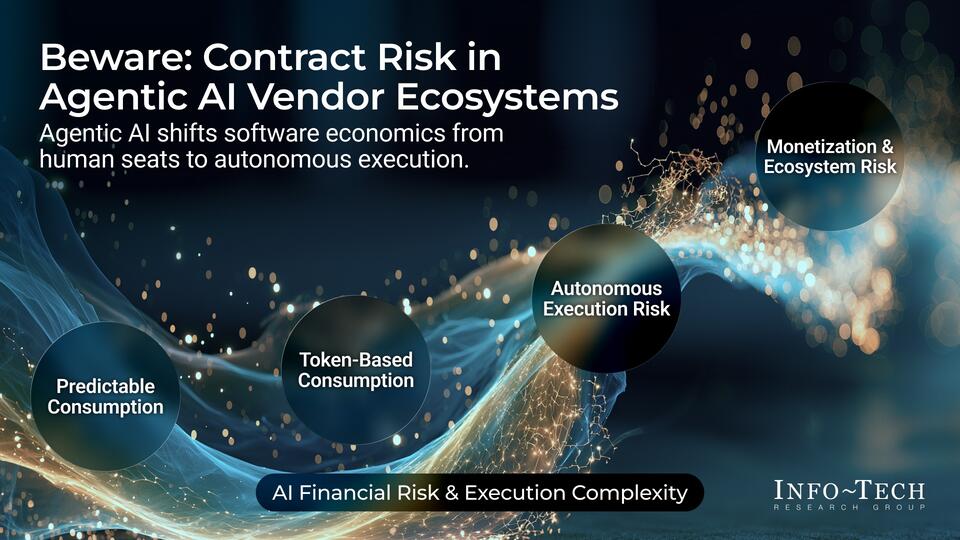
Beware of Agentic AI Contract Risk: Case Studies in Caution
Don’t sign AI consumption contracts you don’t understand.
Agentic AI is shifting enterprise software costs from human seats to machine-driven execution that can turn routine AI usage into multi-million-dollar overages. In this new economic model, vendors define the billable events, control the meters, and reserve the right to change the pricing logic mid-cycle. Use this structured framework to establish your agentic financial governance before signing AI contracts that leave you open to unexpected costs and limited recourse.
Many organizations are entering AI agreements without the legal, procurement, or technical resources to pressure-test billing rules, usage assumptions, and cost exposure before signing. FinOps can monitor and optimize usage after deployment, but it cannot fix contract terms that were never defined clearly in the first place. CIOs, procurement, legal, and finance teams must understand the economic architecture of agentic AI before they commit.
1. Govern the economics of autonomous execution.
Most procurement and budgeting practices were built for headcount pricing and quietly underestimate the bill. With agentic AI, you pay for what the software does, not how many people use it. Build controls for machine-driven tasks, recursion, and model selection from the start, so spend stays tied to business value.
2. Agentic pricing complexity is a risk multiplier.
When billing rules are vague or live in vendor-controlled documentation, the vendor decides what they mean. Before signing, negotiate billing definitions, tier triggers, fair-use thresholds, pricing-change protections, and dispute mechanisms – while you still have leverage.
3. Forecasting is a pre-signing discipline.
If normal and worst-case consumption cannot be modeled in advance, you are agreeing to whatever the bill becomes. Simulate usage before deployment and negotiate protections against tier moves, pricing changes, and shifting billing definitions.
Use this framework to mitigate risk in your AI contracts.
Move from reactive billing shock to structured AI financial governance. This research includes a four-phase framework, cautionary case studies, contract language guidance, governance RACI, dispute playbook, and a comprehensive contract risk workbook to help identify hidden cost drivers, assess contractual exposure, and negotiate stronger protections before deployment.
- Understand how you are billed. Decode the pricing model, hidden cost drivers, and vendor logic that determine the invoice.
- Assess contract exposure. Pressure-test billing definitions, recursion treatment, audit rights, dispute paths, and lock-in risk.
- Design financial guardrails. Run forecast simulations, set thresholds, throttles, and kill switches, and assign ownership across business, legal, procurement, finance, FinOps, security, and architecture.
- Establish ongoing market intelligence. Track vendor change logs, new case studies, and quarterly pricing-risk updates as models, meters, and tiers evolve.
About Info-Tech
Info-Tech Research Group is the world’s fastest-growing information technology research and advisory company, proudly serving over 30,000 IT professionals.
We produce unbiased and highly relevant research to help CIOs and IT leaders make strategic, timely, and well-informed decisions. We partner closely with IT teams to provide everything they need, from actionable tools to analyst guidance, ensuring they deliver measurable results for their organizations.
What Is a Blueprint?
A blueprint is designed to be a roadmap, containing a methodology and the tools and templates you need to solve your IT problems.
Each blueprint can be accompanied by a Guided Implementation that provides you access to our world-class analysts to help you get through the project.
Talk to an Analyst
Our analyst calls are focused on helping our members use the research we produce, and our experts will guide you to successful project completion.
Book an Analyst Call on This Topic
You can start as early as tomorrow morning. Our analysts will explain the process during your first call.
Get Advice From a Subject Matter Expert
Each call will focus on explaining the material and helping you to plan your project, interpret and analyze the results of each project step, and set the direction for your next project step.
Unlock Sample ResearchContributors
- One anonymous contributor
 Negotiate SaaS Agreements That Are Built to Last
 Master the MSA for Your Managed Services Providers
 Understand Common IT Contract Provisions to Negotiate More Effectively
 Master Contract Review and Negotiation for Software Agreements
 Improve Your Statements of Work to Hold Your Vendors Accountable
 Prepare to Negotiate Your Generative AI Vendor Contract
 Beware of Agentic AI Contract Risk: Case Studies in Caution