Accelerate Strategic Resource Planning for Core System Replacement in US State Government
A structured approach to building a strategic resource plan aligned with the critical needs of legacy modernization and core system replacement in government
- Resource Misalignment: Agencies often struggle to allocate the right mix of staff, funding, and technology at the right time, leading to project delays or budget overruns.
- Stakeholder Fragmentation: Competing priorities and unclear roles among internal and external stakeholders hinder unified decision-making and governance.
- Backfill and Staffing Gaps: Lack of planning for staff backfill and skill development creates operational strain and burnout during modernization efforts.
- Legacy System Complexity: Deeply embedded legacy systems with outdated architectures complicate integration, data migration, and replacement timelines.
- Lack of a Unified Roadmap: Agencies frequently lack a phased, actionable plan that links modernization to measurable business outcomes and public value.
Our Advice
Critical Insight
Successful core system replacement requires treating modernization as a multiyear strategic transformation – not just a technical upgrade – anchored by early resource planning, stakeholder alignment, and adaptive governance.
Impact and Result
- Establishes a repeatable planning framework that agencies can adapt for core system replacement across various government contexts.
- Enables resource alignment by integrating staffing benchmarks, budgeting tools, and capacity planning into a unified roadmap.
- Improves stakeholder engagement through a structured workshop model that builds consensus around mission, goals, and governance.
- Reduces modernization risk by identifying backfill needs, forecasting gaps, and embedding mitigation strategies early in the planning process.
- Enhances decision-making clarity by linking modernization efforts to measurable KPIs, public value outcomes, and long-term service goals.
Accelerate Strategic Resource Planning for Core System Replacement in US State Government
A structured approach to building a strategic resource plan aligned with the critical needs of legacy modernization and core system replacement in government.
Analyst perspective
Government agencies must develop a multiyear strategic resource plan that secures essential funding, staffing, and organizational support.
State governments across the United States face increasing urgency to modernize or replace core IT systems that underpin essential services such as finance, human resources, licensing, and benefits administration. Recent reports repeatedly identify legacy modernization as a top priority.
However, core system replacement is not merely a matter of technology refresh; it requires careful strategic resource planning that aligns people, finances, technology, and organizational capacity over multiple years. A shift-left, holistic approach - where potential risks, stakeholder input, and governance structures are addressed from the earliest stages - consistently emerges as a best practice for government agencies.
This research provides an initial strategic resource plan template for core system replacement in government, bringing together guiding principles, phased recommendations, resource considerations, and governance structures to mitigate common challenges.

Neal Rosenblatt
Principal Research Director
Public Health Industry
Info-Tech Research Group
Executive summary
| Your Challenge | Common Obstacles | Info-Tech's Approach |
|
Government agencies must replace aging mission-critical systems while maintaining essential public services.
|
Resource constraints, siloed decision-making, and policy limitations impede modernization progress.
|
Implement a shift-left strategic resource plan that aligns people, finances, technology, and governance across short-, mid-, and long-term horizons.
|
Successful modernization requires strategic resource planning
Government IT modernization is neither purely technical nor purely operational - it is a transformative initiative that demands robust planning, adaptive leadership, and sustained commitment. By proactively addressing core challenges, navigating obstacles with strategic resource allocation, and employing a holistic, shift-left approach, IT leaders can ensure new systems are delivered on time, within budget, in alignment with the evolving needs of citizens and government services.
Core system replacement is far more than a technical upgrade
It is a transformative venture that reshapes how government operates and serves its constituents.
Each phase of modernization brings opportunities to reevaluate established processes, build stronger public trust, and position the state for future challenges.
- The Human Factor: People remain at the heart of successful modernization, from decision-makers who allocate resources to frontline employees who use the new tools daily. By acknowledging and addressing the natural resistance to change, leaders can mitigate disruptions and harness collective creativity for smoother transformation.
- The Technical Imperative: Rapid advancements in cloud computing, AI, and cybersecurity require government agencies to integrate emerging technologies responsibly. Modernization projects thus become pathways for not only upgrading legacy systems but also embedding advanced functionalities that drive efficiency and agility.
- The Continuous Evolution: Modernization is rarely a one-time effort. As policies, technologies, and constituent and stakeholder expectations evolve, so too must the new system. Long-term success hinges on cultivating a culture of continuous improvement, supported by ongoing assessments, incremental updates, and stable funding commitments.
A Holistic Vision for the Future of Your Agency
By treating core system replacement as a transformative journey that addresses not just technology but also people, processes, and long-term resiliency, state governments can build the frameworks necessary for ongoing success. This holistic vision empowers agencies to adapt more swiftly to future challenges, secure public trust, and deliver on the promise of modern, reliable, and constituent-centric government services.
Your challenge
Government IT modernization is neither purely technical nor purely operational.
- Escalating Complexity: Government IT environments rarely consist of a single monolithic system; instead, they involve a patchwork of older platforms. As a result, updating one component often triggers additional, unplanned changes elsewhere. This interconnectedness creates heightened risks around data migration, security compliance, and system interoperability.
- High Stakeholder Expectations: In the digital era, constituents and policymakers anticipate services that are not just functional but also intuitive and available 24/7. Meeting these demands requires government agencies to adopt user-centric design principles, bolster system resilience, and maintain robust service level agreements (SLAs).
- Evolving Compliance: Regulatory landscapes shift as new mandates around privacy, data security, and service delivery emerge. For example, federal and state policies may require stronger encryption or faster reporting cycles, compelling agencies to ensure that modernized systems can rapidly pivot to meet these new standards without interrupting critical operations.
Common obstacles
A realistic view of current limitations - both structural and cultural - sets the stage for meaningful change.
- Underinvestment: Government modernization projects often suffer from inconsistent or limited budgets. Short-term political cycles and competing priorities can result in incremental funding instead of comprehensive multiyear appropriations, undermining agencies' ability to staff projects effectively and sustain forward momentum.
- Organizational Inertia: Even when resources exist, deeply ingrained processes, lengthy procurement procedures, and a reluctance to alter established workflows can hamper transformation. This inertia is frequently compounded by siloed leadership structures, where different departments struggle to synchronize on shared objectives.
- Complex Governance: In many states, oversight responsibilities are fragmented among various committees or boards. This structure can create conflicting mandates and unclear lines of authority, making it difficult to prioritize modernization initiatives. As a result, decisions stall, resources remain underused, and momentum is lost.
Info-Tech's approach
Shift left to proactively build resilience into your modernization efforts.
- Phased Roadmap: Dividing the modernization journey into short-, mid-, and long-term goals helps prevent scope creep and funding bottlenecks. Each phase includes concrete milestones - for instance, addressing mission-critical technical debt first - followed by iterative enhancements to future-proof the entire ecosystem.
- Robust Governance: Establishing a centralized steering committee composed of IT leaders, finance experts, and policy stakeholders ensures that decision-making is transparent and aligned with state priorities. Incorporating independent verification and validation (IV&V) adds an impartial checkpoint to validate project quality, budgets, and timelines.
- Proactive Change Management: Early and continuous communication prevents staff turnover, attrition, or disengagement from derailing modernization. By clearly explaining the vision, providing upskilling opportunities, and engaging end users in pilot programs, agencies foster ownership and readiness for the system-wide changes to come.
Download Info-Tech's Core Systems Replacement in Government
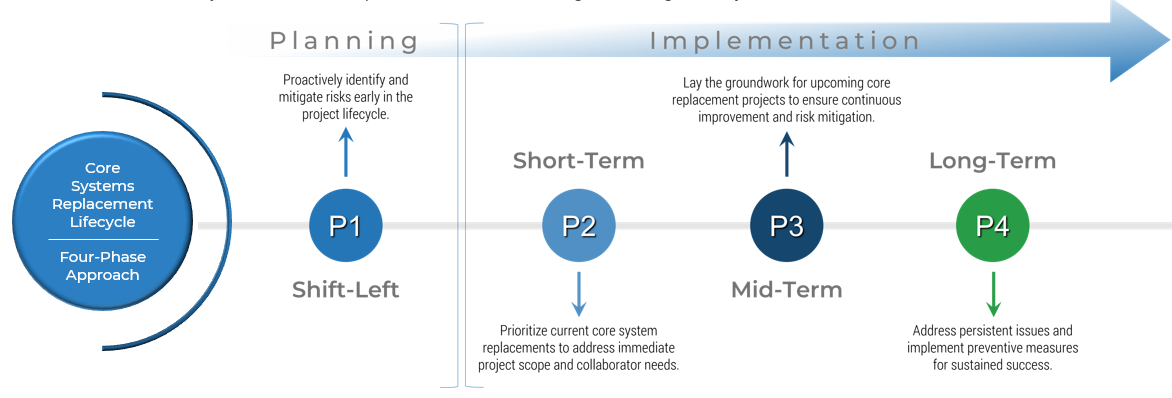
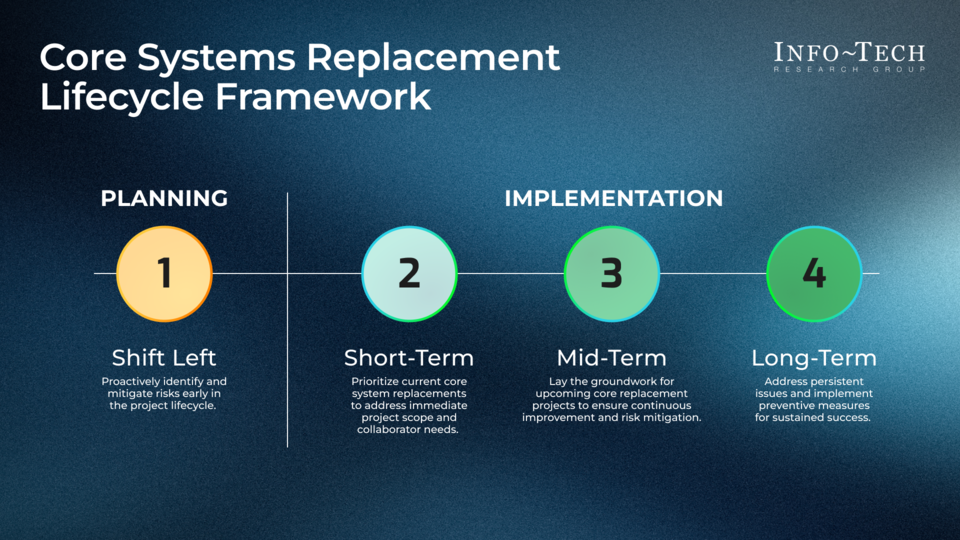
Core Systems Replacement Lifecycle Framework
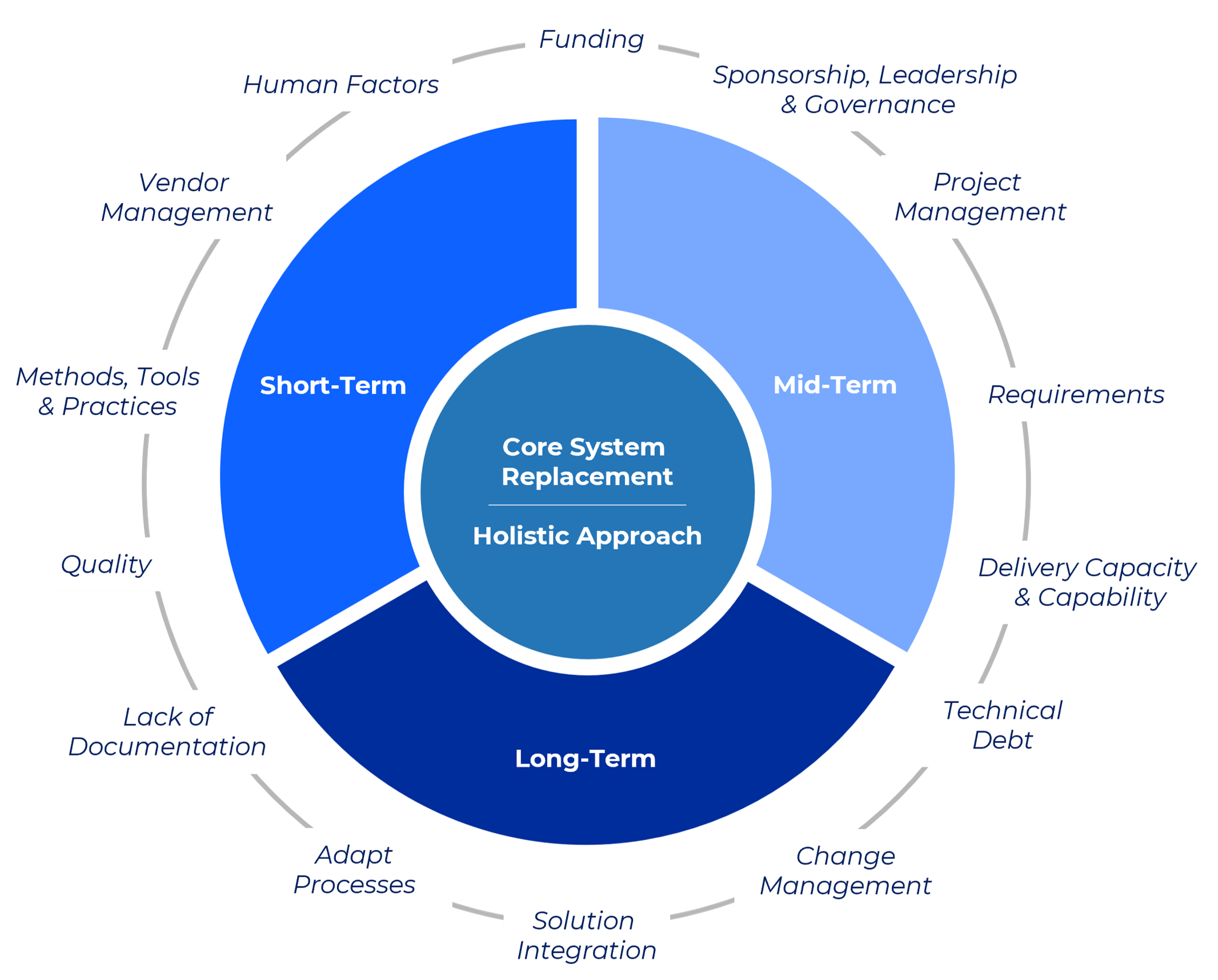
The holistic approach involves aligning the core system replacement project with the strategic goals of the organization, ensuring that the selected solution not only meets immediate operational needs but also aligns with long-term objectives.
Info-Tech Insight
By combining the holistic perspective with the strategic shift-left mindset and aligning actions across short-, mid-, and long-term horizons, governments can navigate the complexities of core system replacement projects more efficiently and effectively, ensuring successful outcomes and long-term benefits at all levels of government - local, state, and federal - and for all collaborators and stakeholders involved.
Navigating core system replacement in government is a complex and extensive undertaking
The Problem:
Agencies must develop a multiyear strategic resource plan that secures essential funding, staffing, and organizational support.
The Solution:
Implement a shift-left strategic resource plan that aligns people, finances, technology, and governance across short-, mid-, and long-term horizons.
COMMON CHALLENGES
Short-Term Recommendations
- Develop a project vision, strategy, and roadmap.
- Transform the business, not just systems.
- Establish a strong data governance framework.
- Select the right delivery approach and partners.
- Establish robust oversight mechanisms.
- Adopt business relationship management.
- Overinvest in the right people (the "A team") and capabilities at the outset.
- Prioritize change management and collaborator engagement.
- Enhance business processes.
Mid-Term Recommendations
- Develop a modernization strategy and determine your risk.
- Manage technical debt.
- Establish explicit protocols for discontinuing projects.
- Establish a proactive, enabled governance capability.
- Initiate continuous improvement.
- Strengthen business architecture and enterprise architecture alignment.
Long-Term Recommendations
- Improve procurement practices.
- Transition from Waterfall to Agile mindset.
- Address chronic underinvestment.
- Develop flexible funding approaches.
- Invest in skills and capacity building.
- Adopt agile procurement.
- Regulatory compliance and implementation.
- Establish independent oversight capability.
- Establish user experience and feedback loops.
- Enhance technology understanding and adoption.
- Balance policy prioritization with implementation.
- Address technical and policy debt.
Insight summary
Successful modernization requires strategic resource planning
Government IT modernization is neither purely technical nor purely operational - it is a transformative initiative that demands robust planning, adaptive leadership, and sustained commitment. By proactively addressing core challenges, navigating obstacles with strategic resource allocation, and employing a holistic, shift-left approach, IT leaders can ensure new systems are delivered on time, within budget, and aligned with the evolving needs of citizens and government services.
Navigate the complexities of core system replacement
By combining a holistic perspective with a strategic shift-left mindset and aligning actions across short-, mid-, and long-term horizons, governments can navigate the complexities of core system replacement projects more effectively, ensuring successful whole-of-government outcomes and long-term benefits for all collaborators and stakeholders involved.
Set realistic targets in SMART goal development
One of the most challenging aspects of developing SMART goals and objectives is setting targets. Defining an achievable and realistic target is not an exact science but should be done thoughtfully through consideration of baseline data, desired level of improvement, and time and resources available for improvement.
Core system replacement is a transformative journey
When state governments approach core system replacement as a transformative effort, encompassing not only technology but also people, processes, and organizational resilience, they lay the foundation for sustained success.
Enable adaptability and trust through modernization
This comprehensive approach equips agencies to respond more effectively to future challenges, strengthen public confidence, and consistently deliver modern, reliable, and constituent-focused services.
Blueprint deliverable
Each step of this blueprint is supported by Info-Tech's Strategic Resource Plan Guide Template to help you accomplish your goals:
Strategic Resource Planning Guide Template
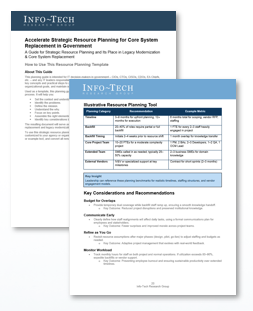
This planning guide is intended for IT decision-makers in government and any IT leaders responsible for legacy modernization and core system replacement. It brings together key concepts and practical steps to accelerate strategic resource planning, align modernization with organizational goals, and maintain service excellence for public sector stakeholders.
A strategic resource plan has both IT and strategic benefits for IT leaders in government
| IT Benefits | Strategic Benefits |
|---|---|
|
|
Measure the value of a strategic resource plan
A strategic resource plan will have a measurable impact on your agency's people, technology, and processes.
People - Workforce capacity, readiness, and alignment
Staff utilization efficiency: % of staff time effectively balanced between operations and modernization (target: =80% workload).
Skill gap reduction rate: % decrease in capability gaps via targeted training or hiring (e.g. cloud, AI, cybersecurity).
Backfill implementation success: % of roles filled within two to four weeks before staff transition (target: =90%).
Employee engagement scores: Change in satisfaction levels before and after strategic resource planning, measured through surveys.
Turnover in key roles: Change in voluntary turnover among key staff (target: reduced or stabilized during implementation period).
Technology - Modernization progress, system performance, and security
Legacy system retirement milestones met: % of planned legacy systems replaced or decommissioned on schedule.
System uptime and availability: Measured improvement in service availability post-modernization (e.g. 99.9% uptime).
Time to resolution for IT support tickets: % decrease in average incident resolution time, particularly for modernized systems.
Compliance and security posture: % of systems meeting updated regulatory and security standards (e.g. NIST, zero trust).
Technology alignment score: % of projects and systems aligned to the agency's technology roadmap and enterprise architecture plan.
Processes - Governance, resource allocation, and modernization delivery
On-time milestone completion rate: % of strategic resource plan milestones completed on schedule (target: =85%).
Budget adherence: % variance between projected and actual costs (target: ±10%).
Cross-functional governance participation: % of checkpoints with full representation from IT, finance, ops, and leadership (target: 100%).
Change management effectiveness: % of successful adoption based on training completion, surveys, and reduced resistance.
Process reengineering yield: # or % of workflows streamlined or automated, improving efficiency (e.g. faster cycle times, higher throughput).
Info-Tech Insight
These metrics allow government IT leaders to quantify the value of the strategic resource plan across critical dimensions, demonstrating progress in modernization and enabling data-driven governance.
Measure the value of this blueprint
To further assess the value of this blueprint, we have developed a set of KPIs that evaluate performance across people, technology, and processes.
These metrics present the estimated return on investment (ROI) from implementing Info-Tech's Strategic Resource Plan ("Plan") for core system replacement in government. The Plan enables government agencies to plan resources strategically, improve public services, and reduce risks associated with legacy systems.
| KPI Metric | Target | ROI Assumption | Estimated Impact ($US) | |
|---|---|---|---|---|
| People | Staff Utilization Efficiency | =80% workload | Lower burnout saves $10K per FTE/year across 25 FTEs | $250,000 |
| Skill Gap Reduction Rate | =25% gap reduction | Upskilling avoids $15K hiring cost across 12 roles | $180,000 | |
| Backfill Implementation Success | =90% roles backfilled | Avoids $20K per delay across 10 roles | $200,000 | |
| Employee Engagement Scores | =10% improvement | 1% productivity gain on $10M staff cost | $100,000 | |
| Turnover in Key Roles | =5% turnover | Saves $30K per avoided turnover; 5 roles | $150,000 | |
| Technology | Legacy System Retirement | =80% retired on time | Avoids $1M in ongoing legacy system costs | $1,000,000 |
| System Uptime | =99.9% uptime | Reduces downtime losses by $60K/year | $60,000 | |
| Support Ticket Resolution | =20% faster | Improves IT productivity; $10K saved per 12 teams | $120,000 | |
| Compliance & Security Posture | 100% compliance | Avoids 10 fines at $50K each | $500,000 | |
| Technology Alignment | =90% roadmap alignment | Prevents 8 misaligned initiatives at $25K each | $200,000 | |
| Processes | Milestone Completion Rate | =85% on time | 8 avoided delays at $50K each | $400,000 |
| Budget Adherence | ±10% variance | 5% control on $7M budget | $350,000 | |
| Governance Participation | 100% involvement | Avoids 3 escalations at $25K each | $75,000 | |
| Change Management Effectiveness | =80% adoption | Protects 10% of $900K training investment | $90,000 | |
| Process Reengineering Yield | =25% efficiency gain | 5 optimized processes save $44K each annually | $220,000 | |
| Total Estimated Annual Savings: | $4,145,000 |
Note: Estimated impact is based on realistic assumptions commonly used in public sector IT planning. It reflects conservative projections based on cost avoidance, productivity gains, and reduced risk. These estimates help demonstrate the value of strategic resource planning in digital transformation and provide a compelling case for executive sponsorship, legislative support, and resource investment.
How can you measure the value of following Info-Tech's approach?
This blueprint enables your agency to build an implementable strategic resource plan for core system replacement.
Upon successful completion of blueprint sessions and activities, outcomes will include:
- Vision, mission, goals, and SMART objectives that reflect modernization priorities.
- Governance structure and stakeholder list for building a strong project governance team.
- Prioritized core systems with clear resource assignments.
- Defined resource requirements across staffing, budget, and technology needs.
- Implementation roadmap laying out short-, mid-, and long-term milestones.
These outcomes align with best practices included in the Strategic Resource Planning Guide and will set your agency on a path to successful modernization.
Info-Tech offers various levels of support to best suit your needs
| DIY Toolkit | Guided Implementation | Workshop | Executive & Technical Counseling | Consulting |
|---|---|---|---|---|
| "Our team has already made this critical project a priority, and we have the time and capability, but some guidance along the way would be helpful." | "Our team knows that we need to fix a process, but we need assistance to determine where to focus. Some check-ins along the way would help keep us on track." | "We need to hit the ground running and get this project kicked off immediately. Our team has the ability to take this over once we get a framework and strategy in place." | "Our team and processes are maturing; however, to expedite the journey we'll need a seasoned practitioner to coach and validate approaches, deliverables, and opportunities." | "Our team does not have the time or the knowledge to take this project on. We need assistance through the entirety of this project." |
Diagnostics and consistent frameworks are used throughout all five options.
Guided Implementation
What does a typical GI on this topic look like?
| Session 1 | Session 2 | Session 3 | Session 4 |
|---|---|---|---|
|
Call #1: Discovery and requirements gathering. Call #2: Discuss mission and modernization drivers. Call #3: Draft SMART goals for system replacement. |
Call #4: Identify key stakeholders and governance roles. Call #5: Prioritize systems for replacement. Call #6: Outline impacted functional areas. |
Call #7: Define resource needs (staff, budget, vendors). Call #8: Set short-, mid-, and long-term milestones. Call #9: Address training, change, and continuity. |
Call #10: Build draft strategic resource plan. Call #11: Validate timeline, governance, and risk. Call #12: Define success metrics. |
A Guided Implementation (GI) is a series of calls with an Info-Tech analyst to help implement our best practices in your organization.
A typical GI is 8 to 12 calls over the course of 4 to 6 months.
Leverage skilled facilitation
Info-Tech Research Group provides strategic resource plan development expertise through workshops.
To accelerate the complex process of building a strategic resource and staffing benchmarking plan for core system replacement in your agency, consider involving a skilled facilitator with sufficient training and experience in conducting roadmap development activities.
Their expertise can help:
- Develop vision, mission, goals, and SMART objectives that reflect modernization priorities.
- Build a governance structure and stakeholder list for assembling a strong project governance team.
- Prioritize core systems for replacement with clear resource assignments.
- Define resource requirements across staffing, budget, and technology needs.
- Implement a strategic resource plan roadmap that lays out short-, mid-, and long-term milestones.
A skilled facilitator will ensure that these outcomes align with best practices, supported by Info-Tech's Strategic Resource Planning Guide Template, and will set your agency on a path to successful modernization.
Download Info-Tech's Strategic Resource Planning Guide Template for core system replacement in government
Workshop overview
Four-day workshop focused on developing a strategic resource plan roadmap
| Pre-Work | Session 1 | Session 2 | Session 3 | Session 4 | Post-Work | |
|---|---|---|---|---|---|---|
| Topics | Prepare with background and system assessments | Align on vision and set strategic goals | Define governance and map key stakeholders | Identify and prioritize resource needs | Finalize roadmap and align on key metrics | Confirm next steps and enable execution |
| Activities |
|
1.1 Review workshop goals. 1.2 Discuss mission and modernization drivers. 1.3 Draft SMART goals for system replacement. |
2.1 Identify key stakeholders and governance roles. 2.2 Prioritize systems for replacement. 2.3 Outline impacted functional areas. |
3.1 Define resource needs (staff, budget, vendors). 3.2 Set short-, mid-, and long-term milestones. 3.3 Address training, change, and continuity. |
4.1 Build draft strategic resource plan. 4.2 Validate timeline, governance, and risk. 4.3 Define success metrics. |
|
| Outcomes |
|
|
|
|
|
|
Workshop Focus: Strategic Resource Plan Accelerator
Outcome: Strategic Resource Plan Roadmap
Contact your account representative for more information.
workshops@infotech.com 1-888-670-8889
Pre-Work
Prepare with background and system assessments
Overview
Distribute reading materials such as the Strategic Resource Planning Guide Template, relevant policy documents, and current IT system inventories to all participants well before Session 1.
Ask participants to map out the status quo of their systems, skill sets, and project constraints in a concise format.
Pre-Work
0.1 Present background material
0.2 Complete current-state system assessment
0.3 Encourage pre-reading on resource planning and risk
Session 1
1.1 Review workshop goals
1.2 Discuss mission and modernization drivers
1.3 Draft SMART goals for system replacement
Session 2
2.1 Identify key stakeholders and governance roles
2.2 Prioritize systems for replacement
2.3 Outline impacted functional areas
Session 3
3.1 Define resource needs (staff, budget, vendors)
3.2 Set short-, mid-, and long-term milestones
3.3 Address training, change, and continuity
Session 4
4.1 Build draft strategic resource plan
4.2 Validate timeline, governance, and risk
4.3 Define success metrics
Post-Work
5.1 Finalize and distribute roadmap
5.2 Create comms plan for rollout
5.3 Set up review checkpoints
This session will produce the following outcomes:
- Baseline understanding of systems and priorities
- Shared context for workshop
This phase involves the following participants:
- Executive sponsor
- Core project team (IT leads, business leads)
- Facilitator/workshop lead
- Key functional SMEs
Accelerate Strategic Resource Planning for Core System Replacement in US State Government
About Info-Tech
Info-Tech Research Group is the world’s fastest-growing information technology research and advisory company, proudly serving over 30,000 IT professionals.
We produce unbiased and highly relevant research to help CIOs and IT leaders make strategic, timely, and well-informed decisions. We partner closely with IT teams to provide everything they need, from actionable tools to analyst guidance, ensuring they deliver measurable results for their organizations.
What Is a Blueprint?
A blueprint is designed to be a roadmap, containing a methodology and the tools and templates you need to solve your IT problems.
Each blueprint can be accompanied by a Guided Implementation that provides you access to our world-class analysts to help you get through the project.
Need Extra Help?
Speak With An Analyst
Get the help you need in this 4-phase advisory process. You'll receive multiple touchpoints with our researchers, all included in your membership.
Guided Implementation 1: Align on Vision and Set Strategic Goals
- Call 1: Discovery and requirements gathering.
- Call 2: Discuss mission and modernization drivers.
- Call 3: Draft SMART goals for system replacement.
Guided Implementation 2: Define Governance and Map Key Stakeholders
- Call 1: Identify key stakeholders and governance roles.
- Call 2: Prioritize systems for replacement.
- Call 3: Outline impacted functional areas.
Guided Implementation 3: Identify and Prioritize Resource Needs
- Call 1: Define resource needs (staff, budget, vendors).
- Call 2: Set short-, mid-, and long-term milestones.
- Call 3: Address training, change, and continuity.
Guided Implementation 4: Finalize Roadmap and Align on Key Metrics
- Call 1: Build draft strategic resource plan.
- Call 2: Validate timeline, governance, and risk.
- Call 3: Define success metrics.