
Optimize IT Vendor Contracts in Times of Uncertainty
Rationalize contracts to plan for spend reduction and enable innovation.
CIOs are under pressure to slash vendor spend, but blind cost-cutting can compromise operations and stall innovation. With a structured plan and centralized visibility, organizations can strategically rationalize vendor portfolios, redirecting savings toward higher-impact priorities. This step-by-step research gives IT leaders a practical framework for evaluating which vendor contracts support critical capabilities, innovation, and resilience.
Lack of visibility into the vendor portfolio can mask redundancies, technical debt, and creeping shadow IT – including unmanaged AI use. By mapping keeping-the-lights-on (KTLO) spend, identifying duplicated functionality, and understanding where there is flexibility to renegotiate or exit, CIOs can build an optimization plan that protects core capabilities while creating capacity for innovation. Success in today’s uncertain times is not derived solely from deep cuts, but from spending with clarity and intent.
1. Visibility drives optimization.
Without visibility into vendor contracts, costs, and dependencies, it can be hard to know where to begin optimizing spend. Start by reviewing vendor contracts through a multifaceted lens to reveal redundancies and evaluate strategic fit.
2. Cost-cutting must be strategic, not slash-and-burn.
The ultimate goal of optimizing vendor contracts is not just to reduce spending but to free up budget to boost innovation. Indiscriminate cuts threaten resilience and long-term growth – optimization must be targeted and strategic.
3. Don’t be afraid to start with a quick pass.
In volatile times, delays can mean missing the window to act. Agility is better than perfection – you can make measured, defensible rationalization decisions quickly to uncover immediate savings without sacrificing due diligence.
Use this step-by-step research to optimize vendor contracts with clarity and intent
This research offers deep insights and a comprehensive workbook to take a full accounting of your IT vendors and make a plan to optimize your spend. Use this step-by-step approach to rationalize your vendor portfolio and redirect the savings toward vendors that support innovation and resilience.
- Compile your vendor inventory by listing your vendors, capturing annual spend, and determining KTLO spending.
- Rationalize your IT vendor contracts by assessing renewal milestones, utilization, contract terms, SLA concerns, dependencies, exit provisions, and other factors.
- Prioritize vendors for optimization by capturing key details such as planned cost reduction, optimization costs, known leverage, and operational impact.
- Develop and execute action plans by documenting specific tasks and actions, assigning ownership, and setting timelines for each prioritized vendor – while ensuring operational continuity and minimizing exit risks.
Rationalize contracts to plan for spend reduction and enable innovation.
Analyst perspective
Targeted optimization protects capabilities and fuels innovation.
IT teams are asked to do more with less, but reactive cost-cutting can lead to indiscriminate vendor reductions that jeopardize operations and innovation. Often, IT contracts that are misaligned with strategic objectives consume resources that could be reallocated to higher-impact initiatives.
With centralized visibility into the IT contract landscape, technical debt, and negotiation leverage, CIOs can redirect spend toward value. With the right tools, CIOs can rationalize vendor portfolios not just to reduce spend but to protect critical capabilities and create capacity for transformation.
For CIOs navigating tariff shocks, tighter budgets, and shifting compliance demands, there is an opportunity to prevent broad cuts by offering targeted corrections. Reshaping the IT vendor inventory – to account for "keep the lights on" (KTLO) allocations, duplicated functionalities, viable alternatives, and flexibility in exit provisions – helps inform a constructive optimization plan. This enables leaders to craft a strategic response to uncertainty-driven risks while controlling costs to fund emerging capabilities.
In uncertain times, it's not the biggest savers who thrive but those who spend with clarity and intent. Use this blueprint to break from broad-stroke spend reduction and emphasize business resilience.

Safayat Moahamad
Research Director
Security and Privacy
Info-Tech Research Group
Executive summary
| Your Challenge | Common Obstacles | Info-Tech's Approach |
|
CIOs are under pressure to streamline IT operations while maintaining innovation and security.
|
Balancing support of legacy systems and adoption of modern tools is overwhelming IT teams.
|
Align with strategic objectives by evaluating which contracts support critical capabilities, innovation, and resilience.
|
Info-Tech Insight
Visibility drives optimization. Magnify the opportunity for cost control and innovation by reviewing your IT vendor contracts with a multifaceted lens.
Your challenge
Rationalize vendor spend without undermining innovation or security.
- Leaders need to cut costs without cutting the capacity to adapt, automate, and transform.
- Without centralized visibility, IT contract optimization remains reactive and incomplete.
- Core infrastructure and legacy systems are under review.
- Shifting CapEx to OpEx requires renegotiating or rescoping long-term vendor commitments.
- Shadow IT and shadow AI are proliferating, introducing redundancy, compliance risk, and unmanaged costs.
- You're expected to streamline IT operations and prove ROI under tighter budgets and greater scrutiny.
59% of business technologies used within an organization are candidates for vendor changes.
30% of businesses plan to shift capital expenses to operating expenses.
38% of businesses are decommissioning unnecessary infrastructure, while 29% are consolidating redundant technologies.
Source: Spiceworks, 2024
Common obstacles
Tech sprawl, tight resources, and AI paralysis
- Tech sprawl overwhelms IT, creating frustration in managing business-driven tool proliferation.
- Overlapping tools and contracts increase costs and hinder operational inefficiency.
- Each new tool brings more integration work, security risks, and maintenance overhead.
- Contract and tool visibility gaps create functional redundancies and stall rationalization efforts.
- Legacy system demands persist even as teams are pushed to adopt modern platforms and tools.
- Reduced budgets and headcount stretch IT resources thin, compounding delivery and compliance challenges.
- AI initiatives struggle to scale across disconnected systems.
80% of IT professionals reported frustration managing business-driven tech sprawl.
48% of IT professionals cited higher costs because of this tech sprawl.
90% of IT professionals believe that tech sprawl hinders AI implementation.
Source: s, 2024
Info-Tech's approach
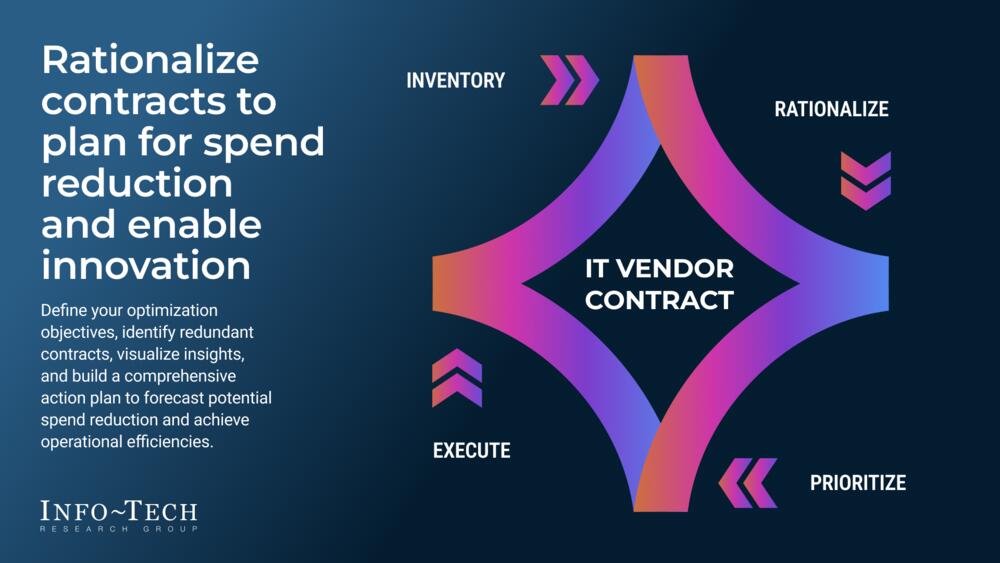
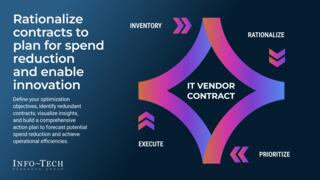
Rationalize contracts to plan for spend reduction and enable innovation.
Shadow IT and shadow AI are introducing redundancy, compliance risk, and unmanaged costs.
INVENTORY
Capture vendor contracts along with key details such as objective alignment, optimization feasibility, annual spend, and the percentage of spend supporting KTLO.
RATIONALIZE
Evaluate renewal milestones, usage, contract terms, service level agreement (SLA) concerns, technical debt, viable alternatives, business dependency, and exit provisions.
EXECUTE
Develop an action plan with specific optimization tasks, responsible owners, and timelines. Track progress of optimization initiatives.
PRIORITIZE
Assess details such as planned cost reduction, optimization costs, and known leverage to identify which contracts should be prioritized for optimization.
Define your optimization objectives, identify redundant contracts, visualize insights, and build a comprehensive action plan to forecast potential spend reduction and achieve operational efficiencies.
Visibility drives optimization. Magnify the opportunity for cost control and innovation by reviewing your IT vendor contracts with a multifaceted lens.
80% of IT professionals reported frustration managing business driven tech sprawl.
Source: CDInsights, 2024
Info-Tech's methodology for IT vendor optimization
| 1. Compile Vendor Inventory | 2. Rationalize IT Vendor Contracts | 3. Prioritize for Optimization | 4. Develop Plan and Execute | |
|---|---|---|---|---|
| Phase Action Items |
|
|
|
|
| Phase Outcomes |
|
|
|
|
Insight summary
Visibility drives optimization
Magnify the opportunity for cost control and innovation by reviewing your IT vendor contracts with a multifaceted lens.
Don't ignore smaller vendors
While the focus will be on your top 10-20 vendors in this activity, be sure to explore the tail-end vendors. Just because they don't make up a large portion of your spend does not mean that there are no cost-saving opportunities.
Plan transitions in advance
Customers requiring transition assistance after terminating a contract may not get much assistance.
Manage security when leaving vendors
Don't overlook the operational issues associated with disentanglement such as eliminating building, network, and email access for vendors.
Blueprint deliverables
Vendor Inventory
Capture vendor contracts along with key details such as objective alignment, optimization feasibility, and the percentage of spend supporting KTLO.
Contract Prioritization
Assess planned cost reduction, optimization costs, and known leverage to identify which contracts should be prioritized.
Contract Rationalization
Evaluate renewal milestones, usage, contract terms, SLA concerns, technical debt, business dependency, and exit provisions.
Optimization Plan
Develop an action plan with specific optimization tasks, responsible owners, and timelines. Track progress of optimization initiatives.
Key deliverable:
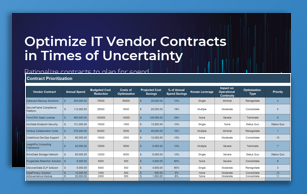
IT Vendor Contract Optimization Workbook and Plan
Use this workbook to help you inventory, rationalize, and prioritize your IT vendor contract and develop an optimization plan for execution.
Blueprint benefits
| IT Benefits | Business Benefits |
|---|---|
|
|
Measure the value of this blueprint
Zoom in on opportunities for spend reduction and track against actuals.
This blueprint will guide you in identifying IT vendor contract optimization opportunities by systematically identifying, rationalizing, and prioritizing contracts for optimization to drive cost savings and operational efficiencies.
In phase 2 of this blueprint, you will evaluate vendor contracts for optimization opportunities.
In phase 3, you will rank vendor contracts for optimization by assessing key details.
In phase 4, you will develop an actionable and time-bound optimization plan for execution.
Consider tracking the following metrics to measure the value of your optimization plan.
| Metric | Expected Action |
|---|---|
| Opportunity to reduce $ | Execute optimization plan to track actuals |
| Projected % of annual spend savings per contract | Collate terms and costs and leverage for budgeting |
| % to KTLO | Leverage IT financial management (ITFM) benchmarking report |
Info-Tech offers various levels of support to best suit your needs
| DIY Toolkit | Guided Implementation | Workshop | Executive & Technical Counseling | Consulting |
|---|---|---|---|---|
| "Our team has already made this critical project a priority, and we have the time and capability, but some guidance along the way would be helpful." | "Our team knows that we need to fix a process, but we need assistance to determine where to focus. Some check-ins along the way would help keep us on track." | "We need to hit the ground running and get this project kicked off immediately. Our team has the ability to take this over once we get a framework and strategy in place." | "Our team and processes are maturing; however, to expedite the journey we'll need a seasoned practitioner to coach and validate approaches, deliverables, and opportunities." | "Our team does not have the time or the knowledge to take this project on. We need assistance through the entirety of this project." |
Diagnostics and consistent frameworks are used throughout all five options.
Leverage ITFM benchmarking report
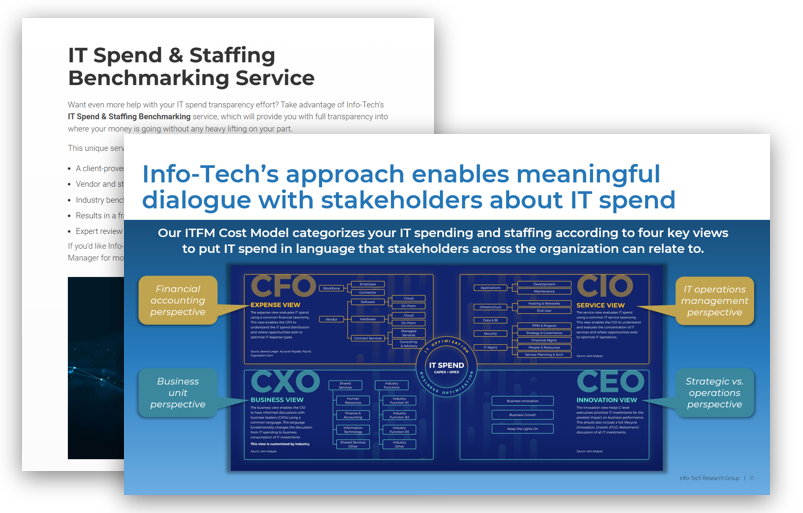
Achieve IT spend and staffing transparency
Mature your ITFM practice into a continuous and sustainable process to drive improved IT investment decisions and prove IT's value.
Having a comprehensive and transparent view of organization-wide technology spend is the only way to have data-driven conversations with stakeholders on what IT delivers and the implications of making changes to IT funding.
Let Info-Tech guide you through the process of mapping your IT staff and vendor spend data so you can generate your own IT spend metrics based on reliable sources and verifiable facts.
Adapt to Uncertainty With a Technology-First Action Plan
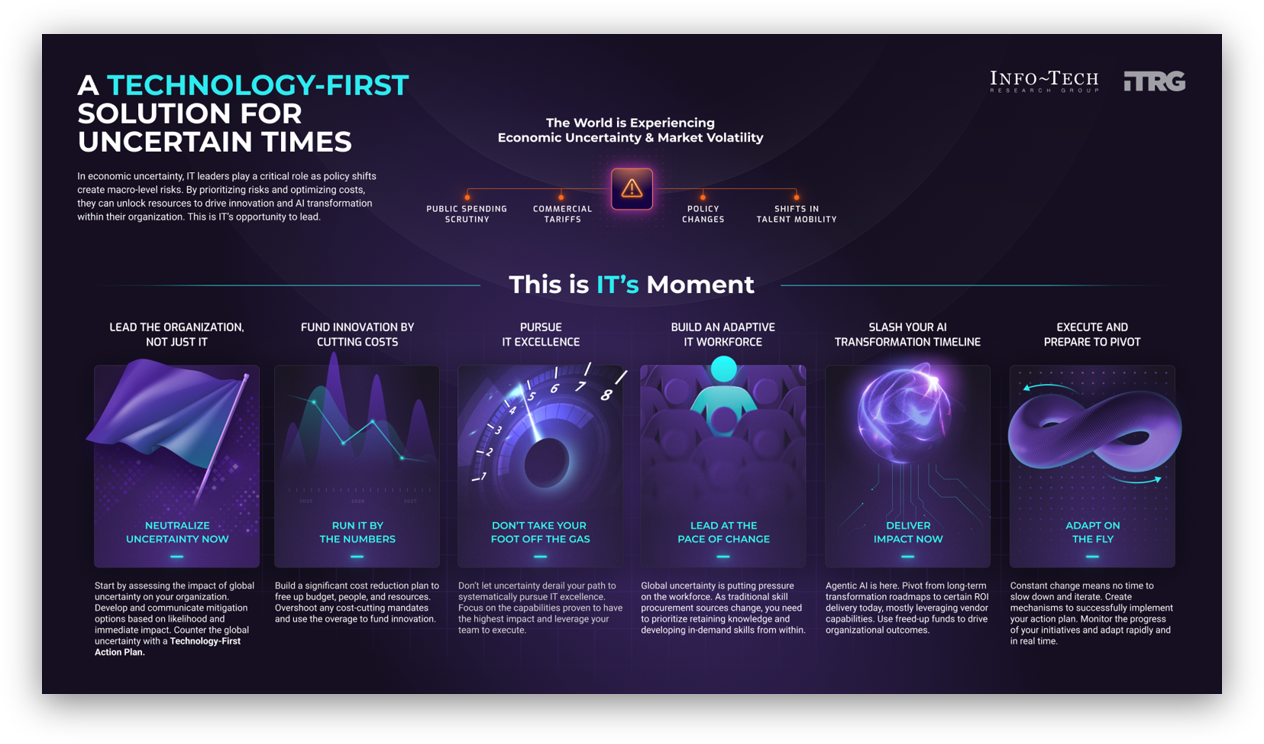
Start by assessing the impact of global uncertainty on your organization.
In 2025, organizations faced a series of unexpected macrovulnerabilities that drastically impacted how they functioned. For CIOs and IT leaders, these vulnerabilities present challenges to achieving their technology mandates.
Complete Info-Tech's Technology-First Action Plan Sample Deliverable to support developing the IT Vendor Contract Optimization Plan.
Phase 1
Compile Vendor Inventory
Phase 1
1.1 Gather ITFM data
1.2 Assess optimization feasibility
1.3 Align with objectives
1.4 Classify vendors
Phase 2
2.1 Review milestones and usage
2.2 Evaluate terms and dependencies
2.3 Flag duplication and technical debt
Phase 3
3.1 Project cost reduction
3.2 Consider costs of optimization
3.3 Evaluate leverage and operational impact
3.4 Identify optimization type
Phase 4
4.1 Review the dashboard
4.2 Define actions per contract
4.3 Assign owners and timelines
4.4 Execute plan
This phase will walk you through the following activities:
- Gather ITFM data
- Assess optimization feasibility
- Align with objectives
- Classify vendors
This phase involves the following participants:
- CIO/IT director
- IT finance lead
- IT asset manager
- IT infrastructure manager
- IT vendor manager
- Other IT management
Optimize IT Vendor Contracts in Times of Uncertainty
1.1 Gather ITFM data
1-3 hours
- As a group, consolidate relevant ITFM data sources to create a baseline view of IT vendor spend. Data may include outputs from the Achieve IT Spend & Staffing Transparency blueprint, ITFM benchmarking reports, or Adapt to Uncertainty With a Technology-First Action Plan blueprint.
- Identify and collect vendor spend information across key categories.
- Validate completeness of vendor spend records.
- Record this information in Tab 3, Vendor Inventory, of the IT Vendor Contract Optimization Workbook and Plan.
Download the IT Vendor Contract Optimization Workbook and Plan
| Input | Output |
|---|---|
|
|
| Materials | Participants |
|
|
Cost optimization can only happen if you know how your budget is distributed
Leverage Info-Tech's IT Spend & Staffing Benchmarking Service to get insight into how your IT budget can be optimized and repurposed to drive innovation.
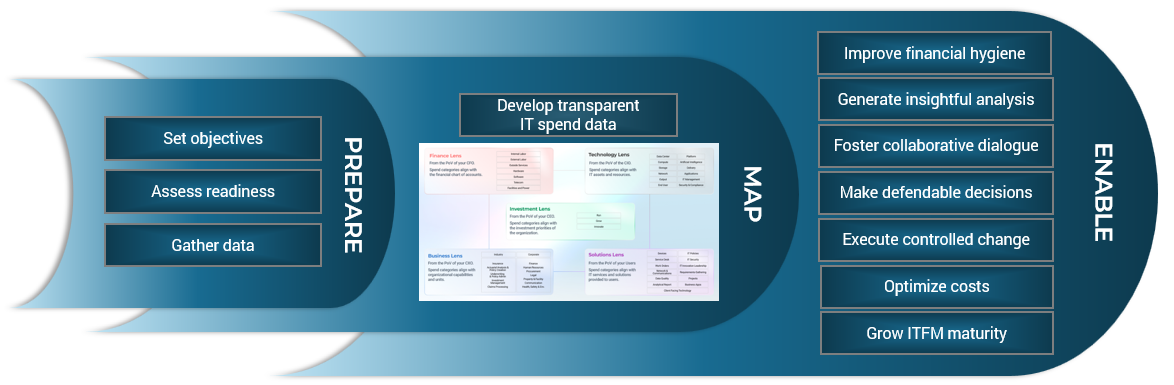
See our website for more information about the IT Spend & Staffing Benchmarking Service or leverage our tools and templates available through the Achieve IT Spend & Staffing Transparency blueprint to gain spend and staffing insight.
Evaluate IT spend using a common financial taxonomy
Info-Tech's ITFM Cost Model categorizes your IT spending and staffing according to five key views to put IT spend in language that stakeholders across the organization can relate to.
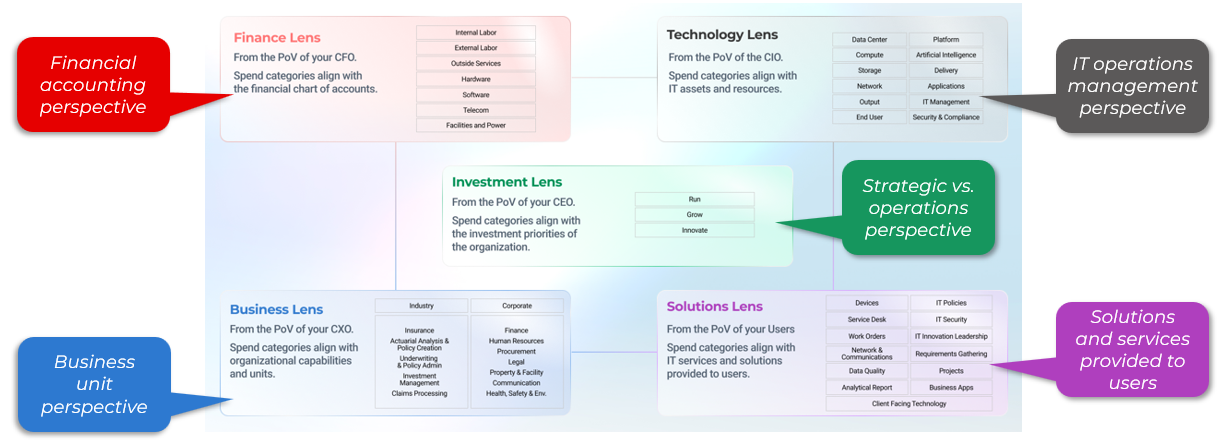
Identify opportunities to make the case for a change in investment strategy with your CEO or organizational leader
From IT's perspective, these islands are intimately connected, with events on one affecting what happens (or doesn't) on another. Focus on the bridges.
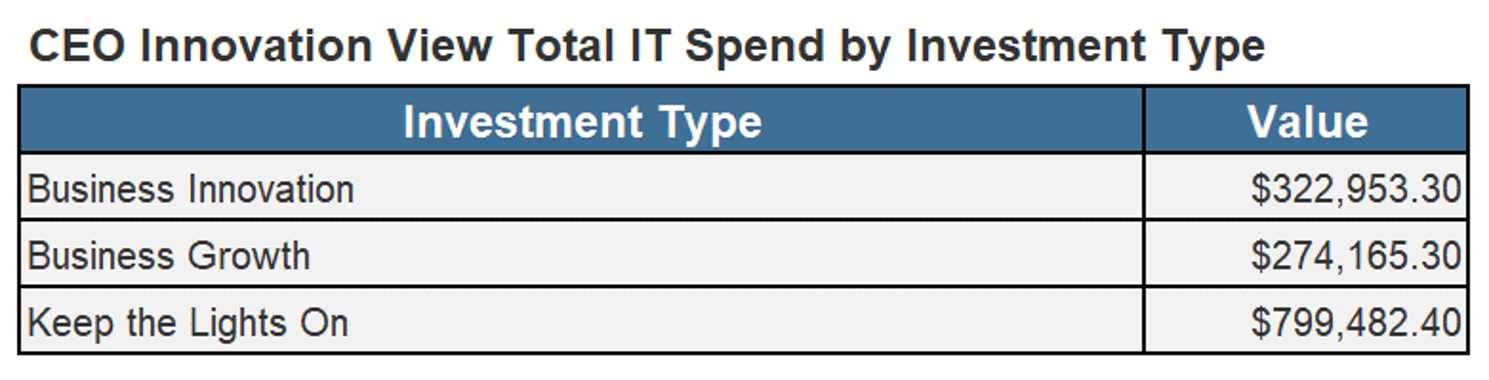
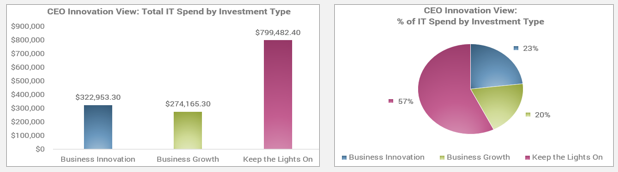
Business innovation and growth: Most of this spend will be tied to formal capital projects and is often approved and managed independently of the rest of IT spend. This is a false separation in reality. Unlike the other views, here you'll want to downplay the distinctions and focus on the things that unify IT spend. Use the data to talk about:
- Clarifying the business's priorities and focus.
- Improving financial governance practices and properly contextualizing associated decisions.
- Confirming the role that the business wants IT to play.
Keep the Lights On: This conversation usually revolves entirely around IT OpEx … and where to cut. While there's always a little fat to trim and some efficiencies to be gained, the main purpose of this spend is literally to keep the lights on (i.e. ensure that the organization can function). Unfortunately, this critical purpose is often overlooked or viewed as "waste." Knowing where this money is going, how it directly enables ongoing business operations, and how it creates the necessary conditions for growth and innovation to happen in the first place is key.
Focus more on unifying the view of technology spend than on the numbers
When talking to the CEO, seek to build mutual understanding and encourage a holistic approach to the organization's technology spend.
Use the numbers to get to the real issues.
- Clarify with the CEO what business innovation, business growth, and KTLO mean to them and the role each plays in the organization's strategic and operational plans.
- Find out the role they think IT, and technology as a whole, has in realizing business plans. Only then can you look at the relative allocation of IT spend with them to see if the aspiration aligns with reality.
- Eventually, you'll need to discuss expectations around who pays the bills for operationally supporting capital technology investments over the long-term (i.e. IT or the business units that actually want and use it). You'll have concrete examples of business projects that consumed IT operations resources without a corresponding increase in IT's OpEx budget.
Focus your KTLO spend conversation on risk and trade-off.
- Every strategic conversation needs to look at the impact on ongoing operations. Every discussion about CapEx needs to investigate the long-term repercussions for OpEx. Look at the whole tech spend picture.
- Use risk to get KTLO/OpEx into the conversation. Be straightforward (i.e. "If we do/don't do this, then we can/can't do that"). Simply put, mitigating the risks that get in the way of having it all usually requires spending.
About Info-Tech
Info-Tech Research Group is the world’s fastest-growing information technology research and advisory company, proudly serving over 30,000 IT professionals.
We produce unbiased and highly relevant research to help CIOs and IT leaders make strategic, timely, and well-informed decisions. We partner closely with IT teams to provide everything they need, from actionable tools to analyst guidance, ensuring they deliver measurable results for their organizations.
What Is a Blueprint?
A blueprint is designed to be a roadmap, containing a methodology and the tools and templates you need to solve your IT problems.
Each blueprint can be accompanied by a Guided Implementation that provides you access to our world-class analysts to help you get through the project.
Talk to an Analyst
Our analyst calls are focused on helping our members use the research we produce, and our experts will guide you to successful project completion.
Book an Analyst Call on This Topic
You can start as early as tomorrow morning. Our analysts will explain the process during your first call.
Get Advice From a Subject Matter Expert
Each call will focus on explaining the material and helping you to plan your project, interpret and analyze the results of each project step, and set the direction for your next project step.
Unlock Sample Research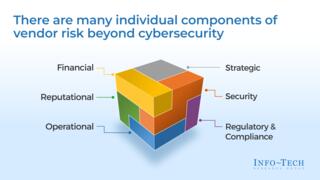 Looking at Risk in a New Light: The Six Pillars of Vendor Risk Management
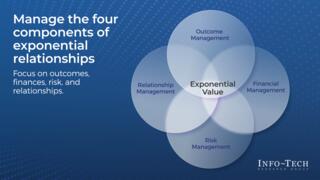 Manage Exponential Value Relationships
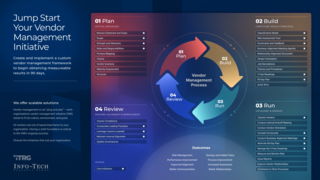 Jump Start Your Vendor Management Initiative
 Capture and Market the ROI of Your VMO
 Cut Cost Through Effective IT Category Planning
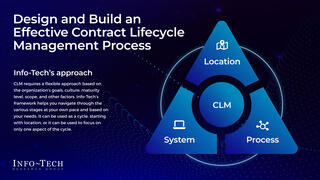 Design and Build an Effective Contract Lifecycle Management Process
 Maximize Value From Your Value-Added Reseller (VAR)
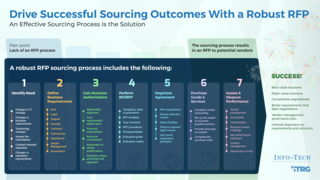 Drive Successful Sourcing Outcomes With a Robust RFP Process
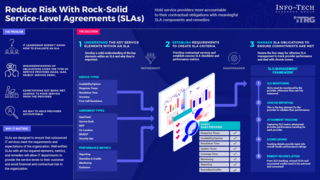 Reduce Risk With Rock-Solid Service-Level Agreements
 Slash Spending by Optimizing Your Software Maintenance and Support
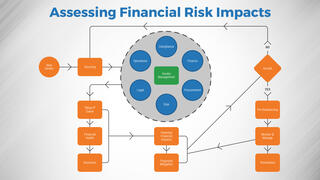 Identify and Manage Financial Risk Impacts on Your Organization
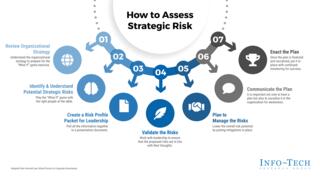 Identify and Manage Strategic Risk Impacts on Your Organization
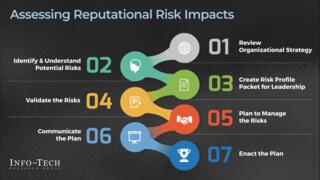 Identify and Manage Reputational Risk Impacts on Your Organization
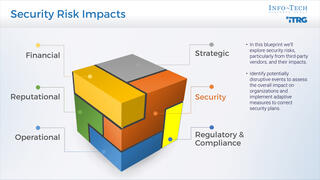 Identify and Manage Security Risk Impacts on Your Organization
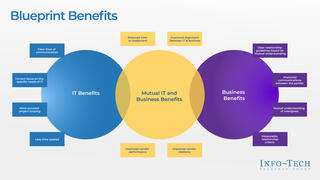 Evaluate Your Vendor Account Team to Optimize Vendor Relations
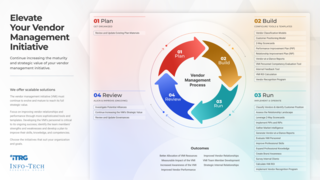 Elevate Your Vendor Management Initiative
 Prepare for Negotiations More Effectively
 Implement Your Negotiation Strategy More Effectively
 Evaluate and Learn From Your Negotiation Sessions More Effectively
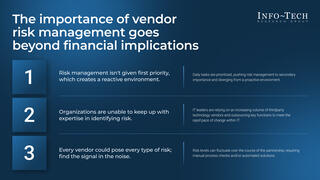 Proactively Identify and Mitigate Vendor Risk
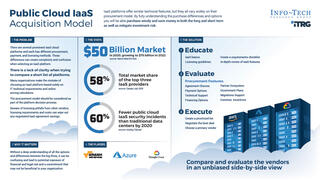 Master the Public Cloud IaaS Acquisition Models
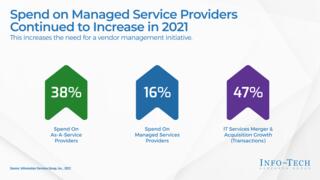 Essentials of Vendor Management for Small Business
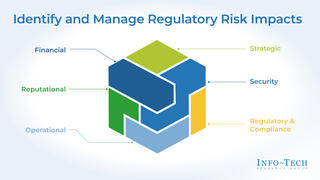 Identify and Manage Regulatory and Compliance Risk Impacts on Your Organization
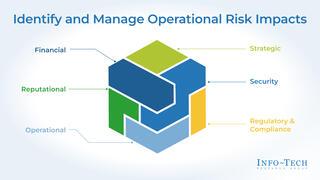 Identify and Manage Operational Risk Impacts on Your Organization
 Don’t Allow Software Licensing to Derail Your M&A
 Identify and Reduce Agile Contract Risk
 Improve Your Statements of Work to Hold Your Vendors Accountable
 Understand Common IT Contract Provisions to Negotiate More Effectively
 Master Contract Review and Negotiation for Software Agreements
 Master the MSA for Your Managed Services Providers
 Negotiate SaaS Agreements That Are Built to Last
 Establish a Vendor Management Roadmap to Succeed With Autonomous Technologies
 Price Benchmarking & Negotiation
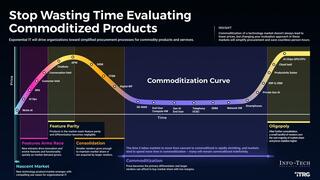 Stop Wasting Time Evaluating Commoditized Products and Services
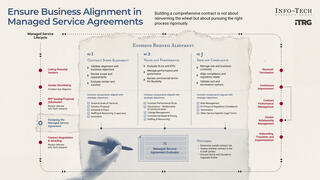 Ensure Business Alignment in Managed Service Agreements
 Comparing Software Practices in Maturing IT
 Run IT By the Numbers
 Transform IT, Transform Everything
 The Race to Develop Talent
 Building Info-Tech’s Chatbot
 Assessing the AI Ecosystem
 Sync or Sink: Aligning IT and HR for the Future of Work
 Building the Road to Governing Digital Intelligence
 Bring AI Out of the Shadows
 The AI Vendor Landscape in IT
 IT Spend and Staffing Benchmarking
 An Operational Framework for Rolling Out AI
 Optimize IT Vendor Contracts in Times of Uncertainty
 AI in Seven Charts
 Emerging AI Trends and Predictions From Our Global Technical Counselor Team
 Master High-Value Contracts: Optimize Costs and Reduce Risks Keynote
 Turn Customer Friction Into Agentic Opportunity
 People Change in the Face of Disruptive Technology
 Lead IT Like a Business: Every Dollar Is a Decision
 Optimize Cloud & AI Spend With Agentic FinOps
 Influence Unleashed: The IT Leader’s Superpower
 The Challenge of Ethics in the Use of AI
 Revolutionize Risk Management With Agentic AI
 Introducing the Info-Tech Speakers Bureau
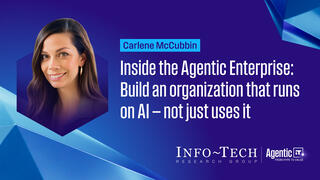 Inside the Agentic Enterprise
 Agentic IT: From Hype to Value
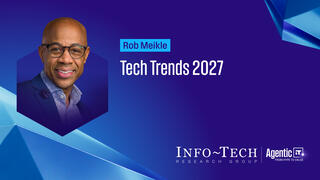 Tech Trends 2027 Keynote
 Become an Exponential CIO
 Beyond the Agent: The Leadership Ecosystem for an AI-Enabled World
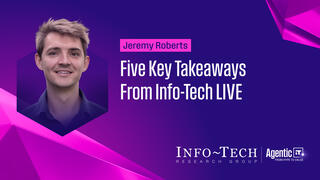 Five Key Takeaways From Info-Tech LIVE 2026