The latest AI news from Anthropic, OpenAI, AWS, Google, Microsoft, Meta, Nvidia, US Administration, Alberta Government, Canada, and an agentic AI customer reference from Anthropic.
INFO-TECH AI INSIGHTS
AI Transformation Brief
VOL 3 JULY 2026
Featuring AI best practices and insights to enable our members to strategize, plan, develop, deploy, manage, and govern AI-based technologies and solutions.
In This Issue –› AI in the News | AI Research Highlights | Vendor Spotlight | Upcoming Events & Resources
AI IN THE NEWS
Anthropic discovers the inner workings of Claude, Fable 5 and Mythos 5 reinstated, and Claude Tag
Anthropic Fable 5 and Mythos 5 reinstated
On July 6, 2026, Anthropic published a research paper that highlighted a hidden workspace inside the Claude AI model. A new Jacobian lens technique that provided insights into the inner workings of the AI model.
On June 30, 2026, Anthropic was given permission to restore access to Fable 5 and Mythos 5, after the US administration lifted its export control directive.
On June 23, 2026, Anthropic launched Claude Tag, a 24x7 AI teammate for Slack that enables the team to assign tasks to @Claude under admin-controlled access, replacing the existing Claude in the Slack app.
ANALYST ANALYSIS
AI researchers found that before Claude outputs its final visible text, it performs complex "hidden reasoning" and structures its thoughts in a latent mathematical workspace that is normally invisible to users. This breakthrough is considered a massive step forward in understanding the inner workings and safety alignment of LLMs.
Governments around the world gained a concrete example of the risks associated with dependence on a small number of foreign AI providers after the US exercised export controls on Anthropic’s models. As a result, many organizations have concluded they should avoid dependence on a single US provider by deploying domestic models, supporting regional AI companies, maintaining multi-model architectures, and/or supporting sovereign AI initiatives.
Claude Tag represents one of the industry's first major implementations of team-based, ambient AI operating natively inside an enterprise communications hub. In addition, this implementation includes enterprise-grade security, single-sign-on, and administrative controls.
OpenAI Unveils GPT-5.6 Sol, ChatGPT Work, and GPT-Live
On July 9, 2026, OpenAI made GPT-5.6 Sol, Terra, and Luna generally available across ChatGPT, Codex, and the API.
On July 9, 2026, OpenAI introduced ChatGPT Work, a GPT-5.6 agent that drafts documents, spreadsheets, and decks across web, desktop, and mobile.
On July 8, 2026, GPT-Live, a full-duplex voice model with live translation was announced and replaces Advanced Voice Mode for all ChatGPT users.
ANALYST ANALYSIS
This month’s announcements from OpenAI focus on differentiating how its offerings are better than Anthropic’s. Using the latest benchmarks, OpenAI explains that GPT-5.6 Sol coding capabilities are slightly better than Fable 5, but at only one-third the cost.
ChatGPT Work is being positioned against Claude Cowork and Claude Tag and represents the transition of ChatGPT from a passive "question-and-answer" chatbot into an active, autonomous AI coworker.
GPT-Live's full-duplex voice and live translation push voice toward a primary interface, not a side feature — which allows it to listen and speak simultaneously.
INFO-TECH AI INSIGHTS
AI Transformation Brief
#2
AI IN THE NEWS
Launch of AWS Forward Deployed Engineering, AWS Context, and AWS Continuum
AWS Forward Deployed Engineering
On June 30, 2026, AWS committed $1 billion to a new Forward Deployed Engineering unit that embeds pods of five to six engineers inside enterprise customers for roughly 45-day agentic AI deployment sprints.
On June 17, 2026, AWS announced AWS Context, a real-time enterprise knowledge graph unveiled at its New York Summit that gives agents the business context to find the right answer or take the right next step.
Also on June 17, 2026, AWS introduced AWS Continuum, an AI-native, model-agnostic security platform. It is designed to handle full-lifecycle software vulnerability management at machine speed.
ANALYST ANALYSIS
The $1B Forward Deployed Engineering unit mirrors moves already made by OpenAI's Deployment Co., Anthropic's Blackstone-backed services arm, and Microsoft Frontier Company. All these vendors are focused on addressing the challenges their customers have with deploying the solutions.
AWS Context dynamically builds a self-learning enterprise knowledge graph. It unifies structured and unstructured data to give AI agents the exact business context, relationships, and metadata they need to execute accurate, multi-step actions without hallucinating. It is a good fit for organizations with heterogenous data who wish to avoid lock-in to a specific cloud vendor.
AWS Continuum is a service that continuously discovers vulnerabilities, runs automated exploit tests in a sandbox to validate them (eliminating false positives), prioritizes them based on business risk, and suggests validated code patches or configuration changes to fix them.
Google “State of AI Infrastructure” study released, Public Preview of Omni Flash and Computer Use now available
State of AI Infrastructure Report
Gemini Computer Use announcement
On July 7, 2026, Google released its "State of AI Infrastructure" Report: 83% of organizations need to upgrade their infrastructure to support agentic AI.
On June 30, 2026, Google released Gemini Omni Flash, rather than treating video generation as a "one-and-done" prompt box, Gemini Omni transforms it into a two-way, multi-turn collaborative conversation.
On June 24, 2026, Google announced Public Preview of “Computer Use” in Gemini 3.5 Flash, a highly cost-effective, unified solution for controlling desktop, mobile, and browser tasks.
ANALYST ANALYSIS
In this latest AI infrastructure report, also highlights that 79% of the survey participants identify that security, governance and operations represent the top challenge when scaling AI inference workloads. In my experience, the greater challenge is managing governance, and this drives organizations to seek and implement an adaptive AI governance program to manage to new risks that are introduced with agentic AI.
Google’s Omni Flash is positioned as a dynamic creative assistant that can accepts text, image, audio, and video inputs, enabling users to edit, swap objects, adjust lighting, and build multi-shot narratives natively using natural, multi-turn dialogue.
Folding Computer Use directly into Gemini 3.5 Flash, rather than routing to a separate model, this mirrors OpenAI and Anthropic's own computer-use pushes, but Google’s value proposition is cost: browser, mobile, and desktop control in one inference pass without paying for a second specialized model.
Microsoft patches a record 570 security flaws, announces $2.5 billion launch of Microsoft Frontier Company and AI Pricing Model Changes
Microsoft patches 570 security flaws
Microsoft Pricing Model Changes
On July 14, 2026, Microsoft announced it patched a record-breaking 570 security flaws in a single monthly rollout – nearly tripling the previous month's count – and attributed this success to AI.
On July 2, 2026, Microsoft launched Microsoft Frontier Company, a $2.5 billion, 6,000-person unit that embeds engineers inside enterprise customers to build and run AI systems.
On June 16, 2026, Microsoft moved Copilot Cowork to usage-based pricing billed in Copilot Credits.
ANALYST ANALYSIS
In a blog post on July 9, Microsoft executive vice president Pavan Davuluri wrote that Windows users will notice "a higher volume of security updates included in each security release" because of using AI (MDASH).
Microsoft's $2.5B Frontier Company is more than twice AWS's FDE commitment made two days earlier, and Microsoft can lean on an existing consulting bench and partners like Accenture and EY – the real test is whether outcome-based engagements beat the 95% AI pilot-failure rate MIT reported.
Shifting Copilot Cowork to usage-based Copilot Credits moves cost-overrun risk onto customers just as GitHub Copilot's token billing sparked backlash – expect buyers to demand spend caps and model-choice controls before expanding Cowork seats.
INFO-TECH AI INSIGHTS
AI Transformation Brief
#4
AI IN THE NEWS
Meta’s first data center in Canada to be located in Alberta
Meta invests $13 Billion in its first data center in Canada
On July 8, 2026, Meta announced its first Canadian data center: a 1-gigawatt, AI-optimized facility in Sturgeon County, Alberta, representing a CAD$13 billion investment and Meta's largest facility outside the US.
ANALYST ANALYSIS
Alberta let data centers build their own generation, and Meta used that: its tolling deal with the gas-fired Greenlight Electricity Centre sidesteps the grid-capacity bottleneck other jurisdictions face.
Closed-loop cooling keeps water use near a golf course's, answering the water-scarcity critique – but Alberta's gas-heavy grid runs at roughly five times the national emissions average, a point Greenpeace Canada raised immediately.
At $13B, scalable to 1.8GW, this is Canada's largest AI infrastructure commitment yet, putting Alberta ahead of Ontario and Quebec in the race for hyperscaler capacity.
Nvidia proposes a new revenue sharing business model for startups
Nvidia proposes a revenue sharing model to startups
On July 1, 2026, Nvidia introduced a revenue-sharing and credit-support model that lets AI cloud providers deploy its GPUs without carrying the full upfront capital cost. This proposal is targeting the growing AI ecosystem of startups, model builders, enterprises, research organizations, and regional AI players.
ANALYST ANALYSIS
A firm leveraging this model avoids massive upfront capital expenditures by acquiring Nvidia GPUs through a combination of revenue-sharing and credit-support financing. In exchange, the firm gives Nvidia standard initial hardware revenue alongside a recurring, usage-linked cut of the cloud rental income the capacity generates. The firm shifts its demand and utilization risks directly to Nvidia's balance sheet through a floor-price buyback guarantee on any unsold or idle GPU capacity
Nvidia is effectively underwriting its own demand – its largest customers, Microsoft, Google, Amazon, and Meta, are all building competing silicon, so financing smaller AI-native clouds and startups is a hedge against hyperscalers eventually routing workloads to their own chips.
However, there is significant risk to the firm adopting this business model for its margin to be squeezed, after the payout obligations to both their chip supplier and investors.
Government of Alberta uses Claude to find and fix cybersecurity vulnerabilities
Read the Anthropic case studyt
On July 6, 2026, Anthropic published a case study describing how the Government of Alberta's Ministry of Technology and Innovation used Claude Code with Opus and Sonnet models to scan 466 million lines of code in 20 hours, uncovering and fixing vulnerabilities across 27 provincial ministries.
ANALYST ANALYSIS
Alberta's approach validates a pattern spreading across public-sector AI adoption: parallel agents for discovery and remediation, with human engineers reviewing every patch before deployment – not autonomous patch-shipping. That governance model, more than the 466-million-line headline, is what other governments should copy.
The scale gap is the real story: Alberta estimates the same review would have taken roughly six and a half years using a traditional human-led process. For governments sitting on decades of undocumented legacy code, that arithmetic makes AI-assisted security review a fiscal necessity, not just a competitive edge.
Rebuilding a 25-year-old Java subsidy portal in four to five days – work that originally took five months – points past security into full legacy modernization. Expect other provincial and state governments sitting on similar technical debt to follow Alberta's playbook rather than build their own from scratch.
INFO-TECH AI INSIGHTS
AI Transformation Brief
#5
AI RESEARCH HIGHLIGHTS
RESEARCH SPOTLIGHT:
Discover the Enterprise Agentic AI Technology Stack Coming Soon!
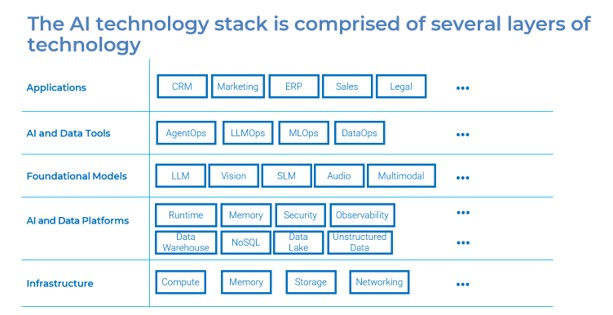
Source: Discover the Enterprise Agentic AI Technology Stack
Info-Tech Research Group
VENDOR SPOTLIGHT:
- Qualys Enterprise TruRisk Platform
- Databricks Is No Longer Just a Data Company
- Verint Engage 2026 Presents the “New Verint,” Moving From CX Automation to Agentic Workforce Orchestration
- Allure Security Targets Enterprise Brand Protection With Faster Detection and Automated Takedown
- SAP Acquires Dremio, Reltio, and Prior Labs to Create an Agentic AI Platform and Research Center for Structured Data
UPCOMING AND RECENT EVENTS
- LIVE Barcelona – Barcelona, Spain, September 22-23, 2026
- LIVE Toronto – Las Vegas, Nevada, November 10-12, 2026
- LIVE Gold Coast – Brisbane Queensland, March 16-17, 2027
AI AND DATA ANALYTICS SOLUTIONS – RESOURCES
- AI Marketplace
- Artificial Intelligence Research Center
- AI Workforce Development Program
- AI Workshops
- AI Strategy
- AI Governance, Liability & Risk
- Accelerate adoption of Gen AI
- Drive Business Value With M365 Copilot
- Design Your Agentic AI Prototype
- Develop Your Agentic AI Prototype
- Scale and Optimize Your Agent Implementation
AI EDITOR-IN-CHIEF
Bill Wong – Info-Tech AI Research Fellow