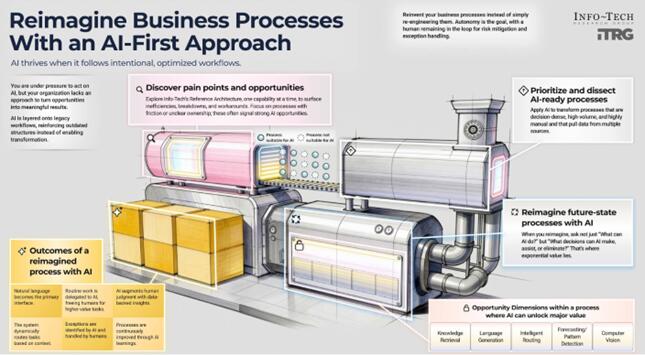
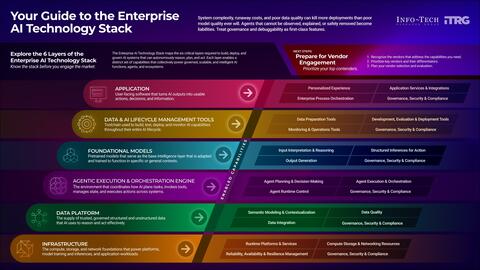
The latest news from the AI Big Tech Vendors: Anthropic, OpenAI, AWS, Google, Microsoft Azure, Cohere, Aleph Alpha, and Oracle and a brief review of how PepsiCo is benefiting from their implementation of agentic AI.
VOL 3 APRIL 2026
INFO-TECH AI INSIGHTS
AI Transformation Brief
Featuring AI best practices and insights to enable our members to strategize, plan, develop, deploy, manage, and govern AI-based technologies and solutions.

In This Issue-> AI in the News | AI Research Highlights | Vendor Spotlight | Upcoming Events & Resources
AI IN THE NEWS
Anthropic leaks Mythos and Claude Code source code and discontinues support for OpenClaw
Anthropic Claude Mythos Preview
Claude Code Leak
OpenClaw Support Withdrawn
On March 26, 2026, Anthropic inadvertently made nearly 3,000 unpublished internal assets publicly accessible, revealing the existence of Claude Mythos, their next-generation AI model, delivering industry leadership for finding and exploiting software vulnerabilities.
On March 31, 2026, over 500 thousand lines of Claude Code source code was accidentally leaked, revealing planned enhancements.
On April 4, 2026, Anthropic announced that support for OpenClaw through existing subscriptions would be discontinued.
ANALYST ANALYSIS
On April 8, Anthropic officially announced Claude Mythos Preview, but decided not to make it publicly available. As part of Project Glasswing, a small group of 40+ security partner organizations including Amazon, Apple, Microsoft, and Palo Alto Networks will have access to the code and are deploying it exclusively for defensive cybersecurity work.
The Claude Code leak revealed an evolution of its AI agent capabilities. The future of Claude Code will focus on persistent, multi-agent, deeply integrated AI systems that autonomously manage software development workflows.
Anthropic has communicated that due to additional demand and strain of OpenClaw on Anthropic's compute and engineering resources, subscribers will now be required to pay for extra usage through a pay-as-you-go option billed separately from their subscription.
OpenAI releases GPT-5.4 mini and nano, discontinues Sora, and releases its agentic AI principles
GPT-5.4 min and nano
OpenAI Sora
OpenAI Model Spec
On March 17, 2026, OpenAI released GPT-5.4 mini and nano, AI models optimized for high-volume workloads such as coding assistants and subagents.
On March 24, 2026, OpenAI announced that it was discontinuing the Sora AI video app and API.
On March 25, 2026, OpenAI introduced the Model Spec, a formal framework defining intended AI agent behavior.
ANALYST ANALYSIS
GPT-5.4 mini and nano are being positioned as AI models delivering lower latency and lower costs for developing AI agents while positioning the larger models to handle AI agent coordination.
Dropping Sora means the three-year agreement with Disney, involving both a $1 billion investment and licensing of over 200 characters, has terminated. Despite OpenAI's abrupt pivot away from consumer-facing video generation,
Disney stated it respects OpenAI's decision and will engage with other AI platforms to explore technology usage without infringing on IP rights.
The OpenAI Model Spec serves as a formal and evolving framework designed to define and govern how AI systems should behave across diverse interactions. It establishes a clear chain of command to resolve conflicting instructions from developers and users while maintaining hard safety boundaries and predictable default behaviors.
Microsoft invest $1 billion into Thailand's digital infrastructure, the availability of the Agent Governance Toolkit, and new AI models
$1B investment Into Thailand
Agent Governance Toolkit
New Microsoft AI Models
On March 31, 2026, Microsoft announced a $1 billion investment in Thailand to establish a secure national digital foundation for cloud computing and AI applications.
On April 2, 2026, Microsoft released the Agent Governance Toolkit, an open-source project designed to proactively address risks like goal hijacking and tool misuse.
On April 2, 2026, Microsoft launched the public preview of following internally developed AI models: MAI-Transcribe-1, MAI-Voice-1, and MAI-Image-2.
ANALYST ANALYSIS
The $1 billion will be invested in the following pillars of Thailand's digital infrastructure:
- Technology, to build world-class infrastructure.
- Trust, to establish a secure, sovereign, and inclusive digital foundation.
- Talent, to ensure the skills needed reach every user.
Microsoft is positioning its Agent Governance Toolkit as the first toolkit to address all 10 OWASP agentic AI risks with deterministic, sub-millisecond policy enforcement.
Microsoft has delivered the following internally developed AI models:
- MAI-Transcribe-1: Speech recognition model supporting 25 languages.
- MAI-Voice-1: Speech generation model capable of producing 60 seconds of expressive audio.
- MAI-Image-2: Text-to-image model allows users to create cinematic scenes and typographic layouts.
AWS announces Nova Forge, AgentCore Evaluations, and DevOps and SecOps agent availability
AWS Nova Forge SDK
AgentCore Evaluations
AWS DevOps and Security Agents
On March 18, 2026, AWS introduced the Nova Forge SDK, a unified developer toolkit that removes the complexity of fine-tuning and deploying specialized Nova models for enterprise-specific AI tasks.
On March 31, 2026, Amazon Bedrock AgentCore Evaluations was released, and it provides a managed service for assessing AI agent performance.
On April 6, 2026, the AWS DevOps and Security Agent were made generally available, marking the launch of autonomous "frontier agents."
ANALYST ANALYSIS
The Nova Forge SDK significantly lowers the barrier to entry for LLM customization to enable organizations to build domain-specific solutions that deeply understand proprietary workflows.
AgentCore Evaluations uses the following three principles for evaluation:
- Evidence-driven development with quantitative metrics.
- Multi-dimensional assessment evaluates different aspects of agent behavior independently.
- Continuous measurement allows developers to detect drift by comparing live performance directly against established baselines.
AWS clients have reported that the DevOps agent has accelerated incident resolution by up to 75% and the Security agent has accelerated security testing by over 50% via automated and context-aware penetration testing.
Google releases Agentic Defense, Gemma 4, and commits to a multi-gigawatt TPU capacity with Anthropic and Broadcom
Agentic Defense
Gemma 4
Multi-Gigawatt Partnership With Anthropic and Broadcom
On March 23, 2026, Google officially completed its acquisition of Wiz and introduced agentic security innovations, including a Triage and Investigation agent and dark web intelligence, to enable "machine-speed" defense against autonomous AI threats.
On April 2, 2026, Google Cloud released Gemma 4, its most capable family of open models.
On April 6, 2026, Google and Broadcom signed a massive agreement with Anthropic to provide multiple gigawatts of next-generation TPU capacity starting in 2027.
ANALYST ANALYSIS
Google will be introducing new agentic automation in Google Security Operations, now in preview, enabling security teams to augment automated actions with agents – combining dynamic and adaptive AI with deterministic automation.
Gemma 4 features native multimodal processing, a 256K context window, and a permissive Apache 2.0 license for complex enterprise orchestration and agentic workflows.
According to Anthropic, the vast majority of the new compute will be sited in the United States, making this partnership a major expansion of their November 2025 commitment to invest $50 billion in strengthening their computing infrastructure.
Cohere and Aleph Alpha in merger discussions
Possible Cohere Aleph Alpha Merger
On April 9, 2026, the German newspaper Handelsblat, made public that merger discussions were occurring between Cohere (Canada) and Aleph Alpha (Germany), after an investigative report.
German Digital Minister Karsten Wildberger supported the potential union as a "very strong signal," underscoring the established AI cooperation between Canada and Germany. While both companies remain cautious – with Aleph Alpha characterizing strategic talks as industry standard and Cohere citing its global growth and the Canadian-German Sovereign Technology Alliance — at this time, German ministries have withheld formal comment beyond the minister's initial endorsement.
ANALYST ANALYSIS
Cohere is a leading developer of enterprise-grade large language models (LLMs) and differentiates itself by offering a cloud-agnostic platform, allowing organizations to deploy secure, private AI models across any cloud provider or on-premises environment.
Aleph Alpha firm focuses on developing sovereign, explainable, and secure LLMs. Targeting the industrial and government sectors, the company positions itself as a strategic European alternative to American AI providers. Aleph Alpha distinguishes itself through a rigorous commitment to data sovereignty and strict compliance with European regulatory standards, offering AI solutions capable of operating within the world's most sensitive and highly regulated environments.
Discussions initiated earlier this year have evolved into merger discussions that would potentially establish a dual-headquartered entity across both Germany and Canada. With Berlin exploring a role as a primary anchor customer, the alliance is being positioned as a critical strategic maneuver to bolster Europe's competitive standing in the global AI landscape.
If the merger proceeds, this would create the first major Transatlantic AI powerhouse, directly competing against the AI model providers: OpenAI, Anthropic, and Google.
Oracle lays off 30,000 employees
On March 31, 2026, Oracle carried out one of the biggest layoffs in its history, impacting approximately 30,000 employees worldwide (roughly 18% of its workforce). Affected staff received a standardized email from "Oracle Leadership" at approximately 6:00am local time, and for many, system access was revoked almost immediately after opening the email.
ANALYST ANALYSIS
According to the Economic Times, the text of the termination email sent was:
"We are sharing some difficult news regarding your position. After careful consideration of Oracle's current business needs, we have made the decision to eliminate your role as part of a broader organizational change.
As a result, today is your last working day. We are grateful for your dedication, hard work, and the impact you have made during your time with us."
Oracle was a negligible cloud computing provider, with single-digit market share adoption. However, the commitment for OpenAI for 300 billion to Oracle over five years (signed in September 2025) for AI infrastructure changed all that. Oracle had to start building the infrastructure to become a viable AI platform provider for OpenAI. In January 2026, TD Cowen released an investor note estimating that the OpenAI deal alone would require $156 billion in capital spending from Oracle. The cost of entry into the market that provides AI infrastructure is high, and it would seem that Oracle will be redirecting the savings of having a smaller workforce into funding the restructuring of its AI infrastructure services.
PepsiCo's early adoption of digital twins and AI agents
Read the Engineering.com Article
On March 3, 2026, PepsiCo benefits from operationalizing the digital twin and AI simulation across live facilities to evaluate line design, material flow, and automation decisions before physical changes occur:
- Up to 90% of potential issues identified before physical modification.
- 20% increase in throughput.
- Nearly 100% design validation before build.
- 10% to 15% reduction in capital expenditure.
ANALYST ANALYSIS
By leveraging Siemens Digital Twin Composer and NVIDIA Omniverse, PepsiCo has pioneered the use of high-fidelity digital twins to map every machine, conveyor, and operator path within its global facilities. This industry-first approach creates immersive virtual environments where autonomous AI agents execute thousands of simulations to stress-test workflows and validate automation strategies. By identifying bottlenecks and optimizing throughput in the digital realm, PepsiCo can finalize critical design decisions before committing to a single physical modification on the factory floor.
AI RESEARCH HIGHLIGHTS
Reimagine Business Processes With an AI-First Approach New!
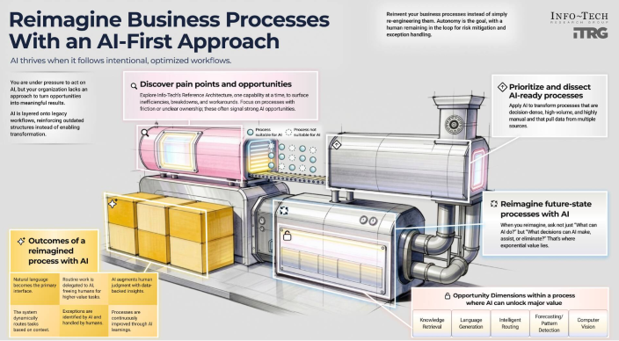
Source: Establish Reimagine Business Processes With an AI-First Approach, Info-Tech Research Group
VENDOR SPOTLIGHT:
- ServiceNow Bundles AI Into Every Product and Bets That Context Is the Missing Piece
ServiceNow Bundles AI Into Every Product and Bets That Context Is the Missing Piece - Winning on Deployment, Not Disruption: What Contract Logix CLM Actually Sells
Winning on Deployment, Not Disruption: What Contract Logix CLM Actually Sells - Cognigy 2026: Agentic AI for Outstanding Customer Care and Proactive Resolution Takes Center Stage
Cognigy 2026: Agentic AI for Outstanding Customer Care and Proactive Resolution Takes Center Stage - AWS Agentic AI Is Built for the Enterprise. OpenClaw Is Not.
AWS Agentic AI Is Built for the Enterprise. OpenClaw Is Not. - Has the "SaaSpocalypse" Come for CX Technology Providers?
Has the "SaaSpocalypse" Come for CX Technology Providers?
UPCOMING AND RECENT EVENTS
UK AI CIO SIG – London, England, April 14, 2026
IGNITE Toronto – Toronto, ON, April 16-17, 2026
IGNITE Detroit – Detroit, MI, April 28-29, 2026
LIVE Las Vegas - Las Vegas, NV, June 9-11, 2026
LEVEL-UP Series: AI Workforce Development
Austin, TX, May 14, 2026
Webinar: Adaptive AI Governance, May 6, 2026, 1:0pm to 2:00am ET Registration
Webinar: Building the Sovereign AI Strategy with a Responsible AI Mandate, May 7, 2026, 10:00am – 11:00am ET Registration
AI AND DATA ANALYTICS SOLUTIONS – RESOURCES
AI Marketplace
Artificial Intelligence Research Center
AI Workforce Development Program
AI Strategy
AI Governance, Liability & Risk
Accelerate Adoption of Gen AI
Drive Business Value With M365 Copilot
Design Your Agentic AI Prototype
Develop Your Agentic AI Prototype
Scale and Optimize Your Agent Implementation
AI EDITOR-IN-CHIEF
Bill Wong – Info-Tech AI Research Fellow