





Govern AI before it scales board- and district-wide
The Challenge
AI is already in schools, ahead of the rules.
Generative AI is already in classrooms and front offices, used by students and teachers daily, often ahead of any board or district policy. Acceptable use rules, data-privacy protections, and academic integrity standards are struggling to keep pace, leaving teachers improvising and students unsure of the line between help and cheating. The choice is not whether AI enters the building, but whether the board or district governs it on purpose.
Why It Matters
Guardrails can't wait another year.
AI adoption has outrun guidance, and boards and districts that delay will inherit privacy, equity, and integrity problems they never chose. With 54% of students and 53% of teachers reporting AI use for school in 2025 while training and policy lag well behind, this is the year to put clear, board- and district-wide guardrails in place ("AI Use in Schools Is Quickly Increasing," RAND, 2025).
The Solution
Form an AI governance committee.
Bring together curriculum, IT, special education, and legal leaders to own AI policy, vet tools, and review privacy and equity risks.
Publish responsible use and academic integrity guidance.
Give teachers, students, and families plain rules on permitted AI use, disclosure, and age-appropriate access across grade levels.
Vet AI tools for student data privacy.
Require vendors to meet the applicable student data privacy laws and standards in your jurisdiction before any classroom tool is approved.
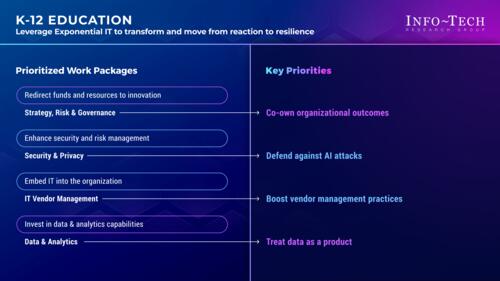
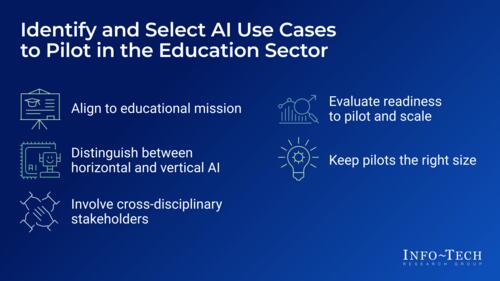


Turn AI pilots into measurable classroom value
The Challenge
Pilots are everywhere; proof is rare.
Boards and districts are piloting AI tutors, lesson-planning aids, and administrative tools, but few can show whether they saved teacher time or improved learning. Excitement drives adoption, but measurement lags, so promising tools fade and questionable ones linger. Without a value test, AI becomes scattered experiments rather than real capacity.
Why It Matters
Tight budgets demand measured AI bets.
With budgets tight, every AI investment has to earn its place by freeing teacher time or lifting outcomes. Because gen AI is now the top-ranked technology priority and 80% of boards and districts already have AI initiatives underway, the boards and districts that win are those that measure impact before scaling ("2025 State of EdTech," CoSN, 2025).
The Solution
Target AI at teacher workload first.
Prioritize use cases like lesson planning, drafting, and routine communication that give teachers time back and show value quickly.
Set success measures before each pilot.
Define the baseline, goal, and owner so impact on time saved or student outcomes can be judged honestly.
Scale only what proves out.
Agree in advance on the evidence, privacy, and budget bar a pilot must clear before it expands board- and district-wide.
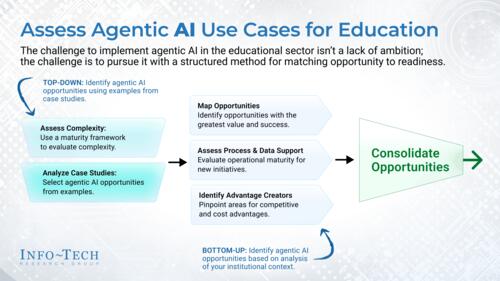


Reengage students with a connected digital experience
The Challenge
Disengaged students are hard to catch in time.
Chronic absenteeism and disengagement remain stubbornly high, yet attendance, behavior, and academic data often sit in disconnected systems. Staff cannot easily spot which students are slipping until they have already fallen far behind, and families experience the board or district through a patchwork of logins and portals. The problem is less a lack of data than an inability to act on it in time.
Why It Matters
Reengagement is now an operational priority.
Reengaging students is now a core operational challenge, not a soft goal, because attendance drives both learning and funding. With chronic absenteeism still around 28%, far above the prepandemic rate of roughly 15%, the boards and districts that connect their data to trigger early outreach will recover students the others lose ("Chronic Absenteeism," US Department of Education, 2024).
The Solution
Build an early warning system.
Combine attendance, grades, and behavior signals so counselors and teachers can intervene before a student becomes chronically absent.
Unify the family digital front door.
Consolidate communication, grades, and scheduling into one clear experience so parents engage instead of getting lost across tools.
Connect the student information system to outreach.
Link the student information system (SIS) to automated, multilingual nudges so attendance and reengagement efforts reach families fast.



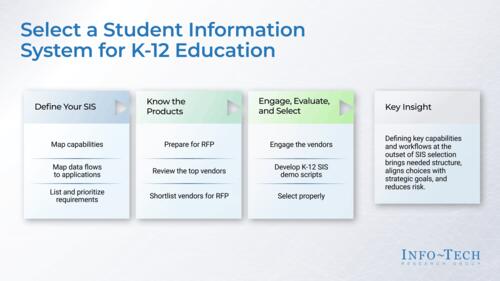
Treat K-12 data as a trusted, governed asset
The Challenge
K-12 data can't yet be trusted.
Student, staff, and operational data live in many systems with unclear ownership, inconsistent definitions, and uneven quality. Leaders asking a basic question, like how many students are truly chronically absent, can get different answers from different offices, and AI tools trained on that data only magnify the gaps. Data cannot guide decisions until someone is accountable for governing it.
Why It Matters
Trustworthy data has to come first.
Reliable data underpins every other priority, from attendance to AI to compliance, which is why governance has become a frontline concern rather than back-office cleanup. As boards and districts expand AI use, edtech leaders cite student data privacy among their top worries, making clear ownership and quality the foundation that has to come first ("2025 State of EdTech," CoSN, 2025).
The Solution
Assign data owners and stewards.
Name accountable owners for student, staff, and operational data so each critical data set has a person responsible for its quality and use.
Standardize definitions and a data dictionary.
Agree on shared definitions for core metrics like enrollment and attendance so reports reconcile across departments.
Set student data privacy and retention rules.
Define who can access which data and how long it is kept, aligned to the applicable student data privacy laws in your jurisdiction.

Defend schools against rising cyber threats
The Challenge
Schools are prime ransomware targets.
Schools hold rich personal data on minors and run flat, open networks with thousands of connected devices, making them prime ransomware targets. Lean IT teams must defend this surface while training staff and students and managing dozens of vendors, and a single breach can shut down instruction and expose families. Security in a board or district is a shared responsibility, not a job for one administrator.
Why It Matters
Attacks rise as federal support shrinks.
Attacks on schools are escalating in scale and sophistication just as federal support shifts toward fee-based models. With 82% of reporting K-12 schools experiencing cyberthreat impacts between mid-2023 and the end of 2024, treating cybersecurity as everyone's job is now urgent ("2025 CIS MS-ISAC K-12 Cybersecurity Report," Center for Internet Security, 2025).
The Solution
Adopt a security baseline and expand multifactor authentication.
Anchor the program in the NIST Cybersecurity Framework and turn on multifactor authentication (MFA) for staff and older students to close the most exploited gap.
Run a vendor and edtech risk review.
Require security and breach notification terms from SaaS and edtech vendors so a partner failure does not become a board or district breach.
Train staff and students continuously.
Deliver short, recurring phishing and safety training so the whole community strengthens defenses.



Tame edtech tool sprawl
The Challenge
Edtech sprawl has outgrown oversight.
Years of rapid, decentralized buying have left boards and districts with thousands of overlapping apps, duplicate licenses, and tools that do not talk to each other. Teachers juggle too many logins, data scatters across vendors, and no one has a clear picture of what is paid for versus actually used. The portfolio has grown faster than the board's or district's ability to manage it.
Why It Matters
Fewer, proven tools save money and risk.
Tool sprawl now drains budgets, fragments data, and widens the security surface at exactly the wrong moment for school finances. With boards and districts accessing an average of about 2,982 distinct edtech tools a year, consolidating to fewer, interoperable, proven tools is both a savings and a safety move ("EdTech Top 40 [2024-25]," Instructure, 2025).
The Solution
Inventory every edtech tool in use.
Catalog each application with its cost, owner, usage, and data access so duplicates and unused licenses are visible.
Consolidate to interoperable, proven tools.
Retire redundant apps and favor tools that meet data standards and integrate with the core platform to cut cost and complexity.
Gate new purchases through review.
Route every new tool through privacy, security, and interoperability checks so sprawl does not rebuild itself.


Modernize teaching and learning for the AI era
The Challenge
AI is outpacing instruction and assessment.
AI is changing how students learn and how teachers plan, assess, and differentiate, but instruction and assessment have not caught up. Teachers want practical support and clear policy, not tools handed over without training, and assessment designed for a pre-AI world is easy to game. Teaching and learning are being redefined whether or not the board or district leads it.
Why It Matters
Teacher capability is the real differentiator.
The advantage is shifting from having AI to using it well, which puts teacher capability and sound assessment at the center of the work. With the share of K-12 teachers using Gen AI for work doubling from 25% to 53% in a single year, the boards and districts that invest in training and redesigned assessment now will set the bar for learning quality ("AI Use in Schools Is Quickly Increasing," RAND, 2025).
The Solution
Invest in teacher AI and digital-pedagogy training.
Fund sustained professional development so teachers can use AI to plan, differentiate, and save time with confidence.
Redesign assessment for an AI world.
Shift toward authentic, process-based assessment so learning stays rigorous as AI tools become routine.
Close the AI access gap across schools.
Direct training and tools to high-need schools so AI narrows rather than widens existing equity gaps.



Stretch every it dollar with cost discipline
The Challenge
Flat budgets meet rising tech demands.
Boards and districts must fund AI, security, and device refresh while enrollment-based revenue softens and one-time relief money disappears. Technology costs are often buried across departments, so leaders cannot see what a tool truly costs or what it returns, and across-the-board cuts risk hitting the wrong things. Without cost transparency, every budget cycle becomes guesswork.
Why It Matters
Spending visibility protects the classroom.
Doing more with less is now the baseline, so visibility into technology spending is what protects instruction from blunt cuts. With most boards and districts lacking dedicated cybersecurity funding and leaning on stretched general funds, disciplined cost management is what frees dollars for the priorities that matter ("2025 State of EdTech," CoSN, 2025).
The Solution
Build a transparent technology budget.
Show spending by tool and service so leaders can weigh value rather than cut blindly.
Recover savings from license and tool cleanup.
Redirect dollars freed by retiring duplicate apps and right-sizing contracts into security and instruction.
Tie renewals to evidence of use and impact.
Review each contract at renewal against actual usage and outcomes so spending follows value.


Protect student safety and digital wellbeing
The Challenge
Devices expose students to new risks.
Students now learn on school-issued devices and personal phones, exposing them to cyberbullying, harmful content, online predators, and mounting mental-health pressure. Boards and districts must keep students safe and meet content-filtering obligations without over-blocking the very support resources students need. Student safety is now a digital problem as much as a physical one.
Why It Matters
A youth mental-health crisis meets new laws.
Student digital safety and wellbeing have become urgent, board-level concerns amid a youth mental health crisis and a wave of new state laws. With at least 35 states now restricting student phone use following US Surgeon General advisories on youth mental health, boards and districts that build thoughtful safety, filtering, and wellbeing practices now will protect students and stay compliant ("A Look at State Efforts to Ban Cellphones in Schools," KFF, 2025).
The Solution
Modernize content filtering and monitoring.
Meet Children's Internet Protection Act (CIPA) obligations and flag self-harm, violence, and bullying signals without over-blocking legitimate student support resources.
Operationalize cellphone and social media policies.
Pair clear, enforceable device policies with the technology and communication needed to implement them consistently.
Connect safety signals to student support.
Route digital warning signs to counselors and threat assessment teams so concerns lead to help, not just alerts.
Sustain technology past the ESSER funding cliff
The Challenge
Pandemic relief money has run out.
Federal pandemic relief paid for many of the devices, software licenses, and support staff that boards and districts now depend on, and that money has run out. Boards and districts face hard choices about which one-to-one device programs, edtech tools, and technology positions to keep without the temporary funding behind them. The cliff is here, and unmanaged, it forces abrupt cuts to things students rely on every day.
Why It Matters
Temporary money funded permanent needs.
Sustaining technology now is a budget-survival issue, because the one-time money has run out while its recurring costs remain. With federal ESSER relief fully spent and K-12 funding projected to stay roughly flat in nominal terms through 2026-27, a real per-pupil cut once inflation is counted, boards and districts must decide what to sustain, fund differently, or sunset ("From surplus to scarcity," McKinsey, 2025).
The Solution
Map technology costs left exposed by ESSER.
Identify the devices, licenses, and staff funded by relief money so leaders know the recurring bill that remains.
Prioritize what to sustain by impact.
Keep funding the tools and roles with evidence of impact and plan a deliberate sunset for the rest, rather than cutting across the board.
Move essential costs into the recurring budget.
Shift must-keep technology into general funds and pursue E-Rate and grants to stabilize device refresh and connectivity.

Comprehensive Education - K-12 Industry Coverage




Testimonials

“We decided to figure out how we could work together to support technology rather than restrict it. By partnering with our schools in these endeavors, the framework shifted the whole conversation around innovation and technology.”
Michelle Bourgeois, CTO, St. Vrain Valley School District
View Full Case Study