Digital Disruption
with Geoff Nielson


Our Guest Salim Ismail Discusses
The AI Comet Has Struck: Moonshots' Salim Ismail Warns Most Organizations Won't Survive AI
What happens when AI, energy, and technology all go exponential at the same time?
In this episode, we sit down with Salim Ismail, the founding executive director of Singularity University and author of Exponential Organizations, to break down the rapid acceleration of AI, robotics, space tech, and solar energy and what it all means for jobs, business, governments, and your future.
Salim explains why AI is doubling every 8-10 weeks, how the cost of technology is collapsing, and how this shift is reshaping innovation, the workforce, and global power structures. From space-based data centers and abundant energy to the rise of AI-native companies, this conversation explores the technologies driving one of the biggest transformations of our time.
00;00;02;01 - 00;00;13;11
Salim Ismail
This is a huge challenge for all the institutions by which we run the world. They're all dissolving in front of us. Journalism is broken. Education is broken. Democracy is breaking in front of our eyes.
00;00;13;13 - 00;00;39;23
Geoff Nielson
Hey, everyone! I'm super excited to be sitting down with Salim Ismael. You may know him as the author of Exponential Organizations. The founding executive director of Singularity University, or as a frequent contributor to moonshots, a top AI podcast. What I love about Salim is that he's a renowned and long standing futurist who can take the long view on technology, society, the economy, and political climate.
00;00;39;29 - 00;01;01;10
Geoff Nielson
But then has the chops and experience to ground it in how it's impacting us right now and what we need to do to be ready. I want to know what future he sees for us. What is taking off exponentially and what are the implications? With so much disruption on the horizon, what do we need to do in our personal lives, our political lives, and our professional lives to get ready?
00;01;01;12 - 00;01;05;08
Geoff Nielson
Let's find out.
00;01;05;11 - 00;01;28;16
Geoff Nielson
Salim, thanks so much for joining today. Super excited to have you on the show. Maybe just to kick things off, you know, you're a big exponential guy. You talking about exponential organizations, exponential technologies in the future? What right now is going exponential? Either like upward exponential or costs or, you know, down exponential to zero. What are some of the things you're seeing that people should be aware of?
00;01;28;18 - 00;01;48;10
Salim Ismail
So I think there are two things that are really unique that are happening today that we've never seen before. And let me touch on each of those. We are very familiar with Moore's Law and the fact that we've been doubling computational price performance forever. What's unique today is now the computation has been seeping into a bunch of other fields, like neuroscience and other areas.
00;01;48;13 - 00;02;07;08
Salim Ismail
We're seeing, for the first time in human history, a dozen technologies that are now operating on this doubling pattern. And this is something we've never seen before, like throughout history, maybe one technology is accelerating or another. We've never seen this many move all at the same time. So for example, drones are doubling every nine months in their price performance, right?
00;02;07;09 - 00;02;28;28
Salim Ismail
Neuroscience in neuroscience, the resolution at which we can image the human brain is doubling every year. AI. Today is doubling every 8 to 10 weeks, which is maybe the fastest moving technology we've ever seen. So I think, point one is that we have all of these technologies doubling on various patterns anywhere from 6 to 30 months, doubling patterns.
00;02;29;00 - 00;02;50;10
Salim Ismail
Solar energy is doubling every 22 months. And it's been doing that for like, 40 years. It's kind of crazy. So that's one. But the second part, which I think is more important, is the cost. So, throughout human history, it's always been true that advanced technologies cost a lot, and only a government or a big corporate lab could do R&D launched new products and services, etc..
00;02;50;12 - 00;03;10;21
Salim Ismail
Today, for the first time in human history, advanced technologies are cheap, right? Whether you spend 20 bucks a month or a million bucks on AI, you're getting basically the same thing. Solar energy is cheap, sensors are cheap, blockchains are open source and free. And so that combination provides the most unbelievably fertile ground for disruptive innovation that we've ever seen.
00;03;10;28 - 00;03;14;29
Salim Ismail
So this is the way I frame what's happening to that.
00;03;15;01 - 00;03;30;06
Geoff Nielson
It's I mean, both, as you said, both of those individually are very exciting. And when you combine them like it's almost and I'm sure you would agree like it feels very difficult to even imagine where we could be a few years from night from now if they keep happening.
00;03;30;12 - 00;03;48;27
Salim Ismail
That's right. And this is why I'm bold. I mean, this is like an unbelievably full time job trying to figure out, okay, and by the way, each of those technologies like solar energy, biotech, neuroscience, drones, AI, robotics, each of them is doubling on their own. But where they where you intersect them, that adds a whole other multiplier to the equation, right?
00;03;48;28 - 00;04;11;03
Salim Ismail
So that's a crazy talk at that point. And so there's some staggering things happen. I'll give you a data point that might be useful for your viewers, which is, when we were launching space shuttles like 20 years ago, it was $600 million per space shuttle launch here with all the employees and everything that NASA had. Space comes along with the reusable rocket technology.
00;04;11;03 - 00;04;36;07
Salim Ismail
They drop it by ten x to 60 million a launch. Pretty amazing. And we're about to have, Relativity Space, where Eric Schmidt has just joined the CEO. They're going to be able to do it for 6 million a launch. Okay, so that's 100 times drop in one generation of a, of crazy capability. And you're. And let's note that rockets is not some Silicon Valley digital social media player.
00;04;36;07 - 00;04;49;08
Salim Ismail
It's like real physics trying to get out of the gravity while on Earth. And even there we've seen, Rex drop. Right. So this is like a staggering amount of demonetization, democratization that's happening across the world.
00;04;49;10 - 00;05;04;12
Geoff Nielson
So let's, let's stay on space tech for just a minute, because this is an area that I hear, you know, people throw around space tech as, oh, it's going to be one of these next frontiers. I haven't heard that stat before, though, about the $6 million rocket, which is which is pretty astounding when you start.
00;05;04;12 - 00;05;08;18
Salim Ismail
To be incredible. And what can you do when you have 100 times more launch capacity? Right.
00;05;08;20 - 00;05;14;10
Geoff Nielson
Well, that's that's the exact question I wanted to ask you. What what can you do if you have 100 times more launch capacity?
00;05;14;10 - 00;05;32;21
Salim Ismail
So it turns out the thing that we'll be doing, we thought tourism would be one big use case for space. We thought maybe, launching to Mars would be another. Great. Okay. But it turns out data centers in space seems to be the most likely, thing to do. Now, Elon, things like 2 or 3 years, we're good to go type of thing.
00;05;32;21 - 00;05;54;09
Salim Ismail
I think it's going to take a little longer than that just because space is just really, really hard. And but it'll happen and it's going to happen over, I would say a 5 to 7 year period. But once you start doing data centers of the space, like anything is possible at that point, because right now there's an inner loop where we're have energy generation turning intelligence.
00;05;54;10 - 00;06;06;27
Salim Ismail
Intelligence is turning into radical capability, which the radical capability then feeds the energy loop. And we've got this inner loop going that's kind of incredible that we've literally, again, never seen before.
00;06;06;29 - 00;06;24;01
Geoff Nielson
So just staying on the on the Elon talk about these data centers in space. Because again, that's one that's sort of a hot topic right now. So and I haven't gone deep here, but as I understand it the energy is kind of built in. Does that does that kind of intersect with solar and how that's taking off.
00;06;24;01 - 00;06;45;01
Salim Ismail
And so imagine what what happens here. Yeah. Imagine you have a small nanosatellite right. It launches into low-Earth orbit. A fan of solar panels opens up. It's gathering solar energy to power the the compute. It's beaming it down. And then it's pointing the on the back end. You have a bunch of fins radiating the heat from the chips up into space.
00;06;45;03 - 00;07;09;03
Salim Ismail
And so the whole thing runs, essentially for free once you have it up there. So that once you've got the CapEx dealt with, there's almost zero opex, the energy is free, etc., etc.. So there's the, basic thesis is that we'll be able to do a huge amount of compute up in the sky, over time. Now it turns out space based solar energy is about five times more efficient than on ground.
00;07;09;05 - 00;07;25;17
Salim Ismail
But on ground, that means you just have five times more solar panels and you're good to go, right? So I think you'll see a combination of both. It's very clear the solar plus battery and storage is going to be the major future for energy, in the world.
00;07;25;20 - 00;07;57;19
Geoff Nielson
I want to I want to extend that a little bit. Because commute that commute to me is as you sort of said, like compute unlocks all these new things you can do that touch all these adjacent technologies. If you put your futurist cap on for a minute, where do you see the implications economically and I guess societally and and, you know, we don't need to talk about 50 years, but in the next handful of years, if we're able to start unlocking this kind of, you know, exponential energy, exponential compute.
00;07;57;22 - 00;08;24;09
Salim Ismail
So the easiest framing is scarcity to abundance. Okay. So we've run the world on scarcity for the whole of history of humanity. Throughout history water has been scarce. Energy has been scarce for the hugest. Then we discovered hydrocarbons and fossil fuels and that radically dropped the cost of energy. But now we'll go to near zero. Because solar energy, once you start capturing it, is almost free.
00;08;24;11 - 00;08;47;27
Salim Ismail
Once you hit that inner loop again of energy being free, desalinization becomes free, right? If you have desalinization and clean water takes out half of the infectious disease in the world, because that's covered by. But dirty water creates most of the infectious diseases. So the ripple effects start growing very radically. And you move from scarcity of lots of things to abundance of lots of things.
00;08;48;00 - 00;09;07;17
Salim Ismail
And this is amazing, at one level, very unnerving from a business industrial perspective, because for 10,000 years, if you didn't have scarcity, you didn't have a business. Right. And so how do you deal with that as we move forward? And that's one of the biggest tensions that I tend to explore with the future of exponential organizations. What are the business models around all of this?
00;09;07;17 - 00;09;25;25
Salim Ismail
How is this going to how are we going to navigate this? We do. We end up in like a Wally scenario on overindulge, right? Do we end up with a decent moderate? The thing will we fight wars if energy is free? Right now, all the wars are being fought over oil, and if you can take out oil and you don't, you have abundant energy.
00;09;25;25 - 00;09;32;05
Salim Ismail
Well, what are we fighting over, right? I'm sure we'll find reasons, but. But it'll make it a lot harder to do that work.
00;09;32;08 - 00;09;51;01
Geoff Nielson
Well, that that's that's sort of where I wanted to go next. Because I love the, I love the dialog and I love the vision of abundance. It's it's so exciting and it's so compelling. And I think we, you know, we as a society are in such dire need right now of something to look positive, to get excited about in the future.
00;09;51;01 - 00;10;12;24
Geoff Nielson
Right. And so what I wanted to ask, though, Saleem, is like, how do you how do you square that with like what you read in the paper and what's going on geopolitically and, you know, wars. And because there's just there's obviously this, you know, utopian vision that we're driving toward. But things on, like a lot of people will say, yeah, right.
00;10;12;25 - 00;10;15;26
Geoff Nielson
You know, that's not my experience day to day.
00;10;15;29 - 00;10;36;26
Salim Ismail
Yes. So, we have actually seen this. Right? So if you go back 30 years ago, I'll give you a couple of small examples. So if you go back to 25, 30 years ago before cell phones, we had no ability to. Communication was scarce. Right. A phone call cost a dollar a minute wherever you wanted to make the phone call, etc..
00;10;36;26 - 00;10;59;11
Salim Ismail
Roll forward. 25, 30 years. I can video with my son for free anywhere on the planet. I can project empathy anywhere on the planet. So we've gone from scarcity to abundance in two very clear domains communications and information transfer. Right. That's like amazing. Once you can have a couple of those things happen. And that's had huge ripple effects from an industrial business perspective.
00;10;59;13 - 00;11;26;17
Salim Ismail
Let's take music for example, used to have 7 or 8 music studio selling cassettes or CDs or DVD selling the physical scarcity. Right, $20, an album for a CD or whatever. Then we digitized music and now you have iTunes, little Spotify delivering abundance on a subscription model. So we've made that full transition in music. We expect that transition to happen in health care and education and transportation, in utilities, pretty much everywhere we've got.
00;11;26;17 - 00;11;51;21
Salim Ismail
This product scarcity model will move to an abundance subscription model. So that's the transition we expect to see on that side. This causes lots of perturbation. Obviously. Those 7 or 8 music studios are essentially after lunch at this point. Right? We sell, for example, 90 million new cars a year right now. If you own a car, it sits at 94% of the time.
00;11;51;21 - 00;12;12;21
Salim Ismail
It's one of the worst purchases you can ever make and is depreciating while you own it. Right? If you have a house, at least house generally is appreciating when you own it. But a car is depreciating the second biggest purchase, and we use it 6% of the time. Okay, so when we can use Uber autonomous cars, robo taxis, whatever, that's completely going to make, transportation.
00;12;12;23 - 00;12;27;19
Salim Ismail
1020 it's more efficient, but huge challenges for the car industry. What are they going to do? Right? Do they turn into drone factories, robot factories? What are what are you going to do with us? So there's a there's a push and pull of this radical transformation, but it's happening across the board.
00;12;27;22 - 00;12;53;20
Geoff Nielson
If you work in IT. Infotech research Group is a name you need to know no matter what your needs are. Infotech has you covered. AI strategy covered. Disaster recovery covered. Vendor negotiation covered. Infotech supports you with the best practice, research and a team of analysts standing by ready to help you tackle your toughest challenges. Check it out at the link below and don't forget to like and subscribe!
00;12;53;22 - 00;13;23;29
Geoff Nielson
I had a conversation last year with, Mo Gawdat about this topic and and big, big fan of his, by the way. Q and one, he super, super smart guy. He talks in kind of broad terms as well about abundance. And one of the things he says, though, that we talked about, was this idea of having what he called a messy decade, or that things would get worse before they get better as we kind of, you know, wrestle with this disruption.
00;13;24;01 - 00;13;34;11
Geoff Nielson
Do you agree with that hypothesis? And I guess in your mind, like, what do we have to get right to make sure we don't screw things up too bad before things get really good?
00;13;34;13 - 00;13;54;14
Salim Ismail
It's a great question, and one of the most important conversations that we could be having in the world today. And, and most leading the charge on that conversation, we do have a very messy decade before we switch all our systems over to, abundance based systems. Okay. It's a very ugly because our, our, our history around this is not great.
00;13;54;16 - 00;14;17;01
Salim Ismail
When you have major technology challenges, you have Luddite revolts, you have, people freaking out. You've got, what I call the immune system response in big companies is if you try anything disruptive, the antibodies attack you because all big companies are designed for efficiency and predictability, not for something crazy happening on the edge. And so this causes problems at the business level.
00;14;17;04 - 00;14;50;05
Salim Ismail
But the biggest challenge I see is actually in our institutions. So it turns out there's about 50 institutions by which we run the world legal systems, health care systems, intellectual property, governance, etc., etc. and all of those are dissolving in front of our eyes with in the face of technology. So one way we frame it is if you take these dozen technologies that are all intersecting and launching, new classes or products and services like you cross drones and computation, you have, electric flying cars, you have, cryptography and computation.
00;14;50;05 - 00;15;11;04
Salim Ismail
You have blockchains at the intersection of that. So you've got major application areas being unlocked with these intersections. Well, this is a huge challenge for all the institutions by which we run the world. They're all dissolving in front of us. Journalism is broken. Education is broken. Democracy is breaking in front of our eyes, right? Because you the.
00;15;11;09 - 00;15;30;24
Salim Ismail
With the pace of change, it's hard to run a democracy because you have to bring the whole population along to vote on things. And that takes a lot of time. And the world is changing so fast we don't have time. So we're turning to autocracy so that we can get decisions made. Then you're at the the mercy of the whims of one political leader Bolsonaro, Trump, you name it.
00;15;30;27 - 00;15;48;10
Salim Ismail
And yes, we can get decisions make done quickly, but hopefully they've the right decisions. And are we making the right choices? So we've got some very big structural issues around our institutions. That's where I'm kind of spending a lot of my time. The way we view the world is we've got two futures in front of us a Star Trek future and a mad Max future.
00;15;48;13 - 00;16;09;17
Salim Ismail
Right? Now, I used to think we'd have one or the other. And can we tilt from the Star Trek to the mad Max future that all our politicians are pulling us to, Gaza, Ukraine, Middle East today is clearly mad Max, right? You can see right there we have the opportunity to move it to a Star Trek future, which would be Silicon Valley, Shenzhen, etc., etc..
00;16;09;19 - 00;16;28;10
Salim Ismail
Cough. Mochaccino delivered by a drone wherever I want it. You know, all of that kind of bright future. I thought we'd be one or the other, but it seems, per all the science fiction novels, we're doing both at the same time. So we're speedrunning pretty much every science fiction plot in real time in front of us.
00;16;28;10 - 00;16;32;03
Salim Ismail
It's everything. All the time, all at once type of thing.
00;16;32;05 - 00;17;01;12
Geoff Nielson
You mentioned the pushback, that people have this kind of Luddite factor in the mix here. Yeah. And it feels like it's growing. And, you know, I seems to be like, you know, the kind of the what, what people are rallying against. And I'm curious. I'm curious, Celine, because if you talk to a lot of the people that hold these views, they'll say, we're going toward the mad Max future, and I have no choice but to, you know, push back against that and rebel and say like, no, I'm not using any of this stuff.
00;17;01;14 - 00;17;23;29
Geoff Nielson
Yeah. Is this backlash, in your view, like purely negative? Can it be a productive force? Where does it sit in the mix? And is there any way we can kind of do we have to convert these people? Can we harness it for good? How do we how do we use people's nervousness or tension to get somewhere better?
00;17;24;01 - 00;17;44;05
Salim Ismail
Great questions. Okay, so let me first contextualize what's actually happening. Okay. So there's when I talk about immune system, it's the cultural resistance to breakthrough new ideas okay. And it actually starts at the individual level. We all have at the back of our brains a little organ called the amygdala. Right. So evolutionary mechanism that's scanning for danger.
00;17;44;10 - 00;18;07;01
Salim Ismail
Because if you went back 10,000 years ago, if you heard a noise in the bushes, you ran. Why? Because bad news could kill you. Good news doesn't kill you. So if you missed a piece of good news, I might miss some. Some fruit that I could eat if I missed a piece of bad news, I literally died. So we're ten times more likely to pay attention to the negative news than positive news because of that old survival factor, right?
00;18;07;01 - 00;18;24;17
Salim Ismail
This is why Fox News does very well. If you watch Fox News, you're going to die this week, right? If you're lucky, you last the next week, but you're going to die. You'll die, but you're going to die. We call CNN the Crisis News Network because we can you can track every bank robbery in real time, high definition string to 20 devices.
00;18;24;17 - 00;18;51;16
Salim Ismail
You think the world is going to go to hell, and you vote on that, and then you end up with Brexit, Bolsonaro, Trump, whatever, whatever. Right. So that's the, physiological challenge that we have to face. Where that intersects with technology is when we come across new technology, take autonomous cars, for example. The first reaction when we see that autonomous car, we don't understand it, and then it provokes a fight or flight response, which we go, oh my God, that car might kill somebody.
00;18;51;20 - 00;19;08;17
Salim Ismail
Let's ban the car until we figure this out, until it's safe. Right? Because people don't want to be killed by robots. They might try to be killed by drunk people, which is what's happening today. Okay, so it takes time to habituate to that uncertainty. And it lights up our amygdala and means you can kind of freak out about it.
00;19;08;17 - 00;19;30;17
Salim Ismail
And that's the first freakout factor when people hear about drones or, autonomous cars or humanoid robots, there's always that initial factor. This is what Hollywood preys on. Hollywood always shows, disruptive technology as dystopian, right? You have The Matrix, you have Skynet, you have the Terminator. If the robot overlords come and take over the world, it's always the plot.
00;19;30;19 - 00;19;52;05
Salim Ismail
If we're lucky, we're pets. And if we're unlucky, we're food, you know, kind of goes that way. But if you look at what's happening with technology, it's actually totally the opposite. We're actually radically augmenting the human experience with technology very quickly. Right. You've got spectacles, you've augmented your capability. I want the minute I get a vaccination as a child, I'm technically a cyborg.
00;19;52;08 - 00;20;14;08
Salim Ismail
We're improving the human condition with technology in an amazing way. And now we have a dozen technologies all moving at that pace. So the umbrella thesis is really simple. Technology's always been a major driver of progress in the world. Okay. It might be the only major driver of progress in the world. Now, we have a dozen technologies on an accelerated doubling pattern that should give people huge optimism.
00;20;14;10 - 00;20;40;23
Salim Ismail
But because of that, uncertainty, unknown triggers the amygdala. People freak out. So you have to get them over that hump. And we don't have a good way of doing that. You could use narrative and great stories about that, but people tend to listen to the negative stories. So if I could wave a one, I would cut out the amygdala of every person alive, because our chance of dying, of physical death and worrying about a lion jumping out to steal our baby is almost zero compared to where it was 10,000 years ago.
00;20;40;25 - 00;21;18;10
Salim Ismail
And yet we're governed by that freak out factor. We vote on it, we watch movies based on it, etc., etc. so that's the physiological challenge this magnifies into all of our institutions, right? We freak out about the negative things that may come in scan and you look at the political, the political discourse, here and I'm Canadian, but I've been living in the US the last 25 years, and it's kind of incredible to see that, oh my God, that Mexican is going to come and either steal your job, rape your kid or whatever, and you pick whatever ethnicity you want, etc. there's always this freak out factor.
00;21;18;13 - 00;21;44;28
Salim Ismail
People create the other, and the Middle East as the oldest model for this ever. And you, you live on that paradigm, right? And it's very easy to stoke that type of tension and then you have war, etc., etc.. So hopefully what happens in the near term and I'm talking like two, three, four years from now is you get abundant energy, abundant energy means we don't need to be fighting over energy means we can have natural abundance.
00;21;45;00 - 00;22;09;29
Salim Ismail
It'll ripple into all sorts of other areas, and we can have the amount of war in the world drops very radically because we just don't need to fight that much. And so that's the hope human beings will figure out ways of fighting. But that's the optimistic side of it. I totally agree with Mo that we have about a ten year, very, very big danger point, and if we navigate it well, we'll come to the other side of it and then go vertical from there.
00;22;10;01 - 00;22;26;18
Salim Ismail
Have you ever seen the Gartner hype cycle? Yep, yep. So the you know you've got this technology. People get over inflated expectations. Then you have this trough of disillusionment and everybody ignores it. Like 3D printing is there now. Nope. Everybody ignores it. And then little by little it takes off and ends up way better than you ever imagined.
00;22;26;18 - 00;22;51;25
Salim Ismail
Right? We've seen this that curve throughout the world in our eyes right now on the in the peak of that inflated expectations, etc., etc. it's going to do everything, along with robots etc.. We have to get through that curve because civilization is going through that curve right now. Going from a scarcity to an abundance paradigm. We have to go through that trough of disillusionment, and hopefully that trough isn't too deep or too long.
00;22;51;27 - 00;23;10;02
Salim Ismail
And how do we minimize that? And that's a lot of the work that Moe is doing. I've been doing, I've built a whole ecosystem community around that, trying to do exactly that, to minimize that trough, so that we can come out the other side a little bit more elegantly. Otherwise you end up with like several hundred years of the Dark Ages.
00;23;10;04 - 00;23;42;28
Geoff Nielson
There's a there's a lens on that I want to push on a little bit, which is we've talked about scarcity in abundance from sort of like a resource angle broadly. Right. I want to talk about it from, I guess, an individual economic angle, because, you know, to me, so much of this, you know, that this fear, this concern, this push for, you know, authoritarianism comes from this sense that this sense of scarcity economically, that I'm in some way losing out, that somebody is taking something from me.
00;23;43;00 - 00;24;19;20
Geoff Nielson
And, you know, one of the narratives that is creating a lot of traction around AI is I'm going to lose my job to AI, right? That that all that technology is actually going to leave me economically worse off, then better off. And so how do we how do we get to a world where there's more, I guess, economic abundance, where an individual, whether they're working on their own or whether they're working for a corporation that is thriving, like, how do we get to that economic thriving point so that people can, you know, let go of that tension?
00;24;19;22 - 00;24;54;07
Salim Ismail
So this is about ten questions buried in there. But, but but an important set of questions. Let me try to address that a little bit. And it's it's probably the biggest question we're facing from a social perspective today is how do we navigate this from an economic point of view? Right. We run the world on money today. You know, economic success, prosperity, business, the main mode of discourse in the world today, the where people get stuck is they see this awesome promise of AI, this cool stuff, etc. they think it's going to replace human work.
00;24;54;10 - 00;25;25;12
Salim Ismail
And this is an old, conversation we've had it since the Industrial revolution where people freaked out and said, oh my God, that's where you had the Luddite revolt. They were actually breaking the cotton mills, the coffee machines, because they thought they'd be able to work, etc., etc.. The let me give you a story. In the 1970s, we had, ATM machines that got created and you could automate banking, and there was all this hand-wringing that happened going, oh my God, millions of bank tellers will be aimlessly wandering the streets.
00;25;25;15 - 00;25;47;02
Salim Ismail
You know, what will we do with them? There'll be social unrest, etc., etc. we have to figure out something to do with these millions of bank tellers. Do we stop the machines, what do we do, etc., etc. what actually happened was that the banks, the cost of running a bank branch dropped about ten times, the banks created ten times more branches, and the number of bank tellers didn't change at all.
00;25;47;05 - 00;26;13;17
Salim Ismail
Okay. And this is something we see repeatedly in technology. I'll give you one more data point just to triangulate the highest penetration of robotics in the world. Is in South Korea, Sweden and Germany. Okay. The lowest unemployment rates in the world are Sweden, South Korea, Germany. Why? Because as we automate, there are so much more work for human beings to do an increased efficiency, design thinking, problem solving, etc. you lift the human being up the stack, right?
00;26;13;20 - 00;26;36;07
Salim Ismail
And so that's what we that's what we've seen historically 100 times out of 100 when we seen. So when we automate with AI, I'm actually writing a third kind of a book paper right now called the Organizational Singularity. As we have AI coming along, it'll radically change how we organize the world. Right now, all of our workflows and companies are human.
00;26;36;07 - 00;27;02;09
Salim Ismail
The human based, human centric. Right? You do something, you get approval from your manager, it goes up to the next level. A report gets rolled up, a fourth person goes up to senior management, whatever, whatever. Well over as we automate with I will be doing AI centric workflows. Well, where's the role for a human being? And I think what's going to happen is the human being does oversight and exception handling, where the agents do a lot of the knowledge work?
00;27;02;11 - 00;27;25;01
Salim Ismail
I think we'll be able to run a typical company with about 20 to 30% of the workforce that we had before. And the first people go is, oh my God, that means all over 80% an unemployment. No, because we'll create five times more companies. And so that's what I expect to see happen. And that's what we've seen, by the way, every single time in history there's been a technology injection.
00;27;25;07 - 00;27;43;10
Salim Ismail
We see a temporary drop. And then if we just create so many more work, so much more jobs than we could possibly imagine. So if that holds true and everybody goes, this time is different because of I don't buy it. We've never seen this in history. Why should we see it now? So we're actually mapping that out right now to see where this goes.
00;27;43;13 - 00;28;01;15
Salim Ismail
The now you have to take into account I'm a bit of a radical optimist around some of this stuff. So I could be wrong because I've got rose colored glasses on. People are like, yeah, you're always on that positive side. It's going to be so much worse. But we've never seen them before. So the evidence is not there to support that freak out feeling.
00;28;01;17 - 00;28;05;11
Salim Ismail
And so that's why that's where I'm hoping will go.
00;28;05;13 - 00;28;27;24
Geoff Nielson
I want to follow that, thread that you were talking about around kind of the size and shape of organizations and that, you know, organizations don't need to be as large maybe as they are today to do the same things. And one of the questions I've been wrestling with is, you know, there's this kind of dangerous question to ask, which is how many people should an organization have?
00;28;27;26 - 00;28;51;01
Geoff Nielson
And one of my hypotheses is that pretty soon it's going to seem silly to have these enterprises that are like 100,000 people, and that we may end up with a lot more. You know, there's like the, you know, this the story now about, you know, when do we get to $1 billion company with one person? Is it going to be more entrepreneurial than before?
00;28;51;02 - 00;29;01;16
Geoff Nielson
Is there going to be just a more robust mid-market? How do you see the shape of, you know, the economy changing in terms of the role that these companies of different sizes play?
00;29;01;18 - 00;29;25;22
Salim Ismail
So, there's about two major vectors to talk about here. The number one is what happens to people and what's the future of the firm. Right? I think what's happened is the comet has struck okay. And now we're going to have a Cambrian explosion of little furry mammals running around the big dinosaurs, meaning typically big operating companies are toast.
00;29;25;25 - 00;29;43;10
Salim Ismail
One way to put this. As my colleague on the podcast, Alex Wisner Ross talks about is that knowledge work is cooked. Okay, so this is equivalent to what happened, say, 100 years ago. We had all these factory lines where you'd be stamping our widgets, and then you created a machine to do it and you were out of work.
00;29;43;12 - 00;30;04;17
Salim Ismail
Right. And so one level people like, oh my God, what are we going to do? But like as I said, we've got so much other work to be done. We've shifted from manual labor to knowledge work okay. And from knowledge work we've moved to more creative thinking. Like, for example, you can get a perfect lab grown diamond today that's absolutely perfect with no flaws in it.
00;30;04;19 - 00;30;30;13
Salim Ismail
And you know what? People prefer the natural diamonds that have some flaw in it because it shows it's actually authentic and real and not lab grown. And so that's the kind of thing we expect to see happen when you when you study societies that have reached abundance in history, the moguls taking over India, the Romans taking over Europe, the Mongols taking over most of Europe, etc. you typically end up with four activities food, art, music, and sex.
00;30;30;16 - 00;30;51;22
Salim Ismail
Okay. Not in that order, but so we expect to see this explosion of the creative class where people are now feeling a lot more self expressed. If you're building a company, you're building a company in a domain that you're a deep passion for, and it doesn't feel like work anymore. And so there's this incredible self fulfilling of of reaching a level.
00;30;51;22 - 00;31;11;23
Salim Ismail
The highest level of Maslow's hierarchy, which is self-actualization as robots. For me, I started filling in the lower levels. We think that's where we get to again, keep in mind I have my rose tinted glasses, but I can see a very clear line to that. Many people today are doing the work they're doing because they want to do it now, because they have to do it right.
00;31;11;25 - 00;31;27;12
Salim Ismail
If you went back to just even two generations ago to say, any of our grandparents, they were doing the work they were doing because they had to do it, they had almost no choice to doing that kind of work to raise that kind of family, to provide for their kids. Right. And today we have a lot more choice.
00;31;27;12 - 00;31;32;18
Salim Ismail
And I think that among choices exploding every year, that goes back.
00;31;32;21 - 00;31;53;19
Geoff Nielson
That I'm still chuckling at the, you know, the four pillars of, you know, a thriving or abundant kingdom. But but one of the things that comes to mind is most of those pillars seem to align with some of these panics around I that I is ruining music. AI is ruining art. AI is maybe in some ways ruining sex.
00;31;53;19 - 00;32;07;26
Geoff Nielson
I think food might be safe. Do you buy that? Or do you think that these are still areas where, you know, humans have something of value to contribute? You know, as long as we're a species based on, you know, that human demand.
00;32;07;28 - 00;32;32;16
Salim Ismail
We pay for that humanity. Okay. Well, so let me explain what I mean by that. If you take, a professional team, a soccer team or football team or hockey team today, right? Pretty much everybody has the same training, the same access to the right nutrition, the same, physical therapy to be operating at the peak of their game.
00;32;32;16 - 00;32;56;23
Salim Ismail
They have psychologists for every tennis player and every hockey player, etc.. And then what do we do? We pay to see them on the ice. And can they make the big shot at the right time? Right. And we pay to watch that human flawed ness to see can people perform under the crunch, etc.? Can a music artist deliver great performance on stage, live in front of a lot of people?
00;32;56;26 - 00;33;17;25
Salim Ismail
We pay for that humanity and we'll be doing a lot more of that. And we actually really appreciate. And, it's the we, value that human experience in a very profound but very subtle way. And I think as I come, as long as robotics comes along, we'll be doing just that much more of that. Look at the success of, like, America's Got Talent, right?
00;33;18;02 - 00;33;40;17
Salim Ismail
We love watching people strive and go through that hoop. And I may do like to team. I can beat most players at chess, but chess is more popular than ever because it, you kind of go for that human factor. Can that grandmaster find the right move in a pressure situation? And we live for that. We live for that kind of angle of it, the drama of that.
00;33;40;22 - 00;33;51;26
Salim Ismail
I don't think that's going anywhere. So that gives me huge optimism that as we automate lots and lots of other things, that human feeling, that human factor is something we appreciate more and more.
00;33;51;28 - 00;34;16;00
Geoff Nielson
I want to bounce a hypothesis off you that I've been playing with for a bit about the role of, of, you know, this human factor, because there's a lot of, again, there's a lot of talk that so many of these knowledge driven roles are just going to, you know, go extinct because they'll be replaced by AI. My hypothesis is that they're actually going to drive up demand for humans at sort of the premium level.
00;34;16;00 - 00;34;40;13
Geoff Nielson
So if you think about, you know, doctors, if think about lawyers, if you think about consultants, that if you're willing to if you really you can get this long tail for cheap or free with AI. Right. Suddenly there's this tier one that never existed before that gives people access. But it's I don't know. My hypothesis is that that's not going to remove demand for the best of the best.
00;34;40;15 - 00;34;52;00
Geoff Nielson
There's still going to be demand there for the things that that really matter. And you really want the human touch for versus this complete shift. I'm curious if you buy that or if you have a different yeah, you know, a different prediction.
00;34;52;00 - 00;35;29;21
Salim Ismail
I totally buy it and I totally buy it from the far off couple of following reasons. And let's take education and let's take healthcare as two examples, okay. It's very clear that will automate, education. It's going to happen. Having a teacher delivering a lesson repeatedly makes no sense in today's world. You may be familiar with the Alpha school, where they're delivering all the academics in a 90 minute to 2 hour timeframe with the customers are delivering a lesson plan to a kid so they can get a day's worth of academics in 90 minutes, and then the kid is spending the rest of the time doing workshops on their biggest passions.
00;35;29;24 - 00;35;56;24
Salim Ismail
Right? So that's the that's the future of where academics is going to go. It means, though, that the teacher becomes even more valuable as the guide, as the mentor, as the coach, not delivering the lesson, but giving the the, encouragement, giving guidance, being with a person as they're learning, helping them evaluate options, etc., etc. and that's really the most profound, and highest level use of a teacher.
00;35;56;26 - 00;36;19;20
Salim Ismail
Then simply standing up there giving out grade seven math, right? So that's one area the same thing is going to apply to doctors. If you're a doctor today, you get like ten minutes per patient. Right. And you can't really diagnosis. You don't have time to spend with the patients who are so many more to see, etc., etc.. And there's some staggering numbers, by the way, in health care, if you've seen this or not.
00;36;19;22 - 00;36;39;19
Salim Ismail
If you if a doctor does a diagnosis today, they get it right about 74% of the time. Okay. That's the for human doctors. If you give the doctor an eye, you get it right. 76% of the time they better. But, you know, not that much better if you have an AI alone doing the diagnosis, the AI gets a right 88% of the time.
00;36;39;21 - 00;37;04;20
Salim Ismail
Okay. What does that tell you? That tells you doctors should not be doing any diagnosis of any kind. They're the bad of it. Do we have their biases? They've had a bad day. They've not. They've haven't read the League of Papers on this particular condition, etc., etc. so for me, I does the diagnosis and then the doctor can spend way more time with the patient doing the treatment, figure out regime, ensuring compliance, whatever the treatment protocol is, everybody wins in that model.
00;37;04;22 - 00;37;15;22
Salim Ismail
And that's the part that people don't get is how freeing this will be for many, many people in many, many roles and many, many occupations that.
00;37;15;25 - 00;37;33;23
Geoff Nielson
Tying that back to organizations and better business models and broader, you know, kind of, you know, sector impact on AI. There seems to be a view right now. And again, you can see it play out in the stock market that there's just entire sectors that are going to kind of crumble into the sea because they're threatened by AI.
00;37;33;25 - 00;37;47;09
Geoff Nielson
Yeah. Do you, do you by that. Do you see entire business models that are that are threatened here, or do you think it's there's just going to be some, I guess, call it delivery realignment in terms of the same things that people have always wanted.
00;37;47;16 - 00;38;10;11
Salim Ismail
So there is going to be a huge amount of creative destruction that happens because the business model is changing in a number of areas. Okay. Let me give you a couple of examples and say consulting used to hire a really smart person at McKinsey's or BCG or Deloitte Consulting or whatever. And then you would sell them out, rent them out to a client at typically three times their salary.
00;38;10;13 - 00;38;32;20
Salim Ismail
Right. And then that covered your training and the number of people you had on the bench. And that provided a viable business model. And you and you pay and you rent that amount by the hour, $1,000 an hour for a good senior consultant in this domain. That model is breaking because in terms of where we're going, we're now moved doing consulting advisory around much more of a shared value thing.
00;38;32;26 - 00;38;53;24
Salim Ismail
We'll help you build that new division. But we want 20% of the revenues. Right. And so then the incentives are much more aligned. The upfront costs are low and the risk is shared. In in terms of the consultant of the client. So that type of business model shift is what's happening across the board. This is going to happen in many, many areas.
00;38;53;24 - 00;39;15;08
Salim Ismail
And the difficulty is people aren't used to that transition or have been sitting pretty and comfortable. SAS is the obvious example where you're selling per seat, right? Well, in the nature of AI, you don't sell. Proceed. What do you do now? Now, does that mean the end of SAS companies and people like the stock? Because the multiples, we don't know what the multiples will look like, which is a valid point.
00;39;15;08 - 00;39;39;22
Salim Ismail
And there's a structural change coming. But if you take, say, Salesforce, Salesforce is so wired into a lot of the their customers workflows that it's very hard switching costs are very high. And so people it's much easier for people to go, let's just have Salesforce automate and use AI in everything they do, and that'll seep into everything we do by default, rather than trying to change everything about how we do things.
00;39;39;27 - 00;39;59;15
Salim Ismail
So I think there's a, a reasonable future for existing organizations. They just have to pivot very quickly to whatever the new model is. And then you've got the horde of startups, trying it on the new model that will force that change. I think that's all great. And it's going to force a transformation of lots of business models, SAS being one of them.
00;39;59;17 - 00;40;21;11
Salim Ismail
The, the for me, the biggest issue is not so much private sector as public sector, because we need to reevaluate and rethink how we do everything in the public sector, government policy, implementation. All of that stuff needs to be rethought because our institutions, the guardrails and the scaffolding that we used to keep civilization safe, those are dissolving in front of us.
00;40;21;11 - 00;40;24;17
Salim Ismail
And that's, for me, the biggest concerning area.
00;40;24;20 - 00;40;46;25
Geoff Nielson
That I'm asking, and unfairly difficult question, but how do you do that? Because in the in the commercial sector, there's like, there's this competitive force, there's creative destruction and it, you know, the survival of the fittest in the public sector. You've got a monopoly on providing services. Typically within, you know, a country, you're in a state. And there's just I'm sure you've seen it firsthand.
00;40;46;25 - 00;40;58;17
Geoff Nielson
There's so much calcification, there's so much, as you said, these antibodies that are change resistant, how do you innovate in that environment?
00;40;58;19 - 00;41;23;01
Salim Ismail
There's a model for absorbing disruptive innovation that we know now how to do it. Okay. And it works as follows. What you do is you do disruptive things at the edge. Buckminster Fuller first identified this. He said you can never fix the system from the inside. You have to create a new system at the edge and slowly let move things to it and let that become the new gravity center.
00;41;23;04 - 00;41;41;25
Salim Ismail
Okay, this is why the car industry could never create a Tesla. It had to be a startup on the edge a little by little. Everybody's moving to the electric car model because this is a much, much better technology. That's the kind of model that we're going to see evaluate. And as you said very correctly, private sector can navigate this.
00;41;41;25 - 00;42;11;02
Salim Ismail
You have creative destruction. If you're not earning money, you get penalized and you go out of business. Whatever. But public sector is a very different beast. But public sector has all sorts of advantages where they can do these types of experiments. So for example, in the UAE, Dubai has a whole bunch of economic free zones where you can do things in media or in television or whatever without the typical regulatory constraints and try things out there and then as things work, then you move it into the mainstream, right?
00;42;11;02 - 00;42;32;04
Salim Ismail
So that type of a model will start to emerge where we can try different policy ideas in different ways. We're huge fans of what's called UBI Universal Basic Income, because we think that's the model for which the future of government will move to. But how to get there is the big challenge, because to move from a taxation, employment labor union model to that is such a big leap.
00;42;32;04 - 00;42;47;16
Salim Ismail
We have very little confidence in public sector getting us there, except that it's looking increasingly clear they won't have a choice. They have to move to something like that because it's too difficult to navigate the current system and figure out where things are moving, the way things are going.
00;42;47;18 - 00;43;10;16
Geoff Nielson
Is the model. Then, if I'm hearing you correctly, it sounds like the model is actually similar in the public sector to the private sector, but maybe slower, like it's still pockets where there's organizations operating at the edge, they're innovating effectively. And you know, you hope and pray that eventually everybody else goes, oh, that looks like that is a better way to do it.
00;43;10;21 - 00;43;16;04
Geoff Nielson
And they adopt it or they have no choice but to adopt it. Is that still the model.
00;43;16;07 - 00;43;41;19
Salim Ismail
That's somewhat the model. It's just more difficult in public sector because you have all these other requirements like audit trails and transparency, and public sector does not like to take risk. And taking risk. Is job one of any leader going forward? And so this is going to be very tricky. However, when you can do it and you can do sandbox experiments to try things out like stablecoins or whatever the, the, the, the experiment is.
00;43;41;22 - 00;43;59;13
Salim Ismail
And then you can see if it works. If it works, you just roll it out as fast as you can. Right? And you've got that luxury also. But I think the if you go back to my point that I made at the very beginning, the cost of technology is dropping radically. Magical things are starting to happen. Let me give you a specific example.
00;43;59;16 - 00;44;17;20
Salim Ismail
A few a few years ago, if you were trying to get a wind turbine erected in Colorado in the US, okay, it was taking about two years to get the approval for that wind turbine. They had to check flight paths. And are there any water mains or their power lines? Data da da da. And it took about two years to get approval.
00;44;17;23 - 00;44;41;05
Salim Ismail
Okay. And that was like a nightmare because people are we need energy really badly. Why the hell does it take two years? Some of the one of the in fact one of the applicants finally says, look, can I just help you out with this creates a Google map where they laid all the power lines and whatever, whatever. And you basically say, that's where I'm putting my wind turbine and the system looks it up and in 30s evaluates whether it's okay or not and gives you approval.
00;44;41;08 - 00;45;01;29
Salim Ismail
Right. So a two year process shrank to 30s. That's the opportunity in public sector. We can do so much more in a really radical way. I'm incredibly optimistic as to what the potential is. But you have to embrace it. And you have to go for it and attack it. And what's incredibly powerful is that the cost will drop.
00;45;02;02 - 00;45;18;04
Salim Ismail
And this is the part that most people don't get. A few years ago in the US, the Republican Party asked me to give a talk at their National Leadership Conference. They do an annual get together with all the leaders. And I was going back and forth. Right. So our counter was the speaker of the House at the time.
00;45;18;06 - 00;45;35;21
Salim Ismail
And the talk would be the title of my talk was, how would you drop the cost of government tax within ten years, which you could do. And amazingly, what happens when you can drop the cost of government by ten x? That's amazing. Right? Now it failed because they said, well, I said, in order to do this, you have to embrace technology.
00;45;35;21 - 00;45;57;26
Salim Ismail
And he said, well, we're we're Republicans. We can't do that. And so that was the end of that discussion at that time. But now people have no choice but to embrace the technology. And I think the potential is going to become huge. You know, let me give you a macro example. If you're the U.S. Federal Reserve and you're trying to figure out, okay, how do I drop inflation by 1%, write your report.
00;45;57;27 - 00;46;17;08
Salim Ismail
So you're getting in about the economy or typically a quarter or more late. So the data is on the tape. B you've got certain levers you can knobs and levers you can pull to achieve that. And honestly what you're doing is guessing. You're just just completely guessing that we think this would work will print this much more money, will try and do this and that.
00;46;17;10 - 00;46;34;11
Salim Ismail
Okay. Imagine you have an AI looking at all the financial transactions in the US in real time and has that many more levers and can say if you want to drop, here's the ten things you would do. A human scans those ten things, says let's do those eight, those two a little bit off the wall and boom, you have your answer, right?
00;46;34;13 - 00;46;57;20
Salim Ismail
That's the kind of thing I expect to see that I think was going to be very, very exciting if you adopt that into government. And I think people will have no choice but to do it just because the pace of change will necessitate it. So I tend to be more optimistic than, say, Mo on the future. But there's no question we're going through a very difficult, turbulent time, and we'll see where we get to on the other end.
00;46;57;22 - 00;47;21;08
Geoff Nielson
Let's, let's, let's talk about that a little bit more structurally. Back to this notion of exponential organizations, which, you know, you've you've invested so much time and so much brainpower. And so maybe just like again, to, to zoom out here, what does a successful exponential organization look like? Like what are the key attributes there. And you know, do you have any examples you can point to that help?
00;47;21;08 - 00;47;23;15
Geoff Nielson
You know, I serve as a North Star.
00;47;23;18 - 00;47;48;29
Salim Ismail
Oh hundreds of them. Okay. So, I was running Singularity University, right? 15 years ago, which was we were bring the leading experts in the world in the fastest moving technologies and teaching the future. Right? So we'd get CEOs, investors, executives, government leaders, and we'd say, hey, here's what's happening in biotech in the next three, 5 or 7 years, were these technologies intersecting which labs and companies were doing the most interesting work?
00;47;49;06 - 00;48;08;16
Salim Ismail
What inflection points should you be tracking, etc., etc.? And I realized that, wow, we have if you take all these technologies and the intersections we have 20 Gutenberg problems hitting us at the same time, right? Because the printing press changed the world, and we call that a Gutenberg moment because it changed the world so radically. Well, I changed the world.
00;48;08;16 - 00;48;26;25
Salim Ismail
Drones changed the world. Blockchains changed the world. Life extension role changed the world. And so this is a huge, tsunami of disruptive innovation hitting us all at the same time. How we're going to navigate this. The book came as a response to a question we started to get. We'd have these executives for a week in the classroom.
00;48;26;28 - 00;48;42;01
Salim Ismail
We give them this download at the end of the week, they'd say, okay, get all the disruption. My mind is blown. What the hell do I do on Monday? Like, how do I apply this? And the book was a response to that question. If the world is changing so quickly, how do you adapt to it? How do you organize for this new world?
00;48;42;07 - 00;49;00;22
Salim Ismail
And the specific question we answered in the book is, how do you build an organization that can scale at the same pace? The technology scales? And so we looked at 150 of the fastest growing unicorns in the world at the time, spent a year and a half doing research and said, here's what they're doing and teased out a model.
00;49;00;24 - 00;49;26;22
Salim Ismail
Okay, we didn't invent anything. We kind of just labeled what was going on. So, for example, TEDx was a single conference happening in Monterrey. 1000 people are you're going great. Chris Anderson takes it over. He does three things. He establishes what we call a massive transformative purpose, which was ideas were spreading then he puts all the Ted talks on YouTube leveraging rich media, and then he allows anybody in the TEDx community to go create a ten X event in their local city, right?
00;49;26;22 - 00;49;48;05
Salim Ismail
And then boom, in like five years, he's created a global media brand. So he went from single conference to global phenomena at a cost of near zero. Kind of incredible that you can do that. Right. And so the definition of what we call an exponential organization is you built created an organization that is scaling ten times better, faster, cheaper than your peers in the same space.
00;49;48;07 - 00;50;12;12
Salim Ismail
Okay. Tesla, for example, the number of moving parts in a combustion engine car is over 2000 moving parts just in the drivetrain. A Tesla has 17 moving parts in the drive train. So in terms of maintenance, design, reliability, it's just street light years ahead. Okay. So that's the kind of thing we look for. A classic example that we use today is Airbnb.
00;50;12;15 - 00;50;33;08
Salim Ismail
Okay. So if you think of the marginal cost of adding a room to an Airbnb is near zero for Airbnb, some new user signs up, says my bedroom's available. Boom, you're off to go. If you're Hyatt, you have to build a hotel, right? So what we figured out, when the internet came along, that allowed a whole host of companies to generate demand exponentially.
00;50;33;08 - 00;50;55;13
Salim Ismail
You had the rise of Facebook, YouTube, Instagram, etcetera, using, network effects to drive user growth. Right. But exponential organizations have figured out how to do is rather than dropping the cost of demand, dropping the cost of supply. And that's where Uber comes in. The cost of adding a car to their fleet is near zero. Same with Waze, same with Airbnb, etc..
00;50;55;13 - 00;51;17;20
Salim Ismail
So you have this breed of startups now that are emerging that the cost of supply is dropping, collapsing. Now if you drop your marginal cost of supply, your denominator reduces, your market cap explodes, right? That's why the valuations are so high. So from an economic thesis this is very, very, powerful. There was a an economist in the 1930s.
00;51;17;20 - 00;51;36;07
Salim Ismail
His name was Ronald Coase and he cac. If anybody wants to look at I'm only posited the big companies existed because transaction costs inside a big company are cheaper than outside a company, and therefore firms are just becoming bigger, bigger and bigger. He won the Nobel Prize for this paper that he put together. It's called The Nature of the firm.
00;51;36;10 - 00;51;58;07
Salim Ismail
Well, in the second edition of the Exponential Organizations book, which came out three years ago, we declare Kostas Law dead because the transaction costs outside the company are often now cheaper than inside a company, right? In any company, try and get a web page built. It'll take you like months and approvals and costs, where you can spend 50 bucks and get it done outside of zero and get vercel to do it in five minutes today.
00;51;58;12 - 00;52;20;19
Salim Ismail
So the cost of doing anything is dropping so radically means that we're changing the nature of organizations. And this is profoundly amazing because you can build new organizations for near zero cost. And I was driving that car very, very aggressively. So I've titled this new paper, I hope it's not going to be a cover book, because I don't think I have it in me for another one.
00;52;20;19 - 00;52;44;16
Salim Ismail
But the papers can be titled The Organizational Singularity, and the comment is when, workflow agenda, AI workflows become self-improving, which we have now. And the minute you have that, you can just let agents go improve workflows and you basically can sit back and do very little. And that's I think the future of organizations is going to be built doing that.
00;52;44;19 - 00;52;56;26
Geoff Nielson
It's I'm I'm a fan of that angle as well. And I'm just I'm reflecting, you know, there's there is so much meat in that answer. I feel like we covered like just an insane amount of ground. And in that, like.
00;52;56;28 - 00;52;58;19
Salim Ismail
So many MBA right there.
00;52;58;21 - 00;53;27;08
Geoff Nielson
There you go. There you go. There was a question you asked right at the beginning, though, that's still rattling around in my brain, which is, what the hell do I do on Monday as a leader at one of these companies? And like that with all of this at play, whether it's, you know, a generic AI within your own organization, whether it's, you know, tiny startups that are able to, you know, break cases, law and, you know, challenge your business model.
00;53;27;15 - 00;53;44;24
Geoff Nielson
Well, what the hell do you do on Monday? How is it? Is it an innovation mindset that you need to focus on? Is it structural? How do you avoid, you know, being a, you know, for a crossword like a loser in this space and make sure that you're actually a winner?
00;53;44;26 - 00;54;12;14
Salim Ismail
Okay. So, let me talk about this theoretically and then practically. Okay, theoretically, you have to rethink the value of how things are getting done inside an organization. As I mentioned earlier, right now, we have human centric workflows. Right. And that will fade away in the pace of AI, because I will do things much more quickly and much more seamlessly than human beings can do it.
00;54;12;16 - 00;54;31;23
Salim Ismail
And then so the human being becomes oversight, exception handling, etc., etc. we can see that today in, say, customer service, where you typically have three levels of support and customer service. Level one is easy questions that can be answered. Level two is they need some help resetting your password. Whatever. Level three is really tough problem. Something's really not working.
00;54;31;25 - 00;54;49;15
Salim Ismail
You need an expert to bring it out. And I was doing that. Level one. Level two very well means that you can focus your customer service on level three and deliver a much higher care. Health care would be another example of where you, the doctor, is doing well, spending more time with the patient, where the teacher is spending more time with the student.
00;54;49;18 - 00;55;15;01
Salim Ismail
So the question becomes then if that's the future, how do you navigate to that? Okay. And practically, this is where things become interesting. I've only I've been in the boardroom of probably 150 of the fortune 500, mostly yelling at the board saying wake up and smell the roses, etc. and you have to imagine that when this book, when my book first came out in 2014, it was a difficult conversation to tell people that they were going to be disrupted.
00;55;15;04 - 00;55;35;16
Salim Ismail
Read like I talked to the CEO of a car company and they go, yeah, Tesla is never going to make it that it. And, and I want to just point out something important here. We have a very, very difficult time with this concept of exponential change. Okay. Mostly because we don't see it. Our brains cognitively do not understand this pattern.
00;55;35;19 - 00;55;57;27
Salim Ismail
Okay. If I take 30 linear steps, I'll go to the other end of my house, and you can all predict very well where I am a third or two thirds of the way, going a meter at a time for 30m. We're very good at linear extrapolation. All of our education, training, intuition about the world is linear. Okay. If you have exponential growth and I'm taking two steps, then four steps, then eight steps, and I'm doubling it every step.
00;55;57;29 - 00;56;17;13
Salim Ismail
At step 30 I've got 1,000,000,000m. I'm 26 times around the world, which is a bit further than the other end of my house. Right. And very hard to gauge where I am. A third or two thirds of the evaporation. Okay, so we have a cognitive problem in seeing this curve. People don't see it and then they get surprised.
00;56;17;16 - 00;56;35;28
Salim Ismail
And that's the challenge. So job one is be aware of this pattern and get used to it. Let me give you another example. Just to triangulate. If I take a piece of, eight map by 11 paper, it's like point one millimeters thick, right? If I fold it, it's point two millimeters thick. Fold it again 0.4 millimeters thick.
00;56;36;01 - 00;56;56;03
Salim Ismail
Here's a question for everybody. How thick is that piece of paper? If I folded 50 times right now you can run it a calculator on it. You can calculate that out. It's not intuitive at all. Okay. Some people go babies. This takes some people think is the size of the room, etc., etc. it turns out at 13 steps I'm a meter thick.
00;56;56;06 - 00;57;19;26
Salim Ismail
At 20 steps I'm a football field. At 38 steps, I'm going around the world. And the 50th step I've gone to the sun. Okay, now AI is doubling at that pattern. Okay, so now hard to fold that 50th time grant, right? But the point is that most people will get to that distance. Nobody will get to that distance because you just can't get your head around that concept.
00;57;19;28 - 00;57;35;17
Salim Ismail
And the reality of the world is it's moving at that pace. And so how do we adapt to this? So this is one way of doing this. That's the theoretical what do you do? What do you do if you're an existing company. There's only one path I've ever, ever, ever seen work. And now with AI that becomes amplified.
00;57;35;17 - 00;57;59;09
Salim Ismail
What you do is you take a you create at the edge of your organization in AI native digital twin, and you start building that organization at the edge of your existing company, and then you start moving workflows over to it little by little. Okay? If you try and do it inside the mothership, you get the immune system response, the antibodies attack you, and you'll never again.
00;57;59;09 - 00;58;16;17
Salim Ismail
You'll be stuck in a political fight, and you don't have time today to do to make that assumption. So you do two things at the same time, and you little by little, grow the size of the thing at the edge. Move your most capable people over and then deprecate the, the, the old as naturally and as elegantly as possible.
00;58;16;19 - 00;58;29;22
Salim Ismail
And what will happen is some people will leave, go create their own startups, and they'll do very well. Right. So the only real job description of the future is going to be entrepreneur.
00;58;29;24 - 00;58;54;04
Geoff Nielson
Let's let's unpack that for a second. So and I actually I tend to agree with you on that one when you say entrepreneur, that there's the extreme way you can interpret that, which is, you know, companies of one or there's more of an entrepreneurial mindset where it's, you know, thinking like an owner. Yeah. Is it is it the more extreme one is the first one than the other, you know, can you unpack a little bit.
00;58;54;04 - 00;58;54;27
Geoff Nielson
What. Yeah.
00;58;54;27 - 00;59;17;15
Salim Ismail
So this where this idea of having one person build $1 billion startup with just a bunch of eyes is all very sexy. It's just not fun. You have the most fun when you're with a few people and you're figuring things out, you'll accelerate problem solving very quickly. Yeah, you could build $1 billion company with one person or horde of eyes.
00;59;17;16 - 00;59;40;01
Salim Ismail
It's just going to be a very lonely person. Right? So I think we'll end up with companies in the 5 to 10 person range building billion dollar companies, and they're going to do it very quickly. Noodles just do more of them. Okay. I think that's more likely that we're going to see that now. The way that occurs is you have end up with two classes of AI agents.
00;59;40;04 - 01;00;16;18
Salim Ismail
Okay. Class one is strategic agents that are doing market testing, market research, testing, running experiments in the external world to to a sense, making and figure out strategy as a real time mechanism. And then a second class is a class of execution agents that are tuning product strategy, pricing models, delivery models, etc. to match that strategy. And then human beings doing oversight, as I said, exception handling, etc., etc. that's what I think is going to be the future of the firm, and I think we'll just create a lot more companies doing things.
01;00;16;20 - 01;00;38;07
Salim Ismail
And I think what's going to happen is the cost is going to drop. Now, what's really magical about this, and this is the hard part, is that we've been trained, you know, we've been doing education. I'll just switch to education for a minute here because we're going to see a massive collapse in education now. Right? Because higher education, almost exclusively globally is job schooling.
01;00;38;10 - 01;00;55;17
Salim Ismail
And it's all supply side like you go become an engineer, a doctor, a lawyer, a web designer, an accountant, and you become you get credentialed in that domain, say, an accountant, and then you go to the job marketplace and you're trying to sell those skills on the job marketplace. That's essentially the paradigm in the world today, globally, bar none.
01;00;55;19 - 01;01;18;14
Salim Ismail
We're moving for education from the demand side, supply side to the demand side. Today, kids are saying, what problem do I want to solve? And then getting me acquiring the skills, techniques, technologies that they need to solve that problem. Elon is the most, easily exemplified here. He's got three massive purposes get us to Mars, solve transportation, solve climate change.
01;01;18;16 - 01;01;45;24
Salim Ismail
And he's building companies in each of them. No, he has no experience in the car sector, space sector, energy sector. He goes into each one of them with a beginner's mind, uses first principles and totally disrupts it. That's what's possible today. So the entrepreneur of the very near future is going to be a 16 year old kid who has a deep passion for some particular area, and they're going to use AI to build a company with a few friends, and they're going to go execute that and fulfilled and scratch that itch.
01;01;45;26 - 01;02;08;20
Salim Ismail
And that's what's going to be the predominant modality. I think going forward for business building going forward. Find that passion and then go, use AI to help solve that problem. And when you're doing that, it's not work, right. It's fun. And that's why I think people are going to be so much, enjoying themselves doing this because it'll be fun doing this.
01;02;08;23 - 01;02;28;24
Geoff Nielson
I think so, too. And I'm a big advocate of that model. And I think we're I'm excited, frankly, to see some really amazing things come out of that shape of organization. If you're if you're, you know, I don't want to call it like just every company out there, a legacy company, but it's starting to feel like we might be in that world right now.
01;02;29;00 - 01;02;49;22
Geoff Nielson
But but if you're, you know, a traditional enterprise is your best bet, then to basically replicate that model in house. You talked about the digital twin. Do you need to just like, find your own in-house Elon, you know, find 5 to 10 of your best people and just say, go out and build the next disrupter of our organization in-house.
01;02;49;22 - 01;02;52;17
Geoff Nielson
So it's us instead of somebody else.
01;02;52;20 - 01;02;54;25
Salim Ismail
But in-house, I mean, at the edge of the company.
01;02;54;25 - 01;02;57;23
Geoff Nielson
Yeah, yeah, yeah, yeah, I just mean owned by the organization.
01;02;57;23 - 01;03;26;24
Salim Ismail
But but but you're correct. So every organization has about 5% of the people that are super smart, super loyal, but completely unmanageable. Okay. Very creative, very loyal, great people. But you never know if they're going to get fired or they're just going to quit. Take those people, put them in your company and say your job is to read team this, build their own native organization that's doing exactly what we're doing and disrupt us.
01;03;26;27 - 01;03;46;20
Salim Ismail
In fact, set two teams up are where you distribute the risk given, and then little by little move workflows over to that move clients move product lines over there little by little, and then you'll be there. And so that's, I think, the path that companies are going to have to follow. I really don't see any other alternative if you try and do that in the mothership at sales.
01;03;46;22 - 01;04;15;24
Geoff Nielson
Yeah. I'm no, I agree with you. And I've, I've got a background running, you know, edge of business innovation teams and we've had what we've had decent success with that. I wanted to slightly change the angle here and explore a phrase I've heard you use in the past, which is corporate metabolism and, and basically how you can just as an organization, you know, whether it's public sector or whether it's private sector, just again, to be crass, just get more shit done.
01;04;16;01 - 01;04;37;12
Geoff Nielson
And how with the with the technology taking off exponentially, just being a slow moving business just feels like it's going to be more and more painful. And the reason I bring it up as a separate issue, Saleem, is it feels like the building, something in a truly innovative at the edge will pay off in a handful of years.
01;04;37;12 - 01;04;50;15
Geoff Nielson
And what it does, you know, maybe your metabolism will be increased, but is there another angle you can take to try and increase it along the way? Yeah. To just to or to even get the idea approved in the first place.
01;04;50;17 - 01;05;05;23
Salim Ismail
Yeah. So, two things here. One is you have to do a bunch of things at the same time, okay? One is you have to stop if you do something at the edge, you have to stop the mothership from attacking it, because that's the first thing that's going to happen, right? People go. And I have this firsthand experience.
01;05;05;26 - 01;05;22;06
Salim Ismail
I built Yahoo's incubator and ran it, and I spent all my time fighting the company because the more disruptive an idea we came up with, the less the company could handle it. Right? I was like, wait, you hired us to do disruptive things, and we deliver something to you and you can't cope. What's going on here? Right.
01;05;22;11 - 01;05;43;28
Salim Ismail
And Yahoo's you could expect this at a bank or a telco. Right. But Yahoo's a Silicon Valley company less than ten years old. Why should it have this problem? And finally I met the CTO of Autodesk, who said, oh, you have an immune system problem. Try anything disruptive. The antibodies are going to attack you. And it was like a visual, gripping metaphor that was like, so we actually have solved that problem.
01;05;44;00 - 01;06;04;07
Salim Ismail
When, in 2015, soon after the book came out, I got a call from the CIO of Procter and Gamble who said, hey, we want to work with you because required reading across the company, etc. and I said, I want to try this immune system thing. So they gave me a division and said, let's see. And we ran a ten week engagement and we found a way of hacking culture at scale.
01;06;04;07 - 01;06;29;13
Salim Ismail
And increasing the metabolism in a legacy environment. We've done it 100 times now with big companies around the world Black and Decker, HPV czar, you name it. And we we've reliably found a way of moving leadership, culture, management thinking three years ahead in ten weeks because we have an advisory capability around that IV. And so as we started building this, I was like, okay, this is starting to smell like a consulting firm, and God help me, I don't want to be doing that.
01;06;29;20 - 01;06;50;08
Salim Ismail
So we built a community around it and we do all the consulting from the community. So we're like a distributed. McKinsey's is what we've built. So we now have 44,000 people in 150 countries. We train them in the methodologies, they use these tools, and then they go, transform companies, government, whatever, whatever. Essentially what we've been trying to build is like a Peace Corps.
01;06;50;10 - 01;07;15;17
Salim Ismail
So as the world goes through this huge transition that you have a layer of people trained to how to navigate that, which is what we've done. So if you're a company, have to do three things. One, run this immune system to block the attacking B set this thing above the edge. Secret as possible. Okay. And the third thing that people really struggle with, but it's really true, is that in the past, when you wanted to do something, you had to would do what was called make a big bet.
01;07;15;19 - 01;07;36;22
Salim Ismail
You had to put a lot of resources on the edge. The CFO hated you and would defend you as fast as they could, etc. but today people forget the cost of innovation is near zero. It just requires a crazy mindset to do something. So you do a portfolio approach of this at the edge. You don't even tell the CFO and if something start to succeed, you double down on it right?
01;07;36;22 - 01;08;03;07
Salim Ismail
So you use almost a venture approach to this. The third level of sophistication is once you see started something starting to succeed, don't bring it back in. If it's really disruptive. Is not going to fit anywhere neatly. You're going to end up with a lot of politics. Spin it off and you. I'll give you a live example. Nestlé created Nespresso and for several years tried to run it as an a line of business, but it didn't fit in the main food processing behemoth.
01;08;03;09 - 01;08;29;23
Salim Ismail
It's a different brand, different delivery, different customer proposition, everything. They finally, after reading the book, they put the a brick wall, put it a separate building, said the the the Nespresso guys go over there, and boom, every hotel in the room in the world has an espresso machine now. And so that's the model that we see this occurring where you have companies like Facebook buying Instagram, buying WhatsApp, but leaving them on the edge, leaving the separate entity.
01;08;29;25 - 01;08;45;12
Salim Ismail
And so you're building an ecosystem then rather than building one big operating company, which is what the future is going to be. That's why Google is breaking up in the alphabet and Google spins off those startups. And so that's the model. But these now going forward will be AI native startups.
01;08;45;14 - 01;09;07;07
Geoff Nielson
Tell me if this is an appropriate comparison or not, but it almost feels like when you use the Google example and you use some of these examples that SEOs need to start thinking about. Basically every company as though they're a VC, right? That it's a venture capital approach, and they need to be making several bets at once and allocating resources among these bets.
01;09;07;07 - 01;09;12;12
Geoff Nielson
And not just we do one monolithic thing, don't touch it, and we're crossing our fingers. Is that.
01;09;12;12 - 01;09;32;23
Salim Ismail
Fair? Yes, 100%. Let me give you, a real example there. Cisco in the 1990s exploded it unbelievably well for ten, 15, 20 years. Right. The way they would do it is when a new technology emerged like, say, Bluetooth. Okay. What Cisco would do is they would set up two product teams inside the company to build Bluetooth products.
01;09;32;25 - 01;09;51;18
Salim Ismail
Right? Then they would fund Sequoia, which is their venture fund. And let's say you go fund two Bluetooth startups, and we get to buy them in a pre-agreed price of one of them succeed. So they get for cracks at the pinata. And so de-risking in that way allowed them to essentially do what you're suggesting, which is kind of create a venture approach.
01;09;51;18 - 01;10;08;29
Salim Ismail
We have multiple, firms trying to get the same technology you can't lose, right, because you've got a clear winner out of one of those four. And if the worst case, you've at least learned so much, you know what to fire. If nine of them know the work and they exploded for like 15, 20 years, they stop doing that.
01;10;09;01 - 01;10;13;06
Salim Ismail
And then they stalled.
01;10;13;08 - 01;10;22;18
Geoff Nielson
Yeah, it's I'm a I'm a big fan of that model. I'm just what I'm reflecting on Saleem. And you go ahead.
01;10;22;20 - 01;10;40;20
Salim Ismail
There's a final piece that's really important to note here. What's really, really important to note is that as the world moves forward in the next few quarters, in a couple of years, you don't have a choice. The reason you don't have a choice is the markets are going to be changing so dramatically that you have to do something like this.
01;10;40;22 - 01;10;55;25
Salim Ismail
It's not a luxury. It's not a I think it's not even an option. You have to do it. And so we'll be we're going to be using our coaches to guide a lot of these companies as to how to go about doing this, because you don't really have a choice, because as the world shifts into this AI modality, you'd better be right there.
01;10;55;25 - 01;10;58;29
Salim Ismail
Otherwise you're going to be left behind very quickly.
01;10;59;02 - 01;11;20;11
Geoff Nielson
There's, as I was saying, I'm going to ask you a difficult question, so I'll preface it with that. One of the things that that struck me about this, and I know you do and have worked with a lot of CEOs. I used to do a keynote, you know, about 10 or 12 years ago, probably around the time you were writing your first book that talked a lot about Moneyball.
01;11;20;11 - 01;11;48;10
Geoff Nielson
If you know the, you know, the story of, like, the Oakland A's and implications of that. But one of the things that struck me as I was giving that keynote and telling that story and get really familiar with it, is that, you know, Moneyball. And for those who don't know, Moneyball is the story of, you know, the Oakland A's and how their head coach basically took a very data driven, analytical approach to baseball, found out a new key metric, and, you know, completely changed the way the team performed, by by exploiting something that that other teams didn't know about.
01;11;48;13 - 01;12;08;16
Geoff Nielson
But what struck me about that is that the guy at the top was super bought in to doing something that was considered radical at the time. And one of the challenges I tend to hear a lot about is from people who are, you know, call it C-suite, call it executives, call it board members who they're bought into doing something radical.
01;12;08;23 - 01;12;25;22
Geoff Nielson
But there's one person in the way, whether it's the CEO or the CFO. What do you do when there's one person in the way? How can you be part of the change movement if you're not the one that ultimately is, you know, holding the pan or, you know, in the big chair?
01;12;25;24 - 01;12;34;19
Salim Ismail
This is the hard problem of leadership today, is to take that big leap into the unknown and pull.
01;12;34;19 - 01;12;35;21
Geoff Nielson
Your.
01;12;35;24 - 01;13;04;27
Salim Ismail
Team with you. If not, get rid of the team. You don't really have an option today. You can see the CEOs that are able to do that big shift like Jeff Bezos does this. Elon Musk does this right. Eric Schmidt did this at Google. If you're if you don't have people, if you've got anybody slowing you down, you have to get rid of them because anybody slowing you down today is a death knell for the entire company.
01;13;04;29 - 01;13;27;02
Salim Ismail
Okay. The the idea of kind of being cautious and safe is gone in a world that is moving this quickly, you either have to be there's only two modalities of companies in the future. You're either the disruptor or you are disrupted. There's no middle ground. So you pick and by not picking, you're the disrupted. So it's a pretty easy discussion now.
01;13;27;04 - 01;13;45;08
Salim Ismail
So these days when I talk to CEOs, it's not a question of oh my God, should I change this? Okay, what do I do? Right. Because they can see now and it's easier. It's an easier conversation with boards, etc.. I'll give you a funny story. A few years ago when we were doing these weeklong singularity events, there was a huge, French company.
01;13;45;11 - 01;14;01;10
Salim Ismail
And, the CEO said to me, hey, I'm going to send one of my board, my more forward thinking board members to your weeklong thing one by one, and get them all juiced up. And I said, listen, don't send the most forward thinking once. Send those backwards thinking board members because they're the ones that are slowing you down.
01;14;01;13 - 01;14;08;20
Salim Ismail
So every quarter we have the guy from a French, this one of the board members, a French company he didn't know, you know, explicitly usable, backward.
01;14;08;22 - 01;14;10;12
Geoff Nielson
But hopefully he's not listening to this.
01;14;10;12 - 01;14;31;12
Salim Ismail
And we would we would break their brains and then they'd go back and stop being the most, sluggish of the board members. That's not a great, example, though. In that case, you just need a new board. But this is a huge problem. Look at the board of any big company in the world, and they should be put out to pasture for the most part, right?
01;14;31;12 - 01;14;52;05
Salim Ismail
They cannot get it. And this is an unbelievable shift that's happening. Great level of again, creative destruction etc. that's going to happen. But as I said before though, I think the bigger need is in the public sector because the scaffolding for civilization is really creaking right now and we really need our institutions to be rebuilt. And that's the work that we probably all have to do.
01;14;52;05 - 01;14;55;06
Salim Ismail
More than anything else.
01;14;55;08 - 01;15;14;27
Geoff Nielson
That's yeah, it's an interesting pivot. And it's it comes back to the problem of what's or I shouldn't call democracy a problem, but the, the that the fact that you've got the electorate and, you know, they're the ones holding the, you know, the, quote, board members of the public sector accountable, right? All the all the politicians and yeah, yeah.
01;15;15;04 - 01;15;44;10
Salim Ismail
So the solution there, by the way, is to go to small democracies. We run the world, you know, in the last say, if you went back 500 years ago, it was really useful to be a big country. You could throw your weight around. You have critical mass in multiple industries, lots of natural resources, etc., etc. what we saw during the pandemic was all the smaller countries dealt very, very well with it and all the big countries failed miserably at it because there's too difficult to bring the whole population around, have them pivot on a dime, do lockdowns quickly?
01;15;44;10 - 01;16;08;02
Salim Ismail
Whatever. I think the future, what will we see playing out in the world today is not so much nation states, but city states. So you take, Brexit because really Brexit is really about London versus the rest of the country. It wasn't left versus right with the big tension in the world. Today's urban versus rural. And so, if but if you have people just imagine a future.
01;16;08;04 - 01;16;30;23
Salim Ismail
You take a city like Montreal, okay. If you have solar energy, vertical farming, satellite internet, why do you need Quebec as a province or even the country? Really the infrastructure, the not delivering anything to you. And if you have energy abundance, then you really don't need to fight over anything and cities kind of naturally thing. So we think the future of the world is going to be city states rather than nation states.
01;16;30;25 - 01;16;49;03
Salim Ismail
We're just going through a final purge of the nation state constructed in the last death throes of the oil economy right now, to table that and navigate that. So we see the future coming. The technologies are all there. Now. It's just a question of how quickly can we move to that model and move to that kind of Star Trek type of Marvel.
01;16;49;05 - 01;16;55;10
Geoff Nielson
There's an old quote that comes to mind when you say that, which is the future is here, but just not evenly distributed, distributed.
01;16;55;12 - 01;16;57;15
Salim Ismail
William Gibson, of course. Yeah.
01;16;57;17 - 01;17;18;11
Geoff Nielson
Which I think is a great quote, by the way. I'm, you know, I'm not smart enough to have come up with it myself, but but it, it, it makes me think about these kind of cities versus more rural regions. And that the tension that again, coming back to something we were talking about earlier in the conversation of being left behind economically, and there's regions that are getting hit.
01;17;18;13 - 01;17;36;28
Geoff Nielson
If the pace of change and the pace of growth is faster in a city, then you're just getting farther and farther ahead in a city, right then, then out in the country, and so in this model, does it just it is the implication if you if you just, you know, play the clock forward, that everything needs to be cities.
01;17;36;28 - 01;17;46;06
Geoff Nielson
We, you know, as much as possible need to, you know, centralize on these nodes or how do you see that shaking out I guess geographically.
01;17;46;08 - 01;18;13;01
Salim Ismail
So it can go a number of ways, but I'll give you a couple of the determining factors here that I see happening. Number one, we have autonomous, air taxis, flying cars coming along. Right. Which means I can live in a remote suburb and come into town in ten minutes. Okay, that makes it really interesting to live anywhere I want and then just pop in when I need to pop into the city.
01;18;13;09 - 01;18;41;14
Salim Ismail
So I think that'll be one major, drive for suburban areas, because you have a very comfortable life, and yet you can pop into the big city when you want to. Major innovation always happens where you cluster people together just because of the exchange of ideas. The friction between, finding out things is much lower, etc., etc. but when you, you can actually have the best of both worlds where you can have live wherever you want and pop in very quickly for some major event, right?
01;18;41;17 - 01;19;05;22
Salim Ismail
So when you can do that, you actually get the best of both worlds. The city is not taxed by having huge numbers of people living right at the center, which causes a mess, etc., etc. so I think there's going to be some wonderful things happening around those lines. Also, with more and more electronic communication, like my CFOs in Spain, my CTOs in Silicon Valley, my head of community for X, my XO world is in South Africa.
01;19;05;22 - 01;19;27;19
Salim Ismail
We live in a totally distributed model and it works. Everybody lives where they want and they will get work done. Some time zone messiness, but other than that, we get a lot more done and everybody has a much better lifestyle by living where they choose or where they have family, etc., etc.. So this is, I think, a pattern that's going to be much more pervasive than we thought.
01;19;27;21 - 01;19;50;12
Salim Ismail
I do a lot of flying around traveling. I wish that we could do everything virtually because it would save me a huge amount of time. But, you know, conversations like this that I'm having with you, which we can reach a reasonable number of people, is such a profound opportunity compared to, say, ten years ago, when you'd have to fly to an event and do it in person, etc., that I think I'm very optimistic about that world as it comes along.
01;19;50;12 - 01;20;10;11
Salim Ismail
So I don't think you need to be in the have the density of a huge city for the future. You just have to have, meeting places and events and gathering places for human beings, because I think that will that won't deprecate anywhere near as we think quickly as we think it will. We just love getting together. Just look at the buzz in any stadium, right?
01;20;10;13 - 01;20;20;02
Salim Ismail
People love being in groups. There's a there's a collective energy that comes about that's very powerful and very creative. That will drive a lot of innovation.
01;20;20;05 - 01;20;41;20
Geoff Nielson
There's there's a tension in your answer that I want to tease out a little bit, which is, you know, people wherever they choose to be that's comfortable for them, you know, and on that side, you know, remote work and us talking like this versus you flying around the world. The stadium in fact, the city, in fact, this has become, you know, kind of a hot button issue.
01;20;41;20 - 01;21;01;06
Geoff Nielson
And, you know, there's so much, you know, return to office right now. And, you know, these proclamations that remote work is dead, you know, versus, you know, oh, no, it's the it's the wave of the future. How do you how do you structure your thinking around that? Is is it just somewhere in the middle? And we need to, you know, address every decision thoughtfully?
01;21;01;06 - 01;21;12;05
Geoff Nielson
Or are there some sort of framing devices around the best way to decide when it's worth flying somewhere, having a team local versus, you know.
01;21;12;08 - 01;21;49;06
Salim Ismail
I, I have a very clear framing. Right. But for I've looked at this and we've looked at this as a company as well as in the ecosystem, etc.. And I think I've a pretty clear way of looking at this. And the way I look at it is if you're doing breakthrough product design and product building and you're doing deep innovation for your space, trying to figure out how to build rocket engines, right, you need to be in person the the speed of idea exchange and, throwing up a whiteboard and discussing things as a group, solving problems together in real time is, is 10 to 50 times faster than if you did
01;21;49;06 - 01;22;09;25
Salim Ismail
it in a distributed model. So if you're doing anything that's groundbreaking or at the edge, which is increasingly what we're doing, then you need to be in person. However, the minute you, move away from that. And now you're doing mission control for the launches of space, which is a standardized thing. Now, you can do that from anywhere, right.
01;22;09;26 - 01;22;40;16
Salim Ismail
Or and I will start to do a lot of that. So I think what's going to happen is, for people doing really, radical, groundbreaking stuff, research, etc. they'll do it together. And people that are doing more, standardized roles that are predictable and prescriptive, you'll do it, you can do it more remotely. And all of this comes with the AI wave that's coming because that's going to automate a lot more of that, that, prescriptive work, anything that can be described descriptively.
01;22;40;18 - 01;22;56;27
Salim Ismail
And are robots going to do it much better than right. And so, by the way, I think we're much further away from humanoid robots than most people think. Elon is. They're going, yeah, we'll have it within a couple of years. And I'm like, no, the liability issues and the edge cases are so ridiculous, it's going to take a lot longer.
01;22;56;29 - 01;23;15;18
Geoff Nielson
I think that's true. And I mean, the other question I have for you around that is, to me, like humanoid robots seem like a classic case of just like build what, you know, like why why would the best robots be humanoids? You know, certainly like that would be a better form factor than just rebuilding humans. But the robots.
01;23;15;20 - 01;23;18;19
Salim Ismail
Have you seen our moonshots podcast?
01;23;18;21 - 01;23;22;15
Geoff Nielson
I've seen that. I've seen the podcast. I don't know that I've seen the episode you're talking about, but go ahead.
01;23;22;15 - 01;23;40;00
Salim Ismail
So, this comes up quite a lot where Peter is like, wow, well, of humanoid robots and I'm like, why in God's name do they have to be humanoid? Yeah. You know, at least give me a socket for forearms rather than to anybody filling a garbage bag. Almost wants always wants that third arm that he pulled the bag open.
01;23;40;02 - 01;23;59;17
Salim Ismail
And why does it have to be bipedal? It can have wheels. You'll have so much better flexibility. So we have this ongoing debate on why do the robots need to be humanoid? They should be. I want to be Doc Octopus. Right, doctor? Doctor, I want to have eight arms doing cool stuff. It seems absurd to me to lose that opportunity to do stuff.
01;23;59;17 - 01;24;21;22
Salim Ismail
Especially when you have the coordination capability that I will give you anyway. Just go for it. So we'll see where it ends up. It turns out a human being, the human form factor, is really agile and flexible and can be used for many, many things. So that's one rationale for it. So if I'm a humanoid, I can do gardening and I can do cooking and I can wash dishes and I can fold clothes, right?
01;24;21;29 - 01;24;40;24
Salim Ismail
Whereas if I have a robot, gardener, it may not be able to wash clothes in the same way. So that's one thesis for it. I think that's just limited thinking. It's very clear we'll have very specialized robots doing window cleaning. You're not going to have a humanoid dangling off thing. And then we'll just keep doing more and more of those as the use cases need it.
01;24;40;26 - 01;25;02;07
Geoff Nielson
Got me thinking about, you know, AI and robotics. And, you know, to me, the first real test of that was drones, right? Which are, you know, it's functionally a type of robot that, you know, is often run by AI right now. And it's such like a it's in some ways just like simple and primitive form factor. But but there's you can just do a million things with it and things that I'm sure people never conceived of.
01;25;02;07 - 01;25;15;01
Geoff Nielson
And to me, it it makes me believe that there's probably form factors a lot more simplistic than a full built out human body that can do an unbelievable number of things.
01;25;15;04 - 01;25;39;27
Salim Ismail
100%. This is why we have such diversity in biological species, right? Just in spiders we have like 8 million different spiders doing evolved for different use cases. Why do we think we'll end up with one type of humanoid robot? That's just makes no sense to me. So I think we'll end up with a lot more flavors and varieties than we we think, the inner loop will come when we have robots, building the energy.
01;25;39;27 - 01;25;48;16
Salim Ismail
And with the energy will build more robots. And that's that inner loop. Once we get that going, then the flywheel starts and we'll move things along very, very quickly from there.
01;25;48;18 - 01;25;53;18
Geoff Nielson
Yeah. Now then you've got the real kind of technological singularity that's on the horizon.
01;25;53;20 - 01;26;13;09
Salim Ismail
Which, by the way, we believe we are in the middle of we, we in the podcast that we've been doing, we're pretty clear. We're in the middle of it. It's not a point of this happening at some point. It's started already. And it's just look at the acceleration today. Today, by the time you have AI breakthroughs, by the time you've understood them, that's out of date.
01;26;13;11 - 01;26;24;01
Salim Ismail
So we can't even absorb what's happening in AI. So that's the definition of a singularity. Is that every model that you have broke for what's coming and our models are now broken,
01;26;24;04 - 01;26;44;05
Geoff Nielson
Along those lines, you know, one of the topics, you've talked about it on the podcast, it's, you know, pretty hot in general is AGI. And yeah, you know, I think about it relative to a singularity, because to me there's this struggle about like, is AGI like a singular event or definition? Is it a time period or is the whole thing just sort of bullshit?
01;26;44;05 - 01;26;50;02
Geoff Nielson
And we've reached a level of technological sophistication where the phrase doesn't even matter anymore.
01;26;50;04 - 01;27;19;09
Salim Ismail
So I call B.S. on the whole thing. And the reason I say that is multiple fold. One, you know, the concept of the singularity is when human intelligence overtakes machine or machine intelligence overtakes human intelligence. Right. And I've had a huge beef from that from the beginning, notwithstanding how build Singularity University. We actually had one of the world's top physicists come and visit us for a day, and he spent the day with us, and he said, I gotta ask you a question.
01;27;19;12 - 01;27;39;15
Salim Ismail
And he goes, I totally love what you're doing here. Amazing, fascinating, incredible, great stuff. But you're not really university. You're not about the singularity. So what are you? And I was like, damn, we have a branding problem. The the the the issue I have with what's called the technological singularity is first, we don't know what intelligence is.
01;27;39;18 - 01;28;06;24
Salim Ismail
Okay? It turns out there's about a dozen facets of intelligence, like emotional intelligence, spatial intelligence. Some people have linguistic or musical intelligence. You have the eastern concept of presence or awareness. That's not in the equation anywhere. The intelligence as we have it right now is measured by the IQ test. People talk about AI as reaching an IQ or whatever the IQ test measures two things the speed of thought processing, the ability to match concepts across frameworks.
01;28;06;26 - 01;28;23;08
Salim Ismail
Okay, but if I'm a business leader, I'm using a huge amount of emotional intelligence. When I make judgment calls about things. So that's just that you have a big problem in navigating this, right? And as I said before, the minute something becomes prescriptive in AI or robots are going to do it better than me anyway. So what are we talking about here?
01;28;23;13 - 01;28;36;16
Salim Ismail
So I have a huge beef. It blows my mind that Silicon Valley has raised hundreds of billions of dollars for a concept that cannot be identified, tested or defined. Let's do this. You got here. Oh, I'm for the salesmanship.
01;28;36;18 - 01;28;54;06
Geoff Nielson
You're preaching to the choir here. And I mean, my view on it is that, like, you know, in the 70s and 80s, you know. Sure. What? When AI is some future thing way on the horizon and that level of reasoning doesn't exist. It's something to aspire to, but it feels like based on where we are right now, it's it's marketing hype.
01;28;54;06 - 01;28;59;19
Geoff Nielson
And there's like, we're not going across some sort of magical line and people will be like, oh, that's AGI.
01;28;59;21 - 01;29;19;02
Salim Ismail
No, we're not going to win because we at last count were 14 different definitions of it at last count. So I'll give you two, just two so people get their heads around it. Paul Graham has what he calls the Ikea test. That's his definition of joke. Can you give a robot an Ikea box and have it build a shelf from the right?
01;29;19;04 - 01;29;38;26
Salim Ismail
Well, that doesn't feel like a joke to me. That just means you're putting Lego together. Okay, so that doesn't fit for me at, Paul. That was Steve Wozniak, the co-founder of Apple was. These are high level thinkers, right? He has what's called the coffee machine test. Can a robot or an AI grind some coffee and make me an espresso?
01;29;38;28 - 01;30;00;16
Salim Ismail
Okay. I'm like, well, that can be done already. I don't understand how you how do you create that to AGI? That makes no sense to me. So I don't think people have any sense what they're talking about. And we have a huge I think what will happen is we're going to just expand what we mean by AGI. The goalposts just keep moving and eventually we'll go, oh, AGI is consciousness or sentience.
01;30;00;19 - 01;30;23;25
Salim Ismail
And then we have a huge other bucket of definition problem because we don't know what consciousness is. We don't have a definition. We don't have a test. Right. I joke that if you talk to philosophers, a subset of consciousness is considered to be self-awareness, right? You look like you're self-aware. So I attribute self-awareness to you. I feel like I'm self-aware, but my wife disagrees, and so it's hard to even have the conversation around these topics.
01;30;23;27 - 01;30;43;00
Salim Ismail
I asked Ray Kurzweil this exact question, and he had the most wonderful answer, which was, you know, language is a very thin pipe to discuss topics as complex as this, which I thought was a brilliant answer, but totally sidesteps the yeah, so I don't think we have any idea what we're talking about. We don't know what AGI is.
01;30;43;00 - 01;31;04;03
Salim Ismail
We have no idea what we mean by it. Actually, I have a diagram. I'm just going to flash this up here. Okay. And I'll just so I've, I've kind of come up with like 5 or 6 branches of a tree and the, the roots and the soil would be our cognitive ability to sense the world. But you have, signal to noise detection, which would be what we call AI today.
01;31;04;04 - 01;31;30;04
Salim Ismail
You know, it's mostly, picking, detecting patterns in a mass of data. You have evolution, which is a whole other pattern of, increased complexity, an increased sophistication. You have collective intelligence, like markets have collective intelligence. That's a whole different form of intelligence. You've got real world manipulation. So it turns out a lot of the reason we have brains is to physically move around in the world and adapt to it.
01;31;30;06 - 01;31;52;03
Salim Ismail
Okay, I don't know if you've ever heard of this thing called the sea squirt. There's an organism called the sea squirt which runs around feeding on other things when it's a larval form, and then it becomes an adult, plants itself on a rock and filter feeds from then on. Okay. And the first thing it does when it becomes an adult, it eats its own brain because it will never need a brain again because it's never moving around anymore.
01;31;52;05 - 01;32;14;25
Salim Ismail
Okay? And you look at trees or plants, they don't brains in this way. We do. It turns out, squirrels, birds, mammals, etc. our brains mostly just to physically move around and adapt to our physical environments. So there's that whole other vector of it. And then you've got the whole consciousness qualia, the hard problem with subjective consciousness.
01;32;14;27 - 01;32;23;25
Salim Ismail
So all of those 4 or 5 things are very, very distinct things. And we love them all in this bundle called AGI. And I have huge issues with all of that.
01;32;23;28 - 01;32;33;03
Geoff Nielson
Yeah. Sorry. On and to your point. To your point, it feels like maybe the next step is actually understanding what intelligence is before we try and like compare something else to intelligence.
01;32;33;10 - 01;32;36;04
Salim Ismail
Yes. We have no idea what we're talking about.
01;32;36;06 - 01;32;55;04
Geoff Nielson
Yeah, yeah. The human brain is deeply, deeply fascinating. And we could probably spend a long time talking about that, but I am I am enjoying this segment that's kind of become, you know, Saleem calls bullshit on things. And I'm curious, you've you've picked a few now that you've dunked on, which I'm really enjoying. You've talked about humanoid robots.
01;32;55;04 - 01;33;05;19
Geoff Nielson
You've talked about, you know, AGI is there anything else kind of in your rotation right now that's tends to get a lot of attention that you think is worth calling B.S. on?
01;33;05;21 - 01;33;34;18
Salim Ismail
I think people, geopolitics, I call a lot of B.S. on, I think where a lot of the geopolitics that we have right now, like fighting wars in Iran or whatever, are all operating on this old paradigm, and that keeps us in a in a mad Max mentality rather than moving to a Star Trek mentality. And I think we have the opportunity to move past it notwithstanding, if somebody is out there saying, I'm going to kill you, you need to defend yourself and go, go get them.
01;33;34;18 - 01;33;59;19
Salim Ismail
So, totally understand that part of it. But I think, you know, my father, I have my massive purpose is to transform civilization. I did a Ted talk in Toronto for years ago titled how do You Fix Obligation? Okay, well, I was doing a, workshop with my dad, who's 90 years old at the time. So, puts his hand up because I totally disagree with your fixing civilization idea.
01;33;59;21 - 01;34;18;04
Salim Ismail
I'm like, wow. Okay. Do you do not need to think we need to fix civilization. I says, yeah, of course we do. But I do have an issue with the fixing part. My issue is that when you say civilization, you said we've not civilized the world. We've materialized the world. We're apes with tools operating in tribal paradigms, killing each other with more and more powerful weapons.
01;34;18;06 - 01;34;38;00
Salim Ismail
We still have to do the work of civilizing the world. I was like, wow, wisdom, wisdom back from the elders. You know, I think this is the part that we have to figure out now is moving past our tribal patterns that have ruled us for tens of thousands of years and moving to a more collective, harmonious model like you would see in Star Trek.
01;34;38;07 - 01;35;04;15
Salim Ismail
There's a great little, acronym in Star Trek, when you talk to the Roddenberry family, it's called idiocy, which is the basic thesis inside of Star Trek, which is infinite diversity, infinite creativity. It's just a wonderful framing for how they viewed the the world episodes, exploring the universe, etc., etc. and I think we would do well as a human species to kind of move towards that model.
01;35;04;17 - 01;35;25;11
Geoff Nielson
I, I think we would too. I'm curious, and you made an offhand comment earlier about, you know, running around and just ripping out people's amygdala, which, you know, I it's really good for us as a species. But but short of doing that, you know, there's, there's the age old problem, as you said, of, you know, like monkey brain and, you know, the most, you know, nuclear weapons and drones.
01;35;25;11 - 01;35;44;28
Salim Ismail
2 to 2 quick points to that. E.O. Wilson, famous biologist, used to study ants, etc.. He said the problem with humanity is our emotions are Paleolithic, our institutions are medieval and our technology is godlike. And that's the problem with humanity is I think that's such a great summary of. And all the problems come in the gaps in those layers.
01;35;44;28 - 01;36;12;21
Salim Ismail
Right. Douglas Adams, who wrote Hitchhiker's Guide to the Galaxy, put it in his way. He said, anything in the world when you're born, we call that normal. Okay? Anything that's invented when you're young, we call that a career. Anything invented after he is 35 years old is just blanket bad for the world? Just bad. I think that's just a great summary of things in terms of how we're able to cope with new, new patterns and new ideas and new technologies.
01;36;12;23 - 01;36;36;21
Salim Ismail
Like, you have to be below 25 years old to program open clock today. Otherwise you're too freaked out by the potential of it and you don't touch it because you're too safety oriented. So there's all sorts of things happening. But there's it's clear we have to go past our our human constrained mindsets that we've had for tens of thousands of years.
01;36;36;23 - 01;36;53;15
Salim Ismail
The, cutting out the amygdala. There's a bit of a dramatic one, but psychedelics is probably the next best thing to it that to, to to take a dose of, mushrooms or whatever and just cleanse yourself out from all the cretins, see your own excuse me, Divinity in them operate from there.
01;36;53;18 - 01;37;10;02
Geoff Nielson
I was, believe it or not, that was the road I was going to take us down. And I know you've talked in the past about, you know, your at some point, year of psychedelics and the potential there. And when we talk, when we talk about changing people's minds and opening their minds, you know, psychedelics are certainly one avenue.
01;37;10;02 - 01;37;24;10
Geoff Nielson
And for a lot of people, a pretty controversial avenue. I'm curious, based on your lived experience and on your research, is that something you would just broadly recommend as part of the solution or like what?
01;37;24;12 - 01;37;51;21
Salim Ismail
Yeah, 100%. Let me explain why. So I go at this with a very data scientific evidentiary basis. Okay. So about ten years ago we had a researcher come to singularity. And what he was doing is putting giving people different dosages of different psychedelics and putting them through an MRI machine so you can actually spot a single neuron in your brain firing in real time with a what's called functional magnetic resonance imaging.
01;37;51;23 - 01;38;08;21
Salim Ismail
Okay. So you put them through an AFM. I've seen see exactly. Oh, this dosage of mushrooms, the amplifies this neural circuitry or depresses this neural circuitry whatever. So now you have a feedback loop. Now you have data which we did in the 70s when Timothy Leary and Steve Jobs and all these guys were doing suck it up, they're just chucking it down.
01;38;08;21 - 01;38;31;24
Salim Ismail
You know, they have anecdotal sensors, but no real data. But now we have real data. And then I came across the key molecule in ayahuasca, which is DMT dmt for die method for a trip to me. Okay. Okay. This is amazing. Our brain naturally produces DMT and it's released by your brain twice in your life. Okay?
01;38;32;02 - 01;38;52;28
Salim Ismail
Once at birth, once a death. Go figure that one out. Right. So it turns out we our brain releases it to ease the transition into the world and out of the world. Okay, what they happen was happened in the Amazon is they found if you take this route and this vine and pound this new broth, you get a big hunk of DMT, which goes to your blood brain barrier, and therefore you get this near-death experience.
01;38;53;00 - 01;39;18;14
Salim Ismail
And what DMT does chemically and cycler and physio physiologically, it suppresses your parietal lobe, which is where your three dimensional sense of self sits. So when you suppress the parietal lobe, you have, freer access to your higher divinity, which you don't have normally have to do a truckload of meditation, prayer, whirling dervishes, whatever, kundalini to get to that.
01;39;18;16 - 01;39;36;24
Salim Ismail
But you take a hunk of this and it gets you that instantly it's a shortcut and you have a profound divine experience and so when I look at the the evidentiary nature of that, plus the prescriptive aspect of it is you're like, oh, this is fantastic. So my wife and I did like a year of this together, exploring these different modalities.
01;39;36;26 - 01;39;41;22
Salim Ismail
And I'm a huge fan, just because it's very clear what's happening inside the brain, around.
01;39;41;25 - 01;40;07;17
Geoff Nielson
What it sounds like. You know, I'll just play some of this back to you and, like, try and, like, slightly clean it up, but clean it up for like, I mean, people who are, like, thinking they're listening to a corporate podcast right now, but the like what I heard is, you know, just just like, you know, throwing pills down or tabs or what have you is not necessarily what's going to, you know, works.
01;40;07;19 - 01;40;21;08
Geoff Nielson
What's going to happen is it is is frontier research and investments in the space to better understand how to leverage these tools that help us unlock, you know, this other side of ourselves.
01;40;21;11 - 01;40;38;15
Salim Ismail
Simply. Yeah. And you can look at it as simple example would be you take coffee in the morning and it makes you a bit more alert. This is just a ten x or 100 x on the same basic pattern. It's just lighting up different parts of your brain in different ways. And now we have the medical, imagery to show exactly what's happening.
01;40;38;15 - 01;41;05;14
Salim Ismail
It's not a mystery anymore. We know exactly what's happening. For example, we now know that a single dose of DMT can cure depression like, 100%. Correct. You'll never have it again. So that's like magical stuff. So we just need the. The evidence will show up. I tend to be there's one modality to operate in the world that is coming, which is to be in, an erudite evidentiary freethinker, so erudite, so you can articulate clearly evidentiary.
01;41;05;14 - 01;41;24;11
Salim Ismail
So you're a data driven, otherwise you're you're lost in your guessing all the time and free thinkers. So you're not trapped by other paradigms of thought or other constraints, like, if you the further you go in your education, your brain calcified that much more. And you can't be that creative, right? You have to undo all that type of learning.
01;41;24;14 - 01;41;34;22
Salim Ismail
And so if you look at those three things, then you have all the data, an evidentiary basis for psychedelics. It's clear that this was worth looking at and testing out in different ways.
01;41;34;25 - 01;41;51;07
Geoff Nielson
I really like free thinker is kind of the the final word in that clause, and it was reminding me, you know, I had a I had a guest recently, I think it was it was, you know, Chip Connelly who'd done some work with Airbnb. And he was quoting great. There's this great Pablo Picasso quote, which is computers are useless.
01;41;51;07 - 01;42;12;20
Geoff Nielson
All they do is give you answers. And he was, you know, saying AI is useless. All it does is give you answers. But but to me, like the free thinking part feels like it's still really important that that being able to open your mind, ask interesting questions and have hypotheses and think about like coming back to your whole theme about building something new, right?
01;42;12;20 - 01;42;25;24
Geoff Nielson
Groundbreaking in some way that feels like something that we're not ready anywhere near ready to, you know, give the reins over to technology and.
01;42;25;26 - 01;42;28;07
Salim Ismail
You can guide it in.
01;42;28;07 - 01;42;30;24
Geoff Nielson
Right? Right. But it needs a guide, right?
01;42;30;24 - 01;43;08;22
Salim Ismail
It needs a guide. But but less and less, by the way. Okay. So right now there are what are called dark labs. Dark research labs. So imagine a biotech lab where you've got, jars of different compounds and test tubes and, and, a robot can fill up different amounts of compounds in a test tube. Right. So you've got dark labs where we're robots am I are coming up with different compounds, testing them in the lab, coming up with the experiment, running the experiment, observing the results, reaching conclusions, and doing the whole thing autonomously on a 24 seven cycle.
01;43;08;25 - 01;43;32;27
Salim Ismail
Okay, that's happening right now. So that means the entire R&D cycle of coming up with a hypothesis, etc., is actually being done by I know, and we're solving major challenges. So it's pretty clear this is part of the reason why people are getting so freaked out and correspondingly excited by AI. It's pretty clear we'll be able to solve all mathematics with AI in the next little while.
01;43;32;29 - 01;43;59;04
Salim Ismail
When you solve mathematics, you also solve, material science, and you solve physics and you solve all sorts of other stuff. So we're coming into an era very rapidly. And I'm not talking years. I'm talking months now. We're pretty much everything that's solved. And so that's kind of like a crazy situation where we'll be able to do pretty much anything we want in a very quick way.
01;43;59;04 - 01;44;21;28
Salim Ismail
Energy generation. Yeah. Dumb, climate change solution. Yeah. Done. So the people are getting very, very excited by that capability. What's called that inner loop will start to expand and hit more and more areas very quickly. Nobody would have believed you could automate all software development two years ago. Right. And here we are. Boom. And so it's kind of amazing to watch.
01;44;21;28 - 01;44;43;14
Salim Ismail
What's happening is we automate R&D and automate. We thought, okay, you may be able to run an experiment with an AI, but the hypothesis still has to come from a human being. But no. Now the AI is are generating hypotheses just as well. And so it's a kind of a an amazing time to be alive. You can freak out about it or you can go, this is incredible.
01;44;43;16 - 01;45;01;27
Salim Ismail
Which mindset do you choose to pick? When we wrote the second edition of Exponential Organizations, we close it with a chapter on mindsets, and we identified 5 or 6 mindsets that we think are absolutely critical for the future. For example, a curiosity mindset. One is a gratitude mindset because the world is like infinitely better than we've ever had it.
01;45;01;29 - 01;45;08;13
Salim Ismail
You just wouldn't know that if you watch the news. But really, we're in an amazing place overall.
01;45;08;15 - 01;45;22;14
Geoff Nielson
Tying a few different themes together that we just talked about. What's one view on the future that you've changed your mind on in the past year or so?
01;45;22;17 - 01;45;54;06
Salim Ismail
It would it would break your your laughter. You may save this, but it's about humanoid robots. And I say that because what there are two things I'll tell you. One is that you have, robots when you have a hive mind and a collective AI across all the robots, when one robot learns how to do a task like a complex knee surgery, all other surgical robots now know how to do that task, because they'll have that shared collective learning.
01;45;54;08 - 01;46;13;02
Salim Ismail
And that blows your mind when you think about it. And you see that with the full self-driving cars today, one Tesla learned something, and they're sharing that with all the other Teslas out there. And we're getting to a very rapid collective hive mind acceleration. I didn't think that was going to happen for a very long time. And it looks like we're there now.
01;46;13;05 - 01;46;49;28
Salim Ismail
And in a related fashion, one thing that really changed for me over the last six months or so in the discussions we've been having, amongst ourselves on the podcast and others, is the fact that when you have this concern that, okay, if robots start doing all the work, then economic activity drops, GDP collapses, right? And what changed my mind around that was the fact that even though you have, so much work being done, automatically and autonomously, yeah, GDP collapses, but so much more work enters the economic realm.
01;46;50;01 - 01;47;11;26
Salim Ismail
So, for example, right now I drive my kid to work school every day, and that's, not measured by economic activity. Okay. But once I have a robotaxi taking this to school every day, God bless the day without a prayers. Then that activity becomes part of the economic GDP fabric. And you have what? What's called Jevons paradox.
01;47;12;03 - 01;47;31;23
Salim Ismail
When you automate something, you just do a ton more of it. And therefore the that's where you have to, over capacity and over it or a much bigger demand than you thought. And what I'm realizing is it's the same thing with AI will apply AI to so many areas that we can't even think of right now, that you won't you won't lack from a need for more AI.
01;47;31;23 - 01;47;49;08
Salim Ismail
Therefore, the demand for data centers, energy, etc. just keeps going. There's no such thing as an AI bubble. We're using every little last circuitry of anything we can find through a different lens and different problems. So those are two areas that have really changed for me over the last few years.
01;47;49;10 - 01;48;16;09
Geoff Nielson
Nice. And I yeah, the the point there about consumption and demand changing in the presence of abundance. I mean, it feels like that's been proven out again and again. I mean, I'm sure it has in decades and centuries past. But you know, we've watched even the last handful of years in terms of how people consume things, you know, use the example of music about like, no, and you can just listen to music, have all the music you want all the time, and, you know, access to data, access to media.
01;48;16;10 - 01;48;26;11
Geoff Nielson
Like, it just completely changes the curve. And so it's it's exciting in some ways to, to wonder what will be we'll be able to do in an abundance world.
01;48;26;13 - 01;48;49;29
Salim Ismail
I have a son who's 14 years old, and I'm so, so jealous. I mean, when I was 14, he didn't have any of the stuff to be able to just build anything you want and just dream up something and have it emerge. And and the kids today have such unbelievable potential in front of them. It it's it's super incredible to see.
01;48;50;02 - 01;49;16;04
Geoff Nielson
Are there any you know just just because your son is that age. Are there any things that you use as Guideposts in terms of what we need to do in terms of how we raise our own kids today to make sure that, you know, the future really is better for them. And we don't let unlimited unmetered access to everything, you know, guide them astray or prevent them from living a fulfilling life.
01;49;16;06 - 01;49;37;08
Salim Ismail
Two things that I've found are incredibly important. If you have kids today. Number one, we've been telling kids for hundreds of years, go get a deep skill. As I mentioned before, an accountant, a doctor, a lawyer, and then, you know, find the job marketplace and, and go get trained up in some career that will be in demand when you enter the workforce.
01;49;37;08 - 01;50;01;07
Salim Ismail
Right. And that's gone now, right now we're, we're seeing parents tell their kids, pick what problem is most exciting to you and go attack that problem. And so we're shifting education from a push based educational systems to pull based learning system systems, where they'll pick a problem and go get the training techniques to solve that problem. And I think that's one very, very big shift.
01;50;01;09 - 01;50;26;00
Salim Ismail
The second big, dynamic I would see is the, it's actually quite an incredible damage being done by digital devices. We tried to put technology in classrooms and have smart boards and have kids have tablets. It turns out that's ruining the kids because the kids, need much more tactile learning when they're young than just a digital device that you can engage with.
01;50;26;03 - 01;50;51;23
Salim Ismail
It's, So, Jonathan Haidt has written books about this. Lots of people are seeing this problem. We're seeing this in real time, where kids should not have devices until they're 16, 17, 18 years old and their neocortex is formed. It goes back to that model I mentioned earlier where a lot of, the reason for growing up is we out in the physical world learning how to be in the physical environment.
01;50;51;25 - 01;51;10;27
Salim Ismail
And when you, when kids are stuck in a device, might, might. We sent our son to go hang out with some of his friends last weekend, and he sends us back this photograph of a basement in the dark with six kids sitting with their phones individually, not talking to each other, and all you could see is the glow of six cell phones.
01;51;11;00 - 01;51;28;25
Salim Ismail
You were like, wow, they're not even talking to each other, right? And so this is the antithesis of what it is to really what they really need to be growing up. They need to be out there throwing sticks around and beating each other with stones and like, moving that physical body around to understand how to navigate the world.
01;51;28;25 - 01;51;45;04
Salim Ismail
And they're losing that in today's world. So that part of it, the physicality of, being out in the world in a, in a tactile way, and then the, the whole moving to the demand side would be the two big things I would say for any parent today.
01;51;45;07 - 01;52;17;04
Geoff Nielson
I really like both of those. And as you painted the picture about like the kids in the basement as well, it's just like one of the things I see and I've got a couple of kids, you know, younger, younger than yours. One of the things I'm hoping that we can sort out sooner rather than later is this kind of degradation of what I call shared experience that you've got a shared space, but everybody's having a unique experience, and, you know, these damn phones now, these these damn phones now just feed you what they think you want, which may be different from what you know, your partner on the other side of the couch wants or
01;52;17;04 - 01;52;33;28
Geoff Nielson
what your friends see. And so everybody is having these, these unique consumption habits and what that foundationally does to us as a society, if we lose the ability to relate to each other, and if we lose the desire to relate to each other because people aren't feeding that as much as the devices.
01;52;34;04 - 01;52;59;19
Salim Ismail
Yes, very great, great, great points. Right. And this is why people are starting to date AIS and get married to etc., etc.. I mentioned on a podcast with I was on a podcast with Tony Robbins recently, and you know, the point came up that when you get married, for example, a lot of the reason for being married and being a long term intimate relationship is to take your deepest issues and work them out in that in the in the context of that relationship.
01;52;59;21 - 01;53;07;04
Salim Ismail
So if you're dating in the AI, where does that where's the opportunity for me that coming up. So it's a very surreal world we're entering right now.
01;53;07;06 - 01;53;24;22
Geoff Nielson
Yeah. Yeah. It's going to be it's going to be an awfully interesting time. Hey, I'm I'm just being mindful of the clock as well. Saleem. This has been a really interesting conversation. I've had a ton of fun. We've covered so much ground here. I really appreciate you joining us.
01;53;24;25 - 01;53;26;28
Salim Ismail
It's great. Have been here. Great questions.
01;53;27;00 - 01;53;52;12
Geoff Nielson
If you work in IT. Infotech research Group is a name you need to know no matter what your needs are. Infotech has you covered. AI strategy covered. Disaster recovery covered. Vendor negotiation covered. Infotech supports you with the best practice research and a team of analysts standing by ready to help you tackle your toughest challenges. Check it out at the link below and don't forget to like and subscribe!
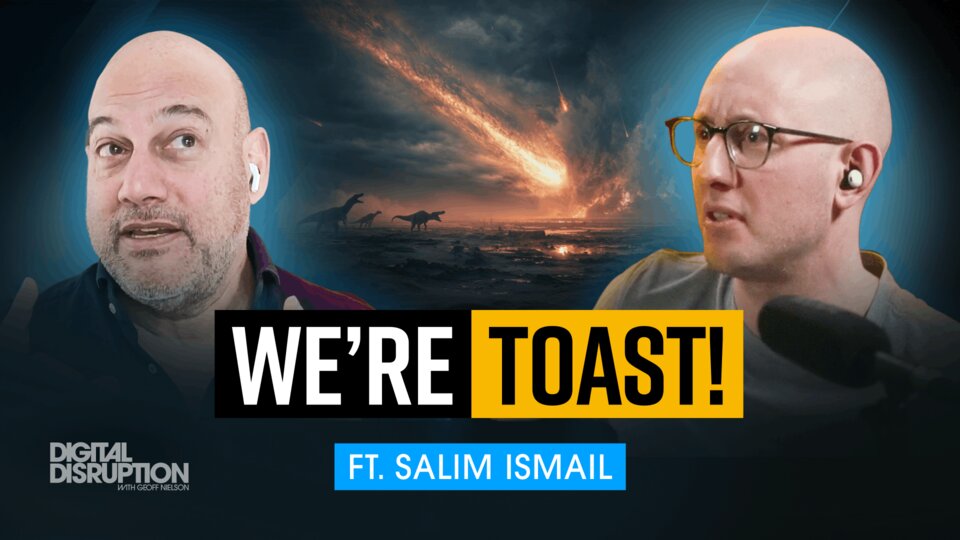



The Next Industrial Revolution Is Already Here
Digital Disruption is where leaders and experts share their insights on using technology to build the organizations of the future. As intelligent technologies reshape our lives and our livelihoods, we speak with the thinkers and the doers who will help us predict and harness this disruption.
Listen


Our Guest Michael Clark Discusses
AI is Breaking the Economy and Education. Here's How to Fix it.
In this episode of Digital Disruption, AI and transformation leader, Michael Clark explains why AI is exposing fundamental flaws in education, business, leadership, and the global economy, and what we need to do next.
Listen
Our Guests Charlie Tyrell and Ted Tremper Discuss
The Most Insidious AI Narrative: We Can't Shape the Future
Artificial intelligence is reshaping work, creativity, business, and society faster than ever before, but how worried should we really be? In this episode, we sit down with The AI Doc producers Charlie Tyrell and Ted Tremper to discuss the biggest lessons they learned after spending years investigating AI and interviewing leading experts
Listen
Our Guest Joscha Bach Discusses
Joscha Bach: AGI, Consciousness, and the Evolution of Intelligence
Artificial intelligence is changing faster than most people realize, but are we asking the wrong questions about AI, AGI,consciousness, and the future of society?
In this episode, cognitive scientist and AI researcher Joscha Bach joins us for a thought-provoking conversation on AI, machine consciousness, LLMs, AGI, human intelligence, and the future of work.
Listen
Our Guest Matthew Loys Duncan Discusses
AI vs. The Invasion of Work: Could We Take Back Our Lives?
Microsoft’s Head of Future of Work & AI, Matthew Loys Duncan, says we’ve reached “human capacity” and that AI may not replace knowledge workers, but instead replace the worst parts of work itself.