
Strengthen Your Organization’s Digital Sovereignty
Move sovereignty forward with practical action.
You need tangible ways to assess your organization's current posture and make meaningful advancements. This blueprint shows how to turn that pressure into a modernization advantage.
Our Advice
Critical Insight
A digital sovereignty mandate can be the supercharger needed for a silo-busting, enterprise-wide modernization strategy. Progress on digital sovereignty requires working comprehensively across the pressure zones and X factors that you identify. CIOs must lead the implementation of digital sovereignty through practical operational next steps.
Impact and Result
- Guide public sector modernization with a new layer of strategic intent.
- Define digital sovereignty as a practical, actionable mandate.
- Translate broad political priorities into practical IT decisions.
Member Testimonials
After each Info-Tech experience, we ask our members to quantify the real-time savings, monetary impact, and project improvements our research helped them achieve. See our top member experiences for this blueprint and what our clients have to say.
10.0/10
Overall Impact
$197,666
Average $ Saved
12
Average Days Saved
Client
Experience
Impact
$ Saved
Days Saved
College of Registered Nurses of Nova Scotia
Guided Implementation
10/10
$25,000
5
He was very helpful and the report demonstrated that Andy made deliberate efforts to put himself in my/our organization's shoes and applied the con... Read More
City of Calgary, AB
Guided Implementation
10/10
$16,000
10
Ministry of Industry, Innovation, Science and Technology
Guided Implementation
10/10
$551K
20
Strengthen Your Organization’s Digital Sovereignty
Move sovereignty forward with practical action
EXECUTIVE BRIEF
Analyst perspective
A catalyst, not constraint, for public sector modernization

Global instability has elevated digital sovereignty to the forefront of public sector IT issues across various countries and orders of government. Digital sovereignty refers to a government’s ability to control and govern its own digital destiny, including the data, digital infrastructure, and technologies it relies upon to deliver public services and government operations.
While public IT leaders try to respond to calls for strengthened digital sovereignty, the path within departments isn’t clear. Infrastructure is globalized, procurement processes are rigid, and guidance on managing quantum risk, building domestic AI capacity, and finding trusted vendors is fragmented.
Digital sovereignty does not mean isolation or total exclusion from global systems. Rather, it means increased domestic capacity to protect citizen data, control and govern digital infrastructure, and ensure continuity of service delivery from governments. Critically, digital sovereignty is not a constraint on modernization but a catalyst for it.
You need tangible ways to assess your organization's current posture and make meaningful advancements. This blueprint shows how to turn that need into a modernization advantage.
CIOs must lead the operationalization of sovereignty by working comprehensively across the ten pressure zones and two X factors identified in this product. Digital sovereignty mandates, when approached strategically with strong CIO leadership, can supercharge modernization by breaking through traditional silos and accelerating long-delayed advancements to data governance, procurement frameworks, and public data infrastructure.
Andy Best
Research Director, Canadian Public Sector
Info-Tech Research Group
Executive summary
Your Challenge
As a national public service technology leader, you need practical strategies to advance digital sovereignty without compromising the best path toward public sector modernization.
You need to translate digital sovereignty mandates into tangible operational plans that accelerate, not hinder, innovation and delivery while incorporating the critical sovereignty goals that governments seek.
Common Obstacles
- Lack of a clear operational definition of digital sovereignty
- Traditional government silos preventing interoperable and long-term solutions
- Lack of central direction or political impetus to advance these issues within a single government mandate
- Inability to benchmark sovereign readiness
- Competing narratives: innovation vs. control
Info-Tech’s Approach
The goal of this project is to create a strong understanding of digital sovereignty principles, show how sovereignty mandates manifest in different jurisdictions, and identify the common components and success factors of those mandates.
Info-Tech equips public sector CIOs and other senior technology leaders with a Digital Sovereignty Prioritization Tool and guides them toward best-in-class modernization strategies that align to emerging digital sovereignty mandates.
Info-Tech Insight
Digital sovereignty mandates can be the supercharger needed for a silo-busting, enterprise-wide modernization strategy. Progress on digital sovereignty requires working comprehensively across identified pressure zones and X factors. CIOs must lead the implementation of sovereignty via infrastructure, partnerships, procurement reform, and digital talent, aligned with national security, economic policy, and cross-governmental mandates.
Your challenge
Organizations need tangible plans to advance their digital sovereignty in response to emerging mandates.
Government technology modernization is hard enough on a good day, and now there are potentially onerous domestic sovereignty goals layered on top as well. A light or nonstrategic approach may view these mandates as constricting, as a barrier, or difficult to operationalize.
Key questions:
- Can a government make and enforce rules to govern its own digital domain, government services, and associated public policy areas?
- Can it define its own digital path while safeguarding national security, regulatory compliance, operational autonomy, and citizen trust?
The challenge is to break through that negative narrative about digital sovereignty mandates and harness it as a key opportunity.
As a national public service technology leader, you need realistic strategies to advance digital sovereignty without compromising the best path toward public sector modernization.
Common obstacles
These barriers make advancing digital sovereignty difficult:
- Chronic underfunding of public sector IT
- Lack of clear operational definition of digital sovereignty
- Traditional government silos preventing interoperable and long-term solutions
- Lack of central direction or political impetus to advance these issues within a single government mandate
- Inability to benchmark sovereign readiness
- Lack of accepted metrics to measure sovereign technology debt
- Overreliance on nondomestic cloud and compute infrastructure
- Fragmented policy and procurement alignment
- Lack of shared ownership between central agencies and line departments
- Lack of digital sovereignty in talent or delivery models
- Insufficient visibility into departmental data flows and dependencies
Info-Tech’s approach
A catalyst, not constraint, for public sector modernization
Translate digital sovereignty mandates into tangible operational plans that accelerate, not hinder, innovation and delivery while incorporating the critical digital sovereignty goals that governments seek. Public service technology leaders need practical strategies to advance digital sovereignty without compromising the best path toward public sector modernization.
Info-Tech’s solution is to provide critical research and tools to turn digital sovereignty into a silo-busting catalyst to solve common IT modernization challenges. By understanding the critical pressure zones where progress on sovereignty can be achieved and working strategically across them, these mandates can be harnessed to make exponential advances that accelerate the standard work of modernization.
Info-Tech’s Digital Sovereignty Prioritization Tool and Executive Communications Guide will help technology leaders understand the nature of digital sovereignty mandates in their jurisdiction, identify their shared and common components and success factors, and guide public sector CIOs and other senior technology leaders through a priority-setting exercise to harnesses the new mandates as a supercharging opportunity, not a constriction. These tools are equally applicable across different countries and levels of government, including subnational governments or municipalities.
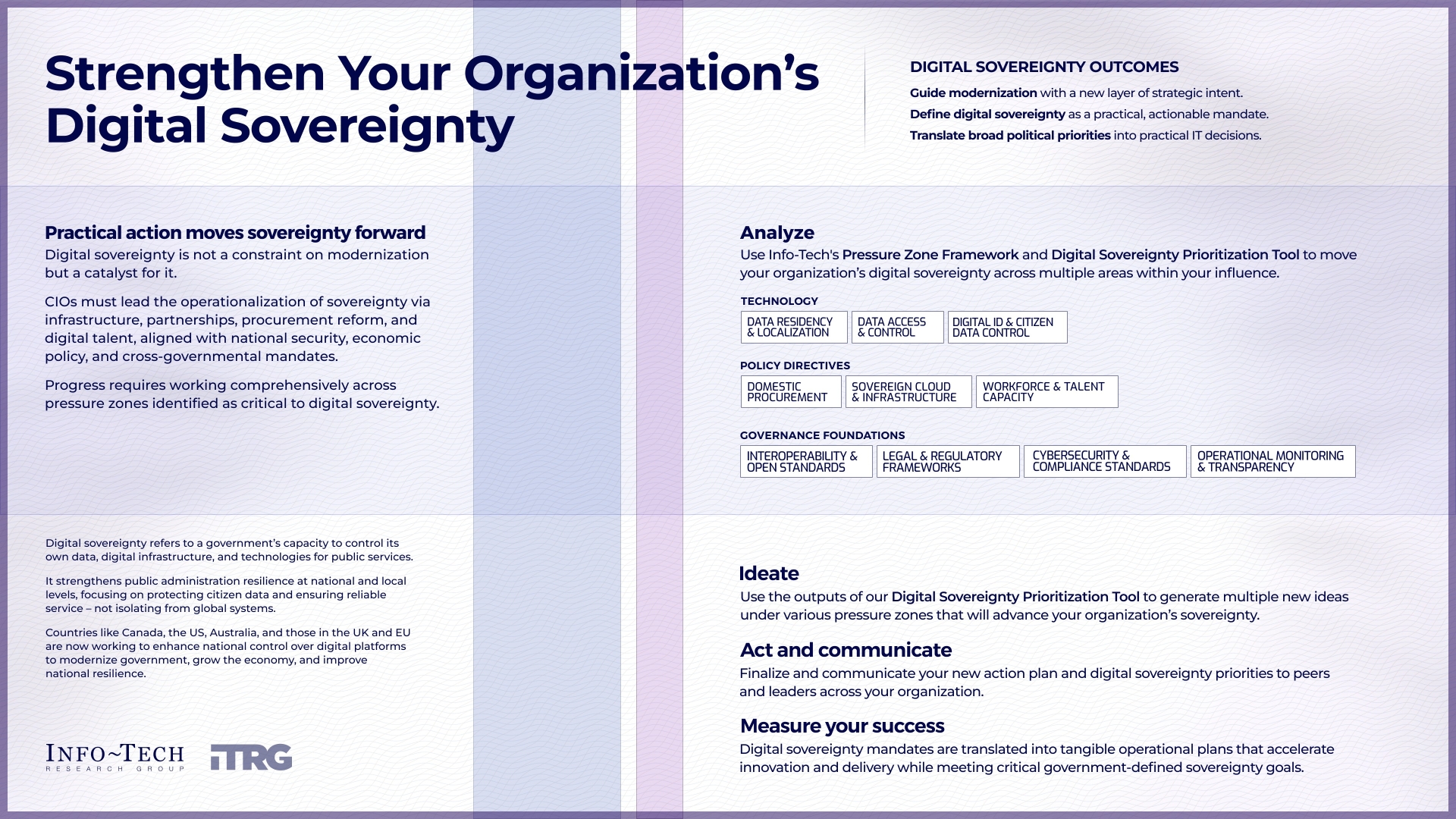
Work across these components of digital sovereignty
Progress on digital sovereignty requires working comprehensively across the following pressure zones (levers available to pull for senior technology leaders) and X factors (foundational characteristics of your government institution):
Data Residency and Localization |
Data Access and Control |
Cybersecurity and Compliance Standards |
Sovereign Cloud and Infrastructure |
Operational Monitoring and Transparency |
Interoperability and Open Standards |
Domestic Procurement |
Legal and Regulatory Frameworks |
Digital ID and Citizen Data Control |
Workforce and Talent Capacity |
X Factors
Maintain public governance and digital policy development capacity to work effectively across the pressure zones.
Continually harness responsible AI, quantum, and other emerging technology.
Info-Tech’s methodology to strengthen digital sovereignty
Info-Tech’s methodology to strengthen digital sovereignty
Phase Steps |
Understand Digital Sovereignty1.1 Interpret sovereignty mandates and jurisdictional boundaries. 1.2 Establish internal definitions across IT, Legal, Policy, and Procurement. 1.3 Assess current sovereignty posture: inventory controls, dependencies, and exposure points. |
Review Digital Sovereignty Globally2.1 Review international models and benchmark leading practices. 2.2 Identify benchmark comparator organizations in your sector. 2.3 Summarize global lessons applicable to your jurisdiction and context. |
Use Initiative Prioritization Tool3.1 Map sovereignty dependencies and control points across systems, vendors, and data flows. 3.2 Use the Digital Sovereignty Prioritization Tool to score pressure zones and generate a heat map. 3.3 Rank and select key initiatives and integrate them with existing modernization strategies. |
Communicate to Your Organization and Action Next Steps4.1 Communicate findings and rationale to leadership and stakeholders. 4.2 Launch sovereignty action plan with owners, milestones, and KPIs. 4.3 Establish governance structure, review cadence, and continuously improve. |
Phase Outcomes |
|
|
|
|
Insight summary
It’s a catalyst, not a constraint
With the correct tools and a strategic understanding of digital sovereignty, you can harness these rapidly emerging mandates to make exponential advances that accelerate public sector modernization.
Sovereignty doesn’t mean isolation
Instead, it refers to the growth in domestic capacity to protect citizen data, control and govern digital infrastructure, and ensure continuity of service delivery from governments.
Mandates can create much needed momentum
Policy-driven sovereignty requirements accelerate long-delayed upgrades to infrastructure, governance, and data management systems across public institutions.
Measurement builds executive confidence
Quantifying time, cost, and risk savings from sovereignty actions reframes compliance as measurable modernization value, not administrative burden.
Holistic understanding of digital sovereignty creates maximum impact
Using the Pressure Zones Framework reveals where control, capability, and confidence intersect, turning general sovereignty ideas into a proactive strategic management opportunity to strengthen your organization.
Blueprint deliverables
Each step of this blueprint is accompanied by supporting deliverables to help you accomplish your goals:
Digital Sovereignty Prioritization Tool
This tool identifies which pressure zones matter most to you and generates concrete next steps to advance your digital sovereignty mandate.
Digital Sovereignty Executive Communications Guide
This guide equips you with key messages and templates to share your new digital sovereignty priorities and plan with executives across your organization.
Key deliverable
Digital Sovereignty Prioritization Tool
Identify which pressure zones matter most in your jurisdiction.
Receive concrete next steps to advance your digital sovereignty based on your current priorities and organizational context.
Info-Tech offers various levels of support to best suit your needs
DIY Toolkit
"Our team has already made this critical project a priority, and we have the time and capability, but some guidance along the way would be helpful."
Guided Implementation
"Our team knows that we need to fix a process, but we need assistance to determine where to focus. Some check-ins along the way would help keep us on track."
Workshop
"We need to hit the ground running and get this project kicked off immediately. Our team has the ability to take this over once we get a framework and strategy in place."
Executive & Technical Counseling
"Our team and processes are maturing; however, to expedite the journey we'll need a seasoned practitioner to coach and validate approaches, deliverables, and opportunities."
Consulting
"Our team does not have the time or the knowledge to take this project on. We need assistance through the entirety of this project."
Diagnostics and consistent frameworks are used throughout all five options.
Guided Implementation
What does a typical GI on digital sovereignty look like?
Phase 1 |
Phase 2 |
Phase 3 |
Phase 4 |
|
Call #1: Set context and scope.
|
Call #2: Conduct global benchmarking and current state assessment.
|
Call #3: Analyze prioritization.
Call #4: Design top initiatives and value metrics.
|
Call #5: Develop communications and executive alignment.
Call #6: Institutionalize and monitor.
|
A Guided Implementation (GI) is a series of calls with an Info-Tech analyst to help implement our best practices in your organization.
A typical GI is 4 to 6 calls over the course of 6 months.
Workshop agenda
Contact your account representative for more information.
workshops@infotech.com 1-888-670-8889
Activities |
Session 1Understand Digital Sovereignty1.1 Interpret mandates. 1.2 Establish definitions. 1.3 Assess current posture. |
Session 2Review Digital Sovereignty Globally2.1 Review international models. 2.2 Identify benchmark organizations. 2.3 Summarize global lessons. |
Session 3Use Initiative Prioritization Tool3.1 Map dependencies. 3.2 Use Prioritization Tool. 3.3 Rank initiatives |
Session 4Communicate and Action Next Steps4.1 Communicate findings. 4.2 Launch action plan. 4.3 Establish governance. |
Post-workNext steps and wrap up (offsite)Info-Tech:5.1 Conduct post-workshop review. CxO:Review lessons learned. |
Outcomes |
|
|
|
|
|
Executive brief Case study
Sovereign cloud “Bleu”
In 2021, the government of France launched Bleu, a sovereign cloud initiative developed in partnership with Microsoft, Orange, and Capgemini. The goal was to protect sensitive government data from extraterritorial access while retaining the innovation benefits of global hyperscale platforms.
Situation
French officials faced growing pressure to modernize public digital infrastructure while complying with national and EU data protection laws. The challenge was balancing modernization with legal sovereignty after concerns that US legislation such as the Patriot Act could compel access to data hosted on foreign-owned systems.
Solution
Rather than exclude global vendors, France created a “sovereign cloud” model. Bleu uses Microsoft’s technology stack but is operated exclusively by French companies under French and EU jurisdiction. This hybrid approach combines global performance standards with domestic governance, ensuring compliance, resilience, and trust.
Results
The Bleu initiative became a template for balancing openness and sovereignty across Europe. France secured full legal and operational control over public data while accelerating its cloud transformation. The model now informs similar national strategies, proving that digital sovereignty can drive innovation instead of restricting it.
Executive brief Case study
Cloud policy and open-source modernization*
The government of Quebec’s Digital Transformation Strategy placed digital sovereignty at the center of modernization. The province sought to reduce dependency on foreign vendors, encourage interoperability, and build domestic capability through open standards and local procurement.
Situation
Quebec’s ministries relied heavily on multinational cloud providers, limiting interoperability and control over sensitive public data. Provincial leaders wanted to modernize infrastructure while keeping data residency, access, and service management within the province’s jurisdiction.
Solution
The government adopted a cloud-first policy anchored in open standards and domestic partnerships. By prioritizing open-source tools, shared service platforms, and local vendor ecosystems, Quebec created a model that advanced modernization and sovereignty simultaneously. Procurement policies were updated to favor interoperable, reusable solutions developed in Quebec.
Results
The shift strengthened the province’s technology workforce, expanded the local IT ecosystem, and improved cross-department collaboration. Quebec demonstrated that digital sovereignty can stimulate economic growth, promote interoperability, and empower government teams to innovate on their own infrastructure.
*Some details have been changed for client privacy.
Executive brief Case study
Barcelona: digital commons and citizen data sovereignty*
Barcelona’s Digital Commons initiative redefined urban technology governance. The city replaced proprietary digital systems with open-source platforms and introduced policies to ensure citizen data served the public interest – not private profit.
Situation
Barcelona’s digital services were fragmented across multiple private vendors with limited transparency and oversight. City leaders sought to regain control over public data, align technology procurement with democratic values, and restore citizen trust in digital governance.
Solution
The city launched a comprehensive program to reclaim digital infrastructure under municipal control. Proprietary tools were replaced with open-source alternatives, and data-sharing frameworks were redesigned around privacy, transparency, and accountability. The government also created public dashboards to make municipal data use visible to residents.
Results
Barcelona became a global benchmark for ethical, citizen-centered digital transformation. The city enhanced transparency, improved service delivery, and proved that municipal governments can operationalize digital sovereignty principles at the human scale – building trust while advancing innovation.
*Some details have been changed for client privacy.
Blueprint benefits
IT Benefits
- Guide digital modernization with a new layer of strategic intent: Ensure that modernization is not just about technology upgrades but also about sovereignty and control.
- Define digital sovereignty as a practical, actionable mandate: Move from abstract policy language to concrete steps a municipality or department can take.
- Benchmark your digital posture against emerging government expectations: Understand where you stand and where sovereignty gaps exist.
- Translate broad political priorities into practical IT decisions: Turn high-level direction into clear technical and operational actions.
Business Benefits
- Enhance national or subnational control over sensitive digital assets and infrastructure.
- Build the control mechanisms and contractual protections to make sovereignty real.
- Ensure continuity of digital innovation regardless of political shifts: Design sovereignty measures that remain resilient through changes in leadership or policy.
- Leverage tools, frameworks, and policy mechanisms to make sovereignty real.
- Access and apply practical instruments to achieve visible progress quickly.
Measured Value Framework
Digital sovereignty must show measurable progress, not just policy alignment. Success is defined by visible improvements in control, capability, and confidence. The following metrics demonstrate tangible outcomes for your organization and help track maturity over time.
-
Strategic Alignment
Metric: Leadership agrees on top 3-5 sovereignty priorities using the Digital Sovereignty Prioritization Tool within 60 days. Impact: Establishes shared language and direction across IT, policy, and procurement teams. Aligns digital sovereignty goals with modernization and budget cycles. -
Visibility and Control
Metric: All 10 pressure zones assessed and scored in the Digital Sovereignty Prioritization Tool, producing a heat map showing impact and control levels. Impact: Reveals where sovereignty risks exist and enables evidence-based prioritization. Early mapping avoids rework in procurement and architecture reviews. -
Operational Readiness
Metric: Ranked list of 5-7 sovereignty initiatives with owners, timelines, and success metrics – integrated with modernization roadmaps within 90 days. Impact: Demonstrates early, actionable progress toward sovereign compliance. Converts heat map findings into sovereignty action roadmap with clear accountability. -
Decision Transparency
Metric: Leadership briefing deck completed using heat maps and dependency diagrams and ready for quarterly governance reviews. Impact: Builds stakeholder confidence and demonstrates ongoing transparency. Makes digital sovereignty visible to leadership through evidence-based communication. -
Resilience and Continuity
Metric: Top 3 highest-risk pressure zones from the heat map have documented mitigation plans addressing cross-border legal, supply chain, or security disruptions. Impact: Improves preparedness for sovereignty disruptions. Demonstrates the organization understands critical vulnerabilities and has plans to address them. -
Technology Independence
Metric: At least one critical system or data set migrated from high-risk vendor dependency to a domestic or sovereign cloud environment within 12 months. Impact: Demonstrates practical progress toward autonomy and risk reduction from extraterritorial laws. Converts Measured Value Framework calculations into realized outcomes.
About Info-Tech
Info-Tech Research Group is the world’s fastest-growing information technology research and advisory company, proudly serving over 30,000 IT professionals.
We produce unbiased and highly relevant research to help CIOs and IT leaders make strategic, timely, and well-informed decisions. We partner closely with IT teams to provide everything they need, from actionable tools to analyst guidance, ensuring they deliver measurable results for their organizations.
What Is a Blueprint?
A blueprint is designed to be a roadmap, containing a methodology and the tools and templates you need to solve your IT problems.
Each blueprint can be accompanied by a Guided Implementation that provides you access to our world-class analysts to help you get through the project.
Need Extra Help?
Speak With An Analyst
Get the help you need in this 4-phase advisory process. You'll receive multiple touchpoints with our researchers, all included in your membership.
Guided Implementation 1: Understand Digital Sovereignty
- Call 1: Set context and scope.
Guided Implementation 2: Review Digital Sovereignty Globally
- Call 1: Conduct global benchmarking and current state assessment.
Guided Implementation 3: Use Initiative Prioritization Tool
- Call 1: Analyze prioritization.
- Call 2: Design top initiatives and value metrics.
Guided Implementation 4: Communicate to Your Organization and Action Next Steps
- Call 1: Develop communications and executive alignment.
- Call 2: Institutionalize and monitor.