
Implement an Adaptive System for IT Financial Management
Pave the way for exponential technologies with agile financial practices
Old-fashioned and bureaucratic financial practices impede new technology investment decisions, resulting in missed opportunities and overspend for organizations. Our comprehensive blueprint guides you out of the past and toward Exponential IT with clear steps to building an agile and future-ready IT financial practice.
To match the pace of a highly dynamic future that we call Exponential IT, many organizations will need to re-invent their IT financial management (ITFM) approach so that it can operate with the agility and flexibility required to invest in new technologies and emerging opportunities as they arise.
1. To keep up with your tech needs, make agility your goal.
Have a clear end-state in mind that reflects the goal of agility and effectiveness. This end state will shape your design and the iterative evolution of how you handle IT financial operations.
2. All of IT should align for the financial system to work.
Your IT financial management system should align closely with all IT management functions to build an ITFM system that works for the organization.
3. You can’t fix the IT finance process without first fixing the finance process.
Put the horse before the cart. If you don’t have a cross-functional and organizational view, you won’t be able to build a cohesive finance model because financial management spans the entire organization. IT must look beyond its own borders to effect meaningful change that will have a downstream positive impact on IT’s ability to make the organization future ready.
4. Build trust before you build a process.
Collaboration with the Finance and Procurement functions in your organization will be instrumental to your success. Lead with empathy, communication, and trust to build relationships and IT’s credibility on the organizational stage.
Set up ITFM to get the right technology at the speed you need it using our blueprint
Build future-ready adaptability into your organization’s practice of IT financial management with our step-by-step methodology, templates, and tools:
- Understand the context within which ITFM operates to identify constraints, opportunities, scope of work and objectives.
- Identify and define the elements that make IT financial investment and management possible, including required capabilities, processes, competencies, tools, and governance controls.
- Design and implement a formal system that’s agile and responsive to changing priorities, conditions, and opportunities and can be evolved over time as your organization evolves.
- Collaborate with Finance and Procurement to improve their integration, agility, and analytic capability through automation and analytical tools in order to optimize financial management agility organization wide.
Member Testimonials
After each Info-Tech experience, we ask our members to quantify the real-time savings, monetary impact, and project improvements our research helped them achieve. See our top member experiences for this blueprint and what our clients have to say.
9.0/10
Overall Impact
$392,000
Average $ Saved
Client
Experience
Impact
$ Saved
Days Saved
National Intermodal
Guided Implementation
9/10
$392K
N/A
Very valuable discussion to confirm we are heading in the right direction as we build our Technology budget management, but also provided a few spe... Read More
Implement an Adaptive System for IT Financial Management
Drive an Exponential IT future for technology spend and investment.
Analyst perspective
To be truly agile, you need a well-designed and rock-solid foundation that everyone can rely on.
The most elegant things in life are never simple behind the scenes – they’re often carefully and thoughtfully designed to be that way, and just as often have evolved from some pretty clunky and awkward predecessors. The same can be said of your approach to IT financial management.
The way IT financial management is commonly practiced in many organizations is ad hoc and opaque, leaving IT and other decision-makers unable to quickly and appropriately respond to changing conditions and emerging opportunities. To keep pace with a highly dynamic future that Info-Tech calls Exponential IT, most organizations will need to reinvent their approach to IT financial management so that it can operate with agility and confidence.
Enabling your organization for this future means recrafting the system of IT financial management to be responsive and adaptable, and bringing all financial process owners and their interests together to collaboratively evolve financial management practice organization-wide. Start your Exponential IT journey now.

|
Jennifer Perrier |
Executive summary
Your Challenge
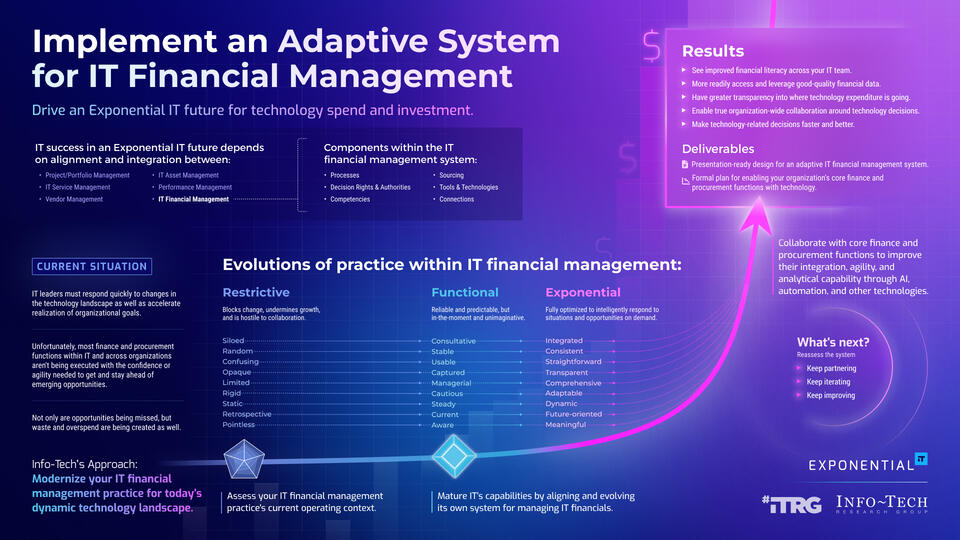
- IT leaders need to be able to respond quickly to changes in the technology landscape and accelerate realization of organizational strategies.
- Unfortunately, most finance and procurement functions within IT and across the organization as a whole are not capable of being executed with the confidence or agility needed to get and stay ahead of emerging opportunities.
- Not only are opportunities being missed, but waste and overspend are being created as well.
Common obstacle
- IT is only one of many players when it comes to how technology funds are spent. One unskilled, unenlightened, or uncooperative actor can undermine efforts to improve IT financial management.
- Organizational finance and procurement functions tend to be siloed and mired in manual, unoptimized processes, limiting what IT can do to improve.
- Industry-specific regulatory constraints combined with unease around innovation throw speed bumps and roadblocks in IT’s path toward transformation.
Info-Tech’s Approach
Enable your organization’s practice of IT financial management to be agile.
- Understand the context within which IT financial management is operating today and establish agility-focused design principles and objectives.
- Mature IT’s capabilities by aligning and evolving its system for managing IT financials with an eye to built-in agility.
- Collaborate with core finance and procurement functions to improve their integration, agility, and analytic capability through automation and analytical tools.
Info-Tech Insight
Slow, bureaucratic, low-trust IT financial practices can crush an organization’s ability to respond and innovate. To succeed with Exponential IT, organizations need the flexibility to invest in new, high-value capabilities as they arise. A foundational step for Exponential IT is the modernization of IT financial practice hallmarked by CIO-CFO partnership, automated and optimized financial management processes, and a more flexible approach to IT funding
Introduction: What is Exponential IT?
- The technology curve has recently bent exponentially.
- Generative AI has been the catalyst for this sudden shift, but there are more and more new technologies emerging (e.g. quantum computing, 5G), putting significant pressure on all organizations.
- All IT leaders and organizations are at risk of falling behind if they do not adopt new technologies fast enough.
- Exponential IT is a framework defined by Info-Tech Research Group to instruct IT leaders across all IT domains on how to transform their organization and elevate their value creation capabilities, to close the gap between the exponential progression of technological change and the linear progression of IT’s ability to successfully manage that change.
- This blueprint provides guidance on establishing an agile IT financial management system by aligning, standardizing, and evolving a more dynamic and coordinated approach to financial management practices.
- CIOs/delegates can use this blueprint to partner with the leaders in their organization’s core finance and procurement functions to enable an Exponential IT future for technology spend and investment.


Your Exponential IT journey
To keep pace with the exponential technology curve, adopt an Exponential IT mindset and practices. Assess your organization’s readiness, and embark on a transformation journey.

Adopt an Exponential IT Mindset
Info-Tech resources: Exponential IT Research Center, Research Center Overview, and Keynote
Explore the Art of the Possible
Info-Tech resources: Exponential IT research blueprints for nine IT domains
Gauge Your Organizational Readiness
Info-Tech resource: Exponential IT Readiness Diagnostic
Build an Exponential IT Roadmap
Info-Tech resource: Develop an Exponential IT Roadmap blueprint
Embark on Your Exponential IT Journey
Info-Tech resources: Implement an Adaptive System for IT Financial Management
To access all Exponential IT research, visit the Exponential IT Research Center - Go to this link
The state of Exponential IT is characterized by the following attributes
These attributes develop at different speeds – this means that reaching a state of Exponential IT is usually not a near-term objective.
However, when you’ve reached that state, what you’ll see is all these characteristics working together in a coordinated way that allows your organization to bring the right technologies to the right people at the right time.
- Integrated: Organizational functions partner and share data, information, and decision-making with other functions in the organization.
- Consistent: Policies, processes, and procedures are standardized across the organization, including supporting tools.
- Straightforward: Processes/procedures are clearly defined, simplified where possible, and usable.
- Comprehensive: All use cases have been identified, are in place, and supporting processes defined and exercised.
- Transparent: Data and information is complete, clean, classified, organized, and accessible.
- Adaptable: Processes can be updated, changed, and evolved to keep pace with changes in legislation, regulation, business conditions, or other needs.
- Dynamic: Processes like reporting can be executed accurately in real-time and on-demand.
- Future-oriented: Practices focus as much on planning for the future as on tracking of (and learning from) the past.
- Meaningful: The importance and purpose of activities are understood, align with and advance organizational objectives; and are treated as a worthwhile investment of time and resources.
Exponential IT isn’t a project. It isn’t a concrete thing that you can look at or touch. Rather, it’s a paradigm, an approach, a state of mind that evolves and is rooted in thoughtful and well-designed practices.
Apply Exponential IT to financial management
The journey from one end of the scale to the other is marked by a series of scenario-based milestones.
See the Info-Tech tool IT Financial Management System Design Workbook for full descriptions of these milestones.
The degree to which… |
Non-Exponential |
Exponential |
The degree to which… |
|
| …the core finance function partners and shares information and decision-making with other functions in the organization. | Siloed | 
|
Integrated | |
| Random | 
|
Consistent | …financial management policies, processes, and procedures are standardized across the organization, including supporting tools. | |
| …financial management processes are clearly defined and usable. | Confusing | 
|
Straightforward | |
| Opaque | 
|
Transparent | …financial data and information is clean, organized, and accessible. | |
| …all financial use cases have been identified, are in place, and supporting processes defined and exercised. | Limited | 
|
Comprehensive | |
| Rigid | 
|
Adaptable | …financial management processes can be updated or evolved to keep pace with changes in legislation, regulation, conditions, or needs. | |
| …financial management processes can be executed accurately in real-time and on-demand. | Static | 
|
Dynamic | |
| Retrospective | 
|
Future-oriented | …financial management practice is focused on planning for the future (financial management) versus tracking of the past (accounting). | |
| …financial management activities are understood; align with organizational objectives; and are seen as a good investment of time and resources. | Pointless | 
|
Meaningful |
However, recognize that there will be challenges…
Many struggle to exist in an Exponential IT world.
Unfortunately, most IT departments and the organizations within which they exist do not have sufficiently mature financial and procurement management practices to operate effectively in an Exponential IT world. This is caused by:
- A lack of knowledge and expertise on the part of both IT and finance/procurement about each other’s disciplines.
- A lack of interdepartmental integration, data sharing, and cooperation between IT, finance, and procurement.
- Significant gaps in the type and quality of data being used to track technology expenditure and make technology investment decisions.
- A lack of governance mechanisms and tools to help prioritize, schedule, organize, and notify primary actors, partners, and collaborators around IT financial activities.
- A tendency to take a historical or reactive stance to financial and procurement issues (accounting) instead of a future-looking, proactive one (financial management).
As a result, not only are opportunities being missed to advance business strategies and transform the organization, but waste and overspend are being created as well.
About Info-Tech
Info-Tech Research Group is the world’s fastest-growing information technology research and advisory company, proudly serving over 30,000 IT professionals.
We produce unbiased and highly relevant research to help CIOs and IT leaders make strategic, timely, and well-informed decisions. We partner closely with IT teams to provide everything they need, from actionable tools to analyst guidance, ensuring they deliver measurable results for their organizations.
What Is a Blueprint?
A blueprint is designed to be a roadmap, containing a methodology and the tools and templates you need to solve your IT problems.
Each blueprint can be accompanied by a Guided Implementation that provides you access to our world-class analysts to help you get through the project.
You Get:
- Implement an Adaptive System for IT Financial Management Storyboard
- IT Financial Management System Design Workbook
- IT Financial Management System Presentation
- Tech-Enabled Initiatives for Core Finance/Procurement Functions Workbook
Need Extra Help?
Speak With An Analyst
Get the help you need in this 5-phase advisory process. You'll receive multiple touchpoints with our researchers, all included in your membership.
Guided Implementation 1: Understand Your ITFM Context and Objectives
- Call 1: Assess your current financial management context.
- Call 2: Identify adaptable ITFM system design principles and objectives.
Guided Implementation 2: Define Your ITFM System Components
- Call 1: Identify ITFM processes and capabilities.
- Call 2: Identify ITFM decision rights and authorities.
- Call 3: Identify ITFM competencies and sourcing strategy.
Guided Implementation 3: Finalize and Launch Your ITFM System
- Call 1: Map ITFM workflows to create a system.
- Call 2: Test and finalize the ITFM system.
- Call 3: Identify implementation initiatives.
- Call 4: Prepare your final system design presentation.
Guided Implementation 4: Tech-Enable Core Finance/ Procurement
- Call 1: Identify finance/ procurement function tech-enablement initiatives.
- Call 2: Craft a finance and procurement tech-enablement plan.
- Call 3: Assess implications for the ITFM system.
Guided Implementation 5: Next Steps
- Call 1: Summarize results and plan next steps.
Contributors
- Carol Carr, CFO, Soroc Technology
- Scott Fairholm, Executive Counselor, Global Services, Info-Tech Research Group
- Mark Hoeting, Senior Executive Counselor, Global Services, Info-Tech Research Group
- Benoit Proulx, Principal Advisory Director, Research Call Quality & Delivery, Info-Tech Research Group
- Tony Tardugno, Executive Counselor, Global Services, Info-Tech Research Group
- Steve Willis, Practice Lead, Research Development, Info-Tech Research Group
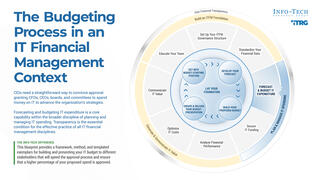 Create a Transparent and Defensible IT Budget
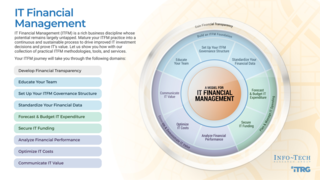 Take a Holistic Approach to IT Financial Management
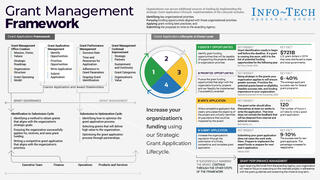 Increase Grant Application Success
 Manage an IT Budget
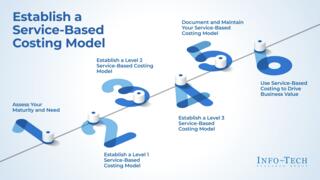 Establish a Service-Based Costing Model
 Implement an IT Chargeback System
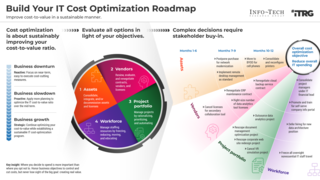 Build Your IT Cost Optimization Roadmap
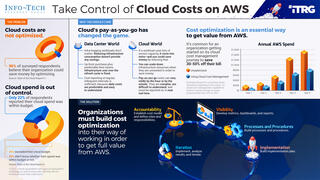 Take Control of Cloud Costs on AWS
 Take Control of Cloud Costs on Microsoft Azure
 Cost-Reduction Planning for IT Vendors
 Start Making Data-Driven People Decisions
 Maximize Your American Rescue Plan Funding
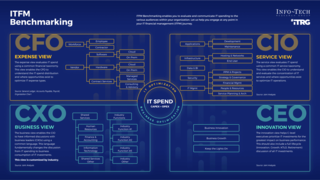 Achieve IT Spend & Staffing Transparency
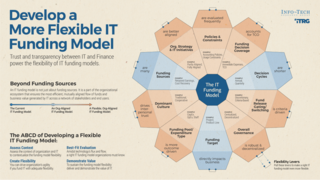 Develop a Flexible IT Funding Model
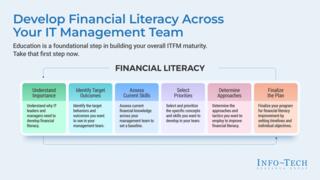 Develop Your IT Leadership Team’s Financial Literacy
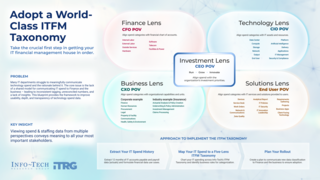 Adopt a World-Class ITFM Taxonomy
 Implement an Adaptive System for IT Financial Management
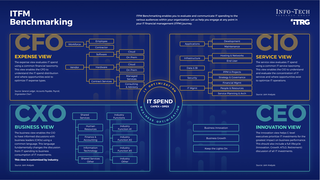 IT Spend and Staffing Benchmarking: Realign Resources for Success
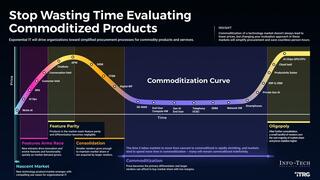 Stop Wasting Time Evaluating Commoditized Products and Services
 Build an ITFM Improvement Roadmap
 IT Spend and Staffing Benchmarking
 Adapt to Uncertainty: Optimize Your Top Areas of IT Spend
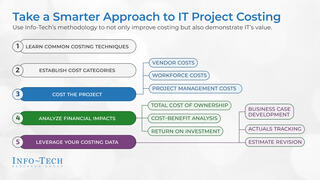 Invest in Realistic and Comprehensive Project Costing
 Demonstrate IT Value Through ITFM Reporting
