Identify Use Cases to Inform AI Strategy for Oil and Gas
Choose relevant and feasible initiatives to maximize business impact.
Leaders must:
- Build an AI strategy that aligns with oil and gas business drivers is time-consuming and complex.
- Balance speed to adoption with a low tolerance for operational disruption and downtime.
- Select AI initiatives that deliver measurable impact while remaining feasible within legacy IT-OT environments is difficult.
- Demonstrate ROI is challenging amid volatile market conditions and capital-intensive operations.
Our Advice
Critical Insight
- AI initiatives must be value-led, not technology-led, to succeed in oil and gas environments.
- Use cases that align to priority business capabilities and market conditions are more likely to achieve adoption and ROI.
- A structured, feasibility-aware prioritization approach helps organizations avoid stalled pilots and wasted investment.
Impact and Result
- Create a clear, defensible shortlist of AI use cases aligned to strategic business goals.
- Improve executive confidence and buy-in through transparent prioritization and value framing.
- Build faster progression from ideation to execution by focusing on initiatives with the highest impact-to-feasibility ratio.
Identify Use Cases to Inform AI Strategy for Oil and Gas
Choosing relevant and feasible initiatives to maximize business impact.
Analyst perspective
Build AI on the foundation of alignment.
In an oil and gas industry that is always seeking the next opportunity to squeeze value from operations, AI presents a compelling argument for progress. Not only do we see the widespread adoption of LLMs and chatbots (ChatGPT, Copilot, etc.) in organizations across all industries, but more and more use cases that specifically target oil and gas capabilities are being implemented in the market. There can be significant pressures on Oil and Gas CIOs to ensure their organization can leverage these opportunities, both to help meet internal goals and to avoid falling behind the competition.
However, to ensure that the full potential of these initiatives is realized, effective planning is necessary. There needs to be clear alignment between the business drivers valued most by oil and gas organizations, namely operational efficiency, productive output, and health and safety, and the initiatives that make it onto your strategic roadmap. Furthermore, unique factors such as legacy technology stacks that include OT, engineering, and field team stakeholders, as well as fluctuating oil prices/demand, must be accounted for to ensure chosen initiatives have a chance at achieving broader adoption.
By using this research as a companion piece to the larger Build Your AI Strategy and Roadmap, members will be able to capture the oil and gas use cases and nuance required to ensure their AI plans are aligned to organizational value and insulated against feasibility blockers that would siphon away value.

Evan Garland
Senior Research Analyst, Industry Practice
Info-Tech Research Group
Executive summary
Your Challenge
- Constructing an AI strategy that aligns with business drivers such as operational safety, reliability, and profitability takes time. Organizations often fear missing out by not acting fast.
- Leveraging AI technology to support and drive business goals without disrupting mission-critical systems or processes is challenging due to a low tolerance for downtime.
- Weighing and selecting initiatives that are both measurably impactful to business operations and feasible with existing PPT foundations requires careful and time-consuming analysis.
Common Obstacles
- Executing on change management plans and proving ROI for AI initiatives is more difficult in the oil and gas industry because of the capital-intensive nature of projects and fluctuating oil prices.
- A fragmented data landscape that includes legacy systems creates difficulty in developing joint IT-OT technology environment.
- Resistance to change at the C-suite level and at the implementation level have separate root causes that must be individually addressed to create necessary buy-in and support.
Info-Tech's Approach
- Guiding business leaders through identifying and prioritizing AI use cases for their business capabilities to start their AI journey.
- Leveraging the output to gain executive buy-in to rapidly and responsibly implement AI, referencing use cases that can provide the greatest value to address your organizational challenges and meet business goals.
- Developing an AI strategy use case roadmap that becomes a strategic path forward that effectively and efficiently accelerates adoption.
Info-Tech Insight
Even in the relatively static technology environment of Oil and Gas, the utility of AI is no longer a debate. A strategy that comprehensively details the gaps within your organization's AI readiness capabilities, and the plan to overcome those gaps, will be the one that succeeds in building trust and support from all levels of the organization.
Your challenge
Implement AI through meaningful initiatives driven by defined business requirements.
- Constructing an AI strategy that aligns with business drivers is inherently time-consuming. Developing an AI roadmap in the oil and gas industry requires balancing business goals such as operational efficiency, operational safety, system reliability and risk management, and profitability. A strategy that covers these goals while also navigating long and capital-intensive project cycles must be built with care. But this creates tension between acting cautiously and falling behind peers and acting fast but undermining operational stability.
- Leveraging AI without disrupting mission-critical operations presents major risks. Integrating AI into systems that control drilling, refining, or pipeline monitoring requires precise control, as even brief interruptions can compromise environmental safety or regulatory compliance. As a result, deployments are often cautious, staged, and slower than executives would prefer.
- Selecting initiatives that balance measurable impact with feasibility requires deep analysis. Choosing the "right" AI projects means prioritizing those that are both operationally impactful and technically achievable within existing People-Process-Technology (PPT) foundations. For oil and gas firms, this involves assessing whether sufficient data exists, whether infrastructure can handle advanced analytics, and whether teams have the necessary skills. Input and collaboration across IT, OT, compliance, and business leadership is essential, and without it, AI projects can miss their outlined ROI and create a culture of skepticism for AI's value.
"Only 4% of companies adopting artificial intelligence reap full value from the technology."
Boston Consulting Group qtd. by CFO Dive, 2024
Common obstacles
Structural hurdles undercut the promise of AI in energy operations.
- Demonstrating ROI is uniquely difficult due to the industry's volatility. Oil and gas organizations must contend with fluctuating oil prices and capital-intensive project economics as they attempt to adopt AI initiatives. Proving ROI in the sector requires modeling benefits over years of production cycles, which can be upended by market volatility. This can cause even promising AI solutions to struggle to clear internal investment hurdles and makes patience and alignment even more important.
- A fragmented and legacy-heavy data environment hampers integration. Oil and gas companies often operate with decades-old SCADA systems, siloed ERP implementations, and disconnected field data capture tools. This patchwork environment makes it difficult to create the integrated IT-OT platforms required for AI models to function effectively. Without reliable, real-time data, AI outputs are limited in accuracy and trustworthiness.
- Resistance to change spans both executive and operational levels. In the C-suite, skepticism may stem from a lack of understanding of AI's tangible business value. On the ground, operators and engineers may view AI as a threat to established expertise or that they will be held responsible if implementation negatively affects production. These dual sources of resistance often require tailored strategies to preserve support as initiatives scale over time.
How to use this report
Use this map to determine where to use this research material.
This report is designed to complement Info-Tech's comprehensive Build Your AI Strategy and Roadmap blueprint and associated activities. Once you have completed the activities within this report, return to the core research to progress through the remaining phases of the broader strategy.
We recommend that you adjust and customize the template as needed to be organization-specific and to create the most valuable AI strategy for your organization.
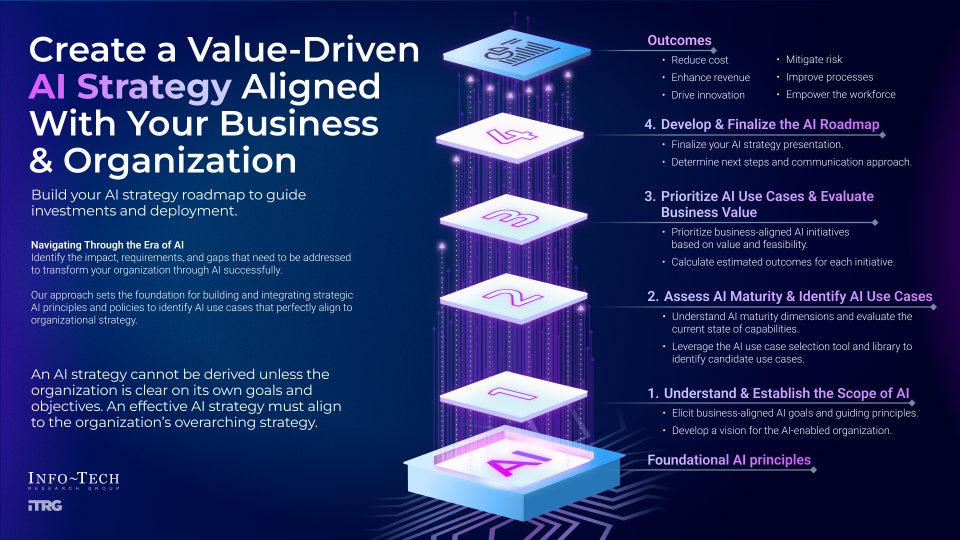
You will use this report as a research-based accelerant input as you work through activities 3.1 and 3.3 of the Build Your AI Strategy and Roadmap blueprint, specifically:
Phase 3
Detail & Prioritize AI Use Cases
Activity 3.1 Map your candidate AI use cases
Activity 3.3 Prioritize candidate AI use cases
AI strategy roadmap activities
Visit Info-Tech's Build Your AI Strategy and Roadmap blueprint for full activity details
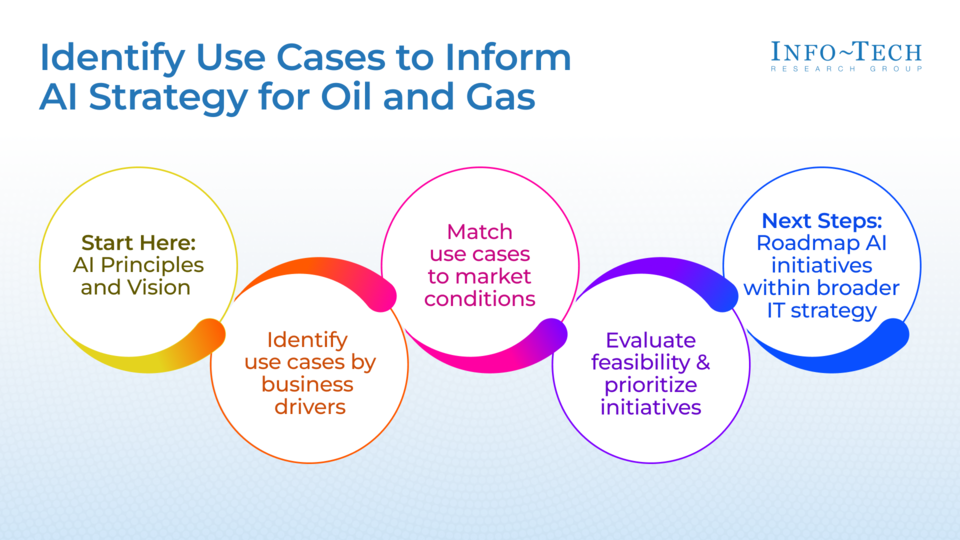
Identify use cases to inform AI strategy for Oil and Gas
Start Here: AI Principles and Vision
Challenges
- AI strategy creation takes time, and organizations fear missing out.
- Low tolerance for downtime or disruption because of AI adoption.
- Balancing feasibility and impact when selecting initiatives.
Identify use cases by business drivers
- Explore candidate use cases in the market and use organizational business drivers to categorize.
- Document problem statements and metrics for tracking expected value returned.
- Prioritize based on alignment with drivers; remove options that are poor matches.
Match use cases to market conditions
- Assess market environment (oil price level, capital availability, org health).
- Evaluate use cases against environment conditions; test against risk events.
- Narrow use case pool based on risk tolerance and current viability.
Evaluate feasibility & prioritize initiatives
- Assess technical feasibility and the individual use case level. Identify dependencies/pre-requisites and synergies.
- Chart initiatives on impact vs. feasibility matrix.
- Create shortlist of best-fit initiatives for AI strategy implementation.
Next Steps: Roadmap AI initiatives within broader IT strategy
Outcomes
- Communicable insight into business drivers and success metrics that AI adoption will impact.
- Prioritized AI use cases by strategic fit, feasibility, and suitability to current conditions.
Case study

INDUSTRY
Oil and Gas
SOURCES
BOE Report and PR Newswire
Challenge
Chevron operates dispersed assets (e.g. Permian/Midland Basin) where routine visual checks and issue triage require significant driving time and expose field teams to travel risk.
The company sought to cut truck-rolls, increase inspection frequency, and detect anomalies faster without adding workload while staying ahead of evolving regulatory expectations for remote monitoring.
Solution
Chevron launched a six-month pilot with Percepto to evaluate AI-powered remote inspections using autonomous "drone-in-a-box" systems and Percepto's AIM software. Missions run from pre-programmed flight plans; onboard and platform AI flag deviations from normal operations and generate automated alerts.
The test began near Midland, Texas, expanded to a second system in Colorado, and integrates with other facility tech to prioritize where crews need to go.
Results
In the first 90 days, Chevron saw indications of:
- Work-hour savings that let personnel focus on higher-value tasks
- Cost-efficient increases in monitoring frequency at remote sites
- Faster issue detection enabling quicker responses
The reduction in time on the road for field teams was also noted as a positive for health and safety purposes.
| 1. Identify Candidate Use Cases and Impact | 2. Prioritize Use Cases by Impact and Feasibility | |
|---|---|---|
| Phase Steps | 1.1 Map your candidate AI use cases 1.2 Build AI initiatives one-pagers |
2.1 Narrow AI use cases by market and firm position 2.2 (Optional) Assess maturity and AI readiness by capability 2.3 Prioritize candidate AI use cases |
| Phase Outcomes | Internally prioritize the business drivers that AI initiatives will align with. Explore and outline candidate AI use cases across key Oil and Gas capabilities. Outline selected initiatives for prioritization in the next phase. | Validate AI candidate use cases against the viability of success in current market conditions. Assess organizational maturity in targeted business capabilities (optional). Prioritize AI initiatives based on alignment, impact, and feasibility for your organization. |
About Info-Tech
Info-Tech Research Group is the world’s fastest-growing information technology research and advisory company, proudly serving over 30,000 IT professionals.
We produce unbiased and highly relevant research to help CIOs and IT leaders make strategic, timely, and well-informed decisions. We partner closely with IT teams to provide everything they need, from actionable tools to analyst guidance, ensuring they deliver measurable results for their organizations.
What Is a Blueprint?
A blueprint is designed to be a roadmap, containing a methodology and the tools and templates you need to solve your IT problems.
Each blueprint can be accompanied by a Guided Implementation that provides you access to our world-class analysts to help you get through the project.
Need Extra Help?
Speak With An Analyst
Get the help you need in this 2-phase advisory process. You'll receive multiple touchpoints with our researchers, all included in your membership.
Guided Implementation 1: Identify Candidate Use Cases and Impact
- Call 1: Scope requirements, objectives, and your specific challenges.
- Call 2: Identify business-aligned AI goals.
- Call 3: Identify candidate AI use cases.
Guided Implementation 2: Prioritize Use Cases by Impact and Feasibility
- Call 1: Assess the organization’s current-state capabilities for managing AI and your strategic investment path.
- Call 2: Prioritize the business AI initiatives.
- Call 3: Assess the value and feasibility of the business AI initiatives.
Contributors
- 1 anonymous contributor, Director of Sales, Oil Field Production Software
- Scott Holland, Managing Partner, Info-Tech Research Group
- George Goodall, Executive Counselor, Info-Tech Research Group
- Chris Key, Executive Counselor, Info-Tech Research Group
- Becky Lynn, Executive Counselor, Info-Tech Research Group