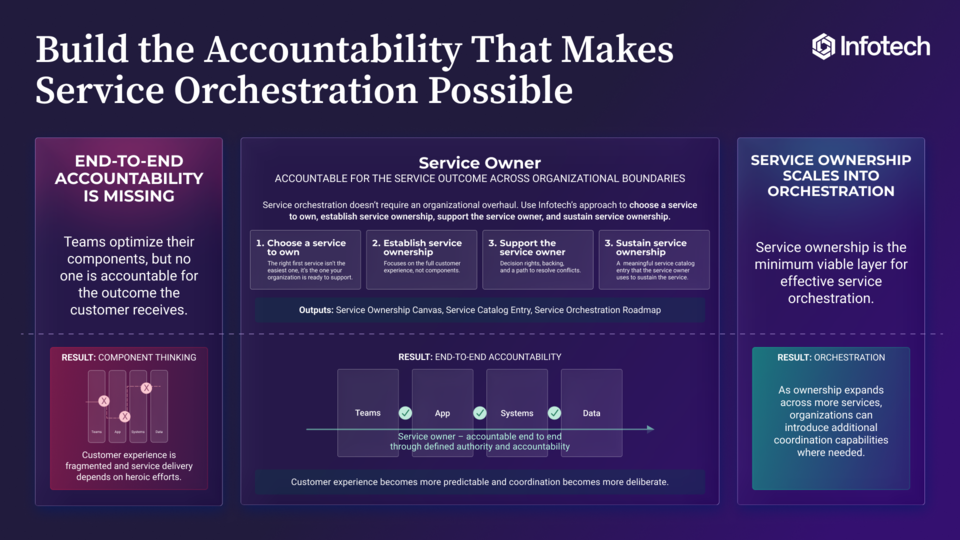
Build the Accountability That Makes Service Orchestration Possible
Service ownership is the minimum viable governance layer needed to coordinate services across organizational boundaries.
IT services increasingly span teams, functions, vendors, processes, and AI-assisted workflows. Yet many organizations still manage them through component-level accountability, with no one clearly accountable for the end-to-end service outcome. This can lead to delays, repeated handoffs, conflicting information, and inconsistent customer experiences when work crosses organizational boundaries. Follow our framework to establish clear service ownership and create the minimum viable governance layer that makes broader service orchestration possible.
Without clear accountability for service outcomes, service delivery gaps between teams must be bridged through informal coordination, institutional knowledge, personal relationships, and individual effort. That makes service delivery hard to improve and increasingly expensive to coordinate. Service ownership lays the foundation for broader service orchestration by creating end-to-end accountability without reorganizing the entire enterprise first.
1. Skip the reorg.
Don’t start with a new operating model. Start with one service and one accountable owner instead.
2. Skip the checkbox appointment.
Choose a service owner with the influence, credibility, mindset, and coordination skills that the role demands.
3. Skip the set-and-forget approach.
Reinforce ownership with a named sponsor, an escalation path, boundary coordination commitments, and regular review.
Use this step-by-step blueprint to establish service ownership as a practical mechanism for improving service orchestration.
Our research and supporting tools give you a step-by-step framework to establish service ownership, build the structures that sustain it, and determine when the model is ready to expand. Use this step-by-step approach to:
- Identify and define an initial service. Reorient thinking from components to outcomes and define one service clearly enough that ownership can be assigned to it.
- Identify and empower your service owner. Name, confirm, and orient a service owner who willingly takes on the initial service, understands what the role requires, and has the authority to act on it.
- Design the structures that sustain service ownership. Design the support structure, review the catalog entry, define and measure success, and build your roadmap.
Build the Accountability That Makes Service Orchestration Possible
Service ownership is the minimum viable governance layer needed to coordinate services across organizational boundaries.
Analyst perspective
Service ownership is the minimum viable layer for service orchestration.
IT services no longer move neatly through a single team, system, or provider, but instead span functions, vendors, processes, and increasingly AI-assisted workflows. Yet many organizations still manage them through component-level accountability, where each team can meet its own objectives even while the service experience remains fragmented.
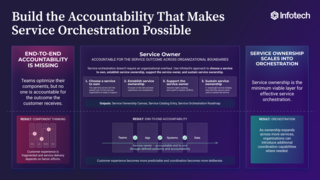
This reflects a structural mismatch: Organizations are structured vertically, but customers experience services horizontally. Teams achieve local goals, yet the service suffers from delays, repeated handoffs, conflicting information, and inconsistent outcomes when work crosses organizational boundaries.
The problem is not that teams are failing to do their jobs; it is that no one is clearly accountable for the outcome the customer ultimately experiences. Without end-to-end accountability, service delivery depends on informal coordination, personal relationships, institutional knowledge, and individual effort to bridge the gaps between teams.
Service ownership closes that gap. By establishing clear accountability for service outcomes, organizations create the minimum viable governance layer needed to coordinate work across boundaries. The result is better coordination, fewer handoffs, and a practical foundation for broader service orchestration without reorganizing the enterprise first.

Diana MacPherson
Research Director, CIO
Infotech
Executive summary
Your Challenge
- Organizations are structured vertically, but customers experience services horizontally.
- When accountability stops at organizational boundaries, coordination effort increases and service outcomes suffer.
The result: Service delivery becomes fragmented, difficult to improve, and increasingly expensive to coordinate.
Common Obstacles
- Component thinking is deeply embedded: Accountability is assigned to functions, applications, vendors, or teams rather than to service outcomes.
- Informal owners exist but the role is unsupported: Individuals often coordinate across boundaries but lack the authority, governance, and escalation support needed to sustain accountability.
- Service complexity continues to grow: Services increasingly span teams, vendors, automation, and AI-enabled workflows, making coordination more difficult and failures harder to manage.
The impact: As accountability dissolves at service boundaries, organizations compensate with coordination effort. Over time, coordination becomes a growing share of the work required to deliver the service.
Infotech's Approach
Rather than launching a broad orchestration initiative, establish explicit service ownership as the minimum viable layer for service orchestration.
- Choose a service that is ready for ownership.
- Select a service owner accountable for the outcome.
- Support the owner with authority, governance, communication, and escalation mechanisms.
- Expand ownership over time as orchestration maturity grows.
The impact: Improved coordination and accountability without reorganizing the enterprise or implementing a full orchestration framework upfront.
Infotech Insight
Service ownership creates the accountability that makes service orchestration possible. Without a clearly accountable owner, service delivery depends on informal coordination, making outcomes harder to improve, scale, and sustain.
Organizations are structured vertically, but services operate horizontally
The absence of end-to-end accountability usually shows up in predictable ways:
- Teams meet their local targets, but the service experience still breaks down. Applications, infrastructure, vendors, and processes appear healthy in isolation because health is measured within each component, not in how they connect to produce an outcome.
- Issues slow down when work crosses team, system, vendor, or process boundaries, and progress across those boundaries depends on meetings, informal escalation, favors, and people who "just know how things work."
- Customers experience delays, repeated handoffs, conflicting answers, or inconsistent outcomes.
The challenge: Every component can be green while the service outcome remains fragmented, unpredictable, and hard to improve.
3:1
Teams spend 3 hours coordinating for every 1 hour solving
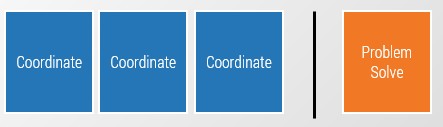
When teams optimize only their component, coordination becomes a disproportionate, and costly, share of the work required to deliver the service.
Source: Front Research
Structural barriers turn coordination into a tax
- Component-level thinking is deeply embedded. Services are owned by function, application, or vendor, not by outcome, so accountability dissolves at every boundary.
- Informal service owners often already exist but lack authority, escalation paths, or defined review cadences, meaning the problem is formalization, not creation of the role from scratch.
- Service complexity is accelerating. Existing coordination challenges become harder to manage as services increasingly span teams, vendors, automation, and AI-enabled workflows. AI agent adoption alone is growing 65% annually against just 12% current governance investment, leaving decision chains undocumented.
Source: Infotech, Tech Trends 2026
The accountability gap shows up in the numbers
Only 29% of organizations believe they have sufficiently mapped services to business outcomes.
Source: AXELOS, 2022
Infotech's approach
Service ownership is often misunderstood or overlooked, but it is the most essential first step in your service orchestration journey.
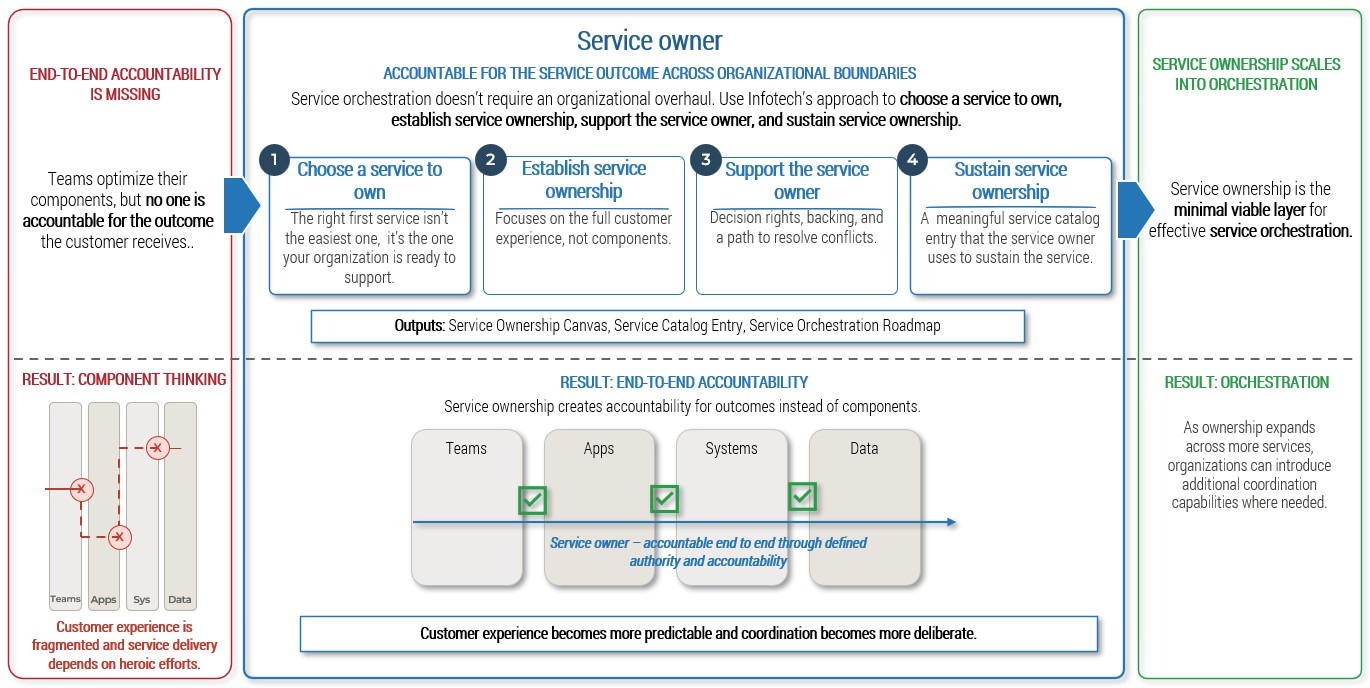
Service orchestration doesn't require an organizational overhaul. Use Infotech's approach to choose a service to own, establish service ownership, support the service owner, and sustain service ownership.
1 Choose a service to own
The right first service isn't the easiest one, it's the one your organization is ready to support.
2 Establish service ownership
Focus on the full customer experience, not components.
3 Support the service owner
Establish decision rights, backing, and a path to resolve conflicts.
4 Sustain service ownership
Create a meaningful service catalog entry that the service owner uses to sustain the service.
OUTPUTS
Service Ownership Canvas, Service Catalog Entry, Service Orchestration Roadmap
The Infotech difference:
The leaders you need are already in your organization. Our approach finds them, builds them, and empowers them, skipping what usually gets in the way:
- Skip the reorg: Start with one accountable owner per service, not a new operating model.
- Skip the checkbox hire: Choose an owner with the influence, credibility, and coordination skills the role demands.
- Skip the set-and-forget: Reinforce ownership through governance, communication, and escalation mechanisms that keep coordination moving.
Build the accountability that makes service orchestration possible
Organizations are designed vertically, but services are experienced horizontally. Service ownership introduces the accountability to coordinate across silos.
Insight Summary
Service ownership works best when you start with the right service, back it with real authority, coordinate through it rather than around it, and measure whether it's actually working.
Overarching insight
Organizations optimize work vertically, but customers experience services horizontally. Service ownership creates the end-to-end accountability needed for service orchestration.
| Choose a service where ownership can demonstrate value | The right first service isn't the easiest one, it's the one your organization is ready to support. |
| Select an owner who can coordinate through influence rather than authority alone | Service owners succeed by serving the stakeholders on both sides of their service's boundaries, not by controlling every component. |
| Support ownership with structures that sustain accountability | A named sponsor, an escalation path, and boundary agreements with adjacent owners reduce cross-boundary friction and allow service owners to successfully usher services through the organization. |
| Measure coordination, not just ownership | Without a baseline and ongoing measurement, there is no way to know whether adding a service owner actually improved coordination or simply changed who's accountable for the same problem. |
Blueprint deliverables
Each step of this blueprint is accompanied by supporting deliverables to help you accomplish your goals:
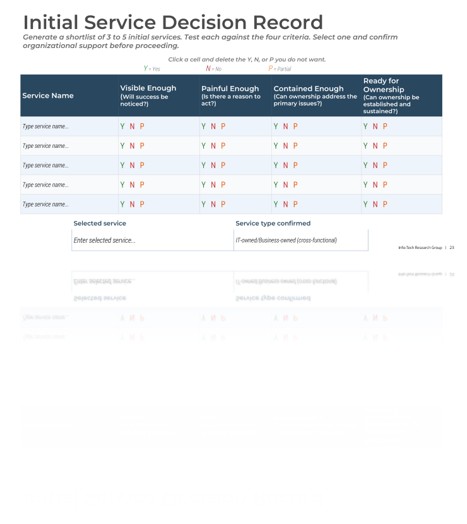
Initial Service Decision Record
Select the best service to assign and model service ownership.
Service Orchestration Roadmap Tool
Track and prioritize action items from your Service Ownership Canvas by timeline and effort level.
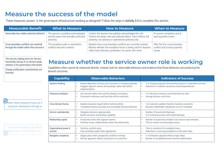
Measures
Select or add your own measures to track the success of the model and the service owner role.
Key deliverable:
Service Ownership Canvases
The service canvas defines who owns your candidate service, what it delivers, and how it is governed.

Blueprint benefits
| IT Benefits | Business Benefits |
|---|---|
|
|
About Info-Tech
Info-Tech Research Group is the world’s fastest-growing information technology research and advisory company, proudly serving over 30,000 IT professionals.
We produce unbiased and highly relevant research to help CIOs and IT leaders make strategic, timely, and well-informed decisions. We partner closely with IT teams to provide everything they need, from actionable tools to analyst guidance, ensuring they deliver measurable results for their organizations.
What Is a Blueprint?
A blueprint is designed to be a roadmap, containing a methodology and the tools and templates you need to solve your IT problems.
Each blueprint can be accompanied by a Guided Implementation that provides you access to our world-class analysts to help you get through the project.
Need Extra Help?
Speak With An Analyst
Get the help you need in this 3-phase advisory process. You'll receive multiple touchpoints with our researchers, all included in your membership.
Guided Implementation 1: Identify and define an initial service
- Call 1: Scope requirements, objectives, and your specific challenges.
- Call 2: Select an initial service.
- Call 3: Define your selected service.
Guided Implementation 2: Identify and empower your service owner
- Call 1: Identify your service owner candidate.
- Call 2: Name, confirm, and orient your service owner.
Guided Implementation 3: Design the structures that sustain service ownership
- Call 1: Design the support structure.
- Call 2: Review the catalog entry and define success measures
- Call 3: Build your roadmap.
- Call 4: Summarize results and plan next steps.
Contributors
- Doug Tedder, Owner and Principal Consultant, Tedder Consulting LLC
- Nicola Betz, Head of Strategy, Policy & Engagement | Digital Identity, UK Government
- Lily Yan, Director, Business Process Architecture, PointClickCare
 Navigate the Digital ID Ecosystem to Enhance Customer Experience
 Document Business Goals and Capabilities for Your IT Strategy
 Build a Business-Aligned IT Strategy
 Define Your Digital Business Strategy
 Drive Digital Transformation With Platform Strategies
 Make IT a Partner in Successful M&A Due Diligence
 Make IT a Successful Partner in M&A Integration
 Plan Your Digital Transformation on a Page
 Review Your Application Strategy
 Start Making Data-Driven People Decisions
 2021 CIO Priorities Report
 Create a Work-From-Anywhere Strategy
 Mergers & Acquisitions: The Sell Blueprint
 Mergers & Acquisitions: The Buy Blueprint
 CIO Priorities 2023
 Communicate Any IT Initiative
 Effective IT Communications
 Establish an Integrated IT-Business Operating Model
 Info-Tech Quarterly Research Agenda Outcomes Q2/Q3 2023
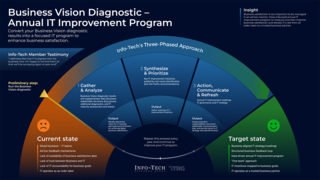 Business Vision Diagnostic – Annual IT Improvement Program
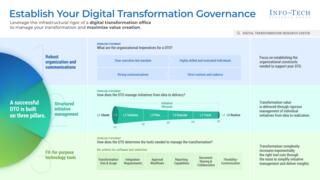 Establish Your Digital Transformation Governance
 Info-Tech Quarterly Research Agenda Outcomes Q4 2023
 Master Your Change Story for Digital Transformation
 Info-Tech’s Best of 2023: The Year IT Reached an Inflection Point
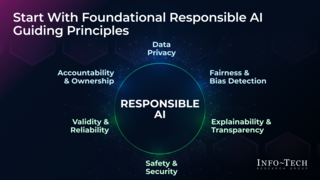 Prepare for AI Regulation
 Crack the Code to Successful Transformation Management
 Info-Tech Diagnostics: Identify and Leverage Your Strengths
 The CIO Playbook: 8 Secrets and 12 Steps to Systematically Achieve IT Excellence
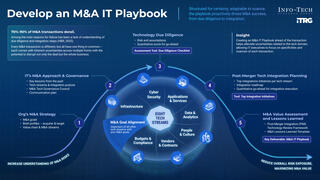 Develop an M&A IT Playbook
 Adapt to Uncertainty With a Technology-First Action Plan
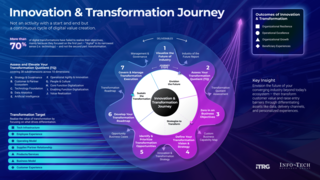 Digital Transformation: A Revolution That Lost Its Way
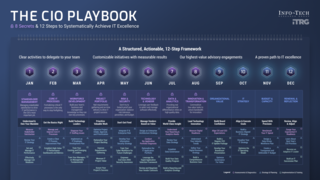 The CIO Playbook
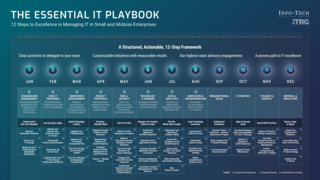 The Essential IT Playbook
 Visualize the Industry of the Future
 CIO Priorities 2026
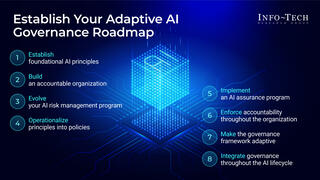 Establish Your Adaptive AI Governance Program: From Principles to Practice
 Assemble Board-Ready IT Updates
 Build the Accountability That Makes Service Orchestration Possible