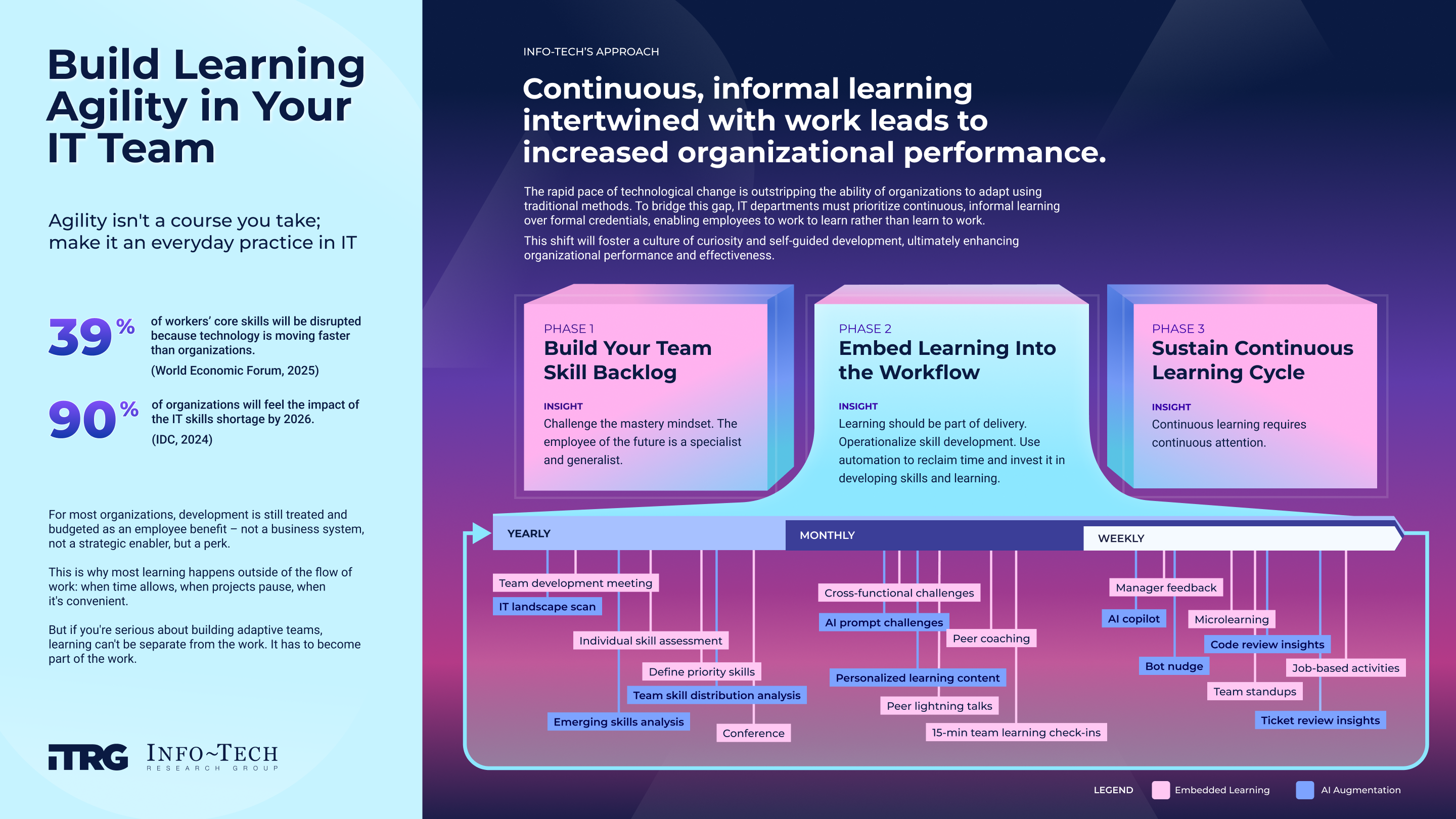
Build Learning Agility in Your IT Team
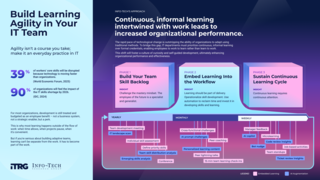
Agility isn’t a course you take; make it an everyday practice in IT.
Rapidly advancing technology is exacerbating the IT skills gap. But most IT teams remain stuck in rigid, episodic learning cycles that can’t keep up with the accelerated learning and skills development needed to support the organization. Use this step-by-step research to craft an agile, adaptable learning framework and ensure your IT team always has the right skills to achieve your organization’s strategic goals.
Some technical skills now have a half-life of just 2.5 years. Yet in most enterprises, IT skills quickly become outdated because learning is treated like a side project. Today’s CIOs must take a structured, hands-on approach to embed learning directly into IT workflows. Equip your IT team to learn continuously, apply knowledge in real time, and adapt to shifting priorities with speed and confidence.
1. The IT skills gap is a symptom, not a root cause.
Most organizations face ongoing challenges related to skills gaps, often because they perceive development primarily as an employee benefit or perk rather than a strategic necessity. To build an adaptive team, you must view learning as a strategic enabler that’s incorporated into workflows.
2. Treat AI as a learning enabler rather than an existential threat.
Some employees see automation as a threat to their jobs. But AI can help staff reclaim the time and space they need to learn and build new skills. Employees shouldn’t have to “find time” to learn. Leverage AI so learning becomes part of day-to-day work and is applied on the job.
3. Continuous learning requires continuous attention.
Stop one-size-fits-all, isolated development initiatives. Instead, develop a continuous learning cadence to guide skill development. Overlay operational rhythms with learning activities to drive strategic results.
Use this step-by-step blueprint to craft an adaptable, sustainable learning strategy for IT teams.
Our research provides IT leaders with a comprehensive storyboard and four practical tools to develop a flexible, sustainable approach to learning that’s aligned with strategic enterprise priorities.
Gain a clear understanding of your IT skills gap to create an actionable framework for perpetual learning and development. Use this blueprint and accompanying tools to:
- Respond quickly to changes in the technology landscape and accelerate the realization of your organizational strategies.
- Challenge the mastery mindset of deep expertise in only one or two areas by encouraging each team member to cultivate a mix of specialist and generalist skills.
- Connect learning to delivery by removing learning from fragmented siloes, making it timely rather than generic, and seamlessly embedding it into work processes.
Build Learning Agility in Your IT Team
Agility isn't a course you take; make it an everyday practice in IT.
Analyst perspective
Learning and development are strategic enablers, not employee perks.
The IT skills gap is not a recent issue; it has been a topic of concern for at least a decade and likely longer. Despite ongoing efforts, the challenge of acquiring and developing IT talent remains a top priority for CIOs, as highlighted in Info-Tech's 2025 Talent Trends report. In fact, it seems to be worsening, and is the primary concern shared by both CxOs and CIOs (Info-Tech CXO Alignment Diagnostic, N=1,161, 2020-2025). Traditional approaches to addressing the skills gap are no longer effective because they lack the flexibility needed to solve the complex and interconnected problems faced by IT today.
While technical skills are essential for effective operation, they become outdated quickly. Some technical skills have a half-life as short as 2.5 years (other skills have a half-life of 5 or more years), meaning the necessary expertise might not be available in the market when you need it. Focusing on developing skills and talent internally to prepare for future demands is a more sustainable strategy. This shift requires rethinking about learning and development – learning and development should not be seen as a simple benefit or perk but as a strategic priority.
IT demands adaptability, which involves dynamic work environments where skills are continuously learned and applied in fluid ways. The need for agility and resilience means consistently learning, unlearning, and relearning. It's crucial to prepare yourself and your workforce for rapid cycles of change and growth, moving away from treating learning as an episodic, separate event.

Heather Leier-Murray
Research Director, CIO
Info-Tech Research Group
EXECUTIVE BRIEF
Executive summary
Your Challenge
Many IT departments have not reached the level of effectiveness that drives innovation and growth for the business while maintaining technology delivery.
- IT leaders need to be able to respond quickly to changes in the technology landscape and accelerate realization of organizational strategies.
- Technological advancement is so rapid that the skills needed are unknown or don't exist yet.
- In an already difficult talent climate, 35% of IT employees who change jobs cite a lack of training, growth, and development as a reason (Skillsoft, 2024).
Common Obstacles
Technology change is outpacing employee learning and development. For most organizations it's treated as a budgeted employee perk and happens outside the flow of work, if time allows. Learning is treated as a separate event.
- Learning expectations are vague, and feedback is delayed.
- Content is a one-size-fits-all approach.
- Training is episodic and delivered out of context.
- You're hurtling toward exponential change but treating learning like a side project.
Info-Tech's Approach
Enable the IT team to learn through the work they do daily to decrease the gap between the skills you have and the skills you'll need to hit organization objectives.
- Counteract the rigidity and cumbersome nature of traditional skills mapping frameworks to get the agility you need in IT.
- Activate learning with a continuous learning plan, exploring AI tools, and embedding learning in work.
- Overlay learning into the existing operational rhythm of the organization.
- Learning and development isn't a perk, it's a business strategy, especially for IT.
Info-Tech Insight
For most organizations, learning and development is still treated and budgeted as an employee benefit or perk, not a strategic business enabler. It's why most learning happens outside of the flow of work, when or if time allows. But if we're serious about building an adaptive team and making progress on the skills gaps, learning can't be separate from the work. The IT skills gap is a symptom of the problem, not the root cause.
"Skills sufficiency" is the top concern of CIOs and CxOs
The biggest threat to an organization's success isn't the tech, it's the people. This is caused by:
- Changing expectations: IT is increasingly expected to lead organizational transformation, half of c-suite executives from our alignment diagnostic (Source: Info-Tech CxO Alignment Diagnostic) say IT's role is to expand or transform the organization. But only 5% of IT organizations are currently meeting that expectation.
- Pace of change: The speed and intensity of technology change is incomparable across the organization. IT transformation cycles are compressed with core responsibilities changing every 18 months.
- Changing skill set: Info-Tech's 2025 IT Talent Trends survey uncovered that 93% of respondents think that skills in IT must change to adapt to the future of work in the next five years.
54% of CIOs say staff sufficiency, skill, and engagement issues are their top pain point.
Source: Info-Tech CXO Alignment Diagnostic, N=1,161. *Included CIOs from 384 unique organizations since 2020-01-01
Common obstacles
Latency and lack of continuous skill development is further complicated by a range of factors:
AI is learning faster than any talent system ever built. This is because AI learns through the work. People, however, learn around the work. The approach to employee development is plagued with:
- Vague expectations and a long annual review processes.
- Traditional, one-size-fits-all mindsets about learning and development.
- Siloed learning and training that is delivered out of context.
A clear, purpose-driven learning loop helps AI learn faster – why not do this for people too? If we want people to learn faster through iteration, feedback, and context, we need to change how learning shows up in our organizations. Think of learning as a delivery strategy.
Talent practices can't keep up with technological change
39% | 39% of workers' core skills will be disrupted because technology is moving faster than organizations. |
|---|---|
90% | 90% of organizations will feel the impact of the IT skills shortage by 2026. |
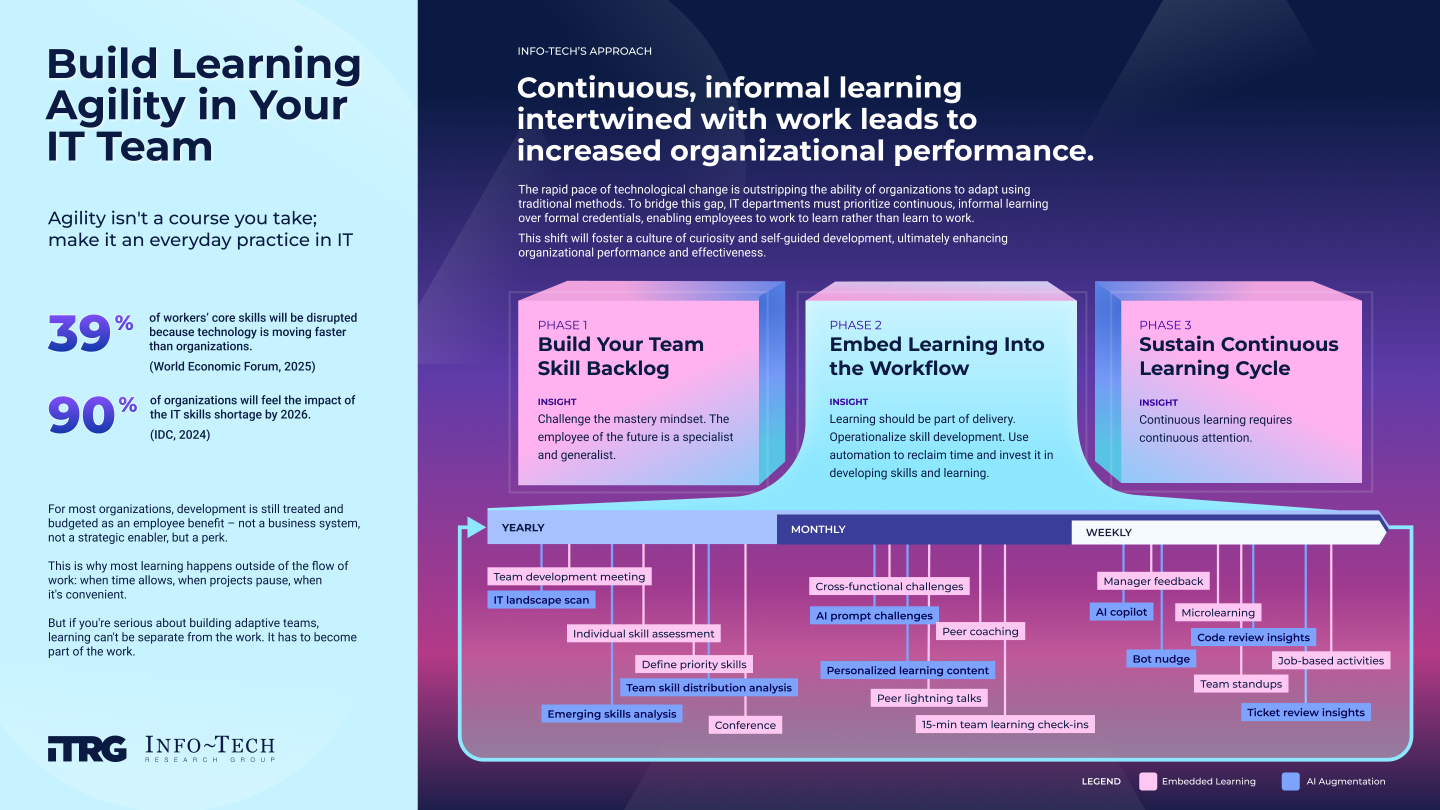
Info-Tech's methodology for Build Learning Agility in Your IT Team
1. Build Your Team Development Backlog | 2. Embed Learning Into the Workflow | 3. Sustain Continuous Learning Cycle | |
|---|---|---|---|
Phase Steps |
|
|
|
Phase Outcomes | Individual and team skills distribution | Intentional learning touchpoints | Development backlog plan |
Insight summary
Overarching insight | |||
|---|---|---|---|
For most organizations, development is still treated and budgeted as an employee benefit or perk, not a strategic business enabler. It's why most learning happens outside of the flow of work, when or if time allows. But if we're serious about building an adaptive team and making progress on the skills gaps, learning can't be separate from the work. The IT skills gap is a symptom of the problem, not the root cause. | |||
Challenge the mastery mindset | There's no time to learn | Learning is disconnected from delivery | Continuous learning requires continuous attention |
Adaptability is a critical success factor for future employees and work. The traditional mindset that deep expertise in one or two areas is being challenged. While expertise is valuable, when combined with rigidity it can hinder innovation. Employees need to be a combination of generalist and specialist. | Automating can be seen as threatening, however it is a legitimate way to reclaim time and create space to learn and build skills in real-time. Instead of stepping away from or out of work to learn, learn in and from the day-to-day work. | Learning is sidelined and fragmented and even when teams get to participate in learning events, it's not aligned to their work. It's often too generic or not timely. The traditional model is about pushing knowledge but not embedding learning and growth into the process of work. | Develop a continuous learning cadence to guide skill development intentionally. Overlaying operational rhythms with learning activities ensures they are not isolated, and they drive strategic achievement. |
Blueprint deliverables
Each step of this blueprint is accompanied by supporting deliverables to help you accomplish your goals.
Team Development Check-In Template
Support a continuous learning culture by incorporating check-ins into your team meetings.
Annual Team Development Calendar
Use this tool to assist in sustaining momentum when building learning agility in your IT team.
Leader's Learning Commitment Template
Create a plan to recognize and celebrate learning wins to support learning agility.
Key deliverable:
Team Development Backlog workbook
This strategic tool is designed to enhance the skills and overall effectiveness of your team. Use the tool to make sure your team is set up to meet the evolving needs of the organization.
Blueprint benefits
IT Benefits | Business Benefits |
|---|---|
|
|
A telecom firm prepared for the future by reskilling
INDUSTRY: Telecommunications
SOURCE: Anonymous, Former Senior Training Manager via McLean & Company
Business drivers
- A large telecommunications company was undergoing significant transformation from analog to digital and software-based technologies.
- The company launched a multiyear initiative to develop employees with the skills needed for new technologies.
- The program included web-based, self-paced courses on skills such as IP networking, data, and analytics. The organization also provided employees the opportunity to take short degrees in partnerships with a university, customized to the company's needs. Web-based courses were free, and employees were reimbursed for university programs.
Transparent communication
- Through town halls held once a month, leaders communicated that the organization needed different skills in the future, and that if employees wanted to have the right skills, they had to reskill.
Results
Employee feedback was overwhelmingly positive, as the organization gave employees the time and resources to prepare if they wanted to stay at the company.
Key Takeaway
Many organizations need new competencies to keep up with the pace of change. Be transparent and proactive with employees about what the organization needs, and provide employees the opportunities and resources to change with the organization.
Leaders gave employees plenty of time to prepare and made it as easy as possible for them to get what they needed.
Info-Tech offers various levels of support to best suit your needs
DIY Toolkit | Guided Implementation | Workshop | Executive & Technical Counseling | Consulting |
|---|---|---|---|---|
"Our team has already made this critical project a priority, and we have the time and capability, but some guidance along the way would be helpful." | "Our team knows that we need to fix a process, but we need assistance to determine where to focus. Some check-ins along the way would help keep us on track." | "We need to hit the ground running and get this project kicked off immediately. Our team has the ability to take this over once we get a framework and strategy in place." | "Our team and processes are maturing; however, to expedite the journey we'll need a seasoned practitioner to coach and validate approaches, deliverables, and opportunities." | "Our team does not have the time or the knowledge to take this project on. We need assistance through the entirety of this project." |
Diagnostics and consistent frameworks are used throughout all five options.
Guided Implementation
What does a typical GI on this topic look like?
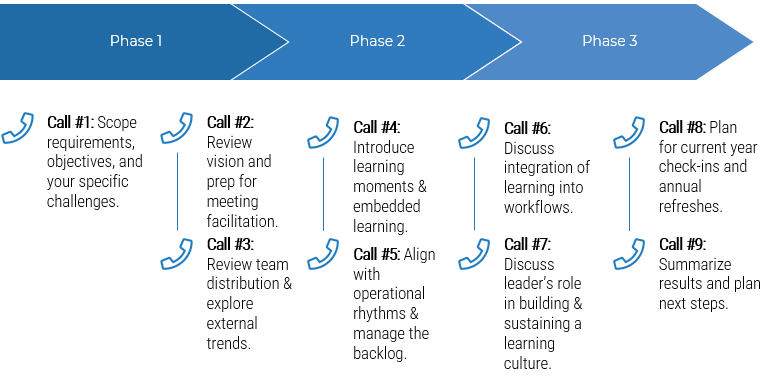
A Guided Implementation (GI) is a series of calls with an Info-Tech analyst to help implement our best practices in your organization.
A typical GI is 8 to 12 calls over the course of 4 to 6 months.
Workshop overview
Contact your account representative for more information.
workshops@infotech.com 1-888-670-8889
Day 1 | Day 2 | Day 3 | Day 4 | Day 5 | |
Activities | Build the development backlog | Map learning into workflows | Explore AI & learning rituals | Build the team development roadmap | Next Steps and |
1.1 Introduction | 2.1 Map key workflows & operational activities | 3.1 Identify tasks for AI use | 4.1 Team review & feedback | 5.1 Complete in-progress deliverables from previous four days | |
Deliverables |
|
|
|
|
|
Phase 1
Build Your Team Skill Backlog
Phase 1 | Phase 2 | Phase 3 |
|---|---|---|
1.1 Prepare for the team development meeting 1.2 Facilitate the team development meeting | 2.1 Identify core processes 2.2 Align learning with operational rhythms 2.3 Map learning touchpoints 2.4 Explore AI-enabled learning 2.5 Identify team learning rituals 2.6 Finalize the workflow visual | 3.1 Define team development reassessment cadence 3.2 Manage the skill backlog 3.3 Support a culture of continuous learning |
This phase will walk you through the following activities:
- Mapping individual skills to identify current skills being used.
- Creating a team skills distribution map to visualize the collective strengths, gaps, and overlaps.
- Conduct a strategic gap analysis to align the team skills with future needs.
- Build your team development backlog.
Step 1.1
Prepare for the team development meeting
Activities
1.1.1 Prepare to facilitate the team development meeting
This step involves the following participants:
- IT team leader
- Team employees
- Business stakeholders (optional)
Outcomes of this step
- Vision for continuous learning & team development
- Team development working meeting agenda
Communicate the vision to ensure accurate skills profiles
IT employees might be apprehensive about building a skills profile, it could feel like a performance assessment, especially if they feel there is fear of losing their job or that they lack the skills required for the future.
To ensure an environment where employees feel comfortable openly and honestly participating and will provide an accurate self-assessment of their current skills, communicate the project purpose or vision, as well as the big picture.
- Reinforce the goal of the skills profile is to determine a department-level baseline to support the IT team in striving to effectively deliver on the strategy.
- Explain how the process will equip them to be more effective in their role and to achieve the strategy.
- Emphasize what they and the organization will gain from the improved learning that will be experienced. And, that this process is not a performance evaluation.
- Put the challenge on the table. Ask the team to discuss potential personal and group gains and potential impacts (risks, losses, challenges) from making this change.
- Agree upon ground rules to minimize the potential that self-interest will derail the project.
1.1.1 Prepare to facilitate the team development meeting
1-3 hours
As the team leader, prepare to facilitate the skills profile activities. Your role is to set the stage, provide structure, and ensure that it's a safe environment to share openly so the team can reflect honestly and collaboratively.
- Document the objectives and outcomes that support your vision of a continuous learning culture:
- Why is this important?
- What reactions do you anticipate from the team?
- In a team meeting:
- Share your vision of what a team that has a continuous learning culture looks like.
- Ask team members for their thoughts on how to create learning agility.
- Ask for examples from their previous experience or an aspirational view of a team that excels at learning agility.
- Reassure the team that the purpose of the upcoming session is for self-awareness, team alignment, and growth. Not performance evaluation. Emphasize there are no "right" or "wrong" skills.
- Share your vision of what a team that has a continuous learning culture looks like.
- Set the agenda and schedule the team development session(s).
Input | Output |
|---|---|
|
|
Materials | Participants |
|
|
About Info-Tech
Info-Tech Research Group is the world’s fastest-growing information technology research and advisory company, proudly serving over 30,000 IT professionals.
We produce unbiased and highly relevant research to help CIOs and IT leaders make strategic, timely, and well-informed decisions. We partner closely with IT teams to provide everything they need, from actionable tools to analyst guidance, ensuring they deliver measurable results for their organizations.
What Is a Blueprint?
A blueprint is designed to be a roadmap, containing a methodology and the tools and templates you need to solve your IT problems.
Each blueprint can be accompanied by a Guided Implementation that provides you access to our world-class analysts to help you get through the project.
Need Extra Help?
Speak With An Analyst
Get the help you need in this 3-phase advisory process. You'll receive multiple touchpoints with our researchers, all included in your membership.
Guided Implementation 1: Build Your Team Skill Backlog
- Call 1: Scope requirements, objectives, and your specific challenges.
- Call 2: Review vision and prep for meeting facilitation.
- Call 3: Review team distribution & explore external trends.
Guided Implementation 2: Embed Learning Into the Workflow
- Call 1: Introduce learning moments & embedded learning.
- Call 2: Align with operational rhythms & manage the backlog.
- Call 3: Discuss integration of learning into workflows
Guided Implementation 3: Sustain the Continuous Learning Cycle
- Call 1: Discuss leader’s role in building & sustaining a learning culture.
- Call 2: Plan for current year check-ins and annual refreshes.
- Call 3: Summarize results and plan next steps.
Contributors
- Natal Dank, Executive Director & Principal Consultant, PXO Culture & Author of Agile HR and Agile L&D
- Marline Thomas, Director of IT Effectiveness, Yamaha Motor Corp., USA, Author of Wired for Success
- Claire Sears, Manager, Learning Solutions, McLean & Company
- 2 Anonymous Contributors
 Help Managers Inform, Interact, and Involve on the Way to Team Engagement
 Implement an IT Employee Development Plan
 Start Making Data-Driven People Decisions
 Reimagine Learning in the Face of Crisis
 IT Diversity & Inclusion Tactics
 The Small Enterprise Guide to People and Resource Management
 Build a Better Manager
 (Re)Calibrate Your IT Workforce for AI
 Grow Your Own Cybersecurity Team
 Build Learning Agility in Your IT Team