
Build a Next-Gen Retail Tech Stack Roadmap
Power smart retail with AI, from warehouse to checkout.
When evaluating how to implement AI into their tech stack CIOs are faced with:
- A flood of disconnected point solutions that obscure the overall architecture.
- Loss of visibility over integration, security, and spend as departments act independently.
- Inability to establish a single source of truth, blocking analytics and AI adoption.
- Difficulty proving ROI when system investments aren’t linked to business outcomes.
- Entrenched legacy dependence and short-term fixes with familiar tools that prevent modernization.
Our Advice
Critical Insight
The greatest obstacle in retail transformation isn’t the pace of innovation; it is the lack of coherence. Modern retailers succeed when they align vision across the enterprise, bring clarity to a complex tech stack, modernize with intent, and empower people to drive lasting transformation.
Impact and Result
- Establish a shared vision that connects strategy to business outcomes.
- Tools to build a transparent technology landscape view for better decision-making.
- A phased implementation plan that balances quick wins with long-term scalability.
- Insights into embedding collaboration to sustain continuous improvement.
Build a Next-Gen Retail Tech Stack Roadmap
Power smart retail with AI, from warehouse to checkout.
Analyst perspective
Turn digital chaos into a competitive advantage

CIOs face a paradox: technology has never been more abundant, yet achieving digital coherence has never been more difficult. In their pursuit of AI, many rush ahead without first understanding their existing tech stack or addressing underlying data quality issues. A costly mistake that leads to wasted time, effort, and investment.
Modern retailers now operate within sprawling ecosystems of point solutions, each promising innovation, efficiency, or AI-driven insights, but collectively they can inadvertently create more fragmentation, redundancy and disconnected data. True progress of powering smart retail with AI, from warehouse to checkout, begins not with more technology but with a unified, well-understood foundation, capable of supporting intelligent, connected retail.
Donnafay MacDonald
Research Director, Industry Research
Info-Tech Research Group
Executive summary
Your Challenge
When evaluating how to implement AI into their tech stack CIOs are faced with:
- A flood of disconnected point solutions that obscure the overall architecture.
- Loss of visibility over integration, security, and spend as departments act independently.
- Inability to establish a single source of truth, blocking analytics and AI adoption.
- Difficulty proving ROI when system investments aren’t linked to business outcomes.
- Entrenched legacy dependence and short-term fixes with familiar tools that prevent modernization.
Common Obstacles
Obstacles that CIOs face in modernizing and rationalizing the retail tech stack:
- Short-term goals are prioritized over shared architecture principles.
- Outdated or inconsistent asset inventory makes it difficult to map dependencies, assess risk, or identify redundancies.
- Tight margins due to competing priorities and high cost of projects delay modernization efforts.
- Familiarity with existing systems and talent shortages lead to slow transformations.
Info-Tech’s Approach
Overcoming these challenges starts with a clear roadmap that unites, clarifies, delivers quick wins, and equips people for change; this research will help CIOs:
- Establish a shared vision that connects strategy to business outcomes.
- Use tools to build a transparent technology landscape view for better decision-making.
- Create a phased implementation plan that balances quick-wins with long-term scalability.
- Generate insights into embedding collaboration to sustain continuous improvement.
Info-Tech Insight
The greatest obstacle in retail transformation isn’t the pace of innovation; it is the lack of coherence. Modern retailers succeed when they align vision across the enterprise, bring clarity to a complex tech stack, modernize with intent, and empower people to drive lasting transformation.
Your challenge
Making AI real in a fragmented tech stack is a challenge and most organizations are faced with:
- Mounting pressure to deliver AI-driven solutions, and yet many are navigating a maze of disconnected systems.
- Departments are adopting tools independently, which erodes visibility into integration, security, spend, and data.
- As legacy platforms and high technical debt continue to dominate, modernization efforts become secondary priorities.
- Without a unified view of systems, data, and process, proving ROI on AI investment becomes nearly impossible, leaving organizations stuck between ambition and execution.
The AI Integration Bottleneck
42%
To deploy AI agents successfully, 42% of enterprises must connect data scattered across eight or more systems.
86%
Outdated tech stacks are blocking more than three-quarters of enterprises from implementing AI agents.
Source: Architecture & Governance Magazine, 2025
Common obstacles
Breaking through barriers to modernization; what is holding organizations back?:
- Modernization is an organizational problem, not just a technology problem.
- Many organizations prioritize immediate goals over architectural discipline, which leads to fragmented systems that are difficult to align.
- Outdated or inconsistent asset management adds to the difficulty of mapping dependencies or identifying redundancies.
- Organizations are locked into the systems they are trying to evolve out of due to tight budgets, familiarity, and talent scarcity.
The Alignment Deficit
61%
EA practitioners who report that shifting organizational priorities disrupt architectural planning.
74%
EA practitioners who say short-term operational needs override strategic goals.
Source: Madhuri Koripalli, “Enterprise Architecture in modern business: Overcoming challenges and ensuring success,” 2025
Start with the business reference architecture
Define how the business creates value before designing how technology enables it.
Before building the Next Gen Retail Tech Stack Roadmap, teams must first establish the Retail Business Reference Architecture and have worked through the exercise of ranking business capabilities that must and should be addressed.
The Retail Industry Business Reference Architecture research ensures that technology strategy aligns with real business needs. It identifies the core value streams and level 1 & 2 business capabilities and takes the team through the exercise of a heat mapping process to find data gaps within the organization; that knowledge is then referenced in this research.
With this foundation piece in place, the Tech Stack exercise uses the final output to map the key technology that supports the key business capabilities.
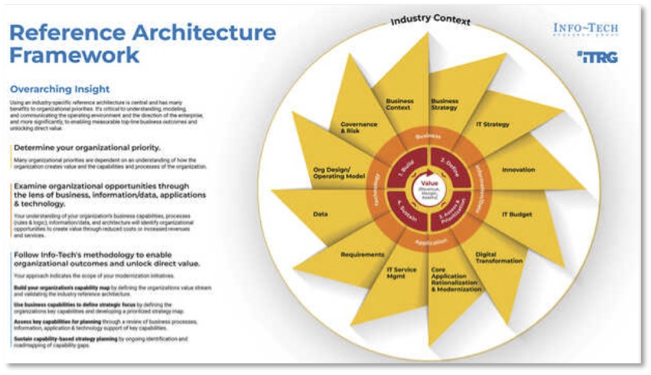
Retail Business Reference Architecture
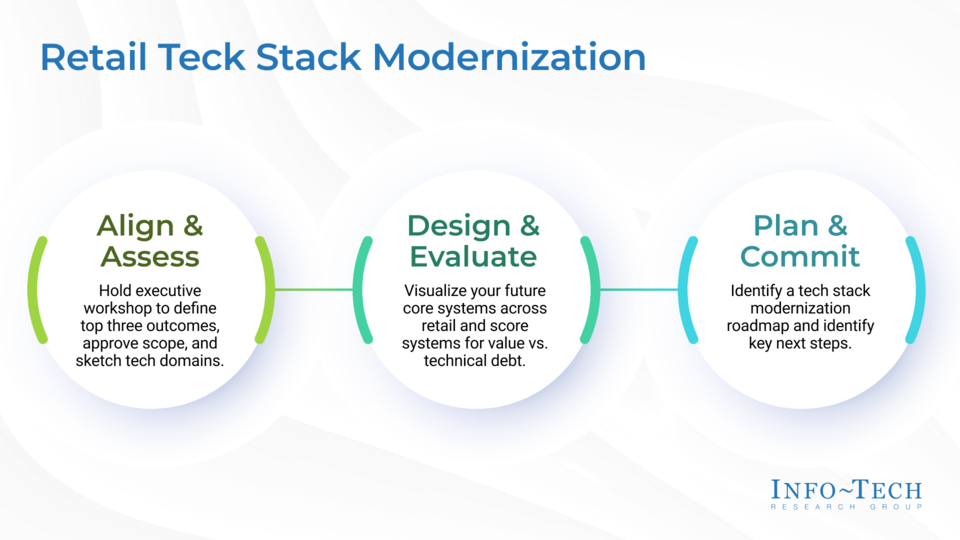
Retail Teck Stack Modernization
Retail CIOs don’t need another long-range transformation plan; they need clarity by Friday.
This one-week sprint produces a clear vision on the core platforms needed to support under-served business capabilities
Align and Assess
Hold executive workshop to define top three outcomes, approve scope, and sketch tech domains.
Design and Evaluate
Visualize your future core systems across retail and score systems for value vs. technical debt.
Plan and Commit
Identify a tech stack modernization roadmap and identify key next steps
Challenges
- Fragmented solutions
- Poor integration visibility
- No single source of truth
- ROI hard to prove
- Legacy systems stall progress
Obstacles
- Short-term focus over architecture
- Inconsistent asset inventory
- Tight budgets and high costs
- Familiar systems and talent gaps
Benefits
- Enterprise clarity and direction
- Gain visibility and control
- Convert strategy into results
- Sustain change through people
Actionable Deliverables
- Capability vs. Technology Assessment
- Core Tech Stack Inventory
- Current and Future Core Tech Stack Sketches
- Core Application Heatmap
- Modernization Roadmap
- Key Insights and Commitments
Info-Tech Insight
Move from managing individual systems to orchestrating the whole ecosystem: set a shared vision, expose integration blind spots, modernize with intent, and equip teams so AI can drive value from warehouse to checkout. Do it in small, focused chunks: run the sprint, ship the first improvements, then iterate to refresh the tech stack over time.
Info-Tech’s methodology for Building a Next-Gen Retail Tech Stack Roadmap
Phase Steps |
1. Align and Assess1.1 Set the Vision and Business Outcomes 1.2 Review Your Business Capabilities Gaps 1.3 Sketch Your Current Tech Stack |
2. Design and Evaluate2.1 Sketch Your Future Tech Stack 2.2 Score Future Core Enabling Tech 2.3 Review and Annotate the Heatmap |
3. Plan and Commit3.1 Visualize Tech Stack Modernization Timing 3.2 Summarize Results and Plan Next Steps |
Phase Outcomes |
A high-level, current-state tech stack sketch that maps systems that support prioritized capabilities |
A high-level, future-state tech stack sketch that maps systems that support prioritized capabilities and scored applications for what matters |
Tech Stack Modernization Roadmap and an Insights and Commitments table |
Insight summary
Architecture is the new AI enabler
The gap between ambition and execution isn’t the lack of innovation, it is a lack of integration. Enterprises that modernize their tech stack, unify data, and enforce architectural discipline are the organizations that will be able to scale AI beyond isolated pilots.
Clarify before complexity
Organizations must align first on shared business outcomes and access their true readiness. When the picture is clear around systems, data flow, and ownership, every AI initiative becomes an opportunity to enable efficiency, improve decision-making, and enhance the overall experience.
Blueprints beat band-aids
Designing systems for AI implementation requires intentional architecture and not incremental fixes. Clearly mapping dependencies and validating integration paths helps to replace short-term workarounds with a scalable framework that can adapt as AI evolves.
Transformation demands discipline
Commitment to modernization means linking architecture decision directly to business value. This helps in reducing drift and ensuring long-term impact beyond initial enthusiasm.
Reduce the architecture deficit
When priorities shift, and inconsistent standards erode the foundation, re-establishing architectural governance is the fastest way to rebuild trust in the stack.
Platform thinking
CIOs must replace fragmented tool choices with unified and interoperable platforms to ensure AI deployment delivers on its promise.
Key Deliverable
Each step of this blueprint is accompanied by supporting deliverables to help you accomplish your goals:
Build a Next-Gen Retail Tech Stack Tool
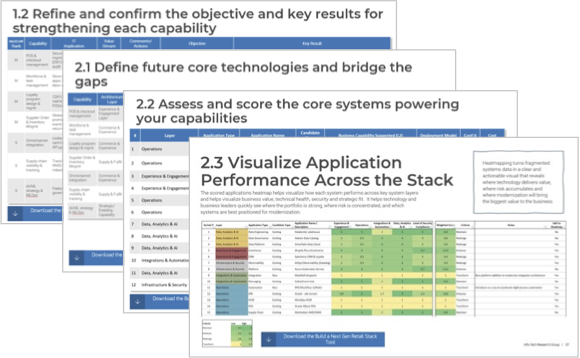
Key deliverable:
Consolidate all your activities through the Build a Next Gen Retail Tech Stack Tool into a single, actionable roadmap that visualizes modernization priorities by system, architecture layer, and time horizon, all in one view!
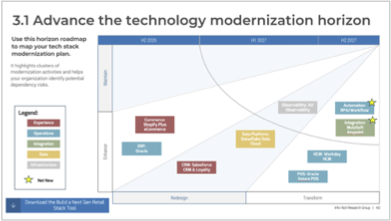
Note: Visuals are examples from the Excel Workbook transcribed to PowerPoint.

About Info-Tech
Info-Tech Research Group is the world’s fastest-growing information technology research and advisory company, proudly serving over 30,000 IT professionals.
We produce unbiased and highly relevant research to help CIOs and IT leaders make strategic, timely, and well-informed decisions. We partner closely with IT teams to provide everything they need, from actionable tools to analyst guidance, ensuring they deliver measurable results for their organizations.
What Is a Blueprint?
A blueprint is designed to be a roadmap, containing a methodology and the tools and templates you need to solve your IT problems.
Each blueprint can be accompanied by a Guided Implementation that provides you access to our world-class analysts to help you get through the project.
Need Extra Help?
Speak With An Analyst
Get the help you need in this 4-phase advisory process. You'll receive multiple touchpoints with our researchers, all included in your membership.
Guided Implementation 1: Scoping Call
- Call 1: Scope requirements, objectives, and your specific challenges.
Guided Implementation 2: Align and Assess
- Call 1: Set the vision and business outcomes.
- Call 2: Review your business capabilities gaps.
- Call 3: Sketch your current tech stack.
Guided Implementation 3: Design and Evaluate
- Call 1: Sketch your future tech stack.
- Call 2: Score future core enabling tech.
Guided Implementation 4: Plan and Commit
- Call 1: Build your modernization roadmap.
- Call 2: Document your insights and commitments.
- Call 3: Summarize results and plan next steps.