Build a Digital Health Strategy for Your Healthcare Organization
Align business and IT priorities to drive connected, resilient, and data-driven care.
- Meeting the demands of the digital economy requires shifting to data-driven, tech-enabled, and patient-centered care models.
- Aligning digital investments with enterprise-wide clinical, operational, and financial objectives remains difficult in a highly complex environment.
- Fragmented business and IT functions obstruct delivery of integrated, personalized, and consumer-grade care experiences.
- Rapid innovation, legacy infrastructure, and siloed data systems make it challenging to scale transformation without disrupting core operations or compromising quality and compliance.
Our Advice
Critical Insight
- Disjointed governance and siloed planning between IT and business functions result in misaligned priorities and fragmented execution.
- Legacy systems and limited interoperability block real-time data flow, hampering integration, innovation, and coordinated care delivery.
- Lack of shared ownership and success metrics undermines accountability for digital initiatives across clinical, operational, and IT leaders.
- Insufficient capacity for transformation, including workforce constraints, technical debt, and low digital maturity, slows adoption and scale of next-gen technologies.
Impact and Result
- Identify and prioritize key value chains (e.g. patient access, clinical operations, finance) where digital initiatives can create measurable clinical, operational, and financial value.
- Discover digitally enabled growth opportunities by scanning emerging technologies (AI, interoperability, virtual care, analytics) and industry trends to drive efficiency and better patient outcomes.
- Transform stakeholder journeys for patients, clinicians, and staff by mapping pain points and redesigning workflows for a seamless, digitally enhanced experience.
- Build an integrated digital health roadmap aligned with business priorities – a multiyear plan that links IT capabilities to strategic goals – supported by governance structures and KPIs to ensure accountability and track patient and business outcomes.
Build a Digital Health Strategy for Your Healthcare Organization
Align business and IT priorities to drive connected, resilient, and data-driven care.
Analyst Perspective
Integrate business and IT strategies to scale digital health transformation.

Healthcare systems are under mounting pressure to meet the demands of a digital economy, requiring patient-centered, data-driven care while navigating legacy systems, workforce gaps, and fragmented planning. Too often, digital investments remain isolated from clinical, operational, and financial priorities, resulting in poor adoption, wasted resources, and stalled innovation.
Success now depends on moving beyond siloed execution to build an integrated digital health strategy, one that aligns business goals with IT capabilities, embeds digital tools into care delivery, and enables coordinated transformation across departments.
To scale digital health effectively, organizations must start by identifying value chains with measurable impact, then link growth opportunities like AI and virtual care to specific patient and workflow challenges. It’s not about chasing technology, it’s about designing sustainable models that improve experience, efficiency, and system-wide performance.
This research provides CIOs, CMIOs, and executive leaders with a step-by-step blueprint to close alignment gaps, operationalize strategic priorities, and build a resilient digital health roadmap. The path to sustainable transformation starts by bridging the divide between innovation and execution.
Sharon Auma-Ebanyat
Research Director, Healthcare Industry
Info-Tech Research Group
Build a Digital Health Strategy for Your Healthcare Organization
Align business and IT priorities to drive connected, resilient, and data-driven care.
EXECUTIVE BRIEF
Executive summary
Your Challenge
- Meeting the demands of the digital economy requires shifting to data-driven, tech-enabled, and patient-centered care models.
- Aligning digital investments with enterprise-wide clinical, operational, and financial objectives remains difficult in a highly complex environment.
- Fragmented business and IT functions obstruct delivery of integrated, personalized, and consumer-grade care experiences.
- Rapid innovation, legacy infrastructure, and siloed data systems make it challenging to scale transformation without disrupting core operations or compromising quality and compliance.
Common Obstacles
- Disjointed governance and siloed planning between IT and business functions result in misaligned priorities and fragmented execution.
- Legacy systems and limited interoperability block real-time data flow, hampering integration, innovation, and coordinated care delivery.
- Lack of shared ownership and success metrics undermines accountability for digital initiatives across clinical, operational, and IT leaders.
- Insufficient capacity for transformation, including workforce constraints, technical debt, and low digital maturity, slows adoption and scale of next-gen technologies.
Info-Tech’s Approach
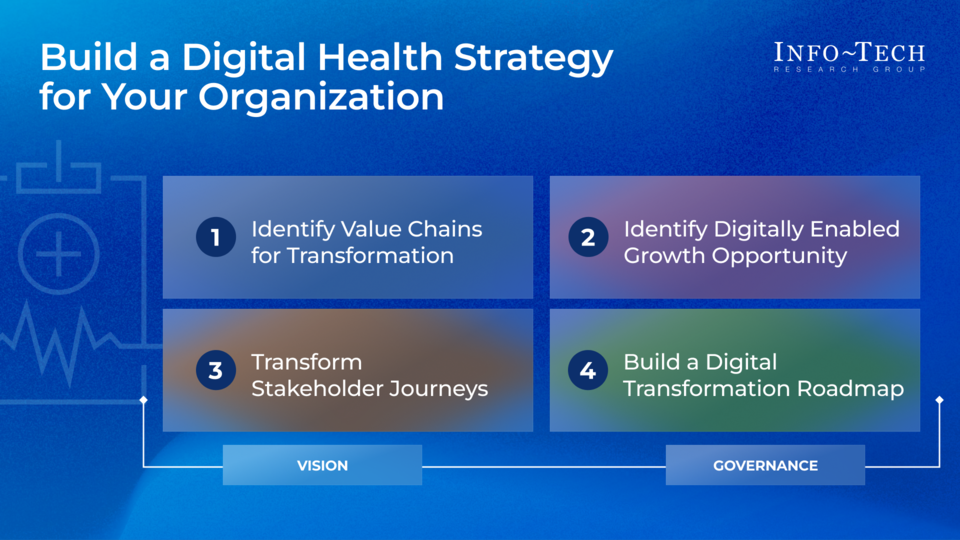
- Identify and prioritize key value chains (e.g. patient access, clinical operations, finance) where digital initiatives can create measurable clinical, operational, and financial value.
- Discover digitally enabled growth opportunities by scanning emerging technologies (AI, interoperability, virtual care, analytics) and industry trends to drive efficiency and better patient outcomes.
- Transform stakeholder journeys for patients, clinicians, and staff by mapping pain points and redesigning workflows for a seamless, digitally enhanced experience.
- Build an integrated digital health roadmap aligned with business priorities – a multiyear plan that links IT capabilities to strategic goals – supported by governance structures and KPIs to ensure accountability and track patient and business outcomes.
Info-Tech Insight
In today’s digital economy, where innovation and integration determine long-term resilience, healthcare organizations can no longer afford misalignment between IT and enterprise business strategy. Success now depends on a unified digital health strategy that connects business vision with technology execution to drive system-wide performance, sustainability, and patient value.
Accelerate digital health integration to align with the digital economy shift
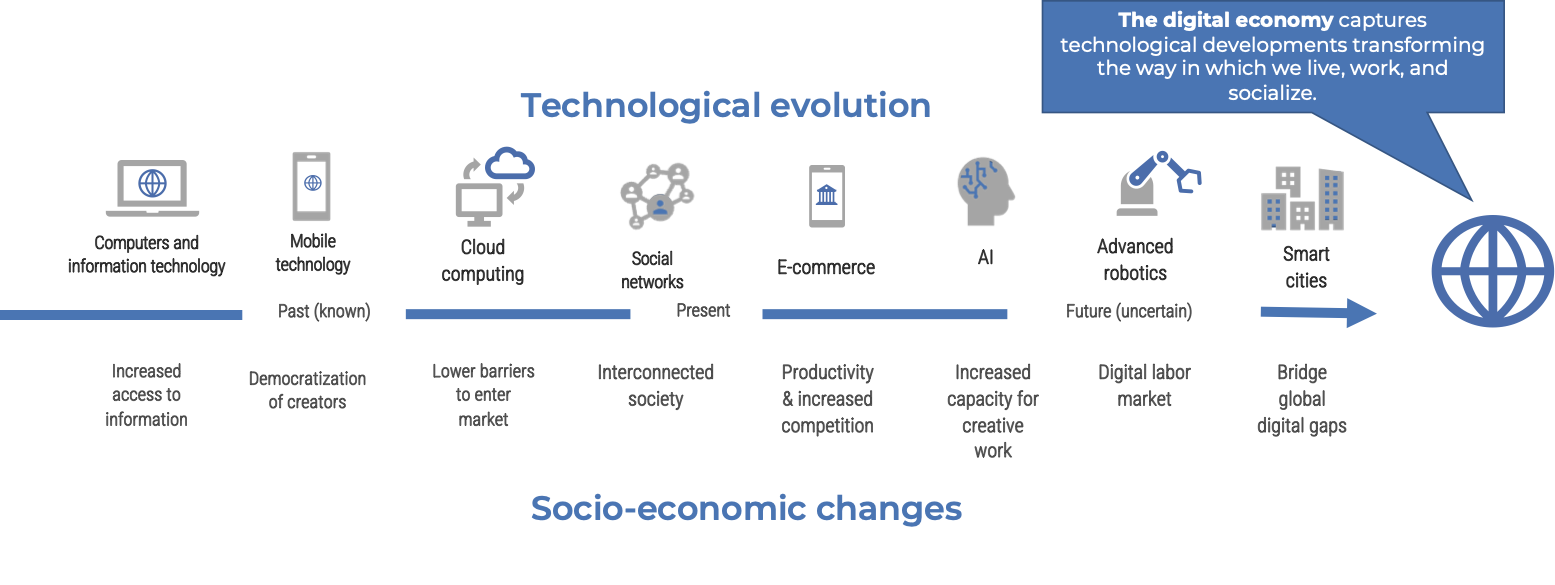
Drive strategic action through healthcare’s digital evolution
Mainframe Computers
1950-1960
- Mainframes introduced across business sectors, with limited adoption in healthcare.
- Systems written in machine and assembly code; complex and hardware-intensive.
- Early data automation focused on administration (billing, census, scheduling).
- High cost and technical barriers restricted clinical application and scalability.
Health IT
1970-2000
- Health informatics emerges; hospitals deploy early electronic health record systems.
- HL7 standards and enterprise IT departments formalize health data exchange.
- Personal computers and clinical decision-support tools gain widespread use.
- IT investments begin aligning with operations, safety, and workflow efficiency.
E-Health
2000-2020
- Internet expansion enables patient portals, online health access, and telemedicine.
- Chronic disease growth drives demand for data interoperability and quality analytics.
- Government investment (e.g. HITECH Act) accelerates EHR adoption and standards.
- Consumerism rises; patients expect transparency, convenience, and remote care.
Digital Health
2025+
- Generative AI, predictive analytics, and automation embedded in clinical workflows.
- Virtual, hybrid, and hospital-at-home models become core to care delivery.
- Interoperability, cybersecurity, and data governance mature into strategic priorities.
- Personalized, connected ecosystems link clinical, behavioral, and lifestyle data.
Navigate paradigm shifts by developing a resilient digital health strategy
Digital Health Strategy
Old Paradigm
- Workforce dependent on geography
- Customer valuing reputation and brand
- Reluctance to use digital collaboration
- Supply chain continuity
- Predictable regulatory systems
New paradigm
- Borderless workforce
- Customer valuing efficiency
- Wide acceptance of digital collaboration
- Supply chain disruptions and shortages
- Unpredictable regulatory changes
Overcome business and IT challenges to thrive in the digital economy and digital health era
-
The Digital Economy Demands Integrated, Consumer-Centric Services
In the digital economy, consumers expect seamless, tech-enabled experiences. Healthcare must evolve from episodic, facility-bound care to continuous, digital-first models – something that can’t be delivered through siloed business and IT strategies. -
Emerging Technologies Outpace Legacy Structures
AI, analytics, and virtual care are reshaping care delivery, but fragmented governance prevents adoption at scale. Separate strategies delay ROI, increase waste, and fail to meet rapidly changing regulatory and competitive pressures. - Operational Resilience Requires a Digital Core The pandemic and post-pandemic disruptions revealed how fragile traditional, non-digitized systems are. Integrated strategies are now essential for sustaining operations, mitigating risk, and enabling agility amid workforce shortages and unpredictable regulatory changes.
- Value-Based Care and Financial Sustainability Depend on It New reimbursement models reward outcomes, efficiency, and experience, not volume. Organizations must embed digital enablers like care automation, predictive analytics, and patient engagement tools directly into business workflows to succeed.
Drivers
WHY YOU SHOULD CARE
Patient demand: Patients now expect the same convenience from healthcare as they do from e-commerce and fintech: on-demand access, personalized insights, and digital touchpoints.
The digital labor market: Remote monitoring, precision medicine, and ambient AI require coordination between clinical, operational, and IT leadership. Without an integrated roadmap, these innovations remain stuck in pilots.
Business continuity and adaptability: Labor and supply pressures depend on unified planning, data flow, and decision-making supported by a digital backbone.
Missed ROI opportunities: Without a single strategy, digital investments often miss the mark on ROI. Integration enables prioritization of high-impact initiatives that tie directly to clinical and financial KPIs.
Address obstacles undermining digital health alignment and scale
Siloed Business-IT Strategy and Misaligned Execution
Disjointed governance and siloed planning between IT and business functions result in misaligned priorities and fragmented execution.
Legacy Systems Limit Progress
Legacy systems and limited interoperability block real-time data flow, hampering integration, innovation, and coordinated care delivery.
Lack of Shared Ownership and Success Metrics
Lack of shared ownership and success metrics undermines accountability for digital initiatives across clinical, operational, and IT leaders.
Limited Capacity to Transform
Insufficient capacity for transformation, including workforce constraints, technical debt, and low digital maturity, which slows adoption and scale of next-gen technologies.
“75% of health system executives report that their organizations place a high priority on digital transformation but lack sufficient planning or resources to deliver it.”
– McKinsey, 2024
Info-Tech Insight
Persistent misalignment between IT and business strategy, outdated systems, and unclear ownership structures continue to delay transformation. Leaders must build shared accountability, prioritize interoperability, and scale digital investments with coordinated governance to accelerate digital health impact.
Integrate your IT strategy into your business to drive digital health transformation
Business Strategy
“Why does our organization exist in the market?”
Digital Health Strategy
“What does our organization need to transform to compete in a digital economy?”
IT Strategy
“What does IT need to be and do to support the enterprise’s ability to meet its goals?”
“How do we make technology decisions?”
“How do we provide services?”
“How do we organize our teams?”
“How do we leverage vendors?”
“How do we foster a strong culture?”
About Info-Tech
Info-Tech Research Group is the world’s fastest-growing information technology research and advisory company, proudly serving over 30,000 IT professionals.
We produce unbiased and highly relevant research to help CIOs and IT leaders make strategic, timely, and well-informed decisions. We partner closely with IT teams to provide everything they need, from actionable tools to analyst guidance, ensuring they deliver measurable results for their organizations.
What Is a Blueprint?
A blueprint is designed to be a roadmap, containing a methodology and the tools and templates you need to solve your IT problems.
Each blueprint can be accompanied by a Guided Implementation that provides you access to our world-class analysts to help you get through the project.
Need Extra Help?
Speak With An Analyst
Get the help you need in this 5-phase advisory process. You'll receive multiple touchpoints with our researchers, all included in your membership.
Guided Implementation 1: Launch Guided Implementation
- Call 1: Discuss business context, aligning your organization’s strategy with business and IT metrics.
Guided Implementation 2: Identify Value Chains for Transformation
- Call 1: Assess business ecosystem.
- Call 2: Identify how your organization creates value.
Guided Implementation 3: Identify Digitally Enabled Growth Opportunity
- Call 1: Perform horizon scanning and trends identification.
- Call 2: Discuss value opportunities and impact.
Guided Implementation 4: Transform Stakeholder Journeys
- Call 1: Identify stakeholder personas and scenarios.
- Call 2: Complete journey mapping exercise.
Guided Implementation 5: Build a Digital Transformation Roadmap
- Call 1: Discuss initiative generation and inputs into roadmap.
- Call 2: Summarize results and plan next steps.
Contributors
- Anonymous, CIO, Acute Care Hospital System in Northwest US
- Anonymous, CIO, Acute Care Hospital System in Eastern Canada
- Anonymous, CIO, Provincial Health Authority in Central Canada