
Assess and Prioritize Agentic AI Use Cases in Mining
Embed agentic AI to bring efficiency and order to complicated technology environments.
- Agentic AI has the potential to yield cost and efficiency improvements in the mining industry but is difficult to implement amid structural boundaries.
- As AI use cases get closer to operational environments, risk tolerance decreases and value and viability must increase to counterbalance.
- Determining the optimal level of agentic AI autonomy, based on your organization’s needs and maturity, further complicates the decision process.
Our Advice
Critical Insight
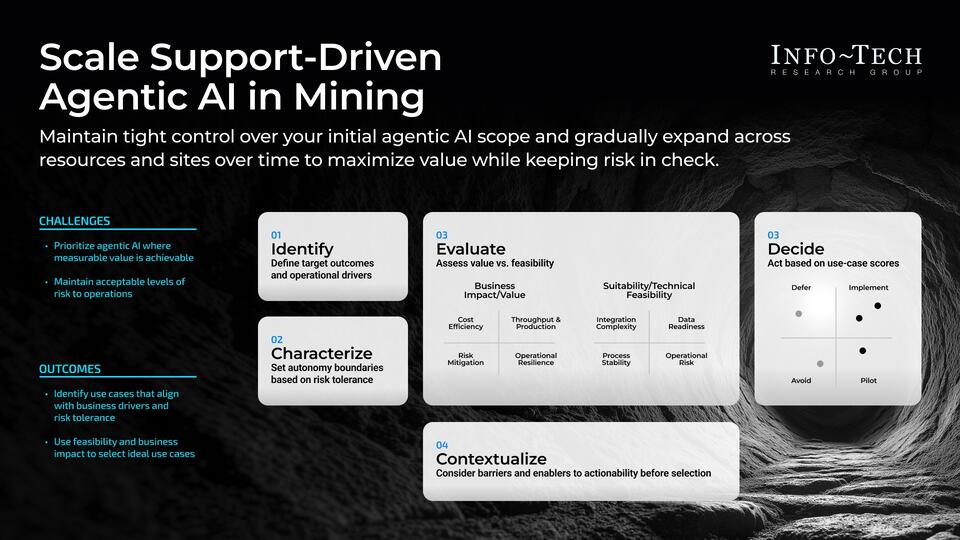
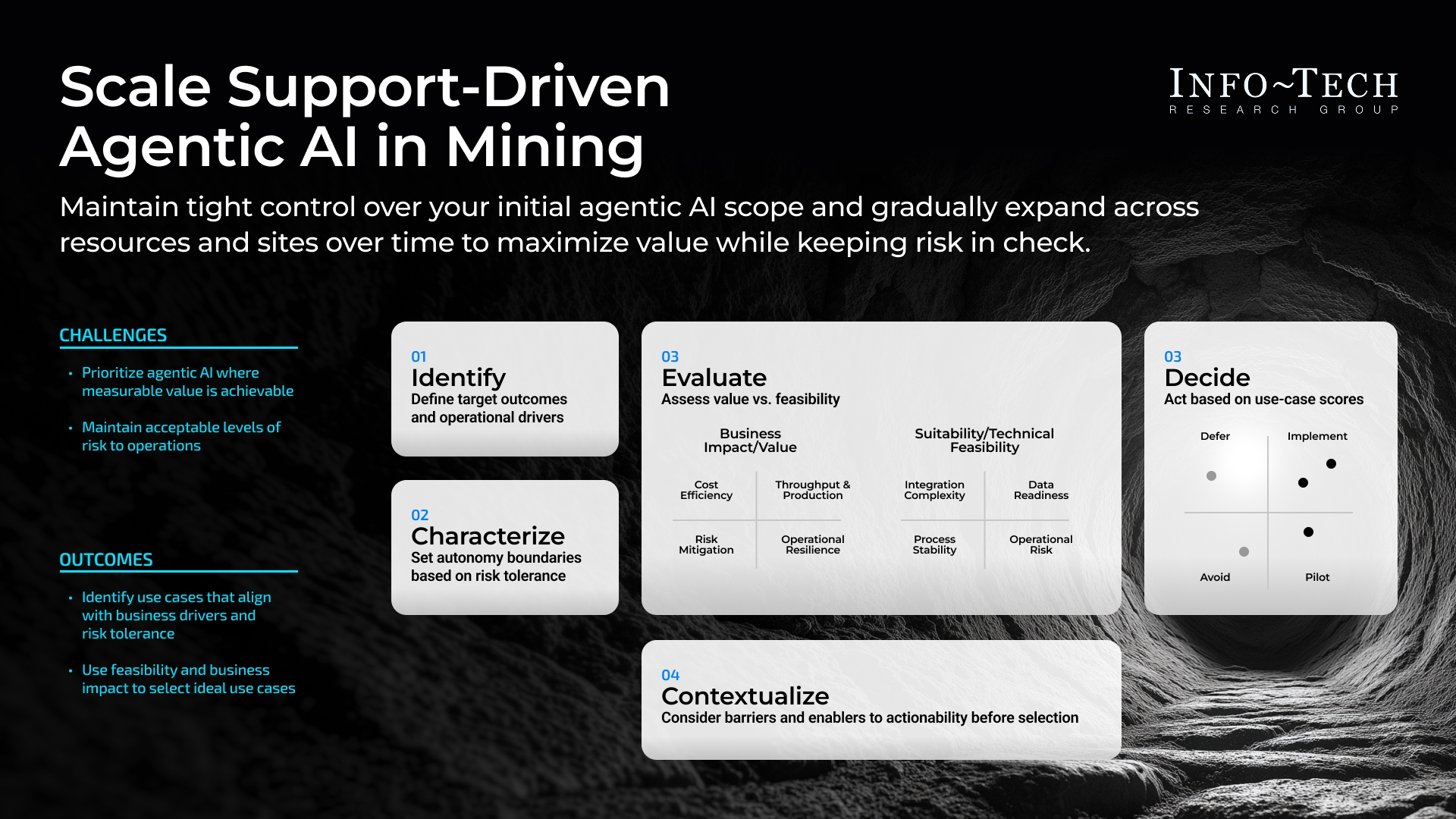
Mining organizations should maintain tight control over initial agentic AI scope and gradually expand across resources and sites over time to maximize value while keeping risk in check.
Impact and Result
- A clear, defensible shortlist of agentic AI use cases aligned to strategic business goals.
- Time savings through the evaluation process and a seamless input into AI strategy and piloting initiatives that follow.
- Established autonomy ceilings and agentic role fit for each capability domain, identifying where regulatory operational constraints limit defensible autonomous decision-making, and what activities are most readily supported by AI.
- Evaluated use cases using a structured value-vs-viability framework, allowing organizations to prioritize initiatives where agent behavior is both operationally useful and risk-appropriate.
Assess and Prioritize Agentic AI Use Cases in Mining
Embed agentic AI to bring efficiency and order to complicated technology environments.
Analyst perspective
The outcomes are straightforward; the path is less so.

Agentic AI is a rapidly expanding frontier within the broader landscape of AI development. As AI competencies become more advanced, mature organizations can deploy increasingly robust multi-agent systems that perform not just individual tasks, but entire workflows of related activities with minimal human guidance. Mining leaders can no doubt appreciate the potential for efficiency and productivity gains but are right to be cautious about the suitability of highly autonomous systems within their environment. Some capabilities are too operationally complicated, require too much regulatory oversight, and have a risk tolerance too low for easy AI implementation.
This is not, however, a strong enough reason to remain in a holding pattern. The longer you operate in catch-up mode to industry peers, the bigger the gap will become in business outcomes. With the correct framework for understanding both the needs of your organization and the landscape of agentic AI use cases, it is possible to find a fit that will yield tangible results without overstepping your capabilities or tolerance. Starting tomorrow might be comfortable, but starting today is practical.
Evan Garland
Senior Research Analyst, Industry Practice
Info-Tech Research Group
Executive summary
Your Challenge
- Identifying agentic AI use cases that can return value within your unique operational context and separating them from those that are possible but not viable.
- Balancing the need for innovation and realized business value against additional exposure to operational risk, especially in core operational domains.
- Determining the optimal level of agentic AI autonomy based on your organization’s needs and maturity further complicates the decision process.
Common Obstacles
- Messy operating environments, especially with fragmentation of data and processes across mine sites, make any form of standardization for innovation initiatives difficult. This introduces value and operational risk, especially for agentic AI.
- The AI solutions marketplace is less standardized and developed than many enterprise AI narratives suggest, which means solution design, integration effort, and accountability questions remain major adoption barriers.
Info-Tech’s Approach
- Align agentic AI evaluation with organizational business drivers and key operational capabilities to the visibility and magnitude of benefits realized.
- Establish autonomy ceilings and agentic role fit for each capability domain, identifying where regulatory operational constraints limit defensible autonomous decision-making, and what activities are most readily supported by AI.
- Evaluate use cases using a structured value-versus-viability framework, allowing organizations to prioritize initiatives where agent behavior is both operationally useful and risk-appropriate.
Info-Tech Insight
Maintain tight control over your initial agentic AI scope and gradually expand across resources and sites over time to maximize value while keeping risk in check.
Your challenge
Implement agentic AI through initiatives that strengthen operational performance without compromising safety or control
Translating proven AI value into complex mining operations. Measurable value has been demonstrated through agentic AI implementation in several mining capability domains. But realizing this value for your organization requires an acute understanding of both your needs and your capabilities within your unique and complicated operating environment. Just because use cases can provide value, it doesn’t guarantee they will.
Navigating fragmented, high-variability operating environments. Mining operations are inherently nonstandard, with fragmented systems, inconsistent data, and varying conditions across sites, assets, and ore bodies. This affects both the ability to pilot AI solutions in an environment where they have a chance, and to scale efficiently when pilots are successful.
Balancing performance gains with safety, cost, and capital constraints. Mining leaders face increasing pressure to improve productivity while managing rising costs, declining ore quality, and sustainability requirements. AI adoption, like any new technology, adds additional risk to be managed. Organizations must carefully determine where agentic AI can deliver meaningful gains without exceeding acceptable risk thresholds or requiring disproportionate investment.
Some examples of value returned from AI implementation include:
2-5% increase in throughput production
5-15% reduction in maintenance costs
2x improvement in scheduler productivity
Source: BCG, 2026
Common obstacles
Structural barriers limit the speed at which agentic AI can be safely adopted in mining operations:
Integration and infrastructure gaps limit agent actionability. Mining environments rely on a mix of legacy systems, vendor-specific equipment, and site-specific configurations that are not easily interoperable. Inconsistent data formats, limited APIs, and remote connectivity constraints make it difficult for agents to operate reliably.
Data foundations are not ready for real-time, decision-driven AI. Most mining organizations do not yet have the data environment required to support agentic AI in practice. Investment and commitment to new standard practices often precede many use cases, making the value justification more difficult.
High variability workflows resist standardization. Mining operations are shaped by changing ore compositions, environmental conditions, and production constraints. These factors introduce frequent exceptions that are difficult to codify into stable workflows, making it challenging to define the boundaries that agentic systems need to operate effectively.
60%
of surveyed Perth mining companies experienced at least one significant data access delay in 2023.
Source: Wolfe Systems, 2026
About Info-Tech
Info-Tech Research Group is the world’s fastest-growing information technology research and advisory company, proudly serving over 30,000 IT professionals.
We produce unbiased and highly relevant research to help CIOs and IT leaders make strategic, timely, and well-informed decisions. We partner closely with IT teams to provide everything they need, from actionable tools to analyst guidance, ensuring they deliver measurable results for their organizations.
What Is a Blueprint?
A blueprint is designed to be a roadmap, containing a methodology and the tools and templates you need to solve your IT problems.
Each blueprint can be accompanied by a Guided Implementation that provides you access to our world-class analysts to help you get through the project.
Need Extra Help?
Speak With An Analyst
Get the help you need in this 3-phase advisory process. You'll receive multiple touchpoints with our researchers, all included in your membership.
Guided Implementation 1: Identify Use Cases That Align to Your Drivers and Capabilities
- Call 1: Scope requirements, objectives, and your specific challenges.
- Call 2: Anchor AI capability to business context and drivers.
- Call 3: Explore agentic AI in practice.
Guided Implementation 2: Characterize AI by Purpose and Scale
- Call 1: Establish agentic AI capability patterns.
- Call 2: Optimize the balance of autonomy and risk within use cases.
Guided Implementation 3: Score & Validate Prioritized Use Cases
- Call 1: Score use cases for prioritization.
- Call 2: Review and validate use case portfolio.