
Assess and Prioritize Agentic AI Use Cases in Healthcare
Assess agentic AI use cases with a triage model that connects fit, guardrails, and value.
- Leadership and economic pressures are pushing CIOs to approve agentic AI before accountability, liability, and clinical governance approaches are settled.
- Healthcare AI governance is internally fragmented: Committees, risk owners, and clinical leaders rarely share one rubric for what means to advance a use case to the pilot stage.
- Platform position (EHR-native, EHR-adjacent, overlay, or internal) materially changes what controls the organization has and changes the approach to the use case evaluation process.
- Agentic AI adoption pressure is outpacing governance maturity, leaving CIOs without a defensible way to say yes, no, or not yet.
Our Advice
Critical Insight
- The unit of approval is not the use case or the vendor, but rather the specific agentic behavior, in a named workflow, on a named platform. Providers need to evaluate and approve use cases at this level of granularity.
- Workflow fit, downstream exposure, and containment are screening dimensions, helping determine which use cases don’t belong under consideration.
- Platform position determines risk and triage treatment. EHR-native, adjacent, overlay, and internal deployments each carry different audit, override, and rollback profiles, and each demands a different governance posture.
Impact and Result
- A shared understanding of agentic AI concepts, vocabulary, and practical fit for healthcare providers.
- A structured set of candidate use cases mapped to business capabilities and screened for structural fit, workflow fit, downstream exposure, containment before any priority scoring exercises is done.
- A scored, visually represented agentic AI portfolio that supports confident, defensible prioritization.
Assess and Prioritize Agentic AI Use Cases in Healthcare
Assess agentic AI use cases with a triage model that connects fit, guardrails, and value.
Analyst perspective
Risk exposure determines agentic approval.
In healthcare, agentic AI is not only a model-risk issue but also a workflow-authority decision: a question of which processes can be delegated to autonomous systems, under what conditions, and with what level of accountability. While there is significant upside and corresponding risk, the pressure to adopt agentic AI is building faster than governance models can meaningfully evaluate the opportunities.
Across provider workflows, vendor capability and business opportunity for agentic applications are rarely the binding constraints. Agent behavior is shaped by the platforms providers operate within (EHRs, point solutions, overlays), none of which the provider fully governs. That lack of control complicates decision-making in ways that generic readiness frameworks do not account for. Successful providers will anchor decisions in workflow authority, gate by exposure profile, and prioritize use cases where the reward is real and output review remains meaningful under real-world conditions.
This research assesses agentic AI through a provider lens, using a staged triage model to surface viable opportunities. Agentic AI in healthcare is a risk-reward trade-off managed workflow by workflow, not a generic productivity initiative or a wholesale redesign effort. The key decision is where autonomy can be safely delegated without weakening accountability, clinical defensibility, reimbursement integrity, or patient trust. However, culture and governance capacity will ultimately determine whether these deployments scale.

Kassim Dossa
Research Director, Healthcare
Info-Tech Research Group
Executive summary
Your Challenge
CIOs and provider leaders are being asked to approve agentic AI capabilities before accountability, liability, and governance guidance are settled.
- Governance guidance remains fragmented, forcing providers to define their own approval rules for accountability and liability.
- Platform position (EHR-native, adjacent, overlay, internal) shapes what providers can see, govern, audit, and contain.
- AI adoption pressure and the release speed of agentic tools in key platforms are rising faster than governance models can react.
Common Obstacles
Providers are under pressure to approve agentic AI before they have a consistent way to judge workflow authority, platform control, and downstream exposure.
- Platform control is fragmented across EHR-native, adjacent, overlay, and internal systems, creating uneven control points, integration burdens, and vendor dependency.
- Individual agentic workflows can affect patient communication, documentation integrity, coding, and reimbursement at the same time.
- Approval decisions lean on near-term throughput or financial gains and can potentially underweight quality and patient experience factors.
Info-Tech's Approach
When CIOs align teams to define practical AI use cases, they reduce risk and avoid stalled adoption. Info Tech helps align teams around practical agentic AI use cases by:
- Tying all potential use cases in the reference architecture to value streams and capabilities.
- Applying a use case filter that confirms workflow fit, validates downstream exposure across clinical and payer boundaries, and verifies the organization's ability to contain and govern the risk.
- Assessing and prioritizing remaining use cases across business impact and implementation feasibility dimensions.
Info-Tech Insight
Agentic AI creates value in provider organizations only when CIOs replace one-off approvals with a consistent filter that links workflow fit, exposure, containment, and prioritized business value into a defensible decision posture.
Your challenge
Deciding where workflow authority can safely shift, how outputs will be reviewed under real workload, and which patient- or payer-facing exposures the organization is willing to absorb.
- Providers must define their own approval rules because accountability, liability, and usable governance guidance are still fragmented.
- Use cases that are "safe by design" can break down in production if clinicians cannot meaningfully review, challenge, or reverse outputs under real workload conditions.
- Use cases that cross into clinical decision support, patient communication, prior authorization, coding, denials, appeals, or billing make errors harder to reverse and costlier to absorb.
- Where the agent lives (EHR-native, adjacent, overlay, internal) changes what providers can see, govern, audit, and contain.
- Adoption pressure and the release speed of agentic tools in key platforms is rising faster than governance models can react.
19% of US clinical care organizations have implemented agentic AI, while another 76% are pursuing proofs of concept.
Source: McKinsey & Company, 2026
Common obstacles
Provider organizations are under pressure to approve agentic AI before they have a consistent way to judge workflow authority, platform control, and downstream exposure.
- Platform control is fragmented, creating different control points, integration burdens and dependency risk based on the underlying system.
- Broad organizational exposure exists when an agentic workflow can impact high-risk areas such as patient communication, documentation integrity, coding accuracy and reimbursement simultaneously.
- Independent evidence of agentic use case effectiveness is still strongest for assistive use cases vs. higher-authority workflow use cases that touch clinical decisioning.
- There is potential for a skewed focus on near-term financial or throughput gains that neglects other impacts (quality, patient satisfaction, equity).
Agentic AI investment is projected to rise nearly 100% in the next 12 months. However, only 14% of organizations are ready to scale it.
Source: IDC/Lenovo, 2026
Healthcare has entered its agentic phase
Agentic AI in healthcare: An AI-enabled system that exhibits autonomous behavior, planning, deciding, and acting across multistep workflows using tools and feedback to progress work toward a defined goal.
19% of organizations have implemented agentic AI. (McKinsey, 2026)
98% of organizations expect at least 10% savings as a result of their agentic investments.
(Deloitte, 2026)
85% of health systems and plans expect to increase their agentic AI investments in less than three years.
(McKinsey, 2026)
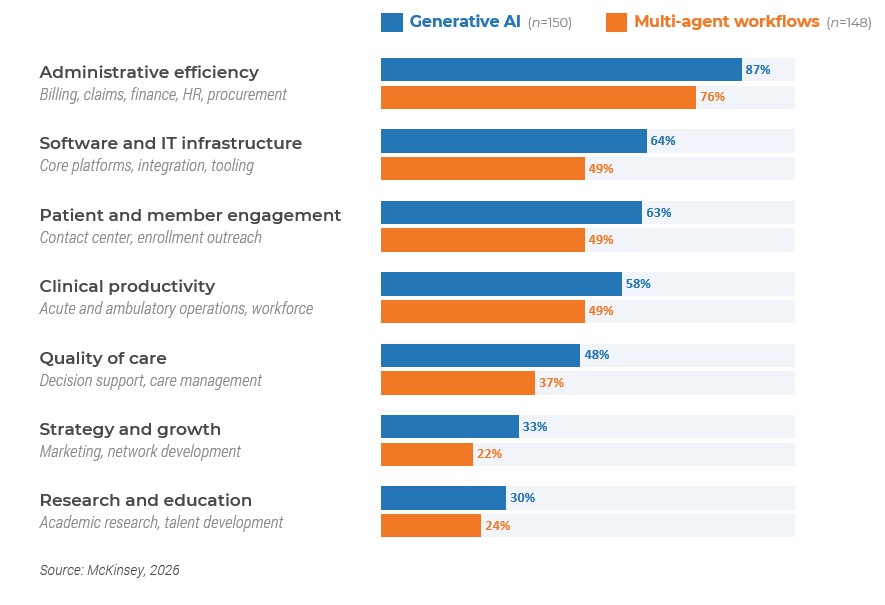
Where healthcare industry leaders see agentic potential
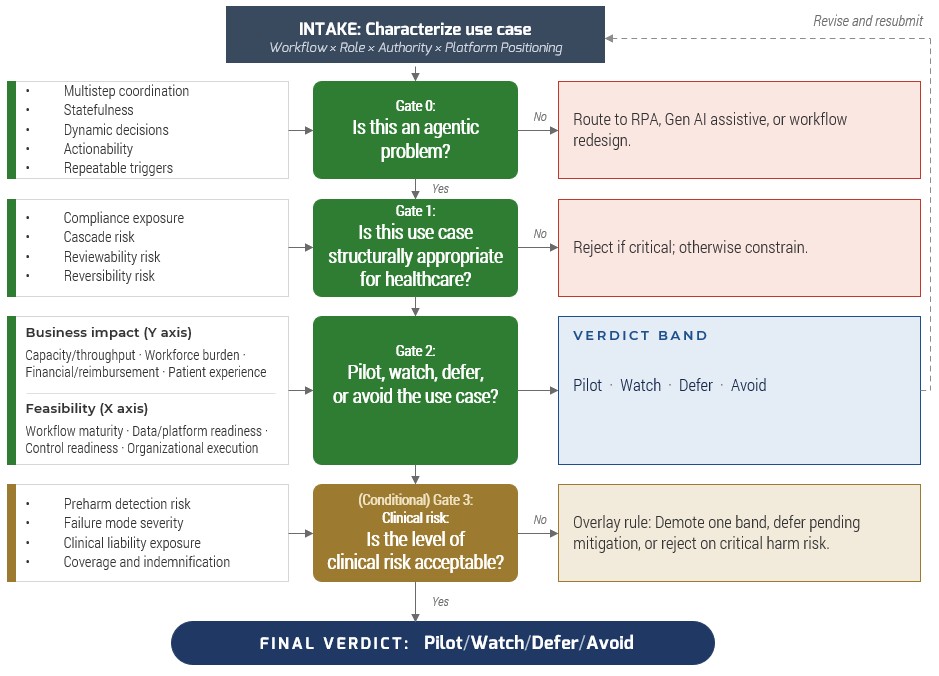
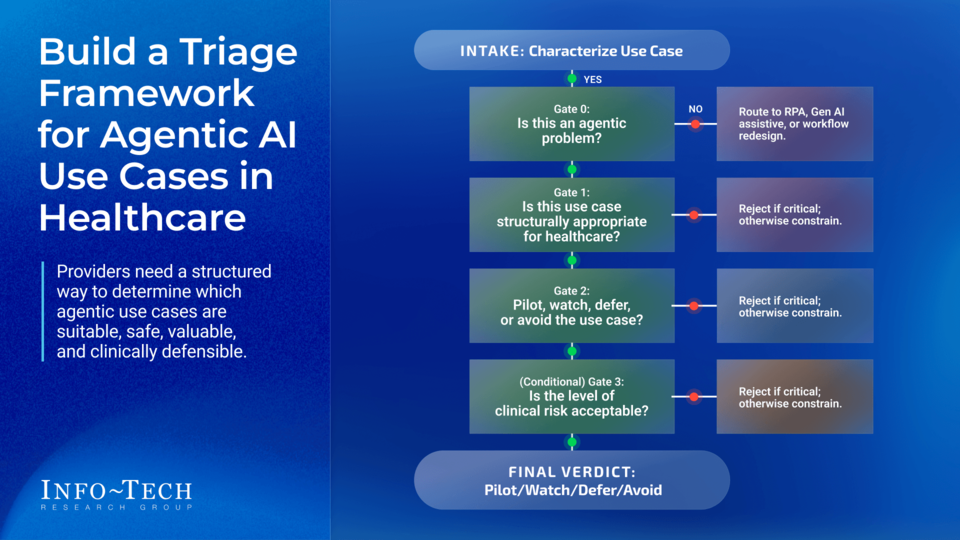
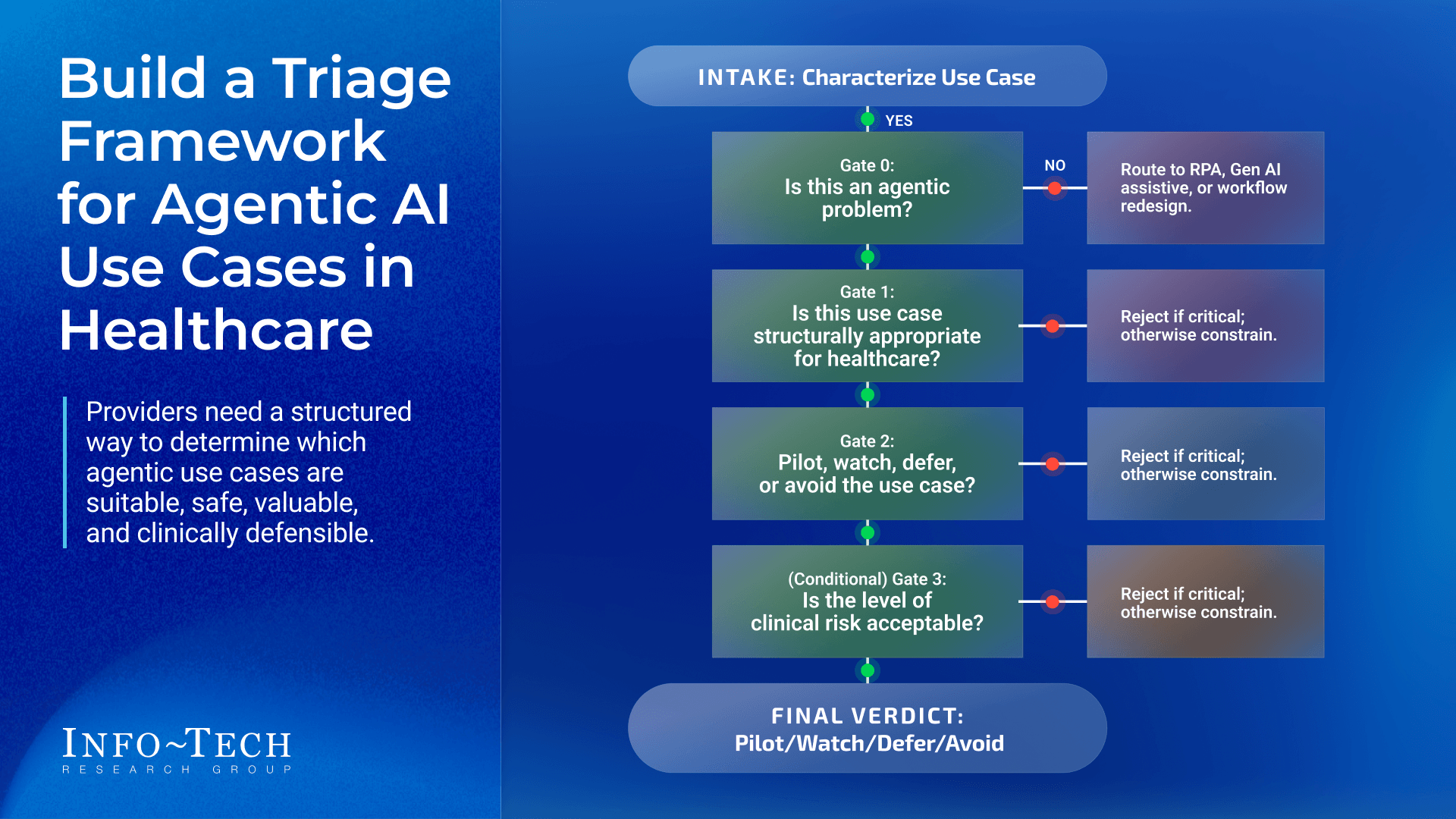
Build a triage framework for agentic AI use cases in healthcare
CORE PROBLEM
Providers need a structured way to determine which agentic use cases are suitable, safe, valuable, and clinically defensible.
FRAMEWORK CONTEXT
Challenges
- Workflow exposure varies across clinical, operational, and platform contexts.
- Adoption pressure is higher where governance maturity and independent evidence is limited.
- Clinical cases carry liability and insurance exposure that administrative cases do not.
Outcomes
- Consistent approval decisions tied to workflow behaviors, not generic AI categories.
- Explicit accountability owner, override path, and risk profile recorded at approval stage.
- Clinical risk separated from operational risk and measured before approving a use case.
KEY INSIGHT
The unit of approval is an agentic behavior within a named workflow on a named platform, not a use case or a vendor. The same agentic capability can be approvable in one workflow and not in another. The triage model delivers a verdict at the granularity where risk and opportunity meet.
Info-Tech's methodology for determining where agentic AI fits in healthcare
| 1. Define and Anchor the Context | 2. Identify and Assess Use Cases | 3. Prioritize and Validate the Portfolio | |
|---|---|---|---|
| Phase Steps | 1.1 Align on fundamental agentic AI concepts. 1.2 Anchor AI capability to business context. |
2.1 Review the tool structure and scoring model. 2.2 Identify candidate use cases across value stream domains. 2.3 Confirm structural fit of use cases. |
3.1 Score use cases for prioritization. 3.2 Apply (conditional) clinical gating. 3.3 Review and validate use case portfolio. |
| Phase Outcomes | A shared understanding of agentic AI concepts, capability patterns, and how they connect to your business context | A structured set of agentic AI use cases, anchored to capabilities evaluated against agentic and structural fit criteria | A prioritized use case portfolio that has been scored for business impact and feasibility, passed clinical review, and is ready for investment discussions |
Insight summary
Agentic AI in healthcare requires workflow discipline.
The strongest healthcare use cases are grounded in real clinical and operational workflows, gated by exposure, and prioritized by business impact, reviewability, and governance readiness.
Anchor to clinical and operational workflows
Use cases must be anchored to named provider workflows: clinical, revenue cycle, scheduling, documentation. Additionally, the evaluation discipline also includes clinical accountability, which systems and handoffs it touches, and how value is measured across care, throughput, and margin.
Target coordination, not clinical judgment
Early agentic win opportunities are found in multistep, coordination-heavy workflows (i.e. prior auth, referral routing, chart prep, intake, follow-up, denials, and documentation assembly). These extend capacity around clinicians and staff without automating clinical decisions.
Gate autonomy by exposure
Patient safety impact, regulatory exposure, reviewability, and platform positioning should determine if and how much autonomy is allowed. In healthcare, acceptable autonomy varies by clinical risk, care setting, and whether the output is patient-facing, payer-facing, or internal.
Measure value beyond productivity
Measure impact beyond task-level productivity gains. Look for upside opportunities in clinical quality, safety, throughput, reimbursement integrity, clinician burden, and patient experience.
Pressure test platform and governance fit
Confirm use case implications early for EHR/platform position, vendor lock-in, clinical governance capacity, and reimbursement workflows before scaling.
Research deliverable
Each step of this research is accompanied by supporting deliverables to help you accomplish your goals.
Agentic AI Use Case Tool for Healthcare
This tool provides the structure to identify healthcare-specific agentic AI use cases, score each one across business value and feasibility, and build a prioritized portfolio, enabling teams to confidently select the highest-impact opportunities ready to move into the Build Your Agentic AI Prototype phase.
Measure the value of this research
Leverage this research's approach to ensure your agentic AI use cases align with and support your key business drivers and speed time to value.
| With Info-Tech Resources | Without Info-Tech Resources | |||
|---|---|---|---|---|
| Project Steps | Time | Estimated Average Cost (USD) | Time | Rationale |
| Workflow Fit & Capability Mapping | 1-1.5 days | $6,000-$9,000 | 2-3 days | Facilitated alignment on agentic concepts, safety and suitability, business capabilities, and workflow boundaries |
| Tool & Scoring Model Validation | 1 day | $3,000-$6,000 | 1-2 days | Alignment facilitation on scoring model |
| Use Case Generation and Fit Screening | 1.5 days | $7,500-$9,000 | 2.5-3.5 days | Consultant facilitation |
| Prioritization & Portfolio Validation | 1-2 days | $9,000-$12,000 | 3-4 days | Scoring discussion facilitation |
| Effort | 4.5-6 days | $25,500-$36,000 | 8.5-12.5 days | |
| Business Outcome Objective | Key Success Metrics |
|---|---|
| Growth & Service Expansion | Patient volume growth, market share by service line, new patient acquisition rate, referral capture rate |
| Patient Experience & Access | Net Promoter Score, complaint, and grievance rate |
| Care Delivery Capacity & Throughput | Encounters per provider day, average length of stay, OR and procedure room utilization, emergency department door-to-provider time |
| Workforce Sustainability & Engagement | Clinician burnout index, clinician turnover rate, vacancy rate, agency spend |
| Financial Performance & Cost Efficiency | Operating margin, cost per adjusted discharge, initial and final denial rates, days in AR |
| Clinical Quality, Safety & Compliance | Risk-adjusted mortality, 30-day readmission rate, hospital-acquired conditions, CMS star rating or Accreditation Canada required organizational practices (ROP) compliance |
Revenue cycle case study
Apollo MD
INDUSTRY
Healthcare
SOURCE
Cedar
Challenge
ApolloMD, a clinician-owned emergency medicine practice management group, faced mounting pressure as high-deductible plans pushed patient bills from $20 copays to $150 or more per visit.
Patients did not recognize ApolloMD as their ER clinician group, which resulted in confusion during calls and corresponding weak collection rates. Additionally, a prior call center partner struggled with long customer wait times and a 10% call abandonment rate.
Solution
ApolloMD partnered with Cedar in 2020, deploying Cedar Pay and Cedar Support to modernize patient billing, then expanded to Cedar's AI voice agent, Kora, in April 2025.
Kora handled patient billing calls end to end by authenticating callers, answering balance questions, explaining charges, and updating insurance using both patient input and account context. The agent escalates to a human when complexity requires it or when the patient asks, retaining bounded authority on routine inquiries.
Results
Within year one, ApolloMD drove a 42% increase in patient collection rate, with 92% of collections coming from digitally engaged patients and 87% patient satisfaction across 44,000+ survey responses.
By 2024, collections reached $48.2M, the highest in ApolloMD's history and a 14% lift over 2023. After Kora launched in April 2025, call handle time fell 27% and call center staffing was reduced by 11% while service levels were maintained. Additionally, call abandonment dropped below 1% by Q1 2025.
Discharge management case study
Honor Health
INDUSTRY
Healthcare
SOURCE
Becker's Hospital Review
Challenge
HonorHealth, a nonprofit health system of six hospitals in Arizona, was keeping patients in beds longer than needed. Discharges kept getting delayed because care teams could not see in real time which patients were ready to leave or what was holding them up.
Additionally, the patient records system they already had could not predict discharge dates accurately enough or flag delays early enough in the process.
Solution
HonorHealth rolled out the Qventus Inpatient Solution across all six of its hospitals starting in 2021. The system predicts when each patient is likely to be ready to go home, flags anything that might delay discharge, and tells care teams what to do next to avoid this outcome.
The system predicts each patient's likely discharge date and where they will go after the hospital (home, rehab, skilled nursing). During the stay, it summarizes patient status for daily team huddles so the right next step is clear. It also sequences tasks in the order most likely to get patients home on time.
Results
Over three years, HonorHealth cut the average hospital stay by 0.65 days per patient and avoided more than 50,000 unnecessary hospital days, saving $62 million.
86% of patients now receive an early discharge plan (up from 14% before Qventus). Additionally, the software automatically creates discharge dates and next-care destinations, saving care teams more than 250,000+ manual process "clicks" in the software.
Denials management case study
Aspirion
INDUSTRY
Healthcare
SOURCE
Aspiron Website
Challenge
A leading nonprofit health system in the Southeast USA with more than ten hospitals and 300+ medical offices faced increasing, complex clinical denials that created unresolved balances and immense financial pressure.
This additional workload further exacerbated internal capacity constraints, prolonging resolution timelines and increasing financial risk.
Solution
The health system deployed Aspirion's Compass platform, which integrates directly with existing EHR workflows to automate the clinical denial appeal process from intake to submission.
Compass uses AI to analyze complex medical records, extract coding and clinical evidence, and autogenerate payer-specific appeal letters targeting level-of-care and patient-status denials.
Each AI-drafted appeal is reviewed and refined by Aspirion's multidisciplinary team of clinicians, attorneys, and claims specialists before submission.
Results
Within two months of tool implementation, the health system collected over $5.6M from complex clinical denials using AI-powered appeals.
$4.8M of that total was collected from first-level appeals (AI written, human-verified) after a single appeal submission. 86% of collections came from these first-level appeals.
Additionally, Aspirion's contingency-based model meant the health system incurred no upfront cost.
Phase 1
Define and Anchor the Context
Phase 1
1.1 Align on fundamental agentic AI concepts
1.2 Anchor AI capability to business context
Phase 2
2.1 Review the tool structure and scoring model
2.2 Identify candidate use cases across value stream domains
2.3 Confirm structural fit of use cases
Phase 3
3.1 Score use cases for prioritization
3.2 Apply clinical gating
3.3 Review and validate use case portfolio
This phase will walk you through the following activities:
- Review your organization's business goals, key initiatives, and capability maps to anchor AI planning in real, firm-level priorities.
- Explore the purpose and structure of AI use cases to build a common understanding of how they support core processes and systems.
This phase involves the following participants:
- AI initiative lead
- C-level leaders
- Other IT/department leadership
- Senior business leaders and managers accountable for AI initiatives
Position agentic AI on the automation spectrum
From rules to agents
| Concept | Profile | Description | Typical Autonomy Range | Typical Use/Example |
| Traditional Automation | Rule-Based Operator | Executes predefined, rule-based tasks with no learning or reasoning. | None | RPA, claims autoadjudication, eligibility checks, lab-result routing |
| AI Decision Support | Specialist | A single intelligent unit that perceives, reasons, and responds. May use memory and tools but operates within defined boundaries and requires human review. | Assistive to Guided | Patient-facing chatbots, clinical decision support, symptom checkers, radiology image triage suggestions |
| Single Agent With Tools | Tool-Using Specialist | An AI agent that uses external tools (EHR, scheduling, knowledge bases) to complete multistep tasks under defined guardrails. | Guided to Conditional | Prior-auth research agent, clinical documentation assistant, patient-intake triage agent |
| Agentic Systems | Self-Managing Team | Self-directed systems of multiple AI agents that reason, plan, and act together – managing their own feedback loops, tools, and orchestration. | Conditional to Autonomous | End-to-end care coordination, autonomous revenue-cycle orchestration, population-health planning |
Agentic systems exist on a progression of autonomy
How much authority should your agent have?
1 Assistive
(Clinician or Staff Initiated)
A team member starts the task. The agent drafts, summarizes, or analyzes, and a qualified human reviews and acts on every output.
2 Guided
(Bounded Workflow Steps)
The agent performs defined steps within fixed rules and explicit approval points. A human still governs handoffs that have significant downstream effects.
3 Conditional
(Acts Within Approved Thresholds)
The agent acts on routine cases that meet preapproved criteria and escalates exceptions to a qualified reviewer.
4 Autonomous
(Acts Without Real-Time Review)
The agent plans and executes without real-time human review. Human review occurs as oversight (human on the loop (HOTL)) or outside of the loop (HOOTL).
Note: This is a set of options, not a maturity path for an organization to follow. Agentic autonomy is not the destination. The appropriate level of automation should be set by each workflow's exposure, reversibility, and reviewability.
Understand platform-level risk considerations
The risk calculus changes for agentic AI depending on the platform where it sits. While EHR-native tools carry the largest downstream blast radius, overlays shift risk to endpoints, and internal builds transfer additional governance burden to the provider.
| Platform Position | Workflow Reach | Risk Profile |
|---|---|---|
| EHR-native AI Epic AI Charting; Oracle Health Clinical AI Agent |
Deepest access to clinical data, documentation, tasking, and system-of-record workflows. | Errors propagate across documentation, orders, coding, care coordination, and downstream systems. Turning the functionality off becomes operationally disruptive once workflows are redesigned around it. |
| EHR-embedded partner Abridge (Epic Pal); Ambience, Suki (Epic Toolbox); DAX inside Microsoft Dragon Copilot |
Embedded in EHR-adjacent workflows: documentation, summarization, and ambient capture. | Liability is shared across provider, EHR, and partner and can require additional treatment around PHI handling and data residency. |
| Adjacent workflow vendor Clinical/Operations: Qventus, Notable, Innovaccer; RCM: Cedar, Aspirion, CodaMetrix |
Deep reach into a bounded workflow: RCM, access, scheduling, coding, or operations. | Narrow scope improves testability, but encoded payer rules and operational logic create hidden workflow lock-in. |
| Overlay/desktop layer Dragon Medical One (dictation); Microsoft 365 Copilot; browser-side AI assistants |
Sits above source systems. User decides whether and how to apply output. | Lower clinical-record blast radius, but shadow AI, data leakage, and observability risk rise if endpoints are not managed well. |
| Internally-built solutions Provider-developed tools on Azure OpenAI, Anthropic API, AWS Bedrock |
Provider defines the agent, data access, orchestration, integration, and monitoring model. | Vendor lock-in may be lower, but bias, drift, safety testing, security, software-as-a-medical-device (SaMD) analysis, and operational support all sit with the provider. |
Match healthcare workflows to four agentic AI use case patterns
Use these patterns to classify where agents create incremental value across healthcare. Many solutions combine multiple patterns, but each should map back to a named healthcare value stream, a defined workflow authority level, and a clear accountability owner.
Execution & Delivery
Produces bounded work outputs or completes defined workflow steps, such as extracting information, drafting content, assembling deliverables, or updating records. Examples: ambient note drafting, prior authorization packet assembly.
Analysis & Recommendation
Pulls information from multiple sources, interprets clinical or operational patterns, and surfaces recommendations, options, or next-best actions for human review and approval. Examples: chart summarization, care gap identification.
Monitoring & Sensing
Continuously watches for changes, exceptions, deadlines, compliance triggers, or performance signals and prompts alerts, escalations, or follow-up tasks. Examples: discharge barrier detection, payer deadline tracking.
Coordination & Workflow
Classifies incoming work, sequences tasks, routes requests, manages handoffs, and tracks progress across people, systems, and approvals. Examples: referral routing, shift matching.
About Info-Tech
Info-Tech Research Group is the world’s fastest-growing information technology research and advisory company, proudly serving over 30,000 IT professionals.
We produce unbiased and highly relevant research to help CIOs and IT leaders make strategic, timely, and well-informed decisions. We partner closely with IT teams to provide everything they need, from actionable tools to analyst guidance, ensuring they deliver measurable results for their organizations.
What Is a Blueprint?
A blueprint is designed to be a roadmap, containing a methodology and the tools and templates you need to solve your IT problems.
Each blueprint can be accompanied by a Guided Implementation that provides you access to our world-class analysts to help you get through the project.
Need Extra Help?
Speak With An Analyst
Get the help you need in this 3-phase advisory process. You'll receive multiple touchpoints with our researchers, all included in your membership.
Guided Implementation 1: Define and Anchor the Context
- Call 1: Align on fundamental agentic AI concepts.
- Call 2: Anchor AI capability to business contexts.
Guided Implementation 2: Identify and Assess Use Cases
- Call 1: Review the tool structure and scoring model.
- Call 2: Identify candidate use cases across value stream domains.
- Call 3: Confirm structural fit of use cases.
Guided Implementation 3: Prioritize and Validate the Portfolio
- Call 1: Score use cases for prioritization.
- Call 2: Apply (conditional) clinical gating.
- Call 3: Review and validate use case portfolio.
Contributors
- Darilyn Doublehead, Clinical Solutions Architect, Cherokee Health Services
- Eric Ammonds, Vice President/CTO, Xtensys
- Derek Spicer, Lead Executive, Enterprise Business Solutions, Arkansas Blue Cross & Blue Shield