
Assess and Prioritize Agentic AI Use Cases in Financial Services
Determine where autonomous agents can operate with regulatory constraints, add value, and are worth scaling.
- Scale agentic AI across lending, payments, and customer operations without increasing regulatory and model risk exposure.
- Move beyond pilots to auditable, explainable autonomous decisioning in credit, fraud, and compliance workflows.
- Align AI-driven decisions with risk appetite, regulatory obligations, and customer trust.
Our Advice
Critical Insight
Agentic AI supports the ability to:
- Govern autonomy to unlock enterprise value.
- Align C-suite sponsorship across functions.
- Prioritize value streams for risk-adjusted impact.
- Redesign operating models around agent capabilities.
Impact and Result
- Define where autonomy is permitted across high-risk workflows (e.g. credit decisions, fraud response, AML triage).
- Build data, governance, and model risk controls to support auditable, compliant AI decisions.
- Prioritize defensible use cases and scale through reusable, governed agent capabilities.
Member Testimonials
After each Info-Tech experience, we ask our members to quantify the real-time savings, monetary impact, and project improvements our research helped them achieve. See our top member experiences for this blueprint and what our clients have to say.
10.0/10
Overall Impact
120
Average Days Saved
Client
Experience
Impact
$ Saved
Days Saved
Credit Union Resources, Inc
Guided Implementation
10/10
N/A
120
The best part of my experience was how accommodating Mitchell Fong and the ITRG team were to our specific needs. I especially appreciate their will... Read More
Assess and Prioritize Agentic AI Use Cases in Financial Services
Determine where autonomous agents can operate with regulatory constraints, add value, and are worth scaling.
Analyst Perspective
Define autonomy boundaries before scaling agentic AI.
Agentic AI is advancing quickly, but most financial institutions remain stuck in pilots. The constraint is not technical capability – it is the absence of clear governance. Without defined autonomy boundaries, auditability, and cross-functional ownership, early deployments introduce compliance risk before delivering value.
Scaling agentic AI requires three executive decisions:
- Define where autonomous agents are allowed to operate within risk and regulatory boundaries.
- Build the data, governance, and talent foundations required to support controlled autonomy.
- Convert pilots into repeatable, governed capabilities that scale across the enterprise.
Institutions that treat agentic AI as a governed operating model move faster, build trust, and scale sustainably.

Mitchell Fong
Research Director, Industry Research
Info-Tech Research Group
Executive Summary
Your Challenge
You need to:
- Scale agentic AI across lending, payments, and customer operations without increasing regulatory and model risk exposure.
- Move beyond pilots to auditable, explainable autonomous decisioning in credit, fraud, and compliance workflows.
- Align AI-driven decisions with risk appetite, regulatory obligations, and customer trust.
Common Obstacles
- Fragmented data across core banking, risk, and compliance systems prevents end-to-end orchestration.
- Undefined autonomy boundaries create audit, explainability, and regulatory compliance risk.
- Limited cross-functional capability across AI, risk, and compliance slows deployment into production.
Info-Tech's Approach
We help you:
- Define where autonomy is permitted across high-risk workflows (e.g. credit decisions, fraud response, AML triage).
- Build data, governance, and model risk controls to support auditable, compliant AI decisions.
- Prioritize defensible use cases and scale through reusable, governed agent capabilities.
An agentic AI playbook for financial services:
A decision framework to determine where autonomous agents can operate within regulatory constraints, deliver measurable value, and scale safely across core banking workflows. Move from isolated pilots to governed, enterprise-scale autonomy.
Your Challenge
Financial institutions must operationalize agentic AI across value streams while preserving regulatory compliance, auditability, and operational control.
- Attract Customers
- Lending & Credit
- Core Banking Operations
- Payments & Card Services
- Wealth & Investment Management
Balancing hyper-personalization with privacy, consent, and fair lending constraints.
Enabling faster, autonomous decisions while maintaining auditability, bias control, and regulatory defensibility.
Coordinating multi-step workflows across systems without breaking established risk and control frameworks.
Reducing fraud and false positives simultaneously while managing real-time risk exposure.
Delivering personalized advice while ensuring explainability, fiduciary compliance, and client trust.
The challenge is not identifying where AI can be applied but determining where autonomous decisioning can be safely introduced within regulatory and risk boundaries.
Common Obstacles
Three systemic barriers prevent financial institutions from scaling agentic AI from pilot to production.
- Data Fragmentation and Siloed Ownership
- Governance Gaps and Regulatory Uncertainty
- Talent Scarcity and Organizational Silos
Legacy systems and split ownership across tech, operations, and risk teams block agents from accessing unified customer views or orchestrating cross-functional workflows, preventing end-to-end autonomy.
Undefined autonomy boundaries, escalation paths, and auditability create compliance and reputational risk in high-stakes workflows.
Limited cross-functional expertise across AI, risk, and compliance slows design, deployment, and oversight of autonomous systems.
Overcoming these barriers requires clear ownership of autonomy decisions, investment in data and governance foundations, and cross-functional alignment across technology, risk, and operations.
Info-Tech's Approach
You need a structured way to decide where autonomy applies.
Scaling agentic AI is not a deployment challenge. It is a decision problem about where autonomous agents should be allowed to operate.
Financial institutions are not struggling to identify AI opportunities. They are struggling to determine:
- Where autonomy introduces unacceptable regulatory or operational risk.
- Which workflows benefit from agentic coordination vs. simpler automation.
- Whether the organization can support autonomous decisioning today.
- Which use cases are worth prioritizing given risk, feasibility, and value.
Without a structured decision model, organizations default to fragmented pilots, inconsistent governance, and stalled scaling.
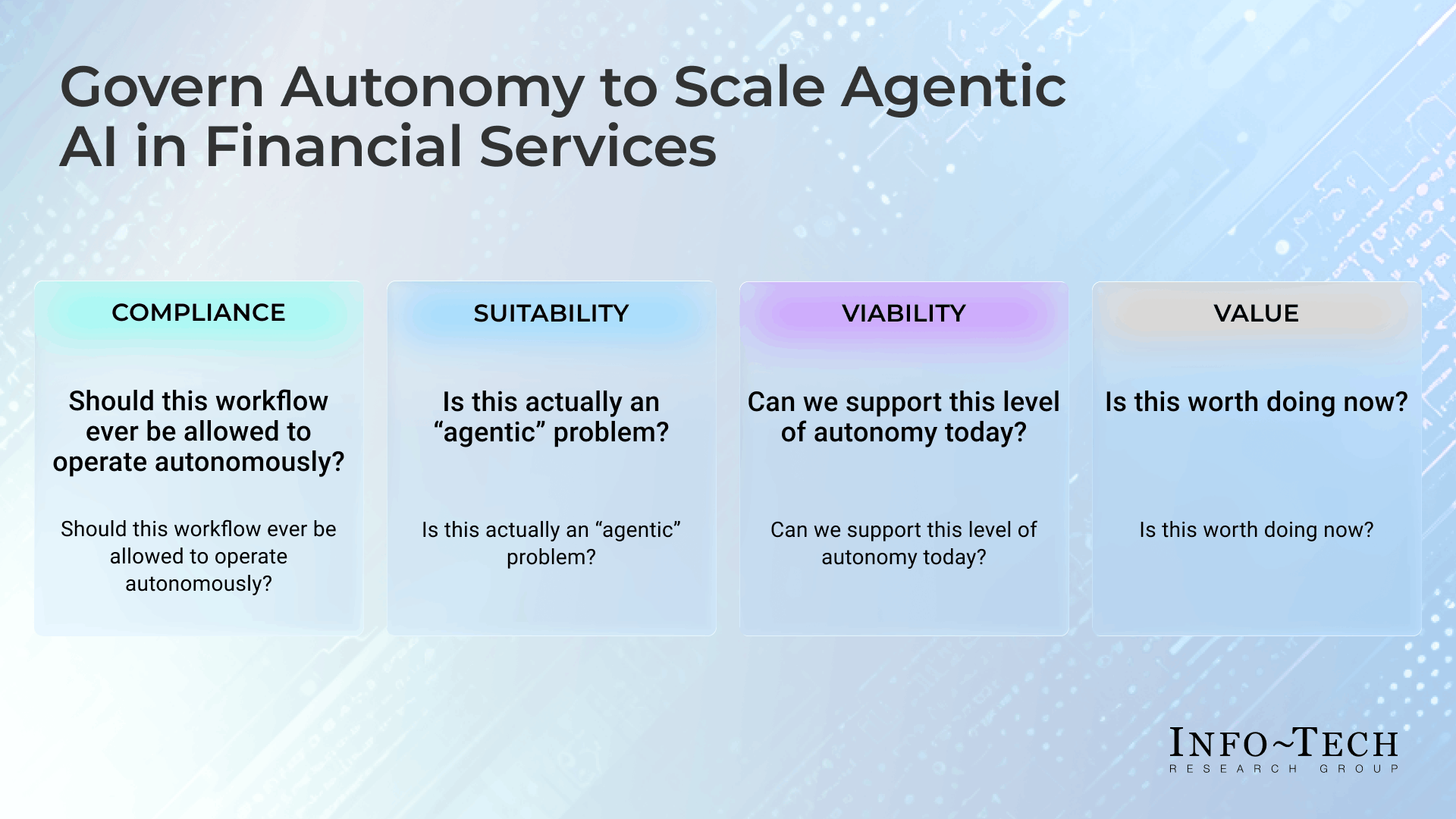
To scale agentic AI, institutions need a clear decision system to evaluate where autonomy is safe, suitable, viable, and worth pursuing.
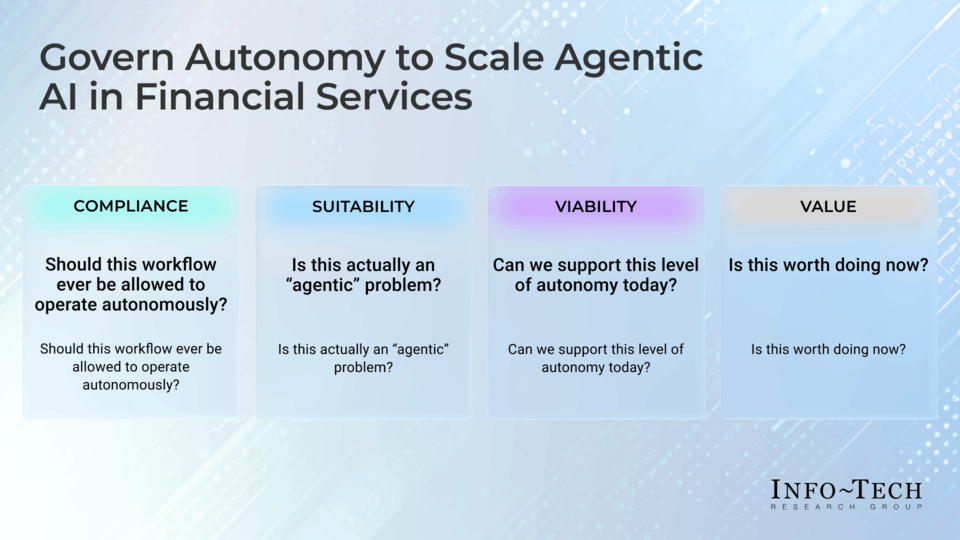
Govern autonomy to scale agentic AI in financial services
Agentic AI adoption is not a use case or technology decision. It is a governance decision about how much autonomy we should accept.
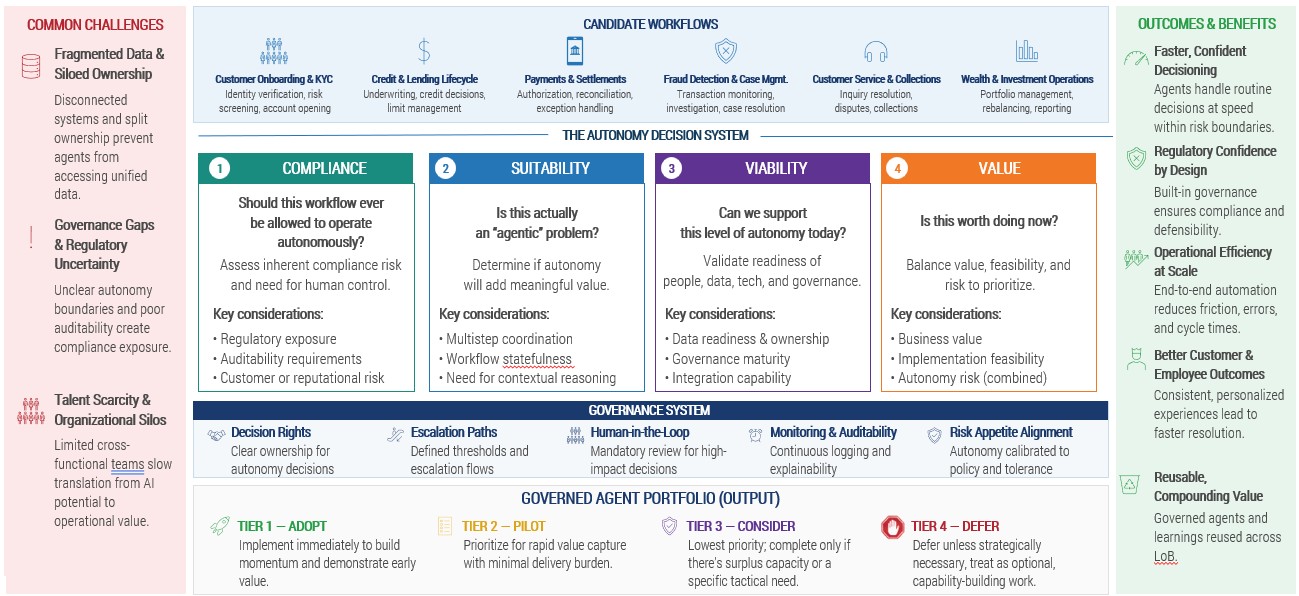
Assess agentic AI use cases for financial services
This four-phase approach establishes governance criteria and applies them to prioritize agentic AI use cases.
| 1. Define Vision and Autonomy Boundaries | 2. Validate Readiness | 3. Prioritize Use Cases | 4. Deploy Pilots | |
|---|---|---|---|---|
| Phase Steps | 1.1 Define AI vision and business value 1.2 Establish autonomy boundaries and escalation rules |
2.1 Assess data, governance, and talent readiness 2.2 Strengthen foundations and define decision rights |
3.1 Identify and map candidate use cases 3.2 Evaluate and prioritize pilots based on value, feasibility & risk |
4.1 Launch pilots with continuous evaluation 4.2 Refine governance, scale agents, and build reusable components |
| Why it Matters | Without clear autonomy limits, pilots create audit and compliance risk before value. | Fragmented data and split ownership stall pilots and prevent scalable, controlled autonomy. | Poor prioritization leads to high-risk pilots that stall under governance scrutiny. | Pilots without evaluation become operational liabilities instead of enterprise assets. |
| Phase Outcomes | A risk-aligned AI mandate with clear decision rights and shared understanding of agentic AI scope, risks, and enterprise context | A board-validated readiness view across data, governance, talent, and ownership | Board-approved pilot priorities with clear rationale, governance confidence, and documented business value per use case | Measured, scaled, governed agents delivering value with institutional learning embedded into governance and reuse decisions |
Insight summary
Govern Autonomy to Unlock Enterprise Value
Agentic AI creates value only when institutions move from isolated pilots to governed, scalable autonomy.
Align C-Suite Sponsorship Across Functions
Scaling agentic AI requires joint accountability across the C-suite. No single function can drive adoption. Cross-functional governance is the prerequisite for scale.
Prioritize Value Streams for Risk-Adjusted Impact
Prioritize coordination-heavy workflows where agents orchestrate multi-step tasks, not isolated high-complexity decisions. Focus on domains with clear data ownership and measurable outcomes before expanding scope.
Redesign Operating Models Around Agent Capabilities
Leading institutions embed AI across entire domains, not isolated tasks. Redesign end-to-end processes so teams manage agents, exceptions, and strategic decisions. Define autonomy boundaries and escalation protocols before scaling.
Pressure-test Commercial Fit Pilot-to-Production Gap
Pressure-test the pilot-to-production gap through continuous evaluation. Measure accuracy, quality, and escalation adherence. Pilots without rigorous evaluation become operational liabilities.
Build Reusable Agent Architecture for Scale
Build modular, reusable agent architectures to reduce cost and accelerate scale. Reusable components convert pilots into enterprise assets and shorten time-to-market.
Apply practical deliverables to achieve each step of the project
Agentic AI Use Case Tool for Financial Services
The tool helps CIOs evaluate where agentic AI should be applied across financial services operations.
Assess value, risk, and governance readiness to determine where autonomy is appropriate, where it should remain constrained, and how adoption should be sequenced.
You get:
- A prioritized list of high-value use cases to support roadmap design, funding, and implementation planning.
Outcomes
- Identify which use cases to explore first.
- Justify where autonomy should be introduced and where it must remain constrained.
- Sequence pilots and deployments aligned to operational priorities and governance requirements.
Measure the value of this research
Leverage this research's approach to ensure your AI use cases align with and support your key business drivers and speed time to value.
| With Info-Tech Resources | Without Info-Tech Resources | |||
|---|---|---|---|---|
| Project Steps | Time | Average Cost (USD) | Time | Rationale |
| Define Vision and Autonomy Boundaries | 0.5-1 day | $7,500-$10,000 | 3-5 days | A risk-aligned AI mandate and decision rights. |
| Validate Readiness | 0.5-1 day | $5,000- $7,500 | 2-3 days | A board-validated readiness view |
| Prioritize Use Cases | 1-2 days | $5,000-$7,500 | 3-4 days | A prioritized list of defensible, risk-adjusted pilot roadmaps. |
| Deploy Pilots | 0.5-1 day | $5,000-$7,500 | 2-3 days | Measured, scaled, governed agents delivering value. |
| Effort | 3-5 days | $22,500-$32,500 | 10-15 days | |
| Business Goals | Key Success Metrics |
|---|---|
| Customer Experience | Improving the customer experience with a product/service via reliability, engagement, transparency, etc. |
| Advisor Experience | Enhancing the productivity of advisors so they have fewer low value tasks, leaving them to focus on customer-facing/high-value activities. |
| Operational Efficiency | Reducing costs through operational performance improvements. |
| Risk Reduction | Using better tools to oversee high volumes of transactional and operational data to reduce the overall level of firm risk. |
| Revenue Growth | Optimizing business processes to allow revenue generating activities to take priority over non-revenue-producing activities. |
| Cost Optimization | By automating tasks, overseeing business processes to increase accuracy and to streamline processes. |
Phase 1
Phase 1
Define Vision and Autonomy Boundaries
1.1 Define AI vision and business value
1.2 Establish autonomy boundaries and escalations
Phase 2
Validate Readiness
2.1 Assess data, governance, and talent readiness
2.2 Strengthen foundations and define decision rights
Phase 3
Prioritize Use Cases
3.1 Identify and map candidate use cases
3.2 Evaluate and prioritize pilots based on value, feasibility, and risk
Phase 4
Deploy Pilots
4.1 Launch pilots with continuous evaluation
4.2 Refine governance, scale agents, and build reusable components
This phase will walk you through the following:
- A risk-aligned AI mandate and decision rights and holistic enterprise view.
- A shared understanding of agentic AI scope, risks, and enterprise context.
This phase involves the following participants:
- Executive Leadership
- Risk & Compliance
- Technology & Data
- Strategy & Transformation
- Business & Operations Leaders
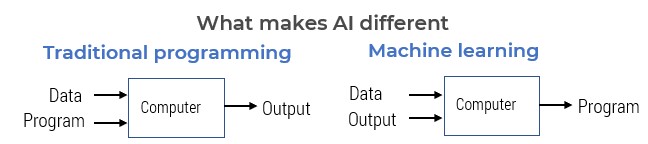
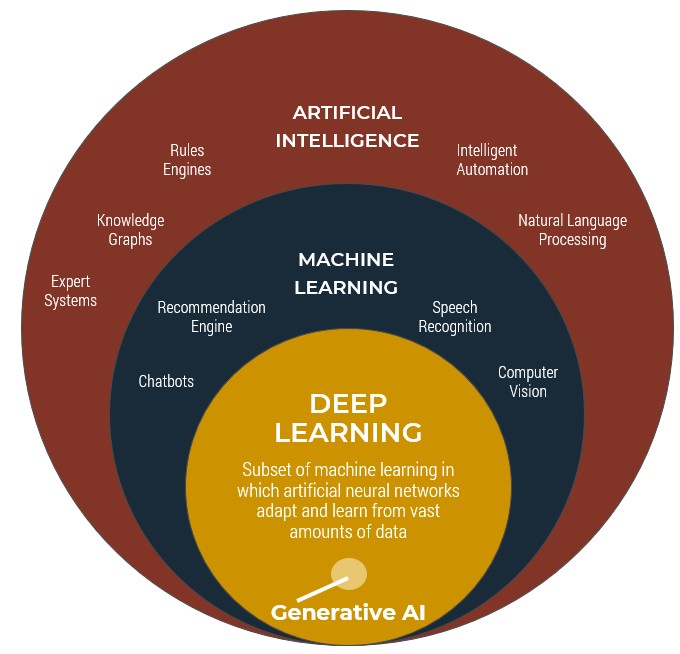
Clarify the relationship between AI, ML, and generative AI
Artificial Intelligence (AI)
An artificial intelligence (AI) system that can make predictions, recommendations, or decisions influencing real or virtual environments.
Machine Learning (ML)
Machine learning (ML) is a subset of AI algorithms that parse data, learn from data, and then decide or make predictions.
Generative AI (Gen AI)
A subset of artificial intelligence systems that generate new outputs based on the data the system has been trained on using modalities such as text, audio, visual, and code.
Distinguish between automation, agents, and agentic AI
| Concept | Profile | Description | Level of Autonomy | Coordination | Typical Use |
|---|---|---|---|---|---|
| Traditional Automation | Rule-Based Operator | Executes predefined rules with no learning or reasoning | None | None | RPA, workflow automation |
| AI Agent | A Specialist | Perceives, reasons, and acts within defined boundaries | Limited/Task-Bound | Minimal | AI assistant, chatbots |
| Multi-Agent System (MAS) | Team of Specialists | Multiple agents coordinate to complete tasks | Coordinated | Moderate | Multi-agent workflows |
| Agentic AI | Self-Managing Assistant | Self-directed system that plans, acts, and adapts across workflows | Autonomous | Dynamic | Adaptive, self-improving systems |
Determine which workflows require agentic AI capabilities
Agentic AI creates value in workflows that require coordination, decisioning, monitoring, or orchestration. Most high-impact use cases combine these capabilities.
Data Processing
Extract, classify, and structure unstructured data
Decision Support
Analyze data and generate recommendations or insights
Monitoring & Alerting
Detect anomalies and trigger alerts or actions
Triage & Orchestration
Route work and coordinate multi-step workflows
Use these patterns to assess whether a workflow requires agentic AI or simpler automation.
Design agentic AI as an orchestration of capabilities
Agentic AI orchestrates predictive, prescriptive, generative, and conversational AI to enable autonomous action.
Predictive AI
Anticipates what is likely to happen
Prescriptive AI
Recommends the best course of action
Generative AI
Creates content and explains decisions
Conversational AI
Enables human interaction and control
Agentic AI
Orchestrates the above into multi-step workflows, maintains context, and acts autonomously toward a goal.
Identify where agentic AI is not the right fit
Agentic AI is powerful but not universally applicable. Use these scenarios to identify where simpler approaches are more effective.
Simple Tasks
Agents are unnecessary for simple, well-defined tasks with existing automation.
Example: Sending automated email notifications or basic data entry tasks.
Deep Domain Expertise
Tasks requiring nuanced judgment or specialized expertise remain better handled by humans.
Example: Medical diagnosis or legal contract review requiring specialized knowledge.
Tight Budgets
High development and operating costs may outweigh value for low-scale or one-time use cases.
Example: Small-scale internal tools or one-time data processing tasks with limited funding.
Human Emotion & Creativity
Use these filters to determine whether a workflow requires agentic AI or simpler automation.
Example: Psychotherapy sessions or composing original works of fiction.
Use these filters to determine whether a workflow requires agentic AI or simpler automation.
Identify high-impact agentic AI applications in financial services
1. Autonomous Credit Decisioning:
AI agents evaluate credit worthiness, verify documentation, and generate credit memos autonomously – reducing approval cycles from days to minutes while maintaining auditability and bias mitigation.
2. Real-Time Fraud Detection and Prevention:
Agents analyze transaction patterns continuously, flagging anomalies and blocking suspicious activity instantly while minimizing false positives that disrupt customer experience.
3. Hyper-Personalized Wealth Advisory:
AI-driven agents deliver portfolio optimization, tax-loss harvesting, and personalized investment recommendations at scale – democratizing services previously reserved for high-net-worth clients.
4. End-to-End KYC and Compliance Automation:
Agents orchestrate document validation, sanctions screening, and adverse media monitoring across jurisdictions – accelerating onboarding while ensuring regulatory compliance.
5. Intelligent Customer Service Orchestration:
Multi-agent systems coordinate account inquiries, dispute resolution, and product recommendations – reducing resolution times and freeing human agents for complex, empathy-driven interactions.
1.1 Define AI vision and business value
2-3 hours
Establish a shared definition of agentic AI, differentiate it from RPA and copilots, and align leadership on where autonomy creates business value across financial services.
Step 1: Introduce Agentic AI Fundamentals
Walk participants through the foundational overview deck. Establish a shared vocabulary for autonomy, orchestration, and escalation. Use the four capability patterns (data processing, monitoring, decision support, triage/orchestration) to ground the discussion in examples specific to Financial Services.
Step 2: Review Four Agentic AI Capability Patterns
In small groups, review the Financial Services value streams (Attract Customers, Lending & Credit, Core Banking Operations, Payments & Card Services and Wealth & Investment Management). For each, capture two or three workflows where agentic AI could deliver differentiated outcomes. Record on flip chart or whiteboard.
Step 3: Define Strategic Vision and Value Thesis
Synthesize group output into a one-paragraph vision statement. Capture in the Vision & Mandate tab of the Agentic AI Use Case Tool for Financial Services.
| Input | Output |
|---|---|
|
|
| Materials | Participants |
|
|
1.2 Establish autonomy boundaries and escalations
4-6 hours
Define where agents can act autonomously, where human oversight is mandatory, and where agentic AI should not be used at all. This is grounded in the organization's regulatory exposure and risk appetite.
Step 1: Review Financial Services Agentic AI Examples
Walk through three to five curated FS examples (KYC, credit decisioning, fraud, compliance monitoring). For each, ask the group and capture on whiteboard:
- What did the agent do?
- Why was it a good fit for an agent?
- How autonomous was it?
- Where did humans stay in control?
Step 2: Map Decision Rights and Escalation Protocols
For each FS workflow surfaced in Step 1.1, place it on a three-tier scale: human-in-the-loop, human-on-the-loop, or autonomous with escalation. Document the trigger condition for each escalation in the Autonomy & Escalation tab of the use case tool.
Step 3: Identify Constrained Domains
As a group, identify workflows where agentic AI should not be used. Use three categories: overkill (rules-based is sufficient), too risky (regulatory or customer-impact exposure), too human (requires judgment, empathy, negotiation). Record rationale alongside each in the tool.
| Input | Output |
|---|---|
|
|
| Materials | Participants |
|
|
About Info-Tech
Info-Tech Research Group is the world’s fastest-growing information technology research and advisory company, proudly serving over 30,000 IT professionals.
We produce unbiased and highly relevant research to help CIOs and IT leaders make strategic, timely, and well-informed decisions. We partner closely with IT teams to provide everything they need, from actionable tools to analyst guidance, ensuring they deliver measurable results for their organizations.
What Is a Blueprint?
A blueprint is designed to be a roadmap, containing a methodology and the tools and templates you need to solve your IT problems.
Each blueprint can be accompanied by a Guided Implementation that provides you access to our world-class analysts to help you get through the project.
Need Extra Help?
Speak With An Analyst
Get the help you need in this 5-phase advisory process. You'll receive multiple touchpoints with our researchers, all included in your membership.
Guided Implementation 1: Pre-Work
- Call 1: Scope objectives and key challenges.
Guided Implementation 2: Define Vision and Autonomy Boundaries
- Call 1: Define AI vision and business value.
- Call 2: Establish autonomy boundaries and escalations.
Guided Implementation 3: Validate Readiness
- Call 1: Assess data, governance, and talent readiness.
- Call 2: Strengthen foundations and define decision rights.
Guided Implementation 4: Prioritize Use Cases
- Call 1: Identify and map candidate use cases.
- Call 2: Evaluate and prioritize pilots based on value, feasibility, and risk.
Guided Implementation 5: Deploy Pilots
- Call 1: Launch pilots with continuous evaluation.
- Call 2: Refine governance, scale agents, and build reusable components.
Contributors
Four anonymous external contributors