
Assess and Prioritize Agentic AI Use Cases in Education
Approach agentic AI for success, not complexity.
Educational institutions are facing increasing administrative workloads, enrollment competition, and student support demands. Agentic AI presents a viable solution to alleviate these pressures. Institutions that fail to adopt AI risk falling behind those already reaping its benefits.
Our Advice
Critical Insight
While education institutions have the ambition to implement agentic AI, they need to pursue it with a structured method for matching opportunity to readiness.
Impact and Result
- Info-Tech provides a method for identifying suitable agentic AI opportunities from both a top-down approach, by selecting from case studies, and a bottom-up approach, by identifying opportunities through analysis of institutional capabilities.
- Use a maturity framework to understand both the complexity and the risk associated with different AI opportunities.
- Select with confidence a specific agentic AI opportunity to pilot.
Assess and Prioritize Agentic AI Use Cases in Education
Approach agentic AI for success, not complexity.
Analyst perspective

Over the past several years, artificial intelligence has evolved in education from curiosity to something closer to infrastructure. Adaptive tutors now personalize math instruction for millions of K-12 students, virtual recruiters engage prospective undergraduates around the clock, and multi-agent systems are drafting grant proposals, catching fraud, and guiding students toward degree milestones before those students think to ask.
The most successful institutions choose their starting point carefully. With new technology, the question isn't whether it works, it's whether the conditions for success are in place. Matching the complexity of the opportunity to institutional maturity isn't caution, it's how progress happens.
Agentic AI does deliver, but it is most successful when the complexity of the problem is honestly matched to the maturity of the institution solving it. An institution running lean on IT staff can still produce real results with a well-scoped attendance intervention agent. That same district attempting a cross-system, multi-agent advising platform isn't being bold; it's arranging its own disappointment.
What follows gives education leaders a structured way to identify where agentic AI can deliver, assess whether the conditions for success are in place, and select the use case most likely to produce measurable outcomes.
Mark Maby
Senior Research Director, Industry Practice
Info-Tech Research Group
Executive summary
Your Challenge
- Educational institutions are facing increasing administrative workloads, enrollment competition, and student support demands.
- Agentic AI presents a viable solution to alleviate these pressures.
- Institutions that fail to adopt AI risk falling behind those already reaping its benefits.
Common Obstacles
- Institutions recognize the potential of agentic AI but hesitate to commit due to the fear of wasted resources and loss of stakeholder trust from a potential failed first deployment.
- There is a significant gap between acknowledging the opportunity of agentic AI and actually executing on it.
- Failing to act on agentic AI can lead to wasted resources and a loss of stakeholder trust.
Info-Tech’s Approach
- Info-Tech provides a method for identifying suitable agentic AI opportunities from both a top-down approach, by selecting from case studies, and a bottom-up approach, by identifying opportunities through analysis of institutional capabilities.
- Use a maturity framework to understand both the complexity and the risk associated with different AI opportunities.
- Select with confidence a specific agentic AI opportunity to pilot.
Info-Tech Insight
While education institutions have the ambition to implement agentic AI, they need to pursue it with a structured method for matching opportunity to readiness.
Your challenge
This research is designed to help education organizations that are facing these challenges:
- K-12 teachers spending hours weekly on noninstructional tasks and higher education staff-to-student advising ratios nearly double the recommended threshold.
- Enrollment and retention pressures are increasing due to a projected decline in the traditional college-age population.
- Delaying structured engagement with agentic AI in education IT risks operational savings and student outcomes.
Education leaders need a credible, structured path into agentic AI, one that captures the operational benefits without exposing the institution to avoidable risk.
The cost of inaction is compounding.
57%
Most higher education leaders expect AI to transform institutional operations within five years …
11%
… yet 11% do not have any AI-related strategy.
Source: EDUCAUSE, 2025
Common obstacles
These barriers make this challenge difficult to address for many organizations:
- Poor use case selection, often due to a lack of structured evaluation, is the main reason for AI project failures, not technology limitations.
- Data readiness is a major barrier to deploying agentic AI in education. Many institutions lack reliable data governance and quality, hindering autonomous AI functionality.
- Education faces governance uncertainty in deploying AI due to regulatory compliance risks, leading to risk aversion. A clear governance framework is needed to assess and manage AI risks effectively.
- Change management is underfunded compared to technical implementation, hindering the success of AI adoption in education despite its importance for faculty and staff buy-in.
Barriers to integrating emerging technology in education:
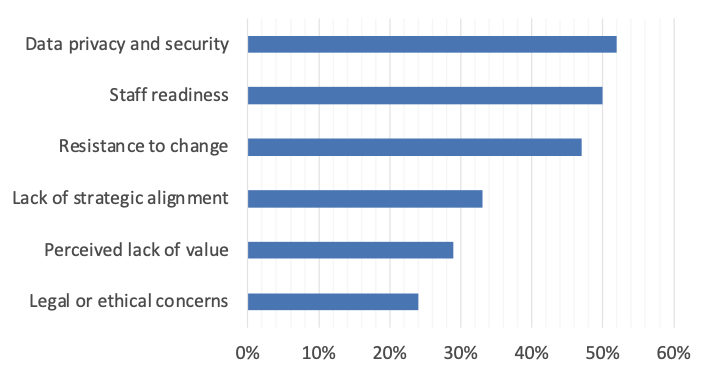
Source: UPCEA, 2025
Assess agentic AI use cases for education
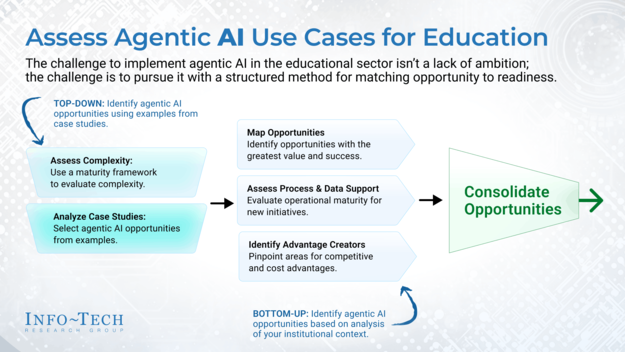
The challenge to implement agentic AI in the educational sector isn’t a lack of ambition; the challenge is to pursue it with a structured method for matching opportunity to readiness.
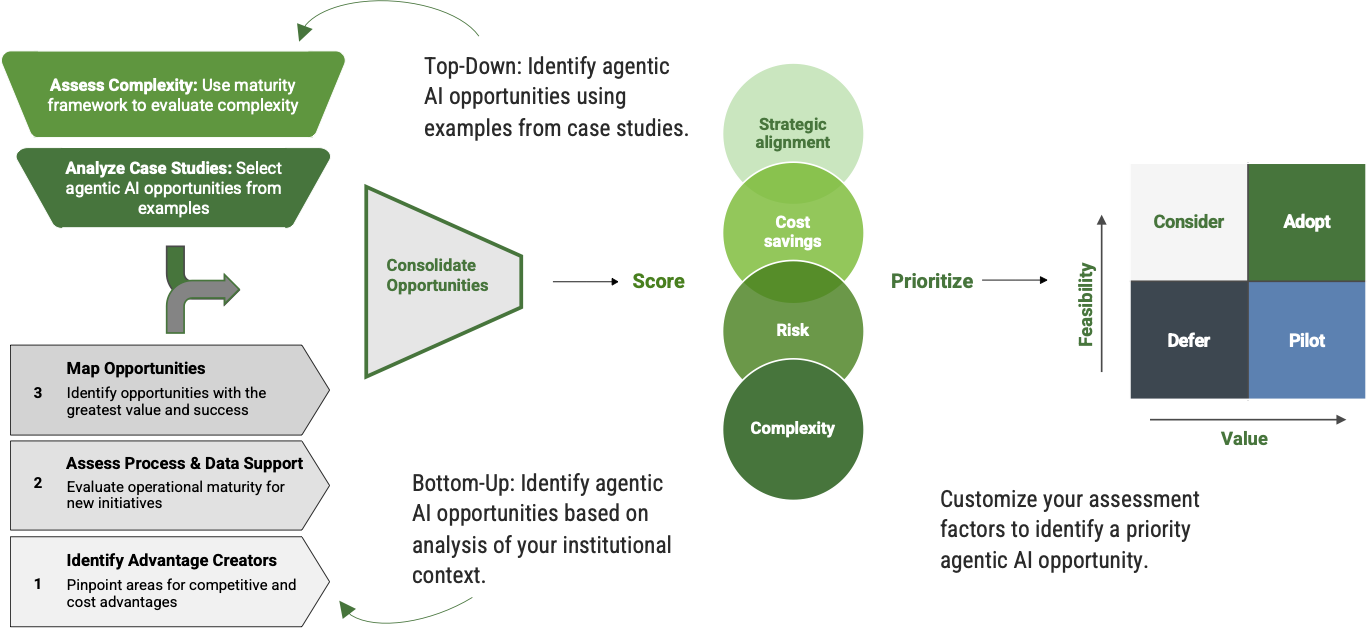
Info-Tech’s Methodology for Assess and Prioritize Agentic AI Use Cases in Education
Approach |
Top Down:Select Agentic AI Opportunities Based on Case Studies |
Bottom Up:Identify Agentic AI Opportunities Through Analysis |
Score:Prioritize an Agentic AI Candidate to Develop Into a Prototype |
Steps |
|
|
|
Analyst support
We can review this research on calls with you.
Call 1
|
Call 2
|
Call 3
|
Multiple calls on a single piece of research allow for analysts to support you through the full methodology.
Info-Tech offers various levels of support to best suit your needs
DIY Toolkit
“Our team has already made this critical project a priority, and we have the time and capability, but some guidance along the way would be helpful.”
Guided Implementation
“Our team knows that we need to fix a process, but we need assistance to determine where to focus. Some check-ins along the way would help keep us on track.”
Workshop
“We need to hit the ground running and get this project kicked off immediately. Our team has the ability to take this over once we get a framework and strategy in place.”
Executive & Technical Counseling
“Our team and processes are maturing; however, to expedite the journey we’ll need a seasoned practitioner to coach and validate approaches, deliverables, and opportunities.”
Consulting
“Our team does not have the time or the knowledge to take this project on. We need assistance through the entirety of this project.”
Diagnostics and consistent frameworks are used throughout all five options.
1. Use the maturity framework to gauge the complexity of agentic AI opportunities
Agentic AI becomes more complex as agents increase their coordination and autonomy for decision-making. This has both technical implications as well as implications for risk and governance.
Level 0 Rule-based & pre-agentic
Deterministic scripts; no reasoning, learning, or goal-directed behavior
Level 1 Information retrieval & analysis
Agents gather, synthesize, and surface insights but humans retain all decision authority
Level 2 Autonomous action, single domain
Agents execute tasks and implement changes within a bounded, well-defined environment
Level 3 Cross-domain orchestration & external action
Agents coordinate across systems, departments, and external digital entities
Level 4 Multi-agent autonomy & physical reach
Any-to-any agent interoperability; physical-world reach; governance becomes critical infrastructure
Info-Tech Insight
Most institutions don't fail at agentic AI because they chose the wrong technology; they fail because they chose a use case that outpaced their organizational readiness.
The maturity framework prevents this by making the gap visible before investment is committed. Matching use case complexity to current capability turns prioritization from a political exercise into an evidence-based decision.
Consider two dimensions for agentic AI maturity
Maturity considers not only the technical complexity but also organizational requirements to support the agents.
First Dimension: Agentic Capabilities
What the AI system can do autonomously and how it does it:
- The functions, behaviors, and actions the agent performs without human initiation.
- How the agent plans, reasons, and executes across steps or systems.
- Whether one agent acts alone or multiple agents coordinate.
- The boundaries of what the system can decide, retrieve, generate, or trigger.
The maturity framework is a synthesis of agentic AI frameworks from Salesforce (2025), Microsoft (2026), Lucidworks (2025), and Outshift by Cisco (2025).
Second Dimension: Organizational Requirements
What the institution must have in place to deploy and sustain the agent:
- Strategy, sponsorship, and governance structures needed at this level.
- Data quality, system integration, and technical infrastructure prerequisites.
- Human oversight mechanisms and defined escalation points.
- Metrics and accountability frameworks to track value and manage risk.
The organizational requirements align with Info-Tech’s AI governance framework. See the four governance bodies described in the adjacent diagram and refer to the blueprint
Establish Your Adaptive AI Governance Program: From Principles to Practice
Level 0 Rule-based & pre-agentic
Deterministic scripts; no reasoning, learning, or goal-directed behavior.
Agentic Capabilities
- Reactive systems driven by hard-coded rules and predefined decision trees
- Typical examples: IVR call routing, FAQ chatbots, password-reset automations
- No adaptability when inputs fall outside predefined parameters
- Significant human intervention required for any edge case or unexpected input
Organizational Requirements
- AI/data science teams identify rule-based bottlenecks where reasoning capabilities would improve outcomes
- AI owners establish a single harmonized data source as the foundation for future agent deployments
- The AI governance council defines organizational risk tolerance before any move toward agentic systems
- The ethics committee is not yet formally active at this level
Level 1 Information retrieval & analysis
Agents gather, synthesize, and surface insights but humans retain all decision authority.
Agentic Capabilities
- Retrieve data from knowledge bases and recommend next actions to humans
- ML augmentation of specific tasks; overall behavior remains deterministic
- Operate continuously as information amplifiers for human decision-makers
- No direct modification of systems, no external actions taken autonomously
Organizational Requirements
- AI/data science teams form consistent working practices
- AI owners establish separate development, test, and production environments as a baseline architectural requirement
- AI/data science teams track qualitative performance metrics and report findings upward to AI owners
- Ethics committee defines what adequate human supervision means; AI/data science teams carry out that supervision operationally
Level 2 Autonomous action, single domain
Agents execute tasks and implement changes within a bounded, well-defined environment.
Agentic Capabilities
- LLM-based planning: understand goal → create plan → execute steps autonomously
- Implement changes within defined parameters: pricing adjustments, scheduling, inventory
- Operate within a single data domain or siloed environment; no cross-system reach
- LLM stochasticity introduces compounding error risk in cascading steps: mitigation is essential
Organizational Requirements
- AI governance council documents AI strategy with executive sponsorship
- AI owners develop and maintain a governance and risk framework, including a risk register and recurring audits
- AI owners define KPIs tied to transformed processes which AI/data science teams track and report
- AI/data science teams incorporate user feedback and enforce brand consistency for external-facing agents
Level 3 Cross-domain orchestration & external action
Agents coordinate across systems, departments, and external digital entities.
Agentic Capabilities
- Orchestrate multistep workflows across CRM, finance, service, and other domains
- Reach beyond internal systems: send emails, place orders, interact with external APIs
- Multiagent collaboration with dynamic task tracking and decision reflection capabilities
- Access contextual signals and sensors; learn from experience and generalize to new situations
Organizational Requirements
- AI owners and AI CoE implement federated governance with automated monitoring and proactive compliance
- AI owners enforce the principle of least privilege and separation of duties for agent access
- AI governance council ties value reporting to organizational goals
- Ethics committee defines advise-but-do-not-act boundaries and mandatory human-in-the-loop requirements; AI owners operationalize these as enforceable standards
Level 4 Multi-agent ecosystems & advanced autonomy
Any-to-any agent interoperability; physical-world reach; governance becomes critical infrastructure.
Agentic Capabilities
- Any-to-any agent operability across disparate technology stacks and vendor ecosystems
- Agents supervise, discover, and dynamically compose other agents at runtime
- Physical-world action: control of equipment, building systems, autonomous vehicles
- New business models and operating structures enabled by collaborative agent ecosystems
Organizational Requirements
- AI governance council drives an agent-first organizational strategy with C-Suite accountability, continuously updated to reflect ecosystem-wide developments
- AI owners, supported by the AI CoE, design and govern the universal agent orchestration layer: APIs, agent bus, per-agent identity, and authorization
- Ethics committee defines kill-switch protocols, human-takeover requirements, and bans on high-stakes irreversible domains; AI owners implement these as enforceable controls
- AI/data science teams operate real-time performance and compliance monitoring; AI governance council reviews enterprise value and predictive risk analytics at portfolio level
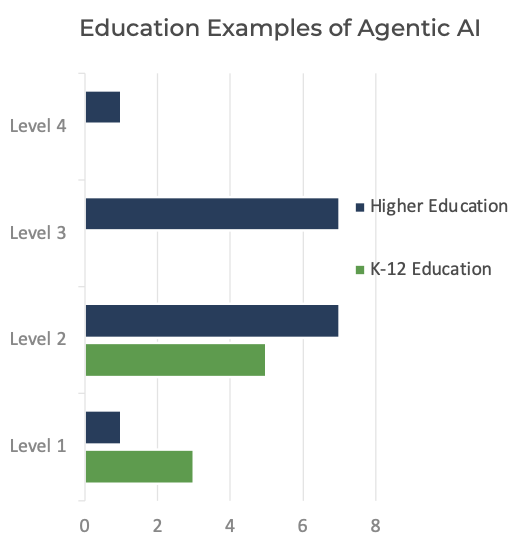
The examples in this blueprint range from a single agent automating a workflow to explicitly orchestrated multi-agent systems. Each is classified using the four-level coordination maturity based on how agents coordinate.
Establish the operational risk foundation that agentic AI requires
Governance requirements scale with agent autonomy.
- Info-Tech's AI risk management roadmap aligns to NIST AI RMF 1.0 and provides ready-to-use tools including a risk assessment worksheet, AI risk register, and a roadmap presentation template.
- Apply the risk tools in proportion to the capability level you are deploying, not as a uniform checklist.
- Supplement the blueprint's NIST-derived risk taxonomy with explicit guardrails for cascading agentic processes. This is particularly important for high-stakes domains, such as student advising, financial aid, and admissions.
- Pair risk management with use-case prioritization to ensure institutions are managing risk in pursuit of measurable outcomes.
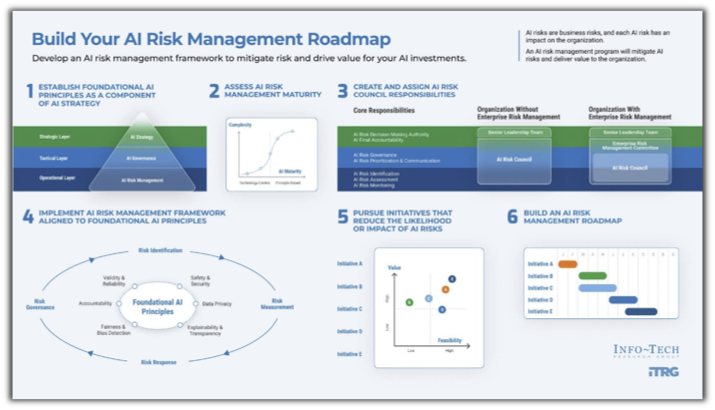
Use Info-Tech's Build Your AI Risk Management Roadmap blueprint to establish the operational risk foundation that agentic AI requires. Three principles should guide how you apply it in a higher education context:
Download this Build Your AI Risk Management Roadmap
2. Align on what agentic AI can do and select agentic candidates
2-3 hours
-
Introduce the four agentic AI capability patterns that repeatedly deliver value in higher education: Data Processing, Decision Support, Monitoring & Alerting, and Triage & Orchestration.
- For each pattern, walk through one curated higher education example from the case library. Discuss: What did the agent do? Why was it a good fit? What was the complexity level?
-
Introduce the maturity framework: Levels 1-4 (Level 0 is pre-agentic)
- Use these levels as the team's shared language for evaluating sophistication and institutional readiness.
- Use the case examples to anchor each level concretely.
- Select agentic candidates based on example. Go through each of the case studies/use cases and identify any of value which you believe could be implemented at your institution. Record the descriptive information and the business owner for the use case in the Agentic AI Use Case Tool for Education, leaving the scoring for later.
-
Define exclusion boundaries. For any use case you exclude, ask what reservations you have about using that use case in your institution. Use these four categories to start:
- Overkill: Simple or infrequent tasks already handled adequately by existing tools.
- Too risky: Decisions with irreversible academic, regulatory, or reputational consequences.
- Too human: Situations requiring emotional intelligence, ethical discretion, or trust relationships.
- Not ready: Workflows that are undocumented, unstable, or lack a clear process owner.
- Record agreed exclusions. These set limits on all downstream activities.
Download the Agentic AI Use Case Tool for Education
2. Align on what agentic AI can do
Input
|
Output
|
Materials
|
Participants
|
Agentic AI Library for Higher Education
Sixteen agentic AI case studies from the higher education industry.
Agentic AI case studies and use cases
How to read these slides
Each slide profiles a single agentic AI capability documented in higher education. The left side tells the story; the right side provides the facts needed to act on it.
Two types of studies
Case Study: Named institution, documented outcomes.
Use Case: Capability validated but evidence is limited to pilots or analogous implementations.
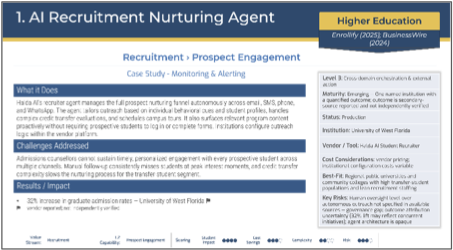
Scoring Summary
| Student Impact: | Greater direct effect on student outcomes: learning, retention, access, or experience. |
| Cost Savings: | Greater potential for operational efficiency, staff time reduction, or resource reallocation. |
| Complexity: | More difficult to implement, higher technical, integration, or change management demands. Plan accordingly. |
| Risk: | Greater exposure to academic integrity, bias, privacy, or regulatory concerns. Not a disqualifier but a signal to invest in governance. |
Implementation Profile
| Level | Refer to the AI maturity framework above. |
| Maturity: |
Proven – deployed at 2+ institutions with documented outcomes. Emerging - one institution or active pilot; outcomes preliminary. Exploratory – no significant HE implementations yet |
| Status: | Current state of deployment: Implemented, Pilot, In Development, or Conceptual. |
| Vendor/ Tool: | The platform or system used. In-house build means institution-developed, typically on open-source frameworks. Where a vendor provides the agent architecture and the institution configures it, the vendor is named. |
| Cost Consider-ations: | Descriptive guidance on cost profile and primary cost drivers. |
| Best-Fit: | The institutional conditions where this capability is most likely to succeed, including infrastructure, staff capacity, student population, and strategic priorities. |
| Key Risks: | The most significant risks to plan for. Common categories include academic integrity, data privacy, algorithmic bias, change management. |
Identify agentic AI opportunities by capability
The table to the right indexes the agentic AI opportunities for higher education. They are organized by value stream and aligned to the L2 capability they best support.
Value Stream |
L2 Capability |
Agentic AI Opportunity |
| Recruitment |
Prospect Engagement Student Recruitment |
|
| Admission |
Application Processing & Evaluation |
|
| Student Enrollment |
Allocation & Placement Student Finance Advice |
|
| Student Administration |
Front Line Service |
|
| Student Support Services |
Academic Advising Academic Advising |
|
| Advancement |
Fundraising Stewardship & Donor Relations |
|
| Teaching & Learning |
Online Instruction Classroom Instruction |
|
| Academic Research |
Research Collaboration Funds & Proposal Development |
|
| Commercialization |
Detection and Protection of IP Development, Delivery & Partner Reporting |
|
About Info-Tech
Info-Tech Research Group is the world’s fastest-growing information technology research and advisory company, proudly serving over 30,000 IT professionals.
We produce unbiased and highly relevant research to help CIOs and IT leaders make strategic, timely, and well-informed decisions. We partner closely with IT teams to provide everything they need, from actionable tools to analyst guidance, ensuring they deliver measurable results for their organizations.
What Is a Blueprint?
A blueprint is designed to be a roadmap, containing a methodology and the tools and templates you need to solve your IT problems.
Each blueprint can be accompanied by a Guided Implementation that provides you access to our world-class analysts to help you get through the project.
Need Extra Help?
Speak With An Analyst
Get the help you need in this 1-phase advisory process. You'll receive 3 touchpoints with our researchers, all included in your membership.
- Call 1: Select agentic AI opportunities based on case studies.
- Call 2: Identify agentic AI opportunities through analysis.
- Call 3: Prioritize an agentic AI candidate to develop into a prototype.